
- Why Hazards Go Unreported or Get Reported Too Late
- Training Methods That Improve Hazard Recognition in the Field
- How Mobile Reporting and Daily Logs Turn Training Into Action
- Using Contractor Foreman to Standardize Follow-Up
- Conclusion: Better Training and Better Records Build Safer Sites
- FAQs
- Related Blog Posts
“Uhh Joe, why is this wire just… lying there?”
“Isn’t this supposed to be covered?”
“No, that’s fine, it’s not live.”
Ten minutes later: sparks, smoke, and a very unhappy site manager.
Here’s the uncomfortable part: Joe and everyone standing there had already sat through hazard recognition training. They could’ve told you, on a written test, exactly what an exposed wire hazard looks like. They just didn’t see it as one in the moment.
Why?
Because classroom knowledge and on-site perception are two different skills, and most training programs only build the first one.
What actually closes the gap:
- Walk-throughs train crews to scan active work areas
- Photo drills sharpen visual hazard spotting
- Near-miss reviews turn close calls into repeat lessons
- Mobile reports create a fast record with photos and location
- Daily logs track hazards, weather, action items, owners, and status
Small risks get brushed aside because they don’t look severe enough to bother with—until they compound into something that is. And even when a hazard does get flagged, if no one is clearly assigned to fix it, it just sits there, unresolved, waiting for someone to trip over it.
The main takeaway: hazard recognition training works best when it is visual, field-based, repeated often, and tied to follow-up. Without that last step, hazards stay open and the same risks show up again on the next shift.
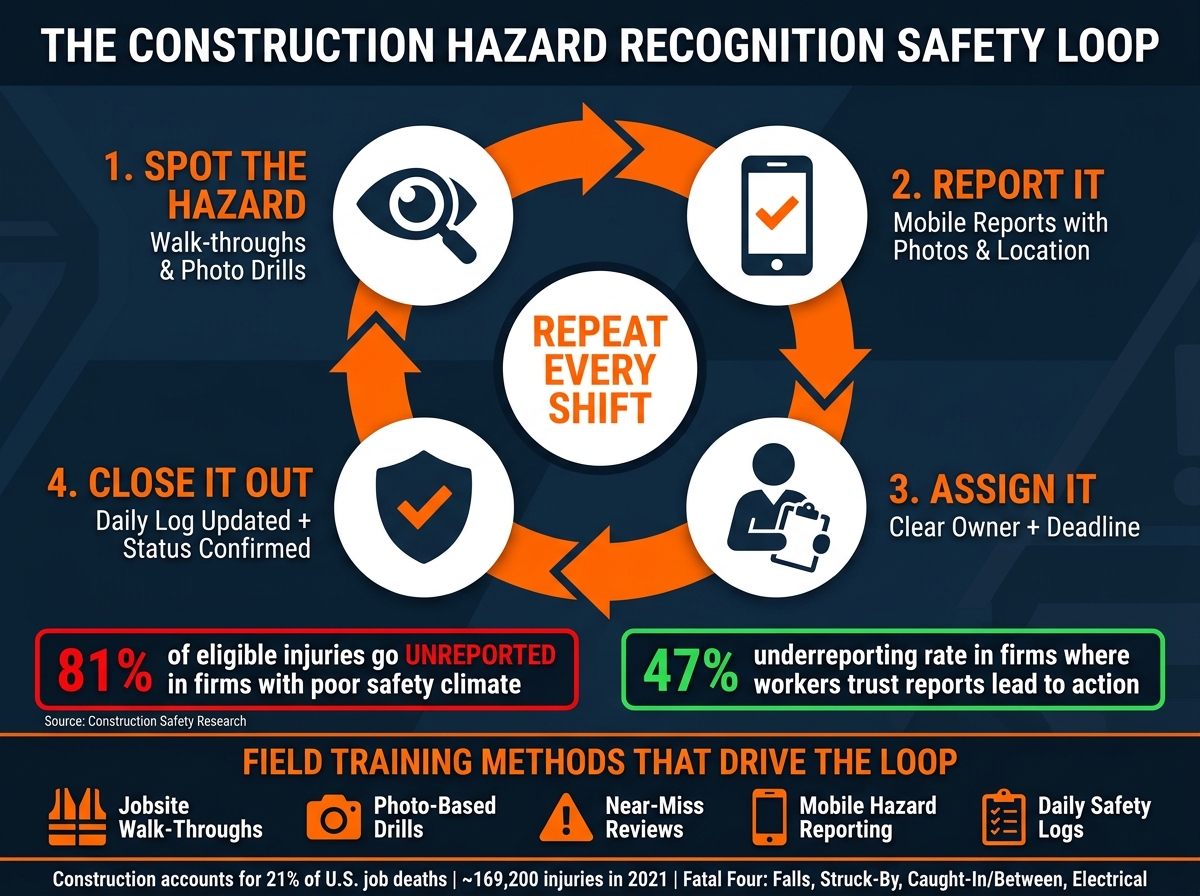
Hazard Recognition Safety Loop: Spot, Report, Assign & Close
Where Hazard Recognition Training Falls Short
Hazard recognition training breaks down when instruction remains confined to classrooms or one-day training programs and is never transferred to field conditions. A lecture can visually represent a fall hazard or an exposed energized conductor, but it cannot replicate the noise, equipment movement, and visual density of an active jobsite — conditions that also shift by shift, trade sequencing, and weather.
This is the core deficiency: passive, lecture-based training develops conceptual knowledge, not applied perceptual competency. Recognizing a hazard in real time requires sustained visual scanning and rapid risk assessment under operational conditions — skills that classroom instruction alone does not reliably build. If personnel are expected to identify hazards while performing concurrent tasks on an active site, training must occur under comparable field conditions.
Why Passive Training Fails in Active Work Zones
When training omits visual identification exercises and site-based practice, hazard recognition stays limited to the theoretical level. A worker may accurately define a struck-by hazard in a one-day training session without being able to identify that same condition amid the sensory and operational complexity of a live site.
Generalized training content compounds this gap. Stock examples don’t correspond to the specific equipment, layout, or exposure profile of a given jobsite. Personnel need repeated exposure to conditions resembling their actual work environment — under representative noise, activity, and time pressure — to build recognition skill that transfers to the field.
Why Hazards Go Unreported or Get Reported Too Late
Spotting a hazard is only half the battle. In many cases, the reporting process falls apart next. Verbal reports can be forgotten. Paper forms can get lost. And when there’s no clear record of who saw the issue, when they flagged it, and what happened after that, accountability slips away.
The cost of missed reports adds up fast. Hazards stay open longer. Incident costs go up. Recordkeeping problems pile on. Research shows that 81% of eligible injuries go unreported in firms with a poor safety climate, compared to 47% in organizations where workers trust that their reports lead to action.
That gap says a lot. If a worker reports a broken guardrail and nothing happens, they stop reporting. It’s that simple. Clear ownership helps keep corrective action from getting passed around and forgotten between crews.
Field walk-throughs and live reporting help close that gap. In practice, that means walk-throughs, photo drills, and incident reporting tools that log hazards in real time.
sbb-itb-5eea312
Training Methods That Improve Hazard Recognition in the Field
Field training works best when its content matches the actual conditions crews encounter on-site.
That’s why hands-on practice matters so much. Structured walk-throughs, photo drills, and near-miss reviews help workers build the habit of spotting trouble before it turns into an incident.
Jobsite Walk-Throughs That Teach Crews to Scan Work Areas
A structured walk-through puts workers face-to-face with actual jobsite conditions and asks them to slow down and look with intent. When a supervisor or safety lead walks the site with the crew, the discussion naturally moves to common trouble spots like fall protection, scaffolding, and ladder use.
The point isn’t only to find problems. It’s to train crews to scan work areas actively, not casually. During the walk-through, the crew should talk through how serious each hazard is, what can be done right away to control it, and who is responsible for the follow-up. Give each fix one clear owner.
Walk-throughs also help because they’re hands-on and immediate. Workers aren’t just standing there listening to a talk. They’re moving through the space, looking at live conditions, and making judgments in the moment.
Photo-Based Training for Faster Hazard Spotting
Photo-based training can sharpen hazard recognition fast. In a safety meeting or onboarding session, show real jobsite photos and ask crews to point out every hazard they can find. Use photos from your own sites when you can, not stock images, so what crews see actually matches what they’ll encounter.
When one worker spots something others missed, that person can explain why it stood out—that reasoning is often more useful than the hazard itself, since it gives the rest of the crew a cue to watch for next time. Then the hazards the group missed become the focus of the next session, so training keeps targeting real gaps instead of repeating the same list.
These visual drills also work well with mixed-language crews, since a photo needs no translation.
Show real jobsite photos and ask crews to name every hazard.
Near-Miss Review as a Repeatable Learning Tool
Near-miss reviews turn close calls into lessons teams can use again and again—instead of quietly moving on because nobody actually got hurt. That instinct to shrug it off is exactly what lets the same close call happen twice, the second time with worse timing.
A short review should cover three things:
- What the hazard was
- What failed
- What has to change
Even a brief team review, run right after the incident while details are still fresh, can help the next shift avoid the same setup entirely. It doesn’t need to be a formal investigation—five minutes with the crew involved is often enough to surface what actually happened and why.
Just as important, log those findings so the follow-up doesn’t slip through the cracks. A near miss that gets discussed once and never written down tends to get forgotten by the next crew change, which means the same hazard gets a second shot at becoming an actual injury.
How Mobile Reporting and Daily Logs Turn Training Into Action
Near-miss reviews create lessons. Mobile reporting and daily logs help crews put those lessons to work.
Once people know how to spot hazards, the next step is simple: capture them right away. If they don’t, that detail can vanish by the next shift. Training only pays off when crews can report hazards fast and someone follows through.
Mobile Reporting for Real-Time Hazard and Near-Miss Capture
When a worker sees an unsafe condition, a phone or tablet lets them report it on the spot, attach photos, and tag the location right away. Automatic notifications send the issue to supervisors fast, which helps move corrective action along.
That matters more than it may look at first. Organizations with a poor safety climate have an 81% injury underreporting rate, compared to 47% in organizations with a stronger safety culture. If reporting from a phone is easy and written in plain language, there’s less friction. And less friction means fewer hazards go unreported.
Those reports should then feed into the daily log so follow-up doesn’t get lost.
Daily Logs That Record Hazards, Weather, and Corrective Actions
A daily log should record the following:
- Date
- Weather
- Crew size
- Work performed
- Hazards
- Near-misses
- Corrective actions
- Owner
- Status
Weather belongs in the list because it directly shapes both risk and working conditions on site—a wet slab or high wind day changes what’s safe, not just what’s comfortable. That’s why it should be logged with each entry, not treated as an afterthought.
Over time, that record helps with accountability and gives teams something concrete to use in later training.
Using Contractor Foreman to Standardize Follow-Up
All the hazard-spotting and near-miss reviews in the world don’t mean much if the follow-up lives in someone’s notebook, a text thread, or a form that never makes it back to the office. Contractor Foreman closes that gap by putting daily log software, mobile incident reporting, and safety meeting records in one place. That makes it easier for supervisors to assign follow-up on the spot and track what happens next, instead of chasing it down days later.
It also includes toolbox talk topics ready to go, so safety meetings don’t turn into a scramble for content, and it can feed incident data straight into OSHA 300 logs when it’s time for reporting. So instead of piecing things together from scattered notes, sticky notes on a truck dash, and someone’s memory of what was said at the last meeting, teams get one clear record showing what was found, who owns it, and whether it actually got fixed.
Conclusion: Better Training and Better Records Build Safer Sites
Hazard recognition training works best when it’s visual, field-based, and repeated often. But that alone isn’t enough. It also has to connect to documentation and follow-up. Each method has a clear job, and together they help crews move from simply noticing hazards to fixing them.
That creates a simple loop: spot hazards, report them, and close them out. Walk-throughs build scanning habits.
Photo-based training helps crews get better at spotting risks. Near-miss reviews turn close calls into lessons people can use. Mobile reporting helps teams log hazards fast. Daily logs track hazards, owners, and corrective actions.
You can see that pattern in the results. A four-year near-miss reporting program in construction found that more reporting went along with lower injury rates, which backs up the value of repeated practice and follow-through.
Contractor Foreman keeps daily logs, mobile incident reporting, and safety meeting records in one place so supervisors can assign corrective actions and track closure. That kind of structure turns one-time training into a repeatable safety process.
The goal is fewer injuries. Better training and better records are how you get there.
FAQs
How often should hazard recognition training be conducted on-site?
Hazard recognition training should be conducted daily on-site as part of safety inspections or toolbox-style training.
It should also be refreshed at least annually and whenever major project conditions change or new hazards or equipment are introduced.
Who should be responsible for closing out reported hazards?
Site supervisors or project managers who handle a job’s hazard records and follow-up should close out reported hazards. The on-site team should back them up by logging the hazard and tracking each corrective action.
That setup helps make sure corrective actions are assigned, checked, and finished so problems don’t sit unresolved.
What should crews do if workers stop reporting near-misses?
Crews shouldn’t treat this like it belongs to someone else. Managers need to set a non-punitive standard: near-misses are early warning signs, not something people get blamed for. Reporting them should be just as easy as reporting an injury, including mobile reporting with photos and location details.
Teams should also review hazards they still see on-site and write down the time, location, people involved, and corrective actions. From there, assign one person to own the follow-up and set a due date. Letting the original reporter know when the issue has been fixed can help rebuild trust.
Related Blog Posts
- How Jobsite Safety Dashboards Improve Reporting
- Top Features of Construction Incident Reporting Tools
- Ultimate Guide to Construction Risk Assessment
- Risk Assessment in Construction: Software Guide







