
Do you remember what happened on April 17 at 3:30 PM?
OF COURSE NOT!
Heck, most of us can barely remember what we had for lunch fifteen minutes ago.
Which is exactly why construction companies keep daily logs. Those notes become incredibly valuable the moment somebody asks why the schedule slipped, whether the materials arrived on time, who approved a change, or what exactly happened on that random Tuesday everyone suddenly cares about.
Every contractor knows daily logs are important. The problem is that keeping them often feels like extra work.
And filling them out sounds much easier at 8:00 AM than it does at 4:30 PM.mBecause by then, you’ve dealt with subcontractors, deliveries, schedule changes, client calls, weather delays, and at least one completely unexpected problem. Sitting down to document everything feels about as realistic as starting a new fitness routine.
That’s the strange relationship construction has with daily logs. Everyone knows they matter. Nobody is excited to fill them out.
Fortunately, modern construction software has made the process far less painful, making it easier to capture information while it’s happening instead of trying to reconstruct an entire day from memory later.
Accurate daily logs help projects stay on schedule and within budget, while also providing strong legal protection.
Here’s what you need to know:
- Why Logs Matter: Projects with daily logs are 25% more likely to avoid delays and cost overruns. Same-day records are three times more reliable in disputes.
- What to Include: Key details like workforce activity, materials, weather, safety incidents, and specific tasks completed.
- How to Improve Accuracy:
- Record events in real time using top construction apps.
- Use clear, factual language (e.g., “Poured 15 CY of concrete at 7:00 AM”).
- Standardize templates for consistency.
- Leverage Technology: Digital tools save time, improve compliance, and integrate with project management systems.
Precise daily logs not only safeguard your project legally but also streamline operations and build trust with stakeholders.
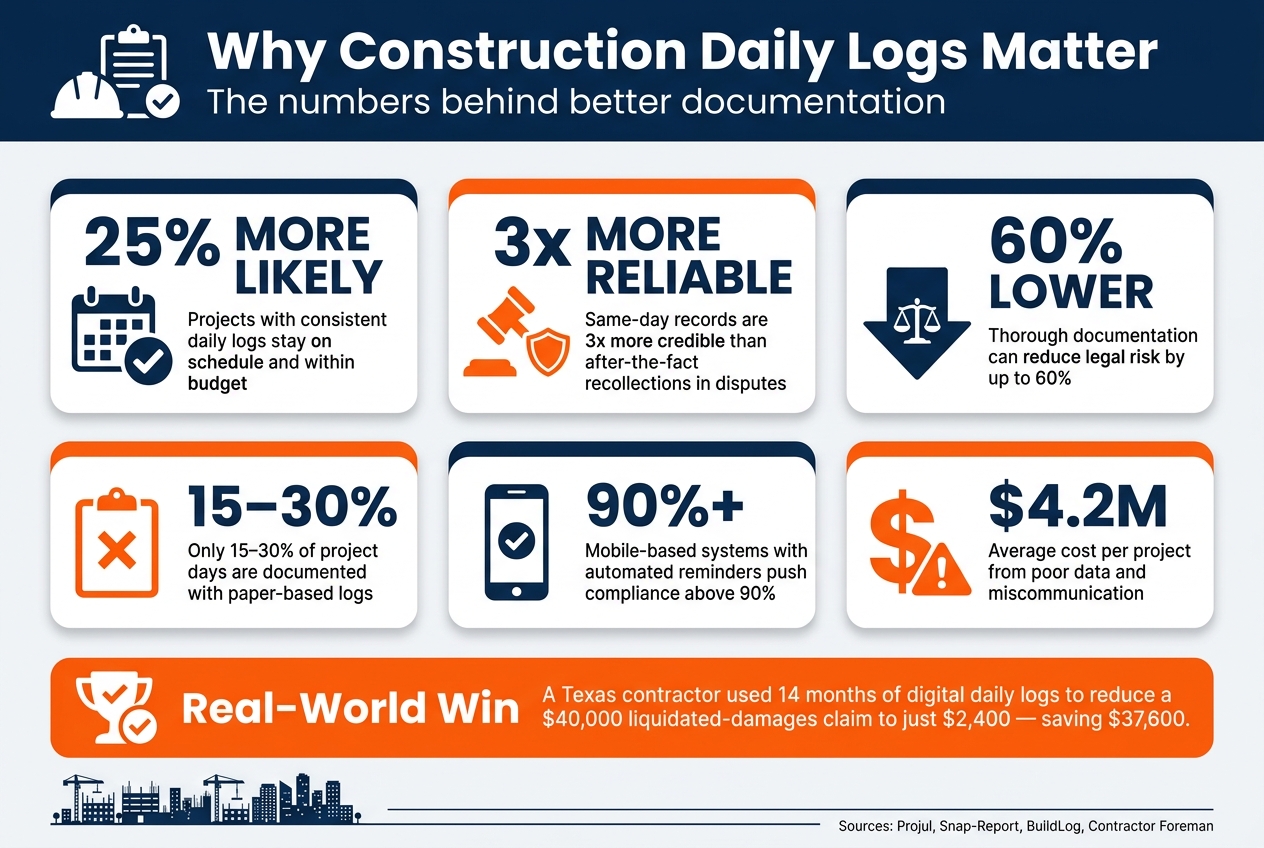
Construction Daily Logs: Key Stats & Benefits at a Glance
What to Include in a Construction Daily Log
Vague entries like “worked on framing” or “safety was good” offer little real value. A daily report that just says ‘worked on framing’ is barely better than no log at all.
The value comes from specifics.
Basic Project Information
Start every daily log with the essentials: project name, site location, date, shift start and end times, and name of the supervisor or author. These details anchor the log to a specific time and place, which is critical for credibility in case of disputes or audits. This foundation makes it easier to build out detailed entries for field data and safety records.
Field-Specific Data
A useful daily log goes beyond the basics. It should include detailed field data such as workforce activity, work performed, materials and equipment, and weather conditions.
- Workforce Details: Instead of just a headcount, include names, trade classifications, subcontractor information, and hours worked.
- Work Performed: Use the 5 W’s (who, what, where, when, why) to describe tasks. For example, instead of “poured concrete”, write: “Crew poured 15 CY of concrete at the north abutment stem wall, Sta. 12+40, from 7:00 AM to 11:30 AM”.
- Materials and Equipment: Record supplier names, batch or ticket numbers, and the condition of deliveries. For equipment, note whether it was operational, idle, or undergoing repairs – this is especially important for force account work.
- Weather Conditions: Go beyond general terms like “sunny.” Record conditions at the start, midday, and end of the shift, and document how the weather impacted progress. For example: “Heavy rain from 6–9 AM delayed grading until 10:30 AM due to a wet subgrade”.
Safety and Compliance Records
Safety documentation is essential for meeting regulations and protecting against liability. Logs should include records of safety incidents and near-misses. For near-misses, note the time, location, hazard, personnel involved, and corrective actions taken.
Also, document toolbox talks, including topics covered, times, and attendees, along with PPE inspections, scaffolding checks, and permit-to-work activities. If an inspector visits, record their name, organization, arrival and departure times, and any verbal instructions they provide – this might be the only proof of a verbal change order. Remember, OSHA requires injury and illness records to be kept for five years, so proper storage is just as important as accurate documentation.
sbb-itb-5eea312
Best Practices for Writing Accurate Daily Logs
When it comes to maintaining accurate daily logs, how you record the details is just as important as what you include. Capturing information in the moment is crucial for keeping your records precise and reliable.
Log Data in Real Time
One common pitfall for field teams is waiting until the end of a shift to fill out the daily log. By then, details can blur, and important events may be forgotten.
Using construction management software features like mobile apps with voice-to-text functionality allows foremen to update logs hands-free – even while wearing gloves. Many of these tools also offer offline syncing, so spotty cell service doesn’t become an excuse for skipping real-time entries. Keep log forms straightforward and quick to complete – ideally in under five minutes. If the process takes too long, team members might delay or avoid logging altogether, which can hurt accuracy.
Use Clear, Objective Language
Daily logs are legal documents, so they should focus on facts, not opinions.
For example, instead of writing, “subcontractor was late again”, opt for something like, “Electrical sub arrived at 10:00 AM (scheduled for 7:00 AM), delaying rough-in for Unit 302.”
Here’s a quick comparison of subjective versus factual entries:
| Weak/Subjective Entry | Strong/Objective Entry |
|---|---|
| “Contractor worked on grading today.” | “ABC Construction graded 500 LF of the north access road (Sta. 10+00 to 15+00) using a CAT 140M motor grader.” |
| “Poured concrete today.” | “Poured 45 CY of 4,000 PSI concrete for Building A footings F-1 through F-5. Pour completed at 11:15 AM. No issues.” |
| “Windows arrived late.” | “Window delivery scheduled for 8:00 AM arrived at 1:45 PM. Installation crew lost 5 hours and shifted to interior prep.” |
Adding context – like noting the impact of a late delivery on a crew’s productivity – turns a simple entry into a solid, defensible record.
Standardize Reporting Across Teams
Without a consistent format, daily logs can vary significantly in quality. Establish a standardized template that includes key details like date, time, weather, workforce, work completed, delays, incidents, and equipment usage. This uniformity makes a big difference: projects with consistent daily reporting are 25% more likely to stay on schedule and within budget. Additionally, thorough documentation can lower legal risks by up to 60%.
Adding Photos, Attachments, and Signatures to Daily Logs
Including photos, attachments, and digital signatures in daily logs creates a detailed and reliable record that can be crucial for resolving disputes.
Why Visual Documentation Matters
While text descriptions provide context, photos bring clarity. For instance, instead of just noting that “concrete was poured for Building A footings”, a timestamped photo of the pour in progress – accompanied by a batch ticket and GPS data – offers a much stronger record by combining visual and written evidence.
Aim to include 5–10 photos in each daily report. These should cover key aspects like pre-activity conditions, ongoing work, completed tasks, material deliveries, and any safety issues or near-misses. Embedding photos directly into the relevant log entries ensures that the context is preserved.
Take this example: In April 2026, a small contractor in Frisco, Texas, used 14 months of digital logs – complete with timestamped photos, weather data, and records of owner visits – to successfully reduce liability in a $40,000 liquidated-damages claim. Thanks to the thorough documentation, the claim was reduced to just $2,400.
Adding digital signatures and conducting end-of-day reviews further solidifies the accuracy of these records.
Digital Signatures and End-of-Day Reviews
Digital signatures go beyond visual evidence to enhance the credibility of daily logs. Without signatures, logs can be challenged more easily. Require all entries to be signed and submitted – complete with tamper-evident metadata – before the last person leaves the site. Waiting until the next morning to finalize entries can weaken their credibility, as contemporaneous records carry more legal weight. Digital tools also maintain an audit trail, preserving the original entry and documenting any corrections along with their reasons.
End-of-shift reviews add another layer of reliability. When both the foreman and subcontractor verify the day’s quantities before leaving, disputes over billing become far less likely. By agreeing on the numbers while the details are still fresh, all parties can avoid misunderstandings. These practices not only simplify construction reporting and record keeping but also strengthen the log’s role as a key legal document.
Using Technology to Manage Daily Logs More Efficiently
Digital tools have revolutionized how daily logs are managed, making the process quicker and more accurate. Tasks that used to take 15–25 minutes on paper can now be completed in under two minutes using a mobile device. These tools also integrate seamlessly with broader project management systems, offering better control over operations.
How Construction Management Software Helps
Paper logs often result in low completion rates, with only 15% to 30% of project days documented. Mobile-based systems, however, use automated reminders to push compliance rates above 90%. This streamlined process makes it easier for workers to document their day. For instance, a foreman can now fill out a structured form on their smartphone instead of searching for a clipboard at the end of a long shift, encouraging more consistent logging.
These systems also sync labor hours with construction cost calculation software and QuickBooks, giving project managers real-time insights into costs versus budgets. One remodeling firm in Nashville used such a system to identify a $12,000 labor overrun by the second week of a bathroom project. This early detection allowed them to adjust crew size and protect the project’s profit margin.
“The daily log is a communication channel, not just documentation.” – Grant Fuellenbach, Founder, GO First Consulting
Contractor Foreman Features That Support Daily Log Management
Contractor Foreman is a contractor-specific tool offering over 35 features, including a dedicated daily logs module. This module simplifies and automates key tasks, making daily log management far more efficient. Here are some standout features:
- Automated weather tracking: Automatically records local weather conditions for each job site using GPS, creating an objective and verifiable record.
- Photo and video attachments: Field staff can embed images and videos directly into log entries, with markup tools to highlight and flag issues, ensuring accurate and legally credible records.
- GPS-verified timecards: Confirms crew members’ presence on-site when they submit entries.
- Client Portal: Automatically shares log details with stakeholders, cutting down on status-update calls and emails.
- QuickBooks integration: Syncs labor hours from the field directly with financial reporting tools in real time.
The platform also offers custom fields to track data unique to specific projects. It supports unlimited projects, with plans starting at $49/month, and includes a 30-day free trial for new users.
With 62.4% of construction companies already using mobile devices for field reporting and 90.9% of construction workers relying on smartphones, adopting digital daily logs is more accessible than ever. The right software ensures that this technology delivers measurable results.
Conclusion: Building Better Projects Through Consistent Daily Logs
Daily logs may seem basic, but they pack a punch when it comes to improving project outcomes. Consistently maintaining these logs can lead to better on-time and on-budget performance. On the flip side, poor data and miscommunication can cost the construction industry a staggering $4.2 million per project on average. Sometimes, all it takes is a foreman dedicating five minutes at the end of the day to jot down what happened.
The legal benefits are just as compelling. Same-day documentation is far more defensible in disputes and can cut legal risks by as much as 60%. For example, in April 2026, a small custom home contractor in Frisco, Texas, faced a $40,000 liquidated damages claim. By leveraging 14 months of digital daily logs, they managed to reduce their liability to just $2,400, saving $37,600. That victory boiled down to thorough, same-day records.
But the value of daily logs goes beyond legal protection. They enhance daily operations by giving project managers a clear view of labor, materials, and progress. They help keep subcontractors accountable and provide accurate data for future estimates. When stored for 7 to 10 years, these logs continue to safeguard your business long after the project is finished.
FAQs
Who should write the daily log on a jobsite?
The task of maintaining daily logs usually rests with site supervisors or project managers. However, assistant superintendents or project engineers might also take on this responsibility. What’s most important is assigning someone who is physically on-site to record activities, safety measures, and progress as they happen to ensure accuracy. Contractor Foreman offers tools tailored to streamline the process, making daily log management much more efficient.
How detailed should a construction daily log be?
A daily log needs to be clear and precise to stand up to potential disputes or audits. To make it effective, focus on the 5 W’s: who, what, where, when, and why. This means recording details like weather conditions, workforce hours, material deliveries, equipment usage, inspections, safety incidents, and any verbal instructions given throughout the day.
To strengthen your log, include geotagged photos and timestamped entries. These additions provide a professional touch and ensure your records accurately reflect daily progress.
What should I do if I forgot to log something the same day?
Contemporaneous records – those created at or near the time an event occurs – carry more weight in legal or dispute scenarios. Their timeliness makes them more reliable and less prone to inaccuracies or memory lapses. However, if you miss logging something on the same day and try to add it later, it can weaken the credibility of that entry.
To ensure accuracy, use tools like Contractor Foreman to document events and details in real time. If you need to make a late entry, be honest and precise about the information. Keep in mind that metadata may reveal when the log was originally created or later edited, which could affect how it’s perceived.







