
You check your account— $235.
Not even close to covering one guy’s paycheck, let alone the whole crew.
Should you go to your bank again? They already side-eyed you last time.
Your brother-in-law? Pass. You two haven’t spoken since Thanksgiving.
The thing is…you shouldn’t even be doing this math right now. You should be walking the site and doing real construction management work!
Funny thing is, you run progress billing on your jobs specifically to avoid this. Get paid in stages as the work goes up, stay ahead of costs, never be the one sweating payroll. That was the whole plan.
And yet here you are — two payments stuck because the clients are sitting on your pay applications, payroll’s Friday, and you’re floating it yourself. Again.
Don’t blame the clients for late payments, though. Nine times out of ten, it’s not them — it’s the contract.
Somewhere in that stack of paperwork you signed month one, there’s a line about WHEN you’re allowed to bill, WHAT you’re allowed to bill, and WHAT has to come attached before anyone even looks at it. Miss any of that — bill stored materials with no backup, submit two days past the window, slip in change work nobody signed — and you don’t get “paid a little late.” You get bumped to next cycle. Full stop.
The fix is matching your payment clause, Schedule of Values, and approval path from day one.
What to check so payment doesn’t stall:
- Cutoff date and submission window
- Retainage rate and release terms
- Stored material rules
- Pay-when-paid or pay-if-paid language
- Signed change orders only
- Lien waivers, payroll, and insurance status
When billing records are built during the month instead of at the cutoff, review tends to move with fewer disputes and fewer payment delays.
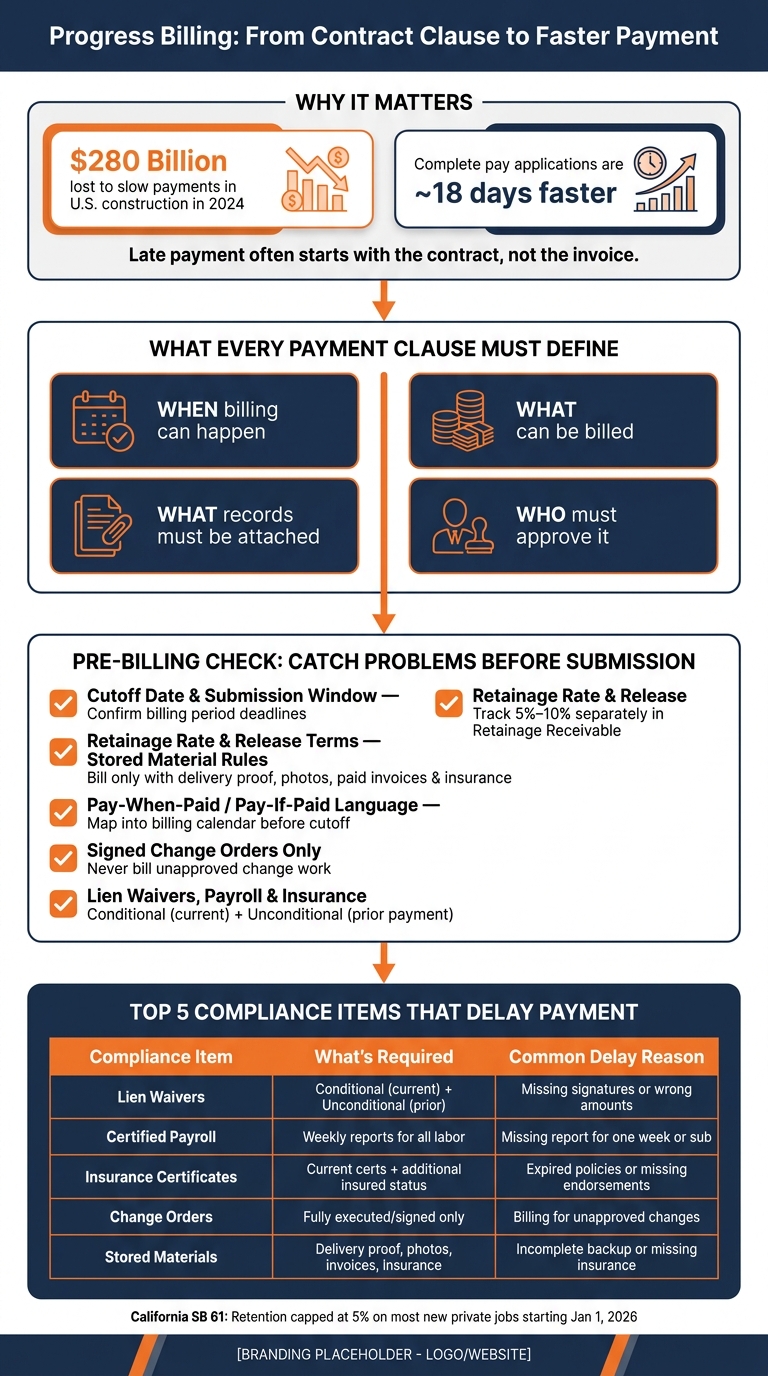
Progress Billing Checklist: From Contract to Payment
Read the Contract and Turn It Into Billing Rules
Each payment clause should become a billing rule: when billing can happen, what can be billed, what backup must be attached, and who signs off. Those rules then drive three controls: the SOV, billing triggers, and approval gates.
Match the Payment Schedule to the Schedule of Values
Approved contract scope should be turned into SOV line items tied to billing rules. A contract-aligned SOV breaks the contract sum into clear line items.
It should cover:
- mobilization
- major trade scopes
- allowances
- approved change orders
- a closeout reserve of 1% to 3% of the contract value for final punch lists, manuals, and final cleaning
When internal cost codes line up with SOV line items during job setup, job costing and billing stay in sync. Early approval matters too. Approval of the SOV by the architect or owner’s representative before the first pay application can prevent line-item disputes later. After approval, each line item should connect to either a percent-complete trigger or a milestone trigger.
Set Billing Triggers for Percent Complete and Milestones
Contract phrases like “foundation complete,” “rough-ins complete,” or “substantial completion” need a clear billing trigger before billing begins. The trigger has to be objective. “Drywall hung and taped” works better than “drywall approximately half complete.” That kind of wording leaves less room for arguments and makes billing easier to defend.
Those triggers should also connect to retainage tracking and payment timing. If the field marker is vague, the billing date usually gets vague too.
Flag Retainage, Payment Deadlines, and Conditional Payment Terms
Retainage should be tracked in a separate Retainage Receivable account, not standard A/R. That split makes it easier to see when release conditions have been met, often 30 to 45 days after substantial completion under contract terms.
Pay-when-paid and pay-if-paid terms should be flagged in both the billing calendar and the subcontract record. Those terms need to be mapped into the billing calendar so cutoff dates, holds, and approval gates are visible before each pay application. That setup helps keep stored materials, retainage, and approval checks from turning into last-minute problems.
sbb-itb-5eea312
Handle Stored Materials, Approvals, and Compliance Checks
Once billing rules are set, the last review usually comes down to three things: stored materials, approvals, and compliance.
Bill Stored Materials Only When Contract Conditions Are Met
Use AIA G703 Column F for stored materials that have not been installed yet. Those amounts should only be billed when the contract allows stored-material billing and the backup file is complete.
For stored materials, keep:
- Proof of delivery
- Date-stamped photos
- Paid invoices
- Insurance certificates that specifically cover the stored items
When materials are stored off-site, contracts usually also require a signed agreement that names the storage facility, proof that the materials are insured, and a provision that gives the owner legal title.
After stored materials are verified, move the pay application through the required approval path.
Build an Approval Path for Each Pay Application
A submission check before filing the pay application helps catch problems early. Confirm that the work is eligible, work in place has been verified, contract values reconcile, and all required documents are attached. The pay application should also go through the required reviewers before submission. Match it against progress records and executed lien waivers.
A pre-billing site walk with the architect or project manager about one week before the cutoff can help settle line-item percentages and reduce surprises during formal review. Internal review should also confirm that no line item is billed at 100% unless it has been verified, previous payment amounts match bank deposits, and retention calculations match the contract.
Track Compliance Items That Can Hold Payment
A correct invoice can still get stuck when compliance paperwork is missing.
The items that most often delay payment are lien waivers, certified payroll, insurance certificates, and change order status. Standard practice calls for a conditional lien waiver for the current payment and an unconditional lien waiver for the previous payment received. Certified payroll is required mainly on public works or federally funded projects under the Davis-Bacon Act, and a missing weekly wage report can stop the payment cycle. Insurance certificates should stay current, and stored-material coverage should include any required additional insured status or endorsement requirements.
Only fully executed change orders should be billed. Tracking these items throughout the month, instead of waiting until submission day, makes it much easier to keep the pay application complete.
| Compliance Item | What’s Required | Common Reason for Delay |
|---|---|---|
| Lien Waivers | Conditional (current) and unconditional (prior) | Missing signatures or incorrect amounts |
| Certified Payroll | Weekly reports for all labor | Missing reports for a single week or subcontractor |
| Insurance Certificates | Current certificates and additional insured status | Expired policies or missing endorsements |
| Change Orders | Fully executed/signed documents | Billing for unapproved changes |
| Stored Materials | Proof of delivery, photos, paid invoices, and insurance coverage for the stored items | Incomplete backup or missing insurance |
Contractor Foreman can keep lien waivers, delivery tickets, and insurance certificates organized in one project workflow.
Prepare Invoice Backup That Supports Every Billed Amount
After approvals and compliance checks, invoice backup becomes the last step. A pay application is only as strong as the records behind it. When backup lines up with the contract clause and the SOV line item, review moves faster. Complete pay applications with proper backup are paid about 18 days faster than incomplete ones.
Use the Right Backup for Work in Place, Milestones, and Retainage
Each billing type needs its own proof.
Backup should match the billing type. For work in place, that usually means an updated Schedule of Values (SOV), daily logs, inspection records, and progress photos. Each line item should tie to the exact SOV number and description. Specific line-item descriptions that match the SOV exactly help avoid back-and-forth.
Milestone payments need signed confirmations, completion certificates, and photos.
Retainage backup should show the amount withheld for each line item and the cumulative total to date. At closeout, retainage release usually calls for a release invoice, a substantial completion certificate, and final unconditional lien waivers.
Organize Records in a Single Project Workflow
When backup is organized by SOV line item, submission turns into a review step instead of a last-minute scramble. The invoice file should be built during the billing period, not at cutoff. As work happens, labor backup, material receipts, and progress photos should go into a dedicated project folder sorted by SOV line item. By the cutoff date, the backup package is already there.
Contractor Foreman supports that process by keeping daily logs, progress photos, and financial tracking in one platform. Field crews can upload date-stamped photos and daily reports from a mobile device, so that proof is ready for the billing team to pull into the next pay application.
Conclusion: Apply Payment Clauses Before Billing Starts
Review the contract before mobilization so the Schedule of Values, billing triggers, and retainage terms are set before work begins.
That setup at the front end matters. Slow payments still strain cash flow, and in 2024 they cost the U.S. construction industry about $280 billion.
Stored materials should be billed only with the backup required by the contract. Retainage should be tracked separately until release. If those amounts are handled the right way, the next trouble spot is often approval delay.
The approval chain should be mapped before the cutoff date so each pay application reaches the correct signers on time. Backup should be built during the billing period, not rushed together at the cutoff. Strong backup helps turn a compliant invoice into one that gets paid faster. When the invoice lines up with the contract, payment tends to move faster.
FAQs
How do I turn payment clauses into billing rules?
Start by identifying contract requirements before the project begins, including the billing cycle, retainage, change order approvals, and required documentation.
In Contractor Foreman, set up a Schedule of Values (SOV) that matches the contract scope and measurable phases or tasks. When milestones are tied to those terms, payment triggers stay clear and easy to audit, so invoices reflect both contract requirements and actual progress.
What backup is needed for stored materials?
To bill for stored materials and support approval, documentation should show ownership and value.
That usually includes:
- Paid supplier invoices
- Delivery receipts
- Inventory lists and clear photos showing the materials are on-site and marked for the project
- Insurance certificates naming the owner as an additional insured
For off-site storage, include a signed agreement that grants the owner title.
What usually delays a progress payment?
Progress payments often get delayed for a pretty simple reason: the paperwork doesn’t line up.
Incomplete or inaccurate documentation is one of the biggest causes. That can mean math errors, missing lien waivers, or mismatches between billing forms, the Schedule of Values, and reported progress. Even small gaps can slow review and hold up payment.
Other common causes include unreconciled retainage, missed submission cutoff dates, and rejected pay applications that roll payment into the next billing cycle. Clear communication and complete supporting documents help reduce those delays.
Related Blog Posts







