
Picture this: you finish a remodel, the homeowner is thrilled, and the final payment hits your account. Job done, everyone’s happy… or so you think.
A few weeks later, the phone rings. It’s the homeowner, their voice tight and uneasy. They tell you a notice arrived in the mail — official, stamped URGENT. A lien has been filed against the property. Suddenly, that finished job doesn’t feel finished at all, and everyone is looking at you for answers.
What should have been a closed-out project turns into a messy dispute, legal stress, and potentially withheld payments, all because one document was missing: a lien waiver.
A lien waiver is a legal document used in construction billing to confirm payment and relinquish lien rights for specific work or materials. It’s crucial for avoiding payment disputes and ensuring properties remain free of liens.
Lien waiver basics every contractor should know
- Types of Lien Waivers:
- Conditional: Effective only after payment clears.
- Unconditional: Effective immediately upon signing, regardless of payment status.
- Progress: Covers work done during a specific period.
- Final: Covers all work upon project completion.
- State-Specific Rules:
- 12 states (e.g., California, Texas) require statutory forms.
- Some states prohibit advance lien waivers.
- Notarization rules vary by state.
- Common Mistakes:
- Signing unconditional waivers before payment clears.
- Using incorrect forms or missing retainage exceptions.
- Best Practices:
- Use conditional waivers for payment requests.
- Align waivers with billing cycles.
- Track all waivers, including those from suppliers and subcontractors.
When lien waivers are handled the right way, you can avoid ugly payment disputes, protect what you’ve earned, and actually walk away from a job knowing it’s truly done. One simple missing document shouldn’t be the reason a finished project turns into a legal mess weeks later.
The 4 Types of Lien Waivers
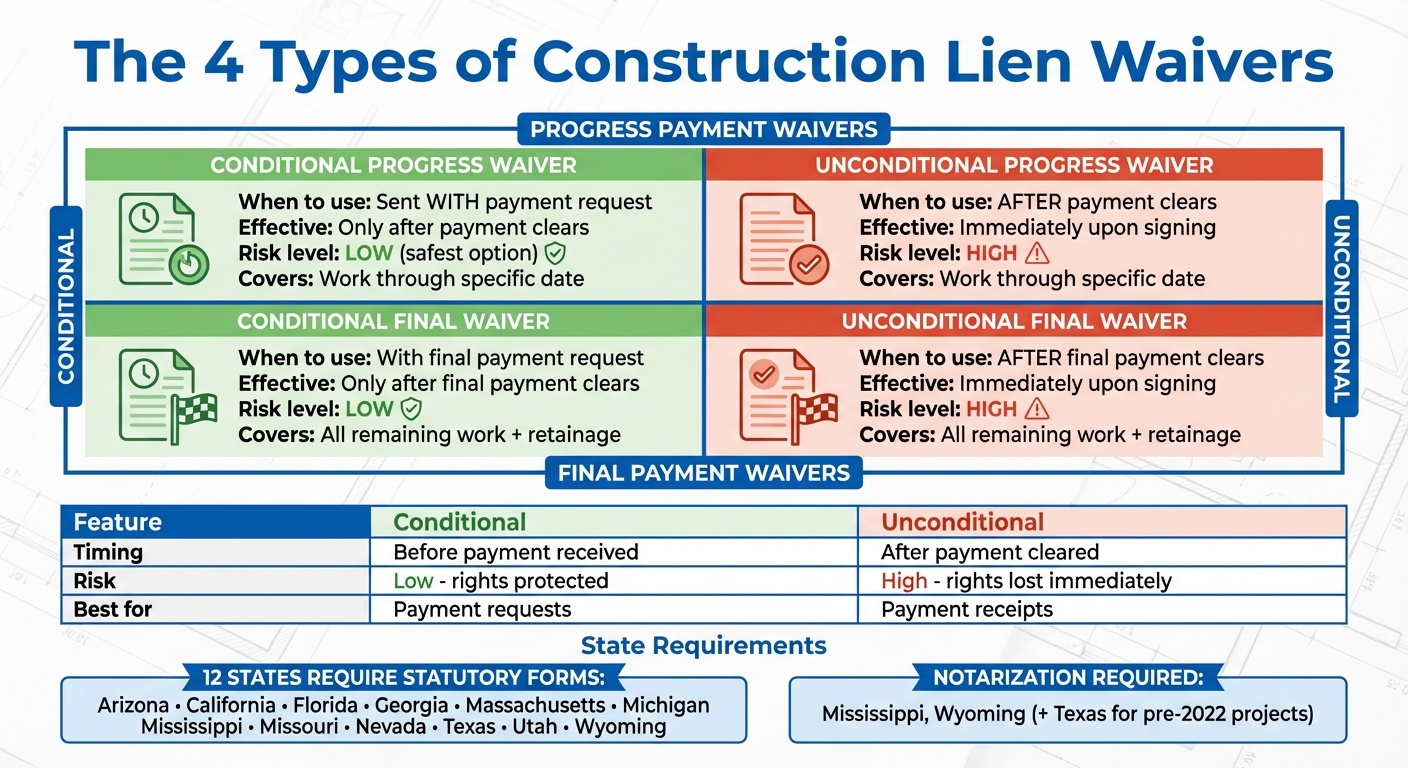
4 Types of Construction Lien Waivers: Conditional vs Unconditional, Progress vs Final
Conditional vs. Unconditional Waivers
The main difference between these two types of lien waivers boils down to timing and risk. A conditional lien waiver only takes effect once the payment has cleared your bank account. This makes it a safer option, as you can send a conditional waiver along with your invoice or payment application while keeping your lien rights intact until the funds are confirmed.
“A conditional lien waiver is your safest option for payment exchanges. It is used before payment is received and only takes effect once the funds are actually received and have cleared.”- Mark Murphy, Head of OGC Sales, Built
On the other hand, an unconditional lien waiver becomes enforceable the moment it’s signed, regardless of whether payment has been received or if the check clears. This makes it a riskier choice, as you lose your lien rights immediately – even if the payment later fails.
| Feature | Conditional Lien Waiver | Unconditional Lien Waiver |
|---|---|---|
| Timing | Sent before payment is received | Sent after payment is received and cleared |
| Effectiveness | Becomes valid only after payment clears | Valid immediately upon signing |
| Risk Level | Low – lien rights are protected until funds clear | High – lien rights are forfeited even if payment fails |
| Billing Use | Used during payment requests | Used as a receipt after payment is confirmed |
To minimize risk, it’s best to rely on conditional waivers for payment requests. Reserve unconditional waivers for situations where you’ve already verified that the payment has cleared.
Progress Payment vs. Final Payment Waivers
Lien waivers also vary based on the payment stage. Progress payment waivers, often referred to as partial waivers, apply to work completed during a specific billing period. These waivers include a “through date”, which identifies the portion of work for which lien rights are waived. It’s crucial that this date aligns with the exact billing period you’re being paid for – otherwise, you could inadvertently waive rights to unpaid work.
Final payment waivers, on the other hand, are used when your work is finished, and you’re receiving the last payment, including any retainage. Signing a final waiver means giving up all remaining lien rights on the project. Before signing, it’s critical to ensure that every dollar owed – including retainage and approved change orders – has been accounted for.
Both progress and final waivers can be conditional or unconditional, creating a matrix of four common waiver types in U.S. construction billing, which can be managed using construction management features.
Common Mistakes to Avoid
One of the biggest mistakes is signing an unconditional waiver before payment has cleared. Even small errors in the waiver’s language can have serious financial consequences and put your lien rights at risk.
“Because the lien waiver is supposed to waive lien rights to all work performed up to the effective date…[if] an owner is withholding retainage, contractors risk waiving their lien rights if they submit unconditional lien waivers.”– David Eisenberg, Attorney
Another common error is using the wrong waiver type for a specific situation. For example, using a final waiver for a progress payment or failing to note exceptions for retainage and pending change orders could result in losing substantial amounts owed. Additionally, in 12 states (including California, Texas, and Florida) that require statutory forms, using a non-compliant form could invalidate your waiver entirely.
To protect yourself:
- Double-check that the “through date” on progress waivers matches your billing period.
- Clearly list any exceptions for retainage or pending change orders.
- Consider having legal counsel review custom forms.
Even seemingly minor issues, like an incorrect property description or overstated payment amount, can lead to your claim being dismissed in court. Careful attention to detail is key to safeguarding your lien rights.
sbb-itb-5eea312
Legal Requirements and State-Specific Rules
How State Laws Differ
Lien waiver laws across the U.S. vary widely. In twelve states – Arizona, California, Florida, Georgia, Massachusetts, Michigan, Mississippi, Missouri, Nevada, Texas, Utah, and Wyoming – contractors must use specific forms dictated by state law. These forms require exact wording, and even minor changes can render them invalid.
“In these [statutory] states, there is no room for debate about the contents of the lien waiver document because the state legislatures typically render any non-statutory lien waiver forms as completely null and void.”- Scott Wolfe Jr.
In the other 38 states, contractors can use custom forms. However, without clear statutory guidelines, there’s a higher risk of including overly broad terms that might waive rights beyond lien claims. This can lead to unintended financial losses, especially if the waiver forfeits key contractual defenses.
Notarization rules also differ by state. While many property owners request notarized waivers, it’s only legally required in Mississippi and Wyoming, with Texas requiring it for projects started before January 1, 2022. Interestingly, in states like California and Arizona, adding a notary seal where it’s not required can invalidate the waiver, as it’s considered an unauthorized change.
These state-specific differences highlight the need for strict attention to compliance.
What You Need for Compliance
To comply with lien waiver laws, precise documentation is a must. For instance, the payment amount on the waiver must match the billed amount exactly – any discrepancy, even a small one, can jeopardize your claim. Similarly, the “through date” on progress waivers must align with the work period covered by the payment application. The waiver should also clearly identify the project to avoid any confusion.
In states with statutory forms, it’s critical to use the exact template provided. Avoid adding company logos, disclaimers, or extra provisions, as any modification can void the document. For example, California’s statutory forms include an “Exceptions” section where you can list retainage, change orders, or unpaid extra work. This section is essential for preserving your right to claim these amounts later.
Categories of State Requirements
State requirements generally fall into three main categories: mandatory forms, rules about advance waivers, and notarization protocols.
- Statutory Forms Required: Twelve states demand the use of specific, state-provided forms. These forms ensure legal clarity but require strict adherence to the prescribed language.
- Advance Waiver Rules: Over 20 states – including Arizona, California, Florida, Illinois, Kentucky, Maryland, Michigan, Nevada, New York, and Texas – prohibit contract clauses that force contractors to waive lien rights before work begins. Only Colorado and Nebraska explicitly allow advance waivers by law.
- Notarization and Witness Requirements: Mississippi and Wyoming require notarization. Georgia, on the other hand, mandates that lien waivers be witnessed and sealed.
Knowing which category applies to your project is crucial, especially if you’re working in multiple states. Lien waiver laws are tied to the location of the property, so understanding these distinctions can save you from costly mistakes.
| Requirement Category | States / Details |
|---|---|
| Statutory Forms Required | Arizona, California, Florida, Georgia, Massachusetts, Michigan, Mississippi, Missouri, Nevada, Texas, Utah, Wyoming |
| Notarization Required | Mississippi, Wyoming (Texas for projects pre-2022 only) |
| Advance Waivers Allowed | Colorado, Nebraska |
| Advance Waivers Prohibited | Most states, including Arizona, California, Florida, Illinois, Kentucky, Maryland, Michigan, Nevada, New York, Texas |
How to Manage and Track Lien Waivers
Creating Standard Lien Waiver Processes
Handling lien waivers across multiple projects requires a consistent approach. Start by standardizing your templates. In the 12 statutory states, it’s mandatory to use the exact state-provided template without any changes. For the other 38 states, adopting a uniform template for all your projects will streamline the process.
Next, establish clear timelines for submitting waivers. Many contractors tie waivers directly to their billing cycles, requiring a conditional waiver to accompany every invoice or pay application. Debbie Clark, Controller at Lenzi Incorporated, highlights the importance of this approach:
“The only solution to tracking is this: When you receive the Sub’s invoice there should be a Conditional Waiver attached. If it is not attached, we won’t process the invoice.”
It’s also crucial to monitor the entire construction payment chain, not just your direct subcontractors. A waiver from your subcontractor won’t protect you from liens filed by their suppliers or vendors. Scott Wolfe Jr., Founder of Levelset, explains:
“The lien waiver from the person you paid directly is worthless in helping protect you against the people that they are supposed to pay. You need those lien waivers directly”.
To stay ahead, request preliminary notices from all subcontractors and periodically audit vendor lists. This ensures you capture all parties with lien rights on your project.
Once these standardized processes are in place, you can leverage technology to make lien waiver management even more efficient.
Using Software to Manage Lien Waivers
After implementing consistent processes, software tools can take efficiency to the next level by automating the management of lien waivers. Tools like Contractor Foreman centralize document management, automate reminders, and integrate seamlessly with financial platforms like QuickBooks. These systems generate the correct waiver type – whether conditional or unconditional, progress or final – based on your billing cycle.
Software solutions also auto-fill key details like project information, invoice amounts, and dates directly from your records, reducing manual entry errors. They provide a dashboard view of all waiver statuses across projects, showing who has received, opened, or signed each document. Automated reminders are sent to vendors with outstanding waivers, saving you from chasing down paperwork.
Contractors using these systems report saving 12 to 23 hours every month and reducing invoice aging by at least 30%.
Collecting Waivers from Subcontractors and Suppliers
Even with standardized processes and automated tracking, collecting waivers from all involved parties is key to protecting your project. It’s not enough to collect waivers from subcontractors; you also need them from lower-tier suppliers and vendors. If a subcontractor fails to pay their supplier, that supplier can file a lien against your project – even if you’ve already paid the subcontractor in full.
To avoid this, require subcontractors to submit preliminary notices for their suppliers. These notices help map out everyone working on the project, making it easier to track who still owes a waiver. Some contractors also use sworn statements or periodic vendor audits to ensure no one is overlooked.
When submitting invoices, use conditional waivers to maintain your lien rights until payment is cleared. For final payments, double-check that the “through date” on the waiver aligns with the work period. Also, ensure that any retainage, pending change orders, or disputed amounts are clearly listed in the exceptions section. This allows you to preserve your right to claim these amounts later while keeping the payment process moving forward.
Adding Lien Waivers to Your Billing System
Aligning Lien Waivers with Billing Cycles
Lien waivers serve as payment receipts, offering protection for both parties involved. To align them with your billing cycle, you can match the type of lien waiver to specific stages of the payment process. For example, attach conditional progress waivers to your monthly pay applications. These waivers only take effect once payment is made. After the payment is cleared, follow up with an unconditional progress waiver to confirm receipt and close out that billing period. For project closeout, use a conditional final waiver with retention requests and issue an unconditional final waiver only after the final payment has been confirmed.
Claire Wilson, Head of Construction Solutions at Siteline, explains how to incorporate waivers into your billing process:
“The easiest way to do this is by adding conditional waivers to your payment application packages. That way, anytime you sign and submit a pay app, you’re also doing so for the conditional waiver.”
This process addresses a common challenge: payers want waivers before releasing funds, while payees want to waive rights only after receiving payment. By not signing an unconditional waiver until the funds have cleared – since it becomes enforceable immediately – you can ensure a balanced and structured approach. Digital tracking tools can further streamline this integration.
Contractor Foreman simplifies the process of managing lien waivers by directly linking them to pay applications, invoices, and project milestones. The platform stores all waivers in a centralized cloud system and automatically generates the correct waiver type based on your project data. Key details like invoice amounts, milestone dates, and payment information are pulled directly from your records, cutting down on manual errors.
Its dashboard offers real-time updates across all your projects, showing which waivers have been collected, which are still pending, and which are missing. Automated reminders notify vendors about outstanding waivers, and you can configure the system to require a signed conditional waiver before processing an invoice. With QuickBooks integration, once a payment is marked as received, the platform can automatically trigger a request for the corresponding unconditional waiver. This setup helps streamline your workflow and reduces the risk of oversight.
Creating an Audit-Ready Documentation System
A centralized digital system takes lien waiver management a step further by creating an audit-ready documentation process. This ensures that every dollar paid is backed by a corresponding waiver, reducing the likelihood of double payments or mechanics liens. It also provides instant access to records during internal reviews or compliance audits.
Scott Wolfe Jr., Founder of Levelset, highlights the importance of this approach:
“The ability to request lien waivers, to accept lien waivers in any form (but primarily electronically), and have all waivers available in one place to be viewed and managed is a life-changer.”
Using electronic signatures eliminates the hassle of printing, scanning, and mailing documents. Your system should also track the entire payment chain, including lower-tier suppliers identified through preliminary notices. This ensures that a waiver from a subcontractor doesn’t leave you vulnerable to liens from unpaid vendors. For states with specific statutory form requirements, digital templates can help you stay compliant and avoid nonconforming forms that could invalidate your waivers.
Conclusion: Reducing Risk with Proper Lien Waiver Management
Main Takeaways
Lien waivers act as the construction industry’s equivalent of a payment receipt. Conditional waivers come into play once funds clear, while unconditional waivers become binding the moment they’re signed. Knowing when and how to use the four types – conditional progress, unconditional progress, conditional final, and unconditional final – is crucial for managing your billing cycle effectively.
State-specific compliance is another key factor. In the 12 states with statutory lien waiver requirements (Arizona, California, Florida, Georgia, Massachusetts, Michigan, Mississippi, Missouri, Nevada, Texas, Utah, and Wyoming), using non-compliant forms can invalidate your lien rights when you need them most.
Legally, parties must be able to rely on lien waiver text in order to assess financial risk and the payment status of a project.
Centralizing lien waiver management – connecting waivers to invoices, payment milestones, and project data – helps eliminate manual errors and reduces the risk of missing critical steps. These strategies pave the way for a more efficient and secure billing process.
Action Steps for Contractors
To put these practices into action right away, consider the following:
- Use conditional waivers by default to ensure protection until payments clear.
- Hold off on unconditional waivers until payments have been deposited into your account, as these waivers take effect immediately upon signing.
- Leverage digital tools like Contractor Foreman to streamline waiver tracking. This platform generates state-specific forms, monitors waiver statuses in real-time, and sends automated reminders to vendors. With QuickBooks integration, it can even trigger the next waiver step once a payment is marked as received. This level of automation can save your team about one week of work per month and reduce invoice aging by at least 30%.
FAQs
What happens if I sign an unconditional lien waiver before receiving payment?
Signing an unconditional lien waiver before receiving payment can expose you to serious financial risks. Once you sign, you immediately surrender your lien rights – even if the payment bounces or is never made. This means you lose the ability to file a mechanics lien to recover unpaid amounts, including retainage or any outstanding balances.
Here’s an example: Let’s say you’re owed $82,000, but the payment fails. By signing an unconditional lien waiver, you give up your right to pursue that money through a lien. To safeguard yourself, it’s smarter to either wait until the payment clears before signing or opt for a conditional lien waiver instead.
How do state laws impact the use of lien waivers in construction projects?
State laws heavily influence how lien waivers are handled in construction projects, with notable differences across the country. In some states, contractors are required to use specific, state-approved waiver forms. For example, 12 states mandate the use of regulated forms that cannot be altered. Meanwhile, other states offer more flexibility, allowing contractors to use general templates, as long as the language is carefully reviewed to avoid potential issues. Adding to the complexity, states like Texas, Wyoming, and Mississippi require lien waivers to be notarized, whereas most states do not have this requirement.
Because of these variations, contractors need to stay vigilant about their lien waiver management to ensure compliance. In California, for example, contractors must use separate waivers for each progress payment and the final payment. On the other hand, in states with fewer restrictions, a single template might be sufficient, provided waivers are signed for every payment. To make this process easier, many contractors rely on tools like Contractor Foreman. These tools can automatically identify the correct state-specific forms, flag when notarization is needed, and maintain a digital audit trail to help contractors stay aligned with local laws.
Why should lien waivers be tied to billing cycles?
Aligning lien waivers with billing cycles is a smart way to make sure payments are only processed once the necessary waivers are in hand. This approach helps safeguard everyone involved by minimizing the chances of payment disputes and keeping the project timeline on track.
When contractors tie waivers to billing, they can better manage cash flow, steer clear of avoidable delays, and adhere to standard construction payment practices. It’s an efficient method to ensure projects move forward smoothly and with clear accountability.







