
Data privacy is a growing concern for construction companies — and if you’re a contractor, surprise, surprise! You’re basically a walking goldmine for hackers.
That’s because you’re basically sitting on millions of dollars worth of your client’s most sensitive information – Social Security numbers, tax IDs, financial records, banking details — all of it ripe for the taking, and all of it devastating to the clients who trusted you with it.
Between 2019 and 2020, data breaches in the construction sector surged 800 percent. It kept climbing, and by 2023, the average breach cost $4.45 million.
We don’t want you to be part of that. So let’s talk about the data privacy issues that construction companies run into all the time — and what you can actually do about them.
Here’s where it usually goes wrong:
- Weak password practices and access control gaps: Shared accounts and over-permissioned roles increase risks.
- Ransomware attacks: Double extortion tactics and unencrypted data are common vulnerabilities.
- Phishing and insider threats: Employees mishandling data or falling for scams can lead to breaches.
- Third-party integration risks: Poorly vetted tools and outdated software create security loopholes.
Despite these risks, 47% of construction firms lack a formal cybersecurity plan, leaving them exposed. However, solutions like multi-factor authentication (MFA), encryption, employee training, and risk assessments can significantly reduce vulnerabilities. Firms investing in cybersecurity measures, such as 75% adopting insurance and 65% implementing MFA, are better positioned to protect their operations and build client trust.
Addressing data privacy isn’t just about avoiding breaches – it’s about safeguarding sensitive data, maintaining compliance, and ensuring long-term business success.
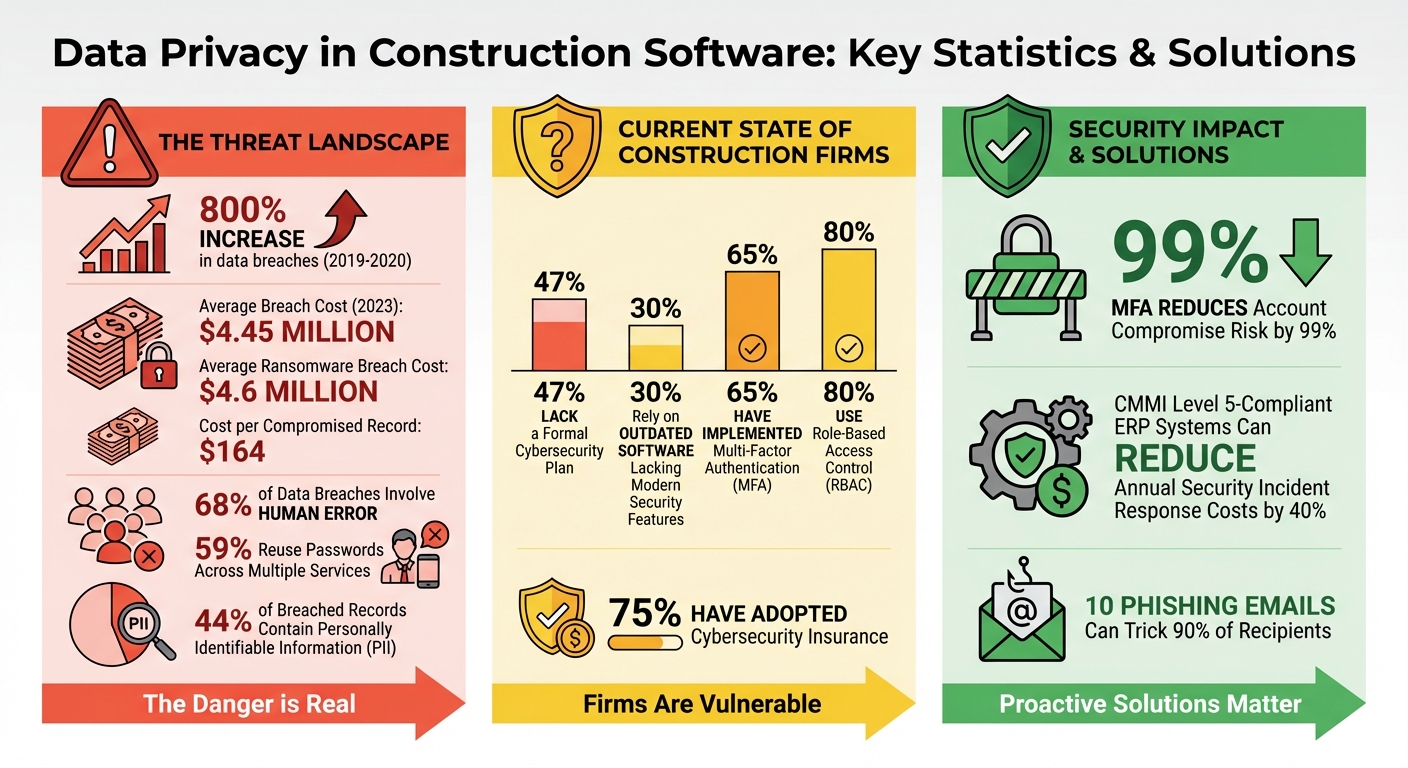
Data Privacy Statistics and Cybersecurity Measures in Construction Software
Common Data Privacy Problems in Construction Software
Construction software deals with data privacy issues that go beyond the usual cybersecurity risks.
Below, we break down some of the most pressing issues.
1. Weak Passwords and Access Control Issues
Password security continues to be a major vulnerability. A staggering 59% of people reuse the same password across multiple services. This means one compromised account can potentially expose several systems.
While about 65% of construction companies have implemented multi-factor authentication (MFA), many still struggle with over-permissioned accounts. For instance, estimators might gain access to payroll data, or subcontractors might view financial projections beyond their scope. Even though 80% of firms use role-based access control (RBAC), shared accounts, orphaned access from former employees, and other lapses remain common.
“Sharing identities diminishes accountability because it becomes challenging to attribute cases and updates to individual users.” — DNV (Det Norske Veritas), global risk management and quality assurance company
“Over 80% of breaches within the hacking category are caused by stolen or brute-forced credentials.” Verizon — Verizon Data Breach Investigations Report (DBIR)
These gaps in access control create a fertile ground for more advanced threats, such as ransomware.
2. Ransomware Attacks and Missing Data Encryption
Ransomware has become a nightmare for construction companies. The average cost of a ransomware breach is now $4.6 million, with attackers often targeting firms knowing that project delays can be extremely costly. A notable example occurred in January 2020 when Bouygues Construction suffered a ransomware attack that locked 200 gigabytes of data, severely disrupting operations.
Modern ransomware attacks often use “double extortion”. Hackers encrypt data to halt operations and simultaneously steal it, threatening to sell it on the dark web if the ransom isn’t paid. Personally identifiable information (PII) is particularly at risk, accounting for 44% of records lost in breaches.
Encryption – or the lack of it – is a critical factor. Data stored without encryption is an easy target, as attackers can access sensitive files immediately. Data in transit is just as vulnerable, especially without Transport Layer Security (TLS) or similar protocols. This is a significant concern when employees access systems from remote job sites or public Wi-Fi networks.
Alarmingly, around 30% of construction firms still rely on outdated software that lacks modern security features.
“The integrity of critical infrastructure is certainly in scope of a malicious actor attempting to cause harm. Construction companies should look to embed security by design principles as part of their requirements definition stage”
Human error and social engineering further exacerbate these vulnerabilities.
3. Phishing Scams and Insider Threats
Phishing attacks have grown more sophisticated, often imitating trusted contacts like suppliers, clients, or software vendors. These emails trick employees into sharing credentials or downloading malware, creating a direct path for attackers.
Insider threats are another concern. Employees or subcontractors with legitimate access may mishandle sensitive data, either by accident or intentionally. For example, someone might download client records before leaving the company or send unencrypted files through email. Without proper monitoring or audit trails, these actions can go unnoticed until the damage is severe.
The challenge becomes even greater when dealing with multiple systems and vendors.
4. Third-Party Integration Security Gaps
Construction firms often rely on a mix of software tools that need to work together. Each integration point, however, can introduce vulnerabilities.
“When companies combine incompatible or poorly integrated solutions, they expose themselves to significant cybersecurity risks. A fragmented system increases the likelihood of misconfigurations, inconsistent patching and user access issues – all of which create vulnerabilities”
Supply chain security is another weak spot.
Smaller subcontractors with lax security measures can serve as backdoors for hackers aiming to infiltrate larger firms’ systems. Legacy software adds to the problem, as outdated tools lacking security updates can become easy targets when connected to newer systems. Sharing sensitive data like Social Security numbers, financial records, or blueprints with third-party providers only broadens the attack surface and magnifies the risk of breaches.
sbb-itb-5eea312
How to Fix Data Privacy Issues
To tackle data privacy issues in construction software, focus on practical, actionable steps. These challenges don’t require a complete overhaul – just the right measures to secure your data from day one.
Use Strong Authentication Methods
Multi-factor authentication (MFA) is a must. This extra layer of security can cut the risk of account compromise by 99%.
Tools like Google Authenticator or Microsoft Authenticator are excellent choices. Pair MFA with strong password policies: require at least 12-character passwords with a mix of uppercase letters, numbers, and symbols . Password managers can simplify the process and reduce reuse. Also, enforce regular password updates every three to six months to keep systems secure.
Role-based access control (RBAC) is just as important. Limit access based on job roles – technicians only see their tasks, while CFOs handle financial data. This approach reduces exposure if an account is compromised . Automated offboarding is also key: revoke access immediately when employees leave or change roles to prevent lingering vulnerabilities .
“Security is not an IT cost center, but a core business continuity function.” – ArionERP Experts
Regular access audits can spot unusual activity and ensure permissions match current roles . Once authentication is solid, encryption becomes the next step.
Encrypt Data and Secure Remote Access
Use AES-256 encryption for stored data like blueprints, financial records, and other sensitive files . For data in transit, rely on TLS 1.2 or 1.3 protocols to prevent interception during communication .
Require VPN access for remote connections to add another layer of security . Secure Wi-Fi networks with WPA3 protocols. If employees use personal devices, enable remote-wiping capabilities to protect data in case of loss or theft.
Follow the 3-2-1 backup rule: keep three copies of your data on two different media types, with one offsite or in a distributed cloud .
| Measure | Standard/Protocol | Purpose |
|---|---|---|
| Encryption at Rest | AES-256 | Protects stored databases and files |
| Encryption in Transit | TLS 1.2 / 1.3 | Secures data moving between devices and the cloud |
| Wi-Fi Security | WPA3 | Prevents network-level intrusions |
| Remote Access | VPN + MFA | Secures remote and field connections |
Train Employees and Monitor Activity
Technology alone isn’t enough – human vigilance is critical. With human error linked to 68% of data breaches, employee training is essential. Regular phishing awareness sessions help staff identify scams.
For example, just 10 phishing emails can trick 90% of recipients.
“Hoping for the best and trusting ‘common sense’ simply doesn’t work anymore, phishing has officially outgrown our antiquated fail-safes.” – Frank Osborn, Foundation Software
Monitor user activity in real time to catch anomalies like large, unexpected data downloads. Keep audit logs to trace breaches . Also, ensure that on-site mobile devices are secure and separate from personal devices.
Vet Integrations and Update Systems
Third-party integrations can introduce risks, so vet them carefully. Evaluate vendors against standards like ISO 27001 and SOC 2 . Ensure integrations use modern authentication protocols, such as OAuth 2.0, and encrypted connections via TLS 1.2 or higher .
“Your software vendor’s security is an extension of your own.” – ArionERP Expert Team
Check vendors’ security histories, including past breaches and their responses. Don’t rely solely on your primary software’s privacy notice – review the privacy policies of all third-party tools. For projects with regulatory requirements, like CMMC 2.0 for U.S. Department of Defense contracts, ensure compliance .
Vetted platforms lower risks . Apply critical patches within 72 hours of release and enable automatic updates when possible. Regularly review user permissions on integrated platforms to ensure they remain appropriate . Use data governance tools to classify sensitive information before sharing it with third-party systems. For firms using CMMI Level 5-compliant ERP systems, annual security incident response costs can drop by 40%.
Creating a Long-Term Data Privacy Plan
Quick fixes won’t work in a world where threats change daily. Construction companies need a privacy strategy that evolves alongside their operations and stays ahead of new risks.
Run Regular Risk Assessments
Start by taking inventory of all your digital assets and mapping out how data flows across your systems. The depth of these reviews should match the sensitivity of the data and the complexity of its processing. For example:
- Routine operations might only need basic checks.
- Sensitive data, like health records or location tracking, requires deeper analysis.
- High-risk activities, such as large-scale monitoring systems, demand thorough evaluations.
Your risk level depends on factors like the type of projects you handle, your customer base, and the technology you use. For instance, government contracts often come with stricter requirements than residential projects. Similarly, advanced tools like biometrics can introduce additional vulnerabilities that need special attention. Performing these assessments regularly allows you to spot new risks early and build a foundation for proactive incident response and ongoing security checks.
Create Incident Response Plans
Having a solid incident response plan is critical. Identify key internal teams – like IT, HR, Legal, and Leadership – and external resources, such as forensic experts, PR specialists, and legal counsel, well in advance. Pre-arranged agreements with these experts can save valuable time during a crisis.
Your plan should ensure that a single security incident doesn’t cripple your entire operation. It should include:
- Clear communication strategies for public announcements and employee instructions.
- Guidelines on when and how to notify your cyber-insurance provider – timing is crucial.
Regular “fire drills” to simulate cyber incidents will prepare your team to respond effectively when faced with real threats.
“While preparation doesn’t guarantee that you’re not going to be impacted, it gives you a greater chance of survival and recovery.” – Keith Onchuck, CIO, Ozinga
Once you’ve established risk assessments and response protocols, the next priority is implementing strong, ongoing security measures.
Use Zero-Trust Security Models
A zero-trust approach means continuously verifying every user and device – not just at login. This is especially important in construction, where projects often involve contractors, subcontractors, owners, and government partners. Each of these groups can introduce potential vulnerabilities into your data chain.
To strengthen your defenses, follow the Principle of Least Privilege. This ensures that access rights are limited and adapt as roles or project needs change. Pair this with mandatory Multi-Factor Authentication, particularly for remote portals and administrative accounts. These steps help minimize the damage from any single compromised account and protect your data as your team and projects expand. Together, these measures create a security framework that evolves to meet emerging threats.
Conclusion
Data privacy in construction software isn’t just a technical concern – it’s a business-critical issue. With the average data breach costing $4.45 million and each compromised record valued at $164, the stakes are undeniable . Add to that the growing patchwork of state privacy laws in places like California, Virginia, and Colorado, and the urgency becomes even clearer. Yet, 47% of construction companies still lack a formal cybersecurity plan.
Addressing these vulnerabilities requires a multi-layered approach. Key measures like strong authentication, encryption, regular system updates, and employee training can mitigate most risks. Combining these with practices such as routine risk assessments, incident response plans, and zero-trust security models ensures your defenses evolve alongside your business.
The right tools make implementing these strategies manageable. A robust construction management platform can streamline security efforts. Contractor Foreman, for example, leverages Amazon Web Services (AWS) for its infrastructure – the same secure backbone that powers Amazon.com. Its features include unlimited centralized storage, advanced encryption for data at rest and in transit, secure client portals with granular access controls, and automated audit trails. This setup is designed to safeguard sensitive information like project blueprints, client addresses, employee Social Security numbers, and financial records.
Beyond its security capabilities, Contractor Foreman provides 24/7 support and free training to help businesses set up permissions, securely integrate tools like QuickBooks, and stay compliant with regulations such as CCPA and GDPR . With over 35 features available on both web and mobile platforms, it centralizes data management and reduces “information sprawl”, a common source of privacy vulnerabilities. This proactive approach not only safeguards data but also reinforces client trust.
Ultimately, protecting client data goes beyond avoiding breaches. It’s about building trust, securing contracts, and ensuring your company’s long-term success. Firms that prioritize data privacy today are positioning themselves to win tomorrow’s most sought-after projects.
FAQs
What construction data is most at risk in a breach?
When it comes to construction data, some of the most sensitive information at risk during a breach includes design plans, financial records, personal details of clients and employees, project specifics, and proprietary data housed in tools like BIM or project management software. To keep this information secure, it’s crucial to implement strong security protocols that prevent unauthorized access and misuse.
How do I prioritize security steps without a big budget?
Protecting your business doesn’t have to break the bank. Here are some practical steps that can significantly lower risks without hefty expenses:
- Enforce Role-Based Access Control (RBAC): Limit access to sensitive information based on job roles to minimize exposure.
- Enable Multi-Factor Authentication (MFA): Add an extra layer of protection by requiring multiple forms of verification for account access.
- Ensure Data Encryption: Protect sensitive data by encrypting it, making it unreadable to unauthorized users.
- Train Your Team: Educate staff on identifying phishing attempts and maintaining strong cybersecurity practices.
- Keep Software Updated: Regularly update your software and apply security patches to address vulnerabilities.
- Leverage Built-In Security Features: Use the security tools included in your construction management software. For example, Contractor Foreman offers features that enhance protection at no additional cost.
Simple measures like these can go a long way in protecting your business while keeping costs under control.
What should I ask vendors about integrations and compliance?
When evaluating vendors, inquire about their integration processes to understand how they prioritize data security and ensure compliance with industry regulations. Ask if they offer clear, detailed documentation and provide ongoing support to help uphold data privacy and meet regulatory requirements during the integration phase. This approach helps safeguard your system and keeps it aligned with necessary standards throughout the process.
Related Blog Posts







