
If seeing the words “data analytics” makes your eyes glaze over, you’re not alone. It sounds technical… and let’s be real – kinda boring.
But in construction, data is often the difference between profit and expensive surprises so it’s one of those things you just absolutely have to learn- period.
Firms that actually use data analytics see 50% higher profit growth than their peers. Meanwhile, more than 80% of collected data goes unused, contributing to $1.84 trillion in annual industry inefficiencies.
So how does that happen?
Data does two things:
It saves money by catching problems early (cost overruns, schedule slippage, underperforming crews, margin erosion)before they become write-offs.
And it drives profit by showing where opportunity actually lives. It lays out which jobs to pursue, which clients to prioritize, how to price smarter, and where productivity can scale.
Let’s say your historical project data shows healthcare work consistently delivers 2% higher margins than commercial, that’s not trivia — that’s money. On a $15M job, that difference is $300,000 in additional profit, just from bidding smarter instead of guessing.
The issue isn’t that data is complicated. The issue is when systems aren’t properly integrated.
In this article, I will outline the best practices for integrating construction data analytics so data finally becomes your friend.
Key Challenges:
- Data Silos: Isolated platforms delay decisions and increase errors.
- Legacy Systems: Older tools lack integration and real-time capabilities.
- Data Quality Issues: Manual errors and inconsistent formats skew insights.
- Scalability: Many systems fail to support diverse or large-scale projects.
Solutions:
- Integrated Platforms: Centralize data with tools like Contractor Foreman.
- Real-Time Analytics: Use dashboards for instant insights and better decisions.
- Standardized Data Practices: Digital forms and naming conventions improve accuracy.
- Scalable Systems: Cloud-based platforms grow with your business needs.
By addressing these issues, contractors can streamline operations, reduce delays, and improve profitability.
Common Integration Challenges
Only 29% of construction firms successfully integrate data from different sources. Tackling these challenges head-on is essential to achieving seamless analytics integration in the construction industry. Below are some of the most pressing obstacles standing in the way.
Challenge 1: Data Silos and Fragmentation
Imagine this: accounting uses one platform, project managers rely on another, and field crews have their own tools. The result? Isolated pockets of data that don’t communicate. Estimators, schedulers, and finance teams often work with incomplete or outdated information because their systems aren’t connected.
“Disconnected software solutions create dangerous data gaps between departments and fragmented data can delay decisions and lead to miscommunication and cost overruns.” – Access Group
Construction generates an incredible 2.5 quintillion bytes of data daily, yet much of it remains trapped in separate systems. Spreadsheets, while common, often lead to version control chaos, broken formulas, and unclear data structures. This fragmentation is a major reason why 70% of construction projects exceed their original budget and schedule estimates. Breaking down these silos is key to improving decision-making and communication.
Challenge 2: Outdated or Legacy Systems
Legacy systems are another hurdle. These older platforms often lack the integration capabilities needed for modern analytics tools. Many construction firms still rely on on-premises systems that demand constant hardware upkeep and don’t support APIs for seamless data sharing.
When data is manually entered into spreadsheets or paper forms, it’s effectively locked away from real-time dashboards and predictive models. To make matters worse, with a significant portion of the workforce nearing retirement, resistance to adopting new technology slows progress even further. This reliance on outdated systems contributes to the $1 billion lost annually in the U.S. construction industry due to poor decisions based on bad data.
Challenge 3: Real-Time Data Processing Limitations
Time is money, especially in construction. Delayed data processing leaves managers relying on outdated information, which can lead to idle equipment, wasted labor hours, and missed opportunities.
Older systems that batch-process data overnight or require manual uploads prevent contractors from having real-time visibility into critical operations. Without up-to-date insights, it’s nearly impossible to quickly reallocate crews or machinery to where they’re needed most. The lack of real-time data creates inefficiencies that ripple across projects.
Challenge 4: Poor Data Quality and Governance
Even when systems are interconnected, the data itself is often riddled with issues. Inconsistent measurement units, naming conventions, and manual entry errors undermine the accuracy of analytics.
For example, workers filling out paper forms at the end of a shift can introduce transcription errors. Shared spreadsheets are another headache – two people editing the same file can easily overwrite each other’s changes. Without clear rules about how data should be entered and formatted, analytics tools end up processing flawed information, leading to unreliable insights.
Challenge 5: Scalability for Diverse Project Needs
Not all projects are created equal. A residential remodel has vastly different requirements compared to a commercial high-rise or a highway expansion. Yet many analytics systems are rigid, designed for specific project types or company sizes. This lack of flexibility leaves only 8% of organizations able to scale analytics.
The problem becomes even more pronounced for firms managing geographically dispersed projects. A system that works for local jobs may not support the multi-location reporting needed for regional or national operations. Firms are often forced to choose between inadequate tools or costly custom solutions that take months to implement, neither of which is ideal for scaling their analytics capabilities.
sbb-itb-5eea312
Solutions and Best Practices
With the challenges outlined, it’s time to dive into practical strategies that can make a real difference. By addressing these obstacles head-on, contractors can use data to fuel growth. In fact, companies classified as “data leaders” report a 50% higher profit growth rate compared to others. This isn’t just about fixing issues – it’s about setting your business up for measurable success.
Solution 1: Use Integrated Construction Platforms
Data silos and fragmented systems are major hurdles. Instead of juggling separate tools for accounting, project management, and field reporting, consider an all-in-one platform that centralizes everything into a single database.
“Data silos are a major barrier to efficiency. Centralizing data across departments – including finance, operations and field service – ensures consistency and accessibility.”- Alex Hall, Head of Pre-Sales, Access Construction
Take Contractor Foreman, for example. It combines over 35 features – project management, financial tracking, scheduling, GPS-driven timecards, and more – into one system. Built-in integrations with tools like QuickBooks and Zapier ensure seamless data flow, eliminating manual exports and duplicate entries. When everyone, from estimators to field crews, operates from the same data source, consistency and accuracy improve. This is critical, especially since more than 80% of construction firms analyze only a fraction of the data they collect.
Solution 2: Conduct Compatibility Assessments
If your business relies on older systems, you don’t necessarily need to scrap everything. Start by evaluating how your existing tools can connect with newer analytics platforms. Check if your software supports APIs, which allow systems to communicate. Cloud-based solutions often integrate more easily than older, on-premises systems that require constant upkeep. Middleware platforms can act as a bridge, connecting tools like project management, accounting, and scheduling for smooth data flow.
Before investing in new tools, map out your current tech stack to identify bottlenecks. Look for platforms with pre-built connectors to save time and effort, preparing your systems for seamless real-time analytics.
Solution 3: Implement Real-Time Analytics Tools
Batch processing delays can leave you reacting too late. Real-time analytics tools solve this by offering instant insights. Cloud-based dashboards let you monitor labor hours, equipment usage, and material costs as they happen. For instance, Contractor Foreman’s GPS-driven timecards automatically log when and where crews are working, feeding data directly into your analytics system. This allows you to spot inefficiencies, such as idle equipment or underutilized labor, within hours and make adjustments immediately.
Solution 4: Standardize Data Entry and Governance
Poor data quality leads to poor decisions. In fact, the U.S. construction industry loses over $1 billion annually due to bad data-driven choices. The solution? Standardize how information is entered.
“Inconsistent data entry is the largest cause of bad data. So by standardizing how you capture information, you can prevent bad data from permeating throughout your organization.”-Eric Thomas, Sr. Multimedia Content Marketing Manager, Autodesk
Swap out paper forms and spreadsheets for digital forms that enforce uniform data entry. This improves the accuracy of progress logs, material tracking, and safety records. Use standardized naming conventions – like “P100-SUB-MECH-001-R2” for mechanical submittals – to make documents easier to find. Role-based access controls can protect sensitive data while ensuring team members only see what’s relevant to them. Regular audits of your data can catch errors early, preventing them from skewing analytics.
Solution 5: Choose Scalable and Flexible Platforms
As your business grows, your analytics needs will evolve. Choose platforms that can scale with you. Whether you’re a small contractor taking on larger projects or a regional firm expanding to new markets, cloud-based platforms can adjust storage and features without requiring expensive hardware upgrades.
Contractor Foreman, for instance, supports unlimited projects across all pricing tiers. Plans start at $49/month for solo contractors and go up to $249/month for larger teams. This flexibility allows you to scale by adding users rather than switching systems entirely. Custom dashboards let CFOs, COOs, and project managers track cash flow, resource use, and potential risks – all from the same data. This adaptability ensures your systems can evolve with your business without major disruptions.
Best Practices Summary Table
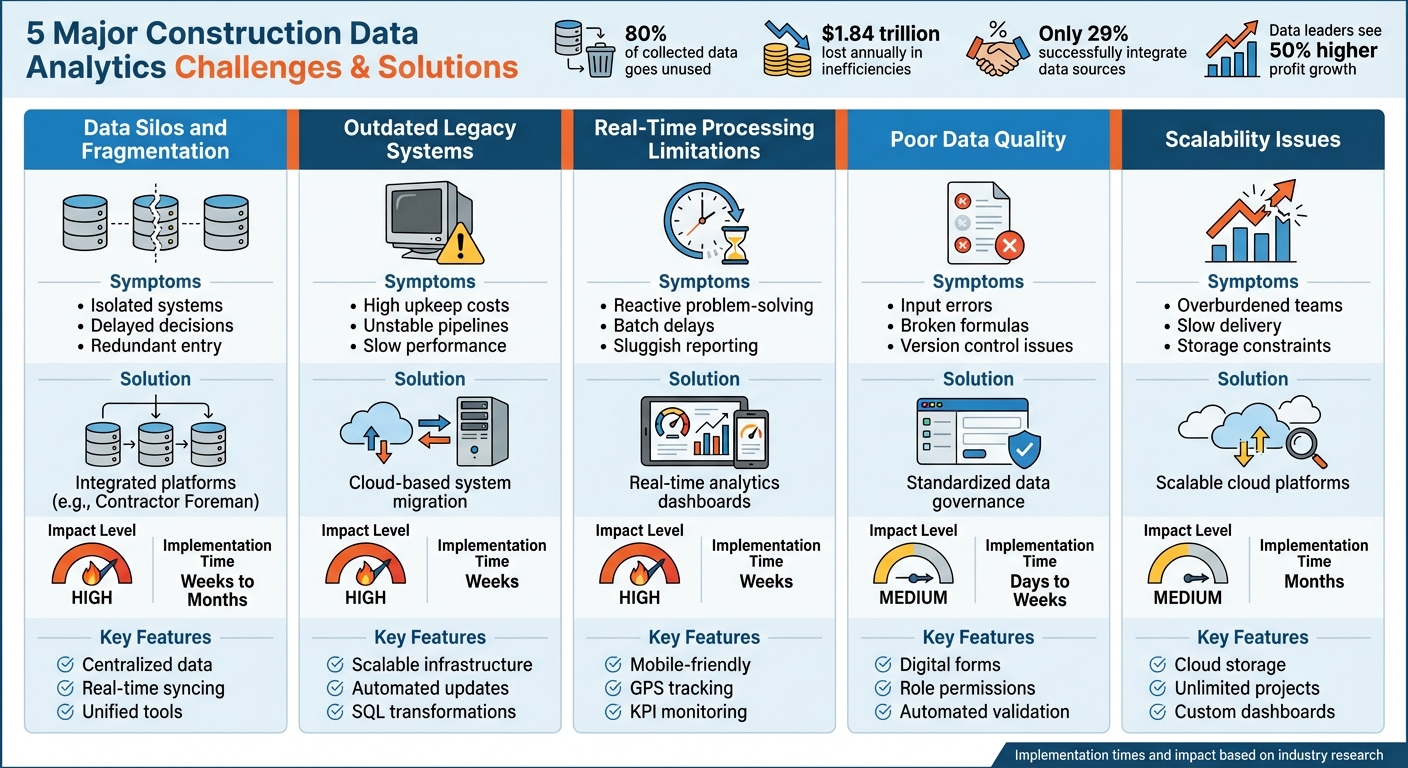
Construction Data Analytics Integration Challenges and Solutions
This table outlines five major challenges in construction data management, along with their symptoms, solutions, expected impact, and timeframes for implementation. It’s a quick reference to help you prioritize which issues to tackle first.
| Challenge | Symptoms | Solution | Impact Level | Implementation Time | Key Features |
|---|---|---|---|---|---|
| Data Silos and Fragmentation | Isolated systems, delayed decision-making, redundant data entry | Switch to integrated construction platforms (e.g., Contractor Foreman) | High | Medium to High (Weeks to Months) | Centralized data; real-time syncing; unified financial and project management tools |
| Outdated or Legacy Systems | High upkeep costs, unstable data pipelines, slow performance | Perform compatibility checks and migrate to modern, cloud-based systems | High | Medium (Weeks) | Scalable infrastructure; automated schema updates; SQL-based data transformations |
| Real-Time Data Processing Limitations | Reactive problem-solving, batch delays, sluggish reporting | Use real-time analytics tools and dashboards | High | Medium (Weeks) | Mobile-friendly; GPS-enabled time tracking; tailored KPI monitoring |
| Poor Data Quality and Governance | Input errors, broken spreadsheet formulas, version control issues | Establish standardized data entry and governance practices | Medium | Short (Days to Weeks) | Digital forms; role-specific permissions; automated validation |
| Scalability for Diverse Project Needs | Overburdened teams, slow project delivery, storage constraints | Invest in scalable platforms with unlimited project capacity | Medium | Long (Months) | Cloud storage; support for unlimited projects; customizable dashboards |
The Impact Level indicates how effectively each solution addresses the estimated $1 billion annual loss tied to poor data management in U.S. construction. Implementation Time varies from just days (e.g., standardizing data practices) to several months (e.g., integrating a full ERP system). The Key Features section highlights the critical functionalities that ensure these solutions drive meaningful improvements, such as real-time accessibility and automated tools.
Conclusion
Construction data analytics holds immense promise, but integration challenges often stand in the way. Right now, over 80% of construction firms analyze just a fraction – about one-third – of the data they collect. Without proper integration, this wealth of information becomes a missed opportunity.
To tap into this potential, contractors need to focus on strategic integration. By centralizing data, automating repetitive tasks, and standardizing workflows, teams can shift from constantly putting out fires to managing projects proactively. Tools like real-time dashboards, predictive analytics, and synchronized financial systems empower contractors to stay ahead in planning, budgeting, and execution.
Platforms like Contractor Foreman make this transformation easier by bringing project management software, finances, field operations, and analytics under one roof. With features like native QuickBooks integration, access to over 8,000 Zapier-connected apps, and mobile-friendly data logging, it eliminates the need for extra coding or manual updates. Plans start at $49/month, offering a 30-day free trial and a fixed-price model that ensures costs stay predictable as your project load grows.
FAQs
What steps can construction firms take to break down data silos and make better decisions?
Construction firms can break down data silos by using integrated software solutions that enable smooth communication across various tools and platforms. For companies relying on older systems, adding middleware can act as a bridge, ensuring smoother data sharing and connectivity.
Another key step is implementing standardized data processes. This includes using consistent naming conventions and centralizing data storage, making it easier for teams to access accurate, up-to-date information. These practices improve collaboration and give teams a clearer view of project performance, helping them make better decisions.
How can contractors successfully move from outdated systems to modern analytics tools?
Transitioning from older systems to modern analytics tools doesn’t have to be overwhelming if you approach it step by step. Start by taking a close look at your current systems. Are there compatibility issues? Will you need upgrades or middleware to bridge any gaps? Answering these questions will help you map out the transition process.
Next, pick tools that integrate easily with your existing setup. This will make the switch smoother and ensure your data flows without hiccups. Centralizing your data collection is another key move – it cuts down on fragmentation and makes automation of data transfers easier, reducing manual work and potential errors.
Don’t forget about your team. Proper training is essential to get everyone on board and comfortable with the new tools. Establishing clear workflows can also help standardize processes and make the adoption process easier. Finally, make it a habit to review and update your systems regularly. This ensures they stay in sync with new technologies and meet your evolving needs. With a solid plan, you can streamline operations and uncover valuable insights that drive your projects forward.
Why is real-time data processing important for improving construction project efficiency?
Real-time data processing plays a key role in improving construction project efficiency by offering immediate access to essential information. This enables teams to make quicker, more informed decisions. With live data analysis, contractors can effectively manage resources, monitor progress, and tackle potential issues early – before they escalate into expensive setbacks.
Taking this approach minimizes delays and enhances project performance, leading to smoother workflows and higher levels of client satisfaction.
Related Blog Posts
- Best Practices for Construction Accounting Integrations
- Best Practices for Real-Time Financial Data Monitoring
- Checklist for Evaluating Dashboard Software
- How Predictive Analytics Enhances Construction Planning







