
Construction safety… it’s something we all worry about, and yet, when we’re at the jobsite juggling 101 things, it’s one of the first ones we tend to skip.
As with most things in life, we don’t think bad things could happen to us if we’re careful.
Instead of doing the daily equipment check, we want to focus on the work. And so we hear Jack, the site foreman, say:
“Uhm… I think we tied the scaffolding properly. Just be careful.”
Or Mike, the crew lead, say:
“I mean, the trench looked fine yesterday. We’ll shore it up if it looks weird.”
This is the reason why workers get included in grim statistics.
In 2024, construction had 1,034 fatalities in the United States, with a fatal injury rate of 9.2 per 100,000 full-time workers.
The solution is simple: integrating safety into your workflow. This way, it becomes effortless because it’s just part of the process, not an extra step someone has to remember.
How to Integrate Safety into Construction Workflows:
- Plan hazards during preconstruction planning with risk reviews, JHAs, and daily pre-task plans
- Check the site each day during setup, huddles, and end-of-shift walks
- Record issues fast in daily logs, near-miss reports, and inspection records
- Use project records at closeout to fix repeat problems on the next job
Safety is strongest when crews can see it in the schedule, in the field, and in the project record at the same time.
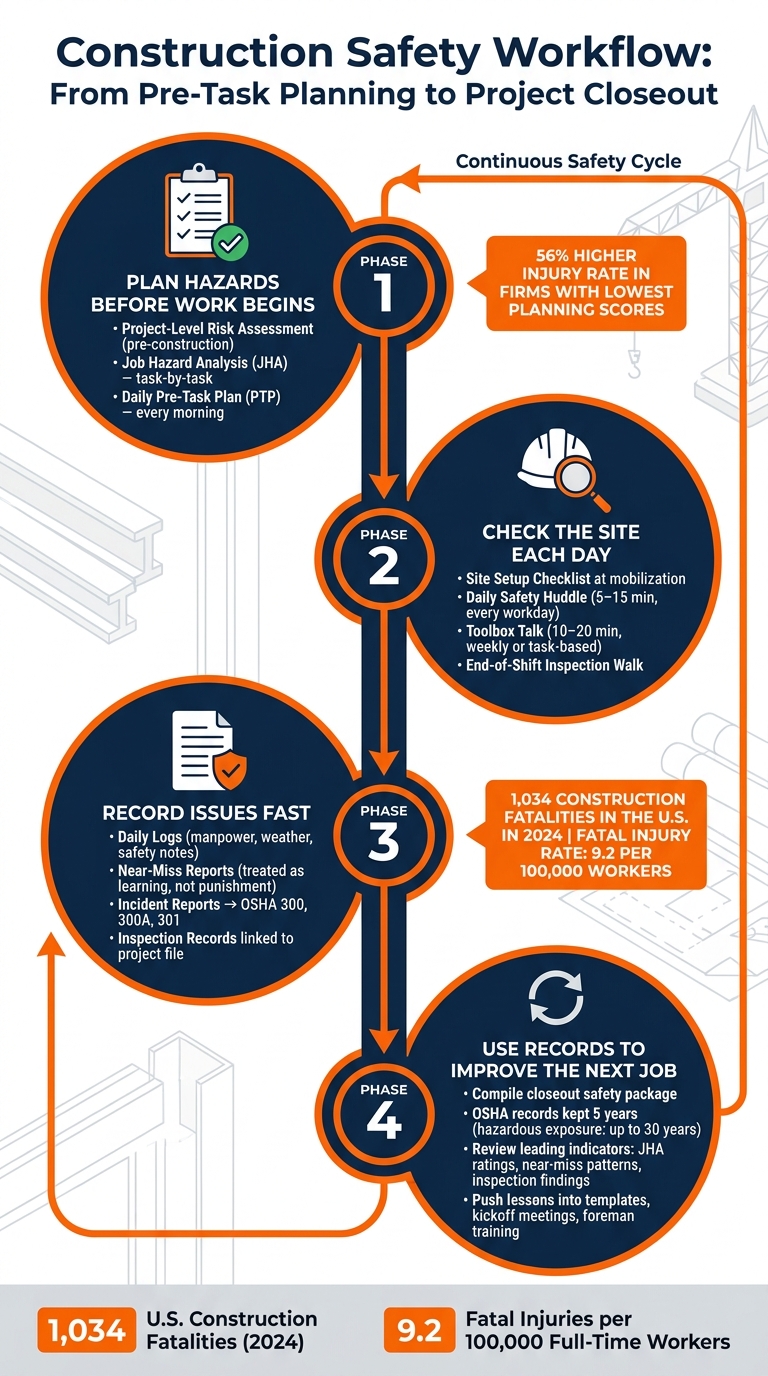
Construction Safety Workflow: From Pre-Task Planning to Project Closeout
Build Safety into Planning Before Work Starts
Most construction incidents can be prevented when crews spot hazards early and deal with them in the plan. That’s why safety should live inside planning from the start, not sit off to the side as one more form to fill out.
Use risk assessments, JHAs, and pre-task plans together
These tools work best as a set.
Use the project risk assessment for the whole job, the JHA for the task, and the PTP for that day’s crew and site conditions.
The project-level risk assessment happens before mobilization. It looks across the full scope and points out major hazards like excavation, work at height, energized systems, multiple crews sharing work areas, and traffic control. It sets the jobwide hazard list and the controls tied to it.
A Job Hazard Analysis (JHA), or JSA, breaks one task into steps and assigns controls to each step. Take roofing. A roofing JHA might split tear-off into setup of access, removal of old materials, debris movement, and installation of new components. Each step gets its own hazard review and control plan.
The daily pre-task plan (PTP) brings that planning down to the shift level. It checks whether that day’s crew, weather, equipment, and site conditions still match the JHA. If the wind picks up, or another trade starts working below the roofline, the PTP is where the crew catches that change before someone gets hurt.
| Planning Level | Scope | Timing | Primary Users | Output |
|---|---|---|---|---|
| Risk Assessment | Entire project | Pre-construction / mobilization | Project managers, superintendents, safety leads | Project hazard list and controls |
| JHA / JSA | Specific task or activity | Before that task begins | Foremen, trade leads | Step-by-step hazard controls |
| Pre-Task Plan (PTP) | Day’s shift, specific crew | Every morning before work starts | Full crew | Daily signed plan with crew assignments, equipment, PPE, and changing conditions |
Once that planning is in place, the next move is simple: check each morning that the site and crew still match the plan.
Tie controls to the actual scope, crew, and schedule
One common problem is planning at too high a level. “Framing” sounds like a task, but it’s not. It’s a phase. The actual hazards show up in the field details: layout, material staging, cutting, lifting, ladder use, fastening, and cleanup. Break work down that far, and it gets much easier to assign the right controls at the right time.
When choosing controls, use the hierarchy of controls. Remove the hazard first if you can. If rooftop work can be done from the ground with prefabrication or lift equipment, that cuts fall exposure before anyone clips into a harness. If excavation has to happen, shoring or sloping does more than a warning sign telling people to be careful. After that come administrative controls like sequencing, restricted zones, spotters, and permits. PPE sits at the end of the line, not the front.
Controls also need to match the day in front of you. Weather changes things. So do trade overlap, deliveries, equipment movement, and shared access points.
Make pre-task planning a daily habit
That shift-level check is what turns a written plan into field practice.
The best PTPs are short, steady, and easy to talk through. Not a long document crews race through just to get moving.
A solid pre-task plan should cover:
- The shift’s scope and sequence
- Crew assignments
- Needed tools and equipment
- Expected PPE
- Site-specific hazards and controls
- Any changed conditions
- Stop-work authority
It should also make clear that work stops when conditions change. Crew sign-off shows the briefing was given and understood. When that rhythm stays the same every morning, it stops feeling like extra paperwork and starts feeling like part of the job.
Daily planning also works better when people can speak up before work starts. Research supports that. A case study report from the Construction Industry Institute found that companies using pre-project and pre-task planning practices – including job hazard analysis, constructability reviews, and site-specific safety programs – had significantly lower recordable injury rates than those that did not. Firms in the lowest audit score quartile also had a short-term disability injury rate 56% higher than similar firms in the highest quartile. That same discipline should carry into site setup and daily field checks.
sbb-itb-5eea312
Add Safety Checks to Site Setup and Daily Field Work
Planning means very little if the jobsite doesn’t match the plan. After the pre-task plan is set, check it in the field at the start and end of each shift. Site setup checklists, daily huddles, and end-of-shift inspections make that part of the routine instead of leaving it to memory.
Use site setup checklists during mobilization
Before the first crew arrives, a supervisor should walk the site with a paper or digital checklist. Confirm clear access and exit routes, perimeter fencing, traffic separation, signage, first aid, SDS access, fire protection, and housekeeping zones before work begins.
Keep SDSs easy to reach in print and on mobile. OSHA’s construction housekeeping standard, 29 CFR 1926.25, requires scrap and debris to be removed at regular intervals and work areas kept clear. Setting housekeeping zones during mobilization helps keep the site orderly from day one. And when that checklist lives in a digital system and gets reused across projects, each job starts from the same baseline instead of being rebuilt from scratch.
Run short daily safety huddles and toolbox talks
Use three meeting formats for three different purposes:
| Meeting Type | Primary Purpose | Typical Length | Typical Frequency | Documentation Needed |
|---|---|---|---|---|
| Daily Safety Huddle | Review daily tasks, site changes, and controls | 5–15 minutes | Every workday | Date, crew, key hazards and controls discussed |
| Toolbox Talk | Focus on a specific safety topic or hazard | 10–20 minutes | Weekly or task-based | Topic, date, attendees, summary of discussion |
| Formal Safety Meeting | Program-level training and review | 30–60+ minutes | Monthly/quarterly or as required | Agenda, minutes, sign-in, action items |
Hold daily huddles near the work area, right after arrival and before work starts. Keep them short and specific. Go over the day’s work, site changes, high-risk tasks, controls, weather, and crew input.
Specific direction works better than broad reminders. Saying use the designated anchor points on the east elevation gives the crew something clear they can act on right away. Contractor Foreman’s safety topic library gives supervisors ready-made material for toolbox talks.
Close the day with inspections and housekeeping checks
A checklist walk about 30 minutes before shift end can catch problems before crews head out.
Equipment should be parked in marked areas with attachments lowered and keys removed. Materials need to be stacked so they stay stable and don’t block access routes. Guardrails, floor hole covers, and open-edge protection should be checked to make sure they’re secure. Walkways and stairs need to stay clear of scrap, cords, and packaging. Gates should be locked, and ladders should be secured to prevent after-hours access.
If a hazard isn’t fixed by the end of the shift, log it with the location, interim controls, owner, and due date. Then bring it back up in the next morning’s huddle. Open items should also go into the daily report so they carry into project records.
Connect Safety Reporting, Documentation, and Software
Field safety work creates a steady stream of logs, photos, findings, and follow-up items. The hard part is making sure all of that information stays tied to the project record so nothing slips through the cracks between shifts.
Capture safety data in daily logs and field reports
At the end of the shift, document what changed, what got fixed, and what still needs follow-up. A daily log connects safety observations to a specific date, crew, project, and location. That keeps safety in the same daily flow as huddles and inspections instead of turning it into a separate admin task.
Each entry should include:
- Date (MM/DD/YYYY), crew names, and headcount
- Weather conditions in °F at key times (for example, “7:00 a.m. – 68°F, clear; 2:00 p.m. – 94°F, high heat index”)
- Work performed by area or task
- Safety entries: record the time, exact location, and a short factual description of incidents, first-aid cases, and near misses (for example, “worker tripped over extension cord in the Level 2 corridor while carrying materials”)
- Photos labeled by task and location
- Corrective actions taken, who was notified, and any open follow-up items
- Heights, trench depths, and scaffold elevations in feet and inches (for example, “8-ft trench, east side of building”) so records stay consistent and easier to review during inspections or claims
Near misses should be documented with the same care as recordable incidents. When teams treat near-miss reporting as a way to learn instead of a punishment, they can spot hazard patterns earlier and stop the same event from happening again.
A daily log does its best work when it stays attached to the project record, not buried in a separate file.
Use Contractor Foreman to keep safety tied to project workflows
Separate forms often break the connection between field activity and the project record. Contractor Foreman keeps safety documentation inside the same system used for daily operations, so field actions stay linked to the project record and easy to pull up on mobile devices.
Daily logs track manpower, weather in °F, work performed, photos, and safety notes directly inside each project. Safety meeting records keep toolbox talk topics, attendee lists, and dates in the same place, which makes it much simpler to show that required training happened. GPS timecards confirm who was on site and when. That matters a lot during an incident review. Document management keeps JHAs, site-specific safety plans, inspection forms, and SDSs organized by project.
Contractor Foreman’s free training and support team can also help contractors build custom forms and checklists that match how the field actually works. That way, safety workflows feel like part of the job, not extra paperwork.
Track leading indicators and feed lessons back into the plan
Once the records are in place, review them for patterns. Incident rates show harm that already happened. Leading indicators point to current risk.
Completed JHAs, inspection findings, near-miss reports, and safety meeting attendance are all leading indicators that can be tracked digitally. Review them on a regular basis to see where risk keeps showing up. Which tasks keep getting high-risk JHA ratings? Which inspection items come up again and again? Which areas produce the most near-miss reports?
That information can shape the next move. You might revise standard templates, change crew sequencing, or add more time for high-risk operations. The table below shows how core digital safety workflows differ by user, trigger, and risk-control value.
| Digital Safety Workflow | Primary User | Trigger | Risk-Control Value |
|---|---|---|---|
| Daily Logs | Foreman / Superintendent | End of each shift | Defensible record of site conditions, manpower, and safety observations |
| Safety Meeting Records | Crew Lead / Foreman | Scheduled huddle or toolbox talk | Documents attendance and turns field concerns into trackable follow-up |
| Incident Reports | Any crew member | At the time of an event or near miss | Supports notifications and OSHA 300 log entries for OSHA compliance |
| Inspections | Safety officer / Foreman | Milestone, weekly, or permit requirement | Links compliance checks directly to project documentation |
| Near-Miss Logs | Field crew | Hazard identification | Identifies leading indicators to help prevent future injuries |
Use each job’s records to set up the next one better. Those records also become the base for final documentation and the next project’s safety setup.
Wrap Up Safety at Closeout and Improve the Next Job
Organize closeout records and confirm required documentation
By the time a job is winding down, closeout should already be well underway. It works best as a running process built into the project, not a last-minute pileup of paperwork.
The closeout package should include the records below. In the U.S., OSHA requires Forms 300, 300A, and 301 to be kept for 5 years after the calendar year they cover. The 300A summary also has to be posted in a visible location each year from February 1 through April 30. And if the job involved hazardous exposure monitoring, records for materials such as silica, asbestos, and lead may need to stay on file for up to 30 years.
| Closeout Safety Record | Purpose | Who Compiles It |
|---|---|---|
| Inspection Reports | Documents site conditions, compliance checks, and approval status | Superintendent / Project Manager |
| Incident & Near-Miss Logs | Supports OSHA log entries and identifies recurring hazards | Foreman / Safety Manager |
| Training Records & Certifications | Verifies crew qualifications and completed safety training | Safety Manager / Project Manager |
| Toolbox Talk Sign-In Sheets | Proves consistent safety communication and attendance | Foreman / Superintendent |
| JHAs & Pre-Task Plans | Shows hazards were identified and controlled before work started | Foreman / Superintendent |
| Corrective Action Records | Demonstrates that identified hazards were addressed | Foreman / Project Manager |
| OSHA Forms 300, 300A & 301 | Required regulatory record of work-related injuries and illnesses | Safety Manager / Project Manager |
| Permit & Equipment Inspection Forms | Confirms compliance with project-specific permit requirements | Project Manager / Superintendent |
In most cases, the superintendent or foreman gathers the field records, while the project manager or safety manager checks the closeout file for accuracy and completeness.
Use lessons learned to improve future workflows
Once the file is done, don’t just store it and move on. Use it to make the next job run better.
Focus on patterns, not one-off events. That means looking at recurring hazards, controls that worked well, steps people skipped, and risks that showed up because of sequencing or site access. If the same issue appears across more than one project, that’s usually a process gap, not a one-site problem.
Take access and egress congestion as an example. If it led to repeated near misses on several jobs, the answer isn’t just telling crews to “be more careful.” The pre-construction checklist should require a marked route plan before mobilization starts.
Contractor Foreman can help here by keeping daily logs, project records, and documents in one searchable system. That makes it much easier to spot patterns across jobs and bring clean records into the planning phase of the next project. The key is to push those lessons into templates, kickoff meetings, and foreman training before the next job begins. Otherwise, the same issues tend to show up again.
Conclusion: Key Steps to Make Safety Part of Everyday Operations
Closeout is the last check on the safety workflow built in the field. Review the records, update checklists, pre-task plans, and supervisor inspections, then carry those changes into the next job before mobilization begins.
When planning, field execution, reporting, and closeout all support the same controls, safety stops feeling like a separate admin task. It becomes part of how the work gets done every day.
FAQs
How do I make safety part of daily work?
Make safety part of the daily routine instead of treating it like a separate task.
Use daily logs to track who was on-site, site conditions, and any safety notes. Hold safety meetings or toolbox talks and document them with attendance records. Then give crews one clear way to communicate by using digitized checklists to report hazards, near-misses, photos, timestamps, and signatures.
That matters because safety can fall through the cracks when updates live in different places. A single workflow keeps the day moving and makes it easier to document what happened.
Contractor Foreman supports all of this in one workflow.
What should a good pre-task plan include?
A good pre-task plan should start with a site walkthrough before work begins. After that, the team should review blueprints, equipment, and past incident reports. On large sites, it helps to break the work into zones so no hazard slips through the cracks.
The plan should then identify hazards, rank them by risk, and apply controls using the Hierarchy of Controls. It should also assign each action to a specific person, set clear deadlines, and document findings in a risk register.
Reassessment triggers should be spelled out from the start. Common examples include near-misses, new equipment, extreme weather, or new subcontractors coming onto the site.
Which safety records matter most at closeout?
At project closeout, keep a complete, organized set of safety records. It matters for compliance, and it can save you a major headache if a dispute pops up later.
That file should include OSHA 300 logs, incident and near-miss reports, routine inspection records, safety training records such as toolbox talks, plus active permits and certifications.
Put everything in one central digital system so it’s easy to search and pull up during an audit. You want clear proof of your safety protocols, hazard assessments, and corrective actions – all in one place, not scattered across inboxes, binders, and job trailers.







