
- Your Job Extends to the Neighbor’s Opinion
- Turn Neighborhood Management Into a Beneficial System
- Contractors Who Turned Neighborhoods Into Their Sales Teams
- Why Most Residential Contractors Lose Business After a Job Well Done
- Daily Practices That Turn Projects Into Referral Engines
- Why Neighborhood Management Is Hard to Compete With
- Every Job Site Can Drive Your Next Five Projects
Picture a quiet neighborhood street with only one house under renovation. The rest was filled with people who now wake up to the sound of trucks backing up and saws buzzing before breakfast.
The contractors never introduced themselves. No one knows how long the disruption will last. Cars are blocked. The sidewalks are dusty. Crews park wherever there’s space. By week two, frustration has already replaced curiosity.
It’s not the work that gets remembered – it’s the experience. The neighbor who would’ve happily asked for a quote now just wants the job to end. Another referral was lost, not because of poor craftsmanship, but because no one thought to manage the relationship outside the property line.
Residential contractors often focus so tightly on the build that they forget every job takes place inside a larger, highly visible environment. When communication breaks down or fails to start at all, neighborhoods can become hostile. That’s when complaints arise, permits get challenged, and reputations take the hit.
But there’s a smarter way to work. Contractors using neighborhood relationship systems create clarity, reduce friction, and turn nearby homes into future clients. By running a smooth and respectful project from start to finish, one job can turn into five without requiring additional leads or budget.
Your Job Extends to the Neighbor’s Opinion
Good work means nothing if the neighbors only remember the mess. Residential contractors often think their job ends at the property line, but the people living next door don’t make that distinction. They deal with the noise, traffic, dust, blocked driveways, and confused scheduling, whether they asked for it or not.
According to Nielsen, over 92 percent of consumers worldwide say they trust earned media, such as recommendations from friends and family, more than any other form of advertising. This is an important network for your business.
However, most contractors let that network die before it ever forms. Even a small bad experience, like starting early without notice, can turn a curious neighbor into someone who warns others not to hire you.
It’s not because of your work but because of how it felt to live next to it. If they hired you, they would have to deal with the same scenario at their own home.
Too many contractors work reactively. They solve problems after the complaint shows up. By then, trust is often gone, and with it, the opportunity to turn that neighbor into a lead.
When you stay silent, people assume the worst. If you leave communication up to the crew, results vary wildly. Essentially, every ignored neighbor is a missed opportunity, and the longer this continues, the harder it becomes to grow solely on reputation.
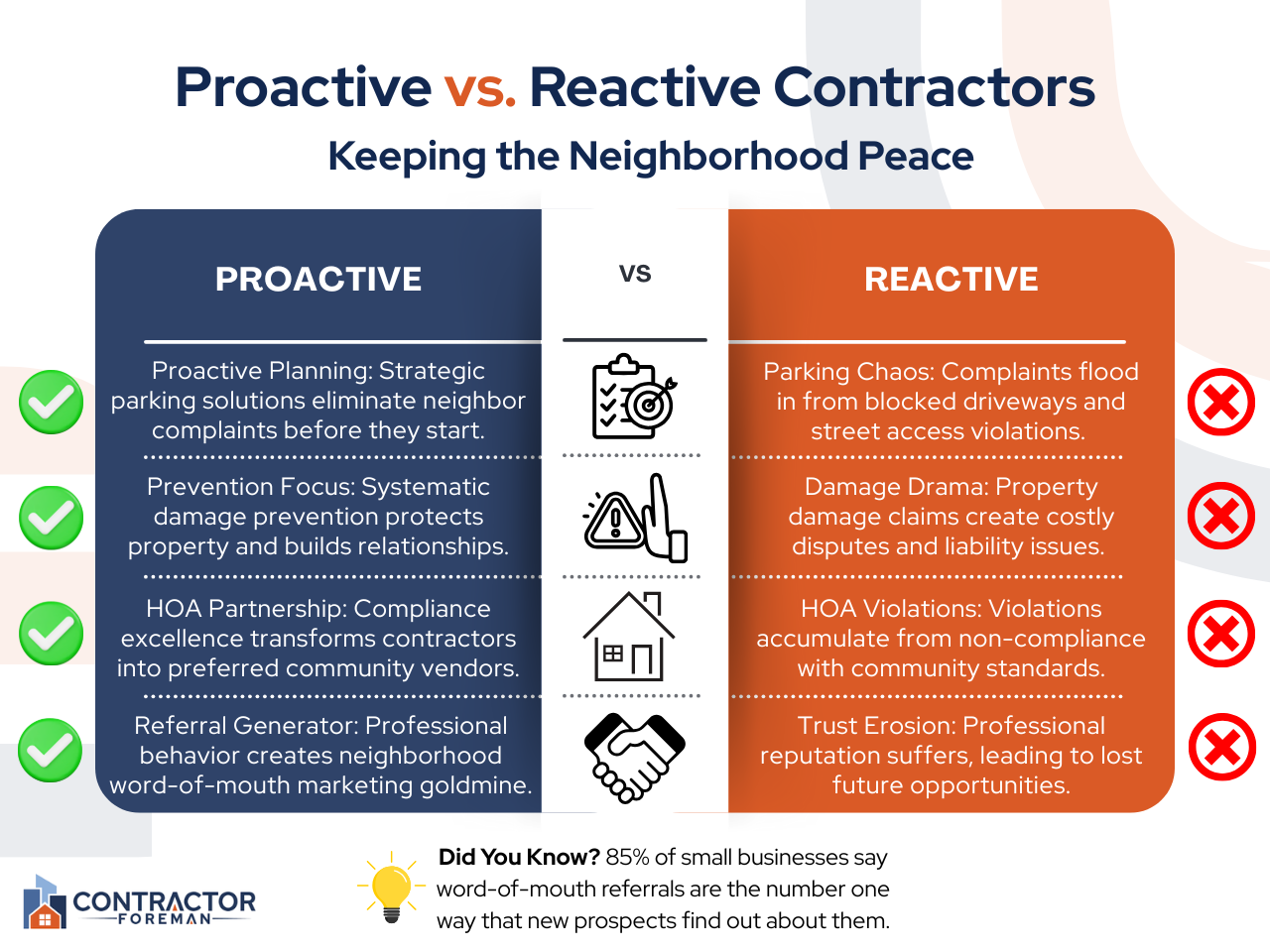
Turn Neighborhood Management Into a Beneficial System
Referrals shouldn’t depend on luck, perfect weather, or having a quiet crew. They should be based on the quality of work and how a business treats its employees and customers.
Residential contractors who build systems for neighborhood communication turn job sites into steady pipelines for growth. Generating neighborhood leads doesn’t require extra work. It just means doing your job well and providing consistent, predictable interactions that reduce problems.
Here’s how to make that shift:
Step 1: Introduce Yourself Before the Job Starts
Contractors who wait for problems to introduce themselves start at a disadvantage. Instead, set the tone early. Use a Client Portal to send a professional introduction to surrounding homes before work begins.
Demonstrate that you understand and empathize with their concerns that the project may disrupt their lives. Share the project timeline, your expected work hours, parking arrangements, and direct contact for any questions.
This single move positions you as organized, respectful, and in control. It will eliminate 90 percent of complaints before they happen.
Step 2: Keep Neighbors Informed With Daily Logs
When no one knows what’s happening, silence creates tension and the assumption that something is going wrong. Daily Logs provide neighbors with quick, non-intrusive updates to keep them in the loop.
Updates can include what was done today, what is planned for tomorrow, and any expected disruptions. Knowing that noise will start at 8 a.m. sharp can go a long way.
You don’t need to knock on doors to keep communication flowing. That visibility builds trust, and trust turns observers into future clients.
Step 3: Make Sure Every Crew Member Speaks With One Voice
Most contractors rely on the crew to “be respectful,” but tone and clarity vary from person to person. What is respectful to one person may be a bit more direct than you would like.
With Team Chat, your internal communication stays aligned. Questions get answered quickly, the tone stays consistent, and the homeowner never hears three different versions of the same update.
Coordinated teams minimize mistakes and misunderstandings while maintaining a professional demeanor at all times.
You can run these steps manually, but it takes time. Or you can plug into a system that handles it all in the background.
Construction management software, such as Contractor Foreman, is specifically designed for the construction industry and combines neighborhood communication, progress logging, and team coordination, allowing you to prevent problems and gain referrals without adding more to your workload.
Contractors Who Turned Neighborhoods Into Their Sales Teams
Small and mid-sized residential contractors often rely on referrals but struggle to control how neighbors experience the job. Contractors using structured neighborhood systems report noticeable shifts, not just fewer complaints, but more calls coming from the same street.
Raleigh Remodeler
This remodeling contractor began using a client communication portal to notify neighbors prior to every job.
Within six months, referrals increased, and most came from people who appreciated the professionalism before a single nail was hammered. Instead of being remembered for noise or dust, they were remembered for caring and clarity.
Boise Exterior Contractor
Frequent complaints from neighbors about noise, blocked driveways, or unclear timelines were a regular part of their week.
Once they began sending daily logs with short project updates, complaints dropped almost entirely. Jobs ran smoother, and unsolicited positive feedback from nearby homeowners became the norm.
San Diego Roofing Contractor
Coordination issues between supervisors and crew had created inconsistent neighbor interactions. After centralizing internal communication, each job began with clear expectations and concluded with referrals from nearby households. Over the next year, over half of their new business came from within blocks of past projects.
Wonder if this could be you? Booking a free demo is the fastest way to see how these tools can fit into your workflow. Start turning every project into your next source of leads.
Why Most Residential Contractors Lose Business After a Job Well Done
High-quality work doesn’t guarantee new business if the neighborhood experience causes friction. Contractors often sabotage future referrals without realizing it. Here’s where things go wrong—and how to correct course:
Ignoring the Neighborhood
Contractors who focus only on the client assume the rest of the block doesn’t matter. However, neighbors often remember the disruption, not the result, and that silence can cost businesses.
What To Do Instead: Send a clear, professional heads-up before work begins. Share schedules, parking plans, and contact info so neighbors feel respected and not surprised.
Solving Complaints After They Happen
Treating each issue as a one-time problem can be time-consuming and erode trust. Over time, the same frustrations keep resurfacing.
What To Do Instead: Build a repeatable best practice punch list. A simple, automated system for communication prevents issues instead of reacting to them.
Letting the Crew Handle Messaging
Even experienced teams say the wrong thing under pressure. Mismatched information and tone can confuse both homeowners and neighbors, which hurts your reputation.
What To Do Instead: Centralize communication. Use internal messaging tools to ensure everyone shares the same updates with clarity and professionalism.
Assuming Work Speaks for Itself
Neighbors don’t see the tile alignment or structural detail—they experience the job as noise, mess, and disruption. If that part feels unmanaged, the quality of the work gets overlooked.
What To Do Instead: Manage the experience, not just the outcome. Professionalism throughout the process is what drives future business.
Daily Practices That Turn Projects Into Referral Engines
Running a clean and organized job is the baseline, and turning that job into future work requires intentional, daily actions that shape how the neighborhood perceives your business.
These practices don’t take extra time, but they pay off in visibility, trust, and referrals.
Start Every Day With Visible Organization
Before tools come out, take two minutes to tidy curb areas, remove debris from walkways, and ensure trucks are parked thoughtfully.
Neighbors notice the effort even if they don’t say anything. A clean setup says you care.
Document Progress Publicly
Daily logs aren’t just for internal tracking. When shared through a client-facing portal, they demonstrate to nearby homeowners that things are running on time and with care.
Even a brief daily update, such as “Roof tear-off complete, framing starts tomorrow,” helps control the story.
Keep Crew Behavior Consistent
Your crew’s actions off the job say as much as their work. Eating lunch on someone’s retaining wall, playing music too loudly, or blocking mailboxes can damage trust.
Make professionalism part of the job site routine, not an exception.
Acknowledge the Neighborhood at Key Milestones
Send a brief message to neighbors when framing wraps up, major deliveries are scheduled, or the project is completed.
You don’t need to market. Just show your awareness. That simple touch turns a passive neighbor into someone who talks about your work with credibility and authority.
Respond to Issues Without Delay
Even minor frustrations, such as dust on a car, early morning noise, or a forgotten tool left behind, can escalate if left unaddressed. Respond quickly, with transparency, and reinforce your reputation as someone who runs a tight, respectful operation.
These practices complement, rather than replace, systems like Client Portals or Daily Logs, thereby strengthening their impact. Combined, they shift the entire neighborhood’s perception from “disruption” to “professionalism worth hiring.”
Why Neighborhood Management Is Hard to Compete With
When you handle neighborhood communication the right way, you’re reducing complaints while you’re building something that other residential contractors can’t easily copy. The right software actually saves you time because everyone is on the same page from the very beginning.
Here’s why:
- It builds trust before anyone picks up a tool
- It turns daily updates into quiet marketing
- It shows discipline and organization that others lack
- It creates a presence on the street even when you’re not on-site
- It makes neighbors feel seen, not sidelined
- It gives every project a longer tail of visibility and reputation
- It makes it harder for competitors to win over your past blocks
- It turns job-site behavior into a referral pipeline
Most contractors don’t do this because it’s not required to finish the job. However, those who do it systematically win more work without having to chase it.
Every Job Site Can Drive Your Next Five Projects
You’ve already seen how the right tools and habits turn neighborhood tension into trust and trust into growth.
You don’t need a bigger sales team when your last five job sites speak for you. But that only happens when the experience is smooth, communication is clear, and professionalism extends beyond the property line. That’s what neighbors remember and what they use for their referrals.
You could manage this manually using printouts, making daily calls, maintaining spreadsheets, and sending crew reminders, but that takes time and energy you don’t have.
Why not spend your time perfecting your craft, empowering your team, and generating revenue for your business?
Contractor Foreman brings it all together for residential contractors. One piece of software handles daily logs, client communication, and team coordination, so every job you complete builds your next one without more effort from you.
To see how it works with your business, try a free 30-day trial. Turn your next project into your best marketing yet while staying budget-conscious.







