
Like most other market sectors, the construction industry has been transforming digitally over the last few years, especially in the post-pandemic period. The industry has become exceedingly fast-paced with growing demand for efficiency and speed, along with rising technical complexity in construction projects. Amidst such conditions, CMS tools have become a must-have for businesses looking to obtain and retain a competitive edge.
But, what does the future of CMS look like? As data and tech becomes more and more important, the upcoming years for construction management software look promising. This article closely explores the trends seen in the industry and what construction businesses have in store in the near future. Let’s get started.
1. Enhanced IoT and BIM Integration

(Pexels)
Building Information Modeling (BIM) is a key procedure that’s already being applied on a broad scale by construction companies worldwide. It helps visualize structures, preventing any costly errors. In the future, CMS and BIM will likely work in closer synergy to streamline construction work and effectively manage relevant data. With real-time updates between the two key tools, construction teams can track projects more accurately, enabling quicker and better on-site problem-solving.
Moreover, Internet of Things (IoT) applications are also on the rise within the construction sector. Advanced equipment like sensors, drones, and cameras work together to collect and utilize copious amounts of data in real time on-site, allowing managers to keep a close eye on worker productivity, equipment, and most importantly, safety. With the continued evolution of CMS tools, integration with IoT devices will allow managers to have a clearer and more holistic view of the project progress in real time. This can lead to game-changing applications, such as advanced IoT sensors giving real-time alerts to managers whenever there’s a piece of equipment malfunctioning or requires maintenance, boosting efficiency by minimizing downtime and potentially avoiding hefty repair costs.
2. Automation and Artificial Intelligence

(Pexels)
AI is no longer “not there yet”—it has already revolutionized most industries of today’s digital world, and the construction industry too has felt the waves. In the very near future, AI will help automate tasks that once took ages to complete at a project manager’s hands.
From automated and synchronized scheduling to efficient allocation of resources and project tracking, AI will be at the center stage. It will have the potential to empower CMS tools that take over all of the redundant work of administration, freeing up managers to dedicate their time and attention on making decisions that truly matter.
AI will also transform data analysis. Its algorithms can analyze historical project data, making meaningful conclusions and predictions about potential risk factors like delays, budget overruns, and shortages in resources. It will allow managers and teams to act proactively, enhancing project success rates and saving money and time.
With the prevalence of automation expanding in areas of repetitive work like billing, compliance reporting and timesheet management, construction companies can get rid of human error risks and speed their workflows up.
3. The Rise of Remote Collaboration and Cloud-Based Solutions

(Pixabay)
Many industries have seen the cloud-based technology transformation ever since the pandemic and the construction sector is no different. Cloud CMS systems allow workers to collaborate remotely and seamlessly, and that’s a valuable technology in an industry where by nature, teams are meant to be scattered across multiple locations and sites. With remote collaboration made easy and instantaneous, teams can work together truly, whether they are on- or off-site. Even while working from home, managers can oversee project progress, accessing up-to-date project information with just a tap on the screen.
This is made possible through centralized platforms that integrate all of the project’s relevant data in the form of documents, designs, and schedules. The system gets rid of the confusion associated with email threads, outdated offline spreadsheets, and communication hiccups.
However, this transformation does come with its own new problems; a major one being security risks. When working with cloud-based systems, it’s important to ensure the security of sensitive project data by taking proactive measures such as mandating the use of a VPN for Mac devices across all team members.
4. Data-Driven Decision-Making through Advanced Analytics

(Unsplash)
With data now becoming the backbone of construction projects, advanced CMS tools will enable teams to harness and leverage data for improved decision-making. CMS evolution will continue in the direction of better and more detailed analytics, enabling managers to fulfill their duties more effectively, which include performance assessment, timely detection of problems, and progress tracking.
In conjunction with advanced analytics, construction cost tracking software provides an essential layer of visibility, enabling project managers to correlate real-time financial data with project progress, helping to identify cost inefficiencies and stay within budget constraints.
With advancements in analytics further fueled by smarter AI, key resources like labor, equipment, and funding can all be allocated and utilized more efficiently. With insights gained through better analytics, managers can foresee the problems that the project can potentially run into, taking preventative measures beforehand. This will minimize delays and ensure the completion of construction projects within the planned amount of time and budget.
5. Sustainability and Green Building

(Unsplash)
As environmental awareness continues to grow among people, construction companies will need to adopt greener building practices.
In efforts to reduce carbon footprint and ensure compliance with strict sustainability regulations and certifications like LEED (Leadership in Energy and Environmental Design), the future of CMS will likely see a great emphasis on sustainability features like tracking energy utilization, monitoring material wastage, and adopting more efficient resource consumption patterns throughout a project’s lifecycle.
With the integration of these features, construction companies will not only be easier on the planet, but also save a considerable portion of costs by improving efficiency, reducing waste and energy consumption.
Conclusion
(Unsplash)
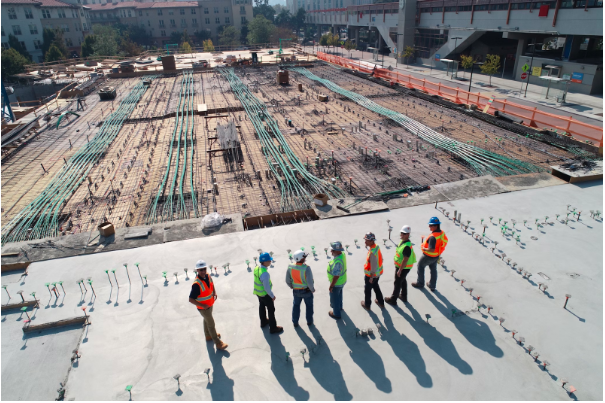
The future of construction management software (CMS) holds various exciting developments. It is likely to be driven by advancements in the fields of tech, AI, and cloud-based systems as companies embrace more digital tools. The evolution of CMS will not only meet the growing quality and efficiency needs of today’s fast-paced industry, but also move the sector in a more sustainable direction.
From AI-powered analytics and automation to remote collaboration supported by IoT integration, next-generation CMS tools will offer construction teams with levels of control and efficiency that were never seen before.







