
There are two ways to win a residential bid:
- Show them you’re great
- Show them you’re the greatest and the cheapest
Guess which one most contractors default to?
So instead of saying “No, costs have gone up and that’s just not possible”—you hear yourself say “No problem. We can go a little lower…”
You already know how this ends. But the motto is win the job, figure it out later. You’ll just trim the margin, make a few little adjustments here and there, it’ll be fine. Except those “little” adjustments aren’t so little. They show up everywhere. Longer days, tighter budgets, zero room for anything to slip (and something always does).
Most bids aren’t lost by a mile. They’re close. And instead of getting sharper, most contractors just get cheaper.
It works. But winning projects with razor-thin returns that could potentially cost you more than they’re worth? That’s not a business. That’s a very busy way to go broke.
Want to win more residential bids without slashing your profits?
Here’s the key: focus on choosing the right projects, accurate cost estimates, and clear communication to show clients your value beyond just price.
So many contractors lose money by underbidding. Instead of cutting margins, prioritize smarter bidding strategies.
What to do:
- Select Projects Wisely: Use tools like bid/no-bid reviews and track your bid-hit ratio to focus on jobs that align with your expertise and profit goals.
- Leverage Cost Estimation Tools: Software like Contractor Foreman ensures precise material and labor estimates, reducing errors and reflecting current market prices.
- Communicate Value Clearly: Professional proposals and client portals build trust, helping clients understand why quality and expertise matter more than the lowest price.
- Track Performance: Monitor bid-hit ratios, profit margins, and historical data to refine your strategy and improve profitability.
Winning the right projects at the right price is about working smarter, not cheaper. With the right tools and strategies, you can protect your margins while growing your business.
How to Choose the Right Projects to Bid On
Successful contractors, especially those maintaining profit margins between 5% and 10%, know better than to chase every lead that comes their way. Instead, they carefully evaluate whether a project aligns with their expertise, profit goals, and available resources before committing time to a proposal.
Start with a bid/no-bid review by thoroughly examining all project documents. This step ensures the scope matches your team’s capabilities. If the project demands skills your team doesn’t have, it’s better to pass. Next, consider whether the project can deliver a healthy margin. Account for both direct costs, like labor and materials, and indirect costs, such as insurance, rent, and marketing. Be sure to include your salary as part of the indirect costs instead of subtracting it from profits. Keep an eye out for warning signs like unclear site conditions, overly tight deadlines, incomplete bidding documents, or potential safety issues.
Another key metric to track is your bid-hit ratio – the number of bids you submit compared to the number of jobs you win. Break this data down by project type, client, and location. For example, if you’re winning 1 out of every 4 private residential projects but only 1 out of every 7 public jobs, it’s wise to shift more focus toward private opportunities where your chances of success are higher. Finally, leverage digital tools to streamline your project evaluation process.
Using Contractor Foreman to Evaluate Projects
Contractor Foreman simplifies project evaluation with its Leads Manager and Opportunities modules, which let you track potential projects in one centralized dashboard. Forget messy spreadsheets or scattered sticky notes – this tool organizes your entire pipeline efficiently. Its Real-time Costs Database provides up-to-date pricing for materials and equipment, helping you quickly assess whether a project is financially viable before diving into a full proposal.
The platform also uses historical bid data to help refine your strategy. By analyzing past wins and losses, you can pinpoint which project types consistently yield strong margins and which ones tend to drain your resources.
How to Filter Leads Efficiently
Once you’ve evaluated potential projects, use an construction financial management software to narrow down your list. After confirming project feasibility, focus on leads that align with your business goals and expertise.
In residential bidding, speed is important, but so is selectivity.
Contractor Foreman’s bid-management system helps you efficiently review project specifications against your core strengths. The software integrates with tools like Angi Leads, QuickBooks, and Zapier, allowing you to connect your marketing efforts directly to your project management system. This setup streamlines lead filtering without the hassle of switching between platforms.
Avoid bidding on every project that comes your way. Instead, prioritize opportunities where you can showcase your strengths, whether that’s specialized skills, exceptional quality, or a proven track record in a particular area of residential work.
“If your customers don’t care about anything but low price, you haven’t given them a good enough reason to.” – Chad Prinkey, CEO of Well Built Construction Consulting
Focus on leads where clients value expertise and quality over just the lowest bid. This strategy not only protects your margins but also increases your chances of winning projects that truly fit your business.
sbb-itb-5eea312
Creating Accurate Bids with Cost Estimation Tools
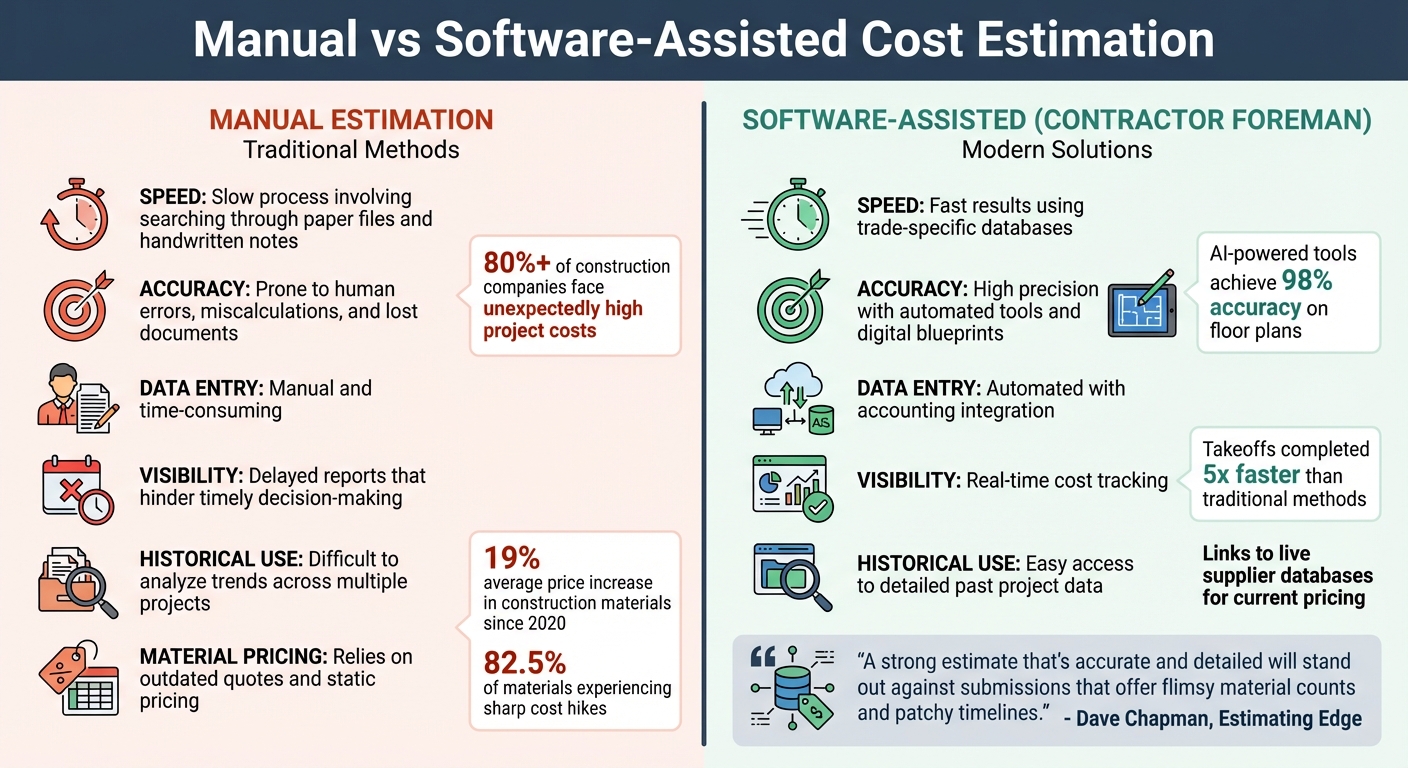
Manual vs Software-Assisted Cost Estimation for Contractors
Getting cost estimates right can make or break a bid. Over 80% of construction companies have faced unexpectedly high project costs, often because their estimates failed to reflect real-world conditions. If you underbid, you’re stuck either losing money or cutting corners. Overbid, and you risk losing the job to a competitor with better pricing.
This is where software-based estimation tools shine.
They take the guesswork out of manual processes. Digital takeoffs, for example, can measure blueprints with precision, producing accurate material lists without unnecessary overages. These tools also eliminate common manual errors like duplicate entries, miscalculations, or incomplete counts – mistakes that can cost thousands of dollars. AI-powered tools are even more efficient, achieving 98% accuracy on floor plans and completing takeoffs up to five times faster than traditional methods.
Since 2020, construction materials have seen an average price increase of 19%, with 82.5% of materials experiencing sharp cost hikes. Software that connects to live supplier databases ensures your estimates reflect these ongoing price changes automatically.
“A strong estimate that’s accurate and detailed will stand out against submissions that offer flimsy material counts and patchy timelines.”– Dave Chapman, Author, Estimating Edge
By adopting software, you can also reduce labor costs and speed up project timelines, making your bids more appealing without sacrificing profit margins. It’s all about combining speed with accuracy – something manual methods struggle to deliver consistently.
Using Contractor Foreman for Precise Cost Estimates
Contractor Foreman’s cost estimation features are designed to protect your profit margins while simplifying the process. Its customizable estimate templates save time by reducing manual entry errors. Instead of starting from scratch for every project, you can tweak professional, pre-built templates to fit new proposals in just minutes.
The Real-time Costs Database is another game-changer. It links your estimates to current market prices, ensuring you’re not relying on outdated quotes in a volatile market. Plus, features like bulk and line-item markup let you adjust pricing dynamically, so you can maintain your margins even when project requirements shift.
Labor costs are another critical factor, especially as 81% of U.S. construction firms have increased base pay and 26% have improved benefits packages. Contractor Foreman’s labor cost simulations let you account for these variables, exploring different workforce setups to find the most cost-effective options. The software also sends real-time notifications when a client opens an estimate, so you can follow up promptly while your proposal is still fresh in their mind.
Integration with tools like QuickBooks ensures your estimates align with actual costs, eliminating double data entry and providing a seamless flow between your financial tracking and bidding processes.
Why Historical Data Improves Bid Accuracy
Past project data is a goldmine for refining future bids. Contractor Foreman centralizes this information, allowing you to analyze cost breakdowns by category – labor, materials, and equipment. This turns completed projects into a valuable resource for improving future estimates.
For example, if historical data shows a consistent gap between estimated and actual labor needs, you can adjust your future bids accordingly. This continuous feedback loop helps you refine your processes and boost profitability.
If you rely on inaccurate numbers from your historical data, you are apt to make poor bidding decisions on subsequent projects.
Accurate data is essential. Contractor Foreman’s daily crew logs and synced invoices provide real-time visibility into costs as they happen, avoiding the delays and surprises common with manual reporting. You can also use custom fields to tag projects with attributes like square footage or finish quality, making it easy to pull comparable data for new bids.
This approach not only saves time but also highlights the advantages of using software over manual methods.
Manual Estimation vs. Software-Assisted Estimation
The gap between manual and software-assisted estimation isn’t just about speed – it’s about reliability and transparency throughout the bidding process.
| Feature | Manual Estimation | Software-Assisted (Contractor Foreman) |
|---|---|---|
| Speed | Slow; involves searching through paper files and notes | Fast; uses trade-specific databases for quick results |
| Accuracy | Prone to errors, miscalculations, and document loss | High precision with automated tools and digital blueprints |
| Data Entry | Manual and time-consuming | Automated, with accounting integration |
| Visibility | Delayed reports hinder timely action | Real-time tracking of costs |
| Historical Use | Hard to analyze trends across projects | Easy access to detailed past project data |
| Material Pricing | Relies on outdated quotes | Links to live supplier databases for current pricing |
Manual estimation involves sifting through physical files or outdated spreadsheets – a slow and error-prone process. In contrast, Contractor Foreman’s software provides instant access to searchable databases of past projects, enabling faster and more accurate bid creation.
This visibility is crucial. Delayed reporting in manual systems can lead to miscommunications and project setbacks, while software ensures all teams work from the same up-to-date information.
Contractors should “rely less on the traditional lowest bid” and instead use a broader strategy. – IIARD Journals
With software-assisted estimation, you can confidently submit bids that are both competitive and precise, avoiding the pitfalls of overbidding or underbidding. It’s a smarter, more reliable way to approach the bidding process.
Building Trust Through Better Client Communication
Winning bids isn’t just about offering the lowest price – it’s about showing your value and keeping your promises. Transparent, real-time communication plays a huge role here. When clients clearly understand what they’re paying for, they’re more likely to accept fair pricing that protects your business’s bottom line. Combine this with different types of construction estimates and a smart approach to bidding, and you’ll ensure your proposals reflect the true worth of your work.
Creating Professional Proposals with Contractor Foreman
First impressions matter, especially when homeowners are making big financial decisions. Contractor Foreman transforms outdated, paper-based proposals into sleek, professional digital ones that radiate expertise. These proposals are detailed, clear, and accurate, making it easier for clients to grasp the scope and value of your bid.
The software’s automated, customizable templates let you create polished proposals quickly. You can tailor each one to address a homeowner’s specific needs, showing that you genuinely understand their project. Including certifications, safety records, and risk management strategies in your proposals builds immediate trust and credibility.
By centralizing all project details and bid information in one digital platform, you and your clients stay on the same page. This minimizes miscommunications and strengthens trust. Once your professional proposal sets the tone, the Client Portal takes the relationship further by offering ongoing, real-time engagement.
Giving Clients Real-Time Access with Client Portals
Homeowners value transparency – especially when they’re making significant investments. The Client Portal gives them real-time access to critical project details, from costs and schedules to progress updates and photo-documented issues. This eliminates the need for constant back-and-forth communication. Breaking down lump-sum costs like labor, materials, and equipment into clear categories helps clients see exactly where their money is going.
Providing this kind of access fosters stronger relationships. Clients are more likely to choose contractors they trust, and nothing builds trust like consistent communication and attention to detail.
Focusing on Value Instead of Price
While advanced proposals and client portals are essential, focusing solely on price can lead to trouble. Competing on price alone often results in razor-thin margins and quality concerns. Instead, emphasize your expertise and the quality of your work in every interaction. Extremely low bids can make clients question the scope or reliability of your services. Shifting the focus to value positions you as a dependable, high-quality choice.
Offering flexible pricing options allows you to meet various client needs while protecting your margins. For example, presenting service tiers or material options empowers clients to choose what works best for their budget. Using structured checklists to detail costs – whether for skilled labor, premium materials, or insurance – shows clients the full value of what you’re offering.
It’s worth noting that 83% of construction companies have identified better material and equipment cost estimation as a key priority for managing market fluctuations and improving performance. By demonstrating this level of precision and professionalism in your client communications, you’ll stand out from competitors still relying on outdated practices. This approach not only helps you secure the right bids but also ensures your margins remain intact.
Tracking Bid Performance and Improving Your Approach
Winning bids consistently isn’t just about crafting competitive proposals – it’s about learning from each one. Interestingly, over 80% of construction companies report higher-than-expected construction costs. This highlights how easy it is to miscalculate or miss opportunities to improve the bidding process without proper tracking. The secret lies in monitoring job outcomes and using that information to refine your strategy. This kind of data-driven method is where detailed reporting tools become indispensable.
Using Contractor Foreman’s Reporting Tools
Contractor Foreman’s financial dashboard gives you a clear snapshot of where your estimates align – or don’t – with actual costs. It lets you track real-time differences across labor, materials, and equipment, helping you spot overruns before they spiral out of control. For example, if labor costs are repeatedly higher than anticipated, you can tweak future bids to reflect reality.
The platform’s GPS timecards are a game-changer for tracking labor hours. They remove the guesswork of manual tracking by capturing precise data for each task and job. Considering that only 18% of businesses regularly access project data, tools like this can make a huge difference. You can also pull historical data to analyze cost breakdowns and establish more realistic production rates.
Contractor Foreman’s Kanban views and filters make it easy to monitor the status of bids and pinpoint which project types deliver the best bid-hit ratio. A solid benchmark is about 5:1, meaning you win one out of every five bids. Recognizing these patterns helps you focus on the opportunities most likely to succeed. With real-time insights like these, you can refine your bidding strategy continuously.
Driving Continuous Improvement
To win more bids without sacrificing margins, you need to constantly fine-tune your approach. Regularly comparing final costs with estimates helps identify errors or unexpected price changes. Contractor Foreman’s cost items database, which integrates with live pricing updates, ensures your bids reflect current market conditions rather than outdated figures.
The estimate tracking feature also provides valuable insights, like when clients open your proposals. This allows you to time follow-ups more effectively, boosting your chances of closing the deal. Whether you win or lose a bid, always seek feedback. Understanding why a homeowner made their decision can help you refine everything from pricing to presentation. While 43% of construction firms focus on short-term financial goals over long-term stability, incorporating feedback loops into your process can give you a competitive edge.
By tracking key metrics, you can refine your bidding process and improve profitability while protecting margins. Here are a few metrics to prioritize:
| Metric to Track | Purpose | Data Source in Contractor Foreman |
|---|---|---|
| Bid-Hit Ratio | Identify which project types convert most often and guide strategic focus | Bid logs and project reports |
| Production Rate | Measure actual labor speed (e.g., SF/hr) | GPS timecards and time tracking |
| Profit Margin Variance | Highlight gaps between estimated and actual profit | Financial dashboard and P&L reports |
| Subcontractor Performance | Prequalify dependable partners for future bids | Project close-out reports and vendor tracking |
Managing subcontractors effectively is another critical piece. Use past performance data to prequalify reliable partners, ensuring your bids are based on accurate pricing and quality work. This approach minimizes the risk of low-ball quotes from subcontractors after you’ve submitted a proposal, helping you avoid unexpected costs and maintain client trust.
Conclusion
Securing residential bids without cutting into your margins is all about working smarter – not just lowering your prices. The strategies outlined here emphasize the importance of selecting the right projects, creating precise estimates, showcasing your value to clients, and continually tracking your performance. These steps can help you stand out from competitors who rely solely on underbidding.
Tools like Contractor Foreman bring these strategies together into one streamlined platform. Whether it’s identifying projects that align with your strengths or producing polished proposals that instill trust, the software eliminates guesswork and reduces manual errors. With features like real-time cost databases, historical bid data, and financial dashboards, your estimates will reflect current market trends while safeguarding your profits. Considering that 83% of construction companies are prioritizing better material and equipment cost estimation to navigate market volatility, having reliable tools isn’t just helpful – it’s essential.
Shifting from price-focused to value-focused bidding is the key to thriving in this competitive space. By emphasizing your team’s expertise, safety record, and quality of service through transparent, customized proposals, you give clients a compelling reason to choose you.
As Chad Prinkey, CEO of Well Built Construction Consulting, aptly says:
“If your customers don’t care about anything but low price, you haven’t given them a good enough reason to.”
Centralizing bid management, automating follow-ups, and leveraging data to refine your process allows you to respond faster and with greater accuracy than traditional manual methods. Tools like Contractor Foreman’s client portals and professional proposal features make it simple to showcase transparency and professionalism at every stage of the bidding process.
Ultimately, data-driven decisions, better client communication, and a focus on delivering value are the keys to winning more residential bids while protecting your profit margins. With plans starting at $49 per month, Contractor Foreman equips you to compete based on quality and expertise, not just price.
FAQs
What should I include in overhead so I don’t underbid?
To make sure you don’t underbid, it’s crucial to include all overhead costs in your bid. This means factoring in both job-specific overhead – like supervision, temporary facilities, site services, and equipment – and general company overhead, such as office rent, administrative salaries, insurance, and marketing expenses.
Start by clearly identifying your fixed and variable overhead costs. Then, distribute these costs across your projects. By doing this, you’ll ensure all expenses are covered, helping you maintain healthy profit margins.
What’s a good bid-hit ratio for residential work?
A solid bid-hit ratio in residential work often points to a higher win rate, though there’s no single “perfect” percentage. Generally, a lower ratio is preferable – it suggests you’re targeting projects where you have a stronger chance of success. Monitoring this ratio allows you to pinpoint the types of projects where your bids tend to be the most competitive and effective.
How can I prove my value without lowering my price?
You can show why your services are worth the investment without slashing prices by emphasizing what sets you apart. Highlight the unique benefits and high-quality results you deliver. Build trust by fostering strong client relationships and demonstrating your expertise. Share what makes your approach stand out – whether it’s efficiency, reliability, or specialized skills.
At the same time, make sure your pricing reflects a clear understanding of your overhead costs and desired profit margins. Communicate the value you bring to the table in a way that resonates with your clients. When they see the results and reliability you offer, they’ll understand why your rates are worth it – even in a competitive market.







