
Nothing says “great day” like OSHA showing up on-site the same week your sub’s safety cert expired.
Just when you thought you could finally exhale after a week spent white-knuckling every deadline.
Except you can’t just shrug this one off or delay it for another day — this one can actually get you in trouble.
Here’s the part a lot of GCs learn the hard way: under OSHA’s multi-employer policy, you can get cited for a violation that’s committed by your sub—that’s right, a violation that isn’t even yours!
If your sub let a cert lapse, forgot to log a training session, sat on an expired insurance doc — it’s your name on the citation (and your business and reputation on the line). Again: Not theirs. YOURS.
So now you’re on the phone, asking your sub how in the world this happened, because you trusted them to do their job right.
Look, they’re not criminals. They’re probably competent, reliable people — but the thing is, most of the time compliance always seems like a “small thing,” which makes it so easy to ignore or do later.
Here are Reasons Subcontractor Safety Compliance Breaks Down:
- Safety rules are communicated but not documented or confirmed
- Hazard updates fail to reach the full crew
- Certifications and records expire or are scattered across multiple systems
- Follow-up responsibility is not clearly assigned
The solution is simple in theory: one shared process for records, alerts, and hazard updates across every live project.
But the implementation? Well, that’s the hard part. It requires constant manual tracking, cross-checking expiration dates, and chasing down confirmations — unless you use an AI-powered tool like Contractor Foreman to handle it automatically.
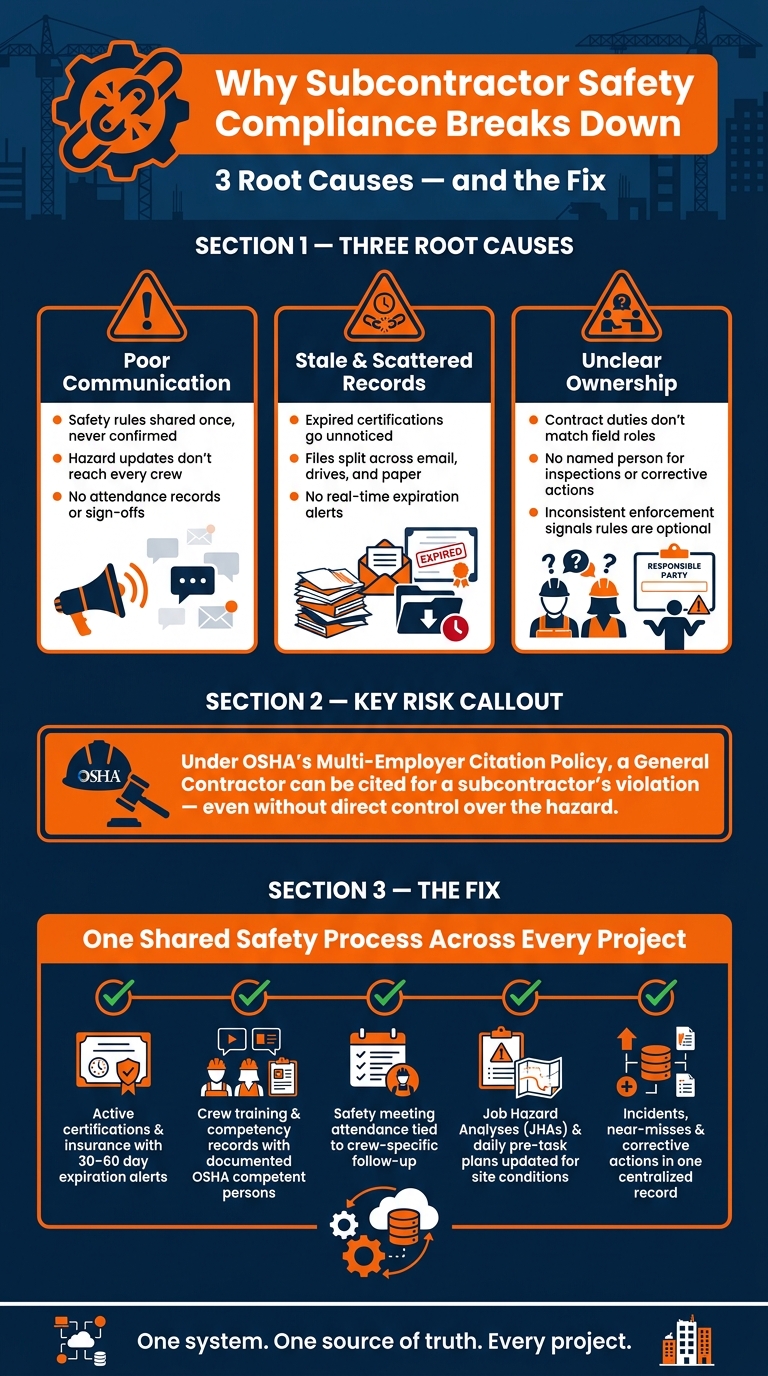
Why Subcontractor Safety Compliance Breaks Down (And How to Fix It)
How Communication Breakdowns Create the First Compliance Gaps
Safety information doesn’t stick after a single announcement. Crews change, conditions shift, and whatever was said at the kickoff meeting fades fast — especially the details that matter most. Nothing catches that drift unless someone repeats the message, checks that it landed, and puts it in writing.
On a busy site, that’s the whole gap: one missed update, one thing nobody wrote down, and a small oversight turns into an incident.
Repetition and documentation aren’t “annoying” extra steps — they’re what makes the safety message durable. Say it once and it’s gone. Say it, repeat it, record it, and it holds.
Safety Rules Are Shared but Never Confirmed or Documented
A crew hears the site rules on day one, but if no one follows up, there’s no clear way to tell whether every worker understood those rules in the same way.
One person may hear “always wear fall protection.” Another may think it only applies near the roof edge, not on the scaffold in between. A third might assume it’s only required above a certain height, and skip it on a lower platform because “it’s not that far down.” None of them heard a different rule — they heard the same one and walked away with a different version of it.
The same thing happens with lockout/tagout, hot work permits, or PPE requirements. “Wear a respirator in the work area” can mean the whole building to one worker and just the room with active dust to another. Without a follow-up — a toolbox talk, a posted sign, a supervisor checking in — there’s no way to catch that gap until someone acts on the wrong version of the rule.
That kind of mismatch creates trouble fast. Without attendance sheets, sign-offs, or even a short comprehension check, a toolbox talk doesn’t carry compliance weight.
And once a rule is shared but not verified, the next problem is obvious: proving it was ever followed.
It may have happened, but if there’s no record to show who was there, it’s useless.
Hazard Updates Do Not Reach Every Subcontractor Crew
When updates travel by text message or word of mouth, they don’t reliably reach the foreman or crew lead when it matters. A message sits in a side thread, gets relayed late, or gets lost somewhere between the office and the field.
That’s not a minor gap. It means the crew that needs to act on an update may never receive it at all.
And once hazard updates stop reliably reaching the field, the problem stops being just about communication. It becomes a proof problem: even if the update was sent, there’s no record that it arrived, was read, or was understood.
sbb-itb-5eea312
Expired Files and Scattered Records Make Compliance Hard to Prove
When a hazard update doesn’t reach the field, the paper trail usually falls apart right after it. Records slip behind, details get missed, and the result is a documentation gap that often comes to light during an inspection or after an incident.
Common File Problems: Expired Certifications, Outdated Plans, and Missing Logs
The most common record gaps aren’t dramatic. They’re small misses that sit in the background until there’s a problem.
A foreman’s “competent person” certification for scaffold erection expires.
A site-specific safety plan created at project kickoff never gets revised after an incident.
Safety Data Sheets for new materials never make it into the log.
Daily inspection reports stop getting completed.
On their own, each one may seem minor. In practice, each one adds audit risk and field risk.
Under OSHA’s multi-employer citation policy, a general contractor can be cited for a subcontractor’s violation even without direct control over the hazard. That’s why documented monitoring matters so much for the GC. If the records aren’t there, there’s no clear proof of due diligence.
Compliance also has to be tracked at the worker level, not just the company level. One expired credential that never entered the tracking system can sit unnoticed until a routine audit surfaces it in the middle of a project.
Once records go stale, proving compliance gets a lot harder.
Why Paper Forms, Email Chains, and Shared Drives Fail in the Field
The issue isn’t only that documents go missing. It’s that teams can’t pull the right record fast when they need it.
Missing records usually don’t show up until an audit or an incident forces the search. If documents are spread across email inboxes, renamed folders on a shared drive, paper sign-in sheets sitting in a truck, and a spreadsheet that gets updated by hand every few weeks, there’s no single source to trust. A safety manager who needs a list of everyone who completed LOTO training in the last 12 months may have to dig through four different places and still end up with an incomplete answer.
A lapsed document can mark a subcontractor as non-compliant before the PM even sees the issue.
OSHA doesn’t only require that training took place. It requires that records be immediately available. When the system is scattered, that’s hard to guarantee.
Centralized digital records give teams instant access, clear ownership, and real-time expiration alerts. The difference is simple: records either live in one system, or they’re spread across a dozen disconnected sources.
Unclear Roles and Weak Oversight Let Problems Continue
Even perfect records fall apart if no one owns the follow-up.
On a busy jobsite, with several trades moving at the same time, compliance starts to slip when roles aren’t assigned to specific people. The risk gets worse when no one is clearly responsible for fixing what paperwork or field checks uncover.
When Contract Language and Field Responsibilities Do Not Match
OSHA’s Multi-Employer Citation Policy makes the GC the controlling employer. That means the GC can be cited for a subcontractor’s violation even if the GC didn’t create the hazard.
But here’s the problem: liability on paper is not the same as day-to-day accountability in the field.
Contracts may say subcontractors must comply with OSHA standards, keep certifications current, and follow the site safety plan. What those contracts often don’t spell out is who collects the documents, who handles inspections, who can stop unsafe work, and who signs off when a corrective action is finished.
When PM, superintendent, and foreman duties blur together, ownership gets muddy. And when ownership gets muddy, documents, inspections, corrective actions, and stop-work authority can all end up in limbo.
Once responsibility is unclear, the next thing to break is field enforcement.
Inconsistent Enforcement Signals That Safety Rules Are Optional
Inconsistent enforcement teaches crews that safety rules are up for debate.
If one superintendent enforces PPE, permits, and inspections, while another lets the same issues slide, crews will usually follow the weaker standard. That’s human nature. People pay attention to what gets enforced, not just what gets written down.
A clearer setup helps cut through that fog:
- Assign by name who runs inspections
- Assign by name who issues corrective action notices
- Assign by name who has authority to pull a crew off a task
That removes the gray area that lets problems hang around.
Joint weekly safety walks between the GC superintendent and subcontractor foremen are one of the most direct ways to build shared accountability into the routine.
The next issue is whether one shared system tracks ownership and follow-up across every project. The fix is a single process that assigns ownership, tracks corrective actions, and shows what is still open across every project.
How One Shared System Helps Prevent Repeat Breakdowns
When records, roles, and updates are scattered, the same compliance problems show up again and again. A shared system helps shut that cycle down.
What a Shared Safety Process Should Track Across Every Project
A shared safety process needs to do more than store certificates.
At a minimum, it should track:
- Active certifications and insurance, with 30- to 60-day expiration alerts
- Crew training and competency records, including a documented OSHA “competent person” for each crew
- Safety meeting attendance tied to crew-specific follow-up, so you can see who got each briefing and when
- Job Hazard Analyses (JHAs) and daily pre-task plans, updated for current site conditions like weather or overlapping trades
- Incidents, near-misses, and corrective actions, kept in one place so office and field teams work from the same record
Tracking near-misses matters because they often point to hazards before someone gets hurt.
The goal is simple: one live process that gives the office and the field the same record.
Using Contractor Foreman to Centralize Safety Records and Field Follow-Up
A single platform can keep records, alerts, and field follow-up in one place across every project. Contractor Foreman keeps expiration alerts active so certifications and insurance don’t lapse without anyone noticing.
Daily Logs store field notes, photos, and links to incident reports, which helps office and field teams stay on the same page. The Safety Meetings module records crew attendance right from a mobile device. And for corrective-action follow-up, the Incidents module generates OSHA 300 logs automatically and ties incident records to employee write-ups, giving teams a clear paper trail for documentation.
Used together, these tools help keep four things in place on every project: current records, hazard updates reaching the field, assigned follow-up, and proof of completion.
FAQs
What is the biggest cause of subcontractor safety compliance failures?
The biggest issue is inconsistency in how crews learn, hear about, and follow safety rules from one job site to the next. When training levels vary and onboarding is scattered, standard practices start to slip.
It gets worse when expired documents aren’t renewed on time and teams rely on manual, spread-out tracking. That’s where Contractor Foreman helps. It puts records in one place, automates compliance tracking, and helps teams keep safety protocols consistent across projects.
How can a GC prove due diligence for subcontractor safety?
A GC shows due diligence with a documented compliance program – not loose, informal processes. That means prequalification and checking subcontractors’ safety records, insurance, and certifications before they’re allowed on-site.
It also means having clear proof of day-to-day oversight: regular inspections, documented toolbox talks, safety orientations, and organized records with alerts, reports, and audit trails. Contractor Foreman helps keep all of that in one place and easy to track.
What should a shared safety system include?
A shared safety system should keep project data in one place. That means no more hunting through scattered spreadsheets or digging through long email threads to find the latest version of a file.
It should track certifications, training records, incident documents, and standard forms for incidents and corrective actions. Put simply, the system should give your team one clear record everyone can use.
It also needs built-in alerts, role-based access, and analytics to help teams spot safety patterns before small issues turn into bigger ones. Contractor Foreman pulls these functions into one platform, along with document management and safety meeting tracking.







