
There are literally a MILLION AND ONE things that could go wrong in residential construction projects.
By addressing five key issues – planning, budgeting, communication, risk management, and quality control checklists – Jim and contractors like yourself can keep projects on track and avoid costly setbacks.
And these issues can easily be managed using contruction tools like Contractor Foreman . For just $49/month, it offers real-time scheduling, financial tracking, and centralized communication to help you manage these challenges effectively.
In this article, we’ll break down the common pitfalls and provides actionable solutions to ensure your projects finish on time and within budget.
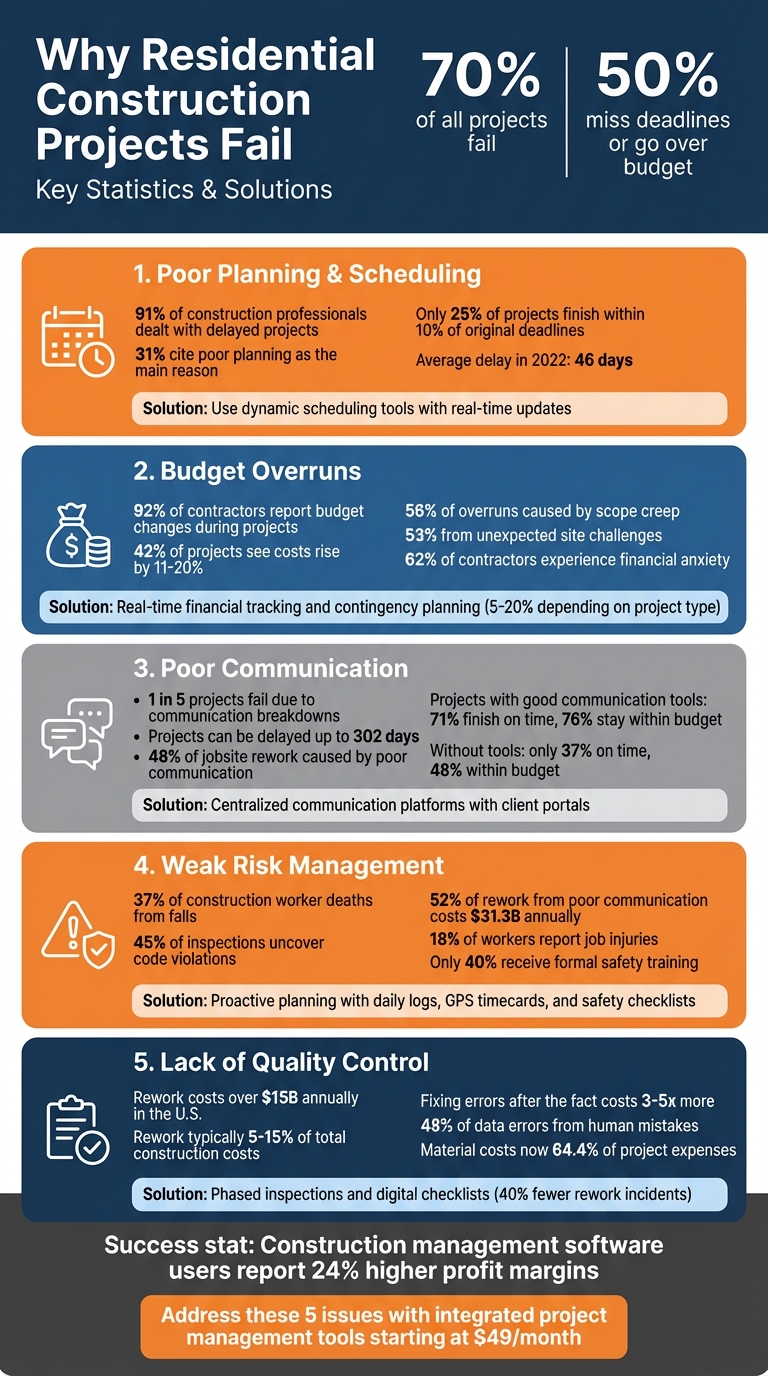
5 Reasons Residential Construction Projects Fail: Key Statistics and Solutions
Reason 1: Poor Planning and Scheduling
Poor planning is at the heart of most construction delays.
A staggering 91% of construction professionals have dealt with delayed projects, and 31% point directly to poor planning and unrealistic schedules as the main reason. The issue often starts with overly optimistic timelines that ignore real-world data and project dependencies.
For example, contractors may schedule crews to install drywall before the electrical work is done, leading to idle workers and increased costs. Permitting is another common oversight – processing permits can take 2–4 weeks for additions and up to 6–12 weeks for custom homes, yet these delays are often left out of plans. Weather disruptions, which account for 3% to 5% of total project duration, are also rarely factored in.
The fallout is significant. Only 25% of construction projects are completed within 10% of their original deadlines. In 2022, the average delay for construction jobs exceeded 46 days. Missed material lead times add to the chaos, with installers arriving on-site only to find that critical items – like windows or specialty tiles – haven’t been delivered. Static schedules that fail to adapt to evolving on-site conditions further compound these issues.
Solution: Use Better Scheduling Tools
Fixing these planning gaps starts with adopting modern scheduling tools.
These tools transform static plans into dynamic, real-time schedules that adjust instantly as changes occur.
For instance, if an inspection fails or bad weather delays exterior work, digital platforms automatically update timelines to reflect how the delay impacts subsequent tasks. With mobile access, field teams can report progress directly from the job site, keeping everyone aligned.
Contractor Foreman supports unlimited projects and offers mobile access on all devices.
Its Gantt chart feature highlights task dependencies, making it easy to identify which activities are critical to meeting deadlines. When you issue construction change orders, the system recalculates the schedule and keeps an audit trail, providing protection during disputes. With subscription plans starting at $49 per month, tools like this help ensure schedules are based on reality, not wishful thinking.
sbb-itb-5eea312
Reason 2: Budget Overruns and Financial Mismanagement
Budget issues are a major reason residential projects go off track.
In fact, 92% of contractor professionals report noticeable budget changes during projects, while 42% of U.S. construction projects see costs rise by 11–20% beyond initial estimates. These financial disruptions don’t just hurt the bottom line – they can force contractors to dip into personal savings, delay payroll, or even shut down operations altogether.
The causes behind these overruns are well-documented.
Client changes and scope creep account for 56% of budget issues, often starting with undocumented verbal agreements. Then there are unexpected site challenges – like finding water damage or hidden structural problems after demolition begins – which contribute to 53% of overruns. Lastly, design errors or omissions lead to 45% of these budget increases, especially when vague architectural plans create conflicts after materials are already ordered. These financial setbacks don’t just hurt profitability – they also throw project timelines into chaos.
Another key issue is financial mismanagement. Many contractors rely on bank balances instead of real project data to make decisions. This approach often misses small overages that, over time, can eat away at profits. It’s no surprise that 62% of contractors experience moderate to severe financial anxiety, even when their businesses appear profitable.
Cash flow management is another common struggle. Contractors who wait until the end of the month to invoice often cover project costs out of pocket. With billing cycles stretching beyond 50 days, this creates unsustainable gaps between paying subcontractors and receiving client payments. Combine that with unpredictable material prices, and projects that seemed profitable at the bid stage can quickly operate at a loss.
Finally, many contractors fail to plan for unexpected costs. Setting aside a contingency fund – 5–10% for new builds, 10–15% for renovations, and 15–20% for historic renovations – can help absorb surprises without jeopardizing profitability. Addressing these financial challenges requires a proactive approach and real-time tracking.
Solution: Track Finances in Real-Time and Manage Budgets
To avoid budget pitfalls, contractors need a system that tracks spending as it happens. Real-time financial tracking gives daily insights into material costs, labor hours, and subcontractor expenses. For example, if a framing crew works an extra day or a supplier invoice is higher than expected, the system flags these changes immediately, allowing for quick adjustments.
The secret lies in linking estimates directly to actual spending. A construction management platform turns your bid into a live budget benchmark. As field teams log hours or record material deliveries, the system continuously compares planned versus actual costs. If a specific phase is trending 15% over budget midweek, you can investigate and address the issue before it escalates. One commercial firm, for instance, reduced preventable overruns by 12% in just two quarters – saving $750,000 across three hospital projects.
Change orders also become easier to manage. Every change is logged digitally, along with its cost and timeline impact. Digital approvals ensure that budgets and schedules are updated automatically, avoiding reliance on verbal agreements that often delay payments.
Integrating with accounting tools like QuickBooks closes the gap between field operations and financial records. When crews mark tasks as complete on mobile devices, the data flows directly into invoicing – no manual entry required. Material purchases sync automatically, reducing errors caused by long days on-site.
Automated alerts act as an early warning system. For example, if any cost category hits 80% of its budget, the platform notifies the project manager immediately. This helps prevent unnoticed overruns until it’s too late. GPS-enabled time tracking can also verify labor costs, eliminating losses from time theft or buddy punching, which can cost a 100-person crew up to $62,400 annually.
Contractor Foreman offers comprehensive financial tracking features across all subscription plans, starting at $49 per month. The platform supports unlimited projects and syncs with QuickBooks, keeping field data and accounting records aligned. Whether you’re managing a single renovation or twenty custom builds, the system tracks costs by specific codes, helping you pinpoint problem areas before they spiral out of control.
Contractor Foreman Pricing Plans Comparison
| Plan Name | Price (Annually) | Users Included | Financial Tracking Features |
|---|---|---|---|
| Basic | $49/month | 1 | Included |
| Standard | $79/month | 3 | Included |
| Plus | $125/month | 8 | Included |
| Pro | $166/month | 15 | Included |
| Unlimited | $249/month | Unlimited | Included |
All plans provide real-time cost tracking, change order management, QuickBooks integration, and mobile access. The only difference lies in the number of team members included per plan.
Reason 3: Poor Communication and Coordination
Good communication is the backbone of any successful project, especially in construction.
Yet, one in five construction projects fails due to communication breakdowns, making it a major stumbling block for the industry. The fallout from poor communication extends far beyond missed deadlines – it can delay residential projects by up to 302 days and contributes to over 48% of all jobsite rework.
The root of the issue often lies in scattered communication channels. When teams rely on multiple tools or informal updates, critical information gets lost. This leads to “information silos”, where, for instance, the framing crew might be using outdated plans while the office has already approved changes. The disconnect between jobsite crews and office staff can be particularly damaging. Without quick and clear communication, records disappear, schedules slip, and frustrations escalate.
Vague instructions add to the chaos. Imagine a scenario where a crew installs the wrong tile because no one clarified which bathroom it was meant for. This type of miscommunication leads to expensive rework. On the client side, problems like overpromising deadlines, using overly technical language, or failing to provide regular updates can erode trust. This often results in a flood of phone calls and additional site visits, wasting time and resources.
The consequences aren’t just financial – they’re human, too. In workplaces where employees feel hesitant to speak up, safety hazards and mistakes often go unreported until they escalate into serious problems. However, companies that encouraged open communication saw a 32% rise in near-miss reporting, which helped prevent injuries. With 2.3 out of every 100 full-time construction workers injured in 2023 – many due to miscommunications – the need for improvement is urgent.
Solution: Improve Communication with Digital Tools
Centralizing communication on a single platform is a game-changer. Instead of juggling different apps and losing track of updates, a construction management system keeps everything – updates, change orders, and documents – in one searchable location. This ensures that field teams and office staff are always working from the same, real-time information, reducing errors caused by outdated plans.
Client portals are another powerful tool.
These portals let homeowners access schedules, progress photos, and financial updates whenever they want, eliminating the need for constant calls while building trust. Tools like daily logs with standardized templates offer clear updates, such as “cabinets installed in master bathroom”, that both clients and managers can review anytime. The results speak for themselves: projects using effective communication tools are far more likely to succeed, with 71% finishing on time and 76% staying within budget, compared to just 37% and 48% for those without such systems.
Mobile access takes communication to the next level. Field teams can instantly receive instructions, upload photos, and flag issues right from their phones, preventing small problems from spiraling into major setbacks.
One platform that delivers all these features is Contractor Foreman, starting at $49 per month. It offers client portals for transparency, daily logs for tracking progress, and team chat organized by job or task. Everything syncs across web and mobile devices, ensuring everyone – whether in the field or the office – has access to the most up-to-date information. Its document management system, complete with version control, ensures that subcontractors and project managers are always working with the correct plans and specifications. By leveraging tools like these, construction teams can tackle communication challenges head-on, aligning with broader strategies to keep projects on track and within budget.
Reason 4: Weak Risk Management
Adding to challenges like poor planning, budget overruns, and miscommunication, weak risk management can seriously threaten the success of residential construction projects.
Risk management isn’t just a box to check – it’s a critical tool for preventing issues before they escalate. Unfortunately, many projects treat it as an afterthought, leading to avoidable problems. For example, falls account for 37% of all construction worker deaths, and 45% of residential field inspections uncover code violations. These aren’t freak accidents – they’re predictable outcomes of neglecting known risks.
The financial consequences are equally severe. Poor communication – a major risk factor – is responsible for 52% of all construction rework, costing the industry a staggering $31.3 billion annually. On top of that, 18% of construction workers report job-related injuries, yet only 40% receive formal safety training. This disconnect between risk and preparedness leaves workers exposed and projects vulnerable.
Legal and compliance mishaps add another layer of complexity. HOA violations, missing permits, and noise complaints can bring work to a standstill. Without proper documentation, verbal agreements can spiral into costly legal disputes over unapproved changes. Weather delays, which impact 45% of the global construction industry, often derail projects without contingency plans in place. The result? 70% of construction projects miss deadlines, and 60% end up over budget.
“Project management is risk management and risk management is project management.” – Construction Management Association of America
Unchecked risks drain profits, delay completion, and erode trust, often leading to outright project failure.
Solution: Prevent Risks Before They Happen
The key to effective risk management is proactive planning.
Don’t wait for problems to arise – use tools like daily logs to document every site interaction, inspector warning, and verbal change order in real time. This creates a solid audit trail, protecting you in disputes and ensuring nothing gets overlooked. Regular “toolbox talks” and safety briefings can also close the training gap. Instead of one-sided lectures, encourage crews to identify hazards and share concerns, fostering a workplace culture where speaking up is the norm.
GPS-driven timecards with geofencing are another game-changer. They ensure workers are physically on-site before clocking in, reducing time theft and providing accurate, time-stamped records of attendance.
Centralizing documentation is critical for compliance. Use a client portal to log every scope change or homeowner request, avoiding disputes and maintaining clear records of risk-related decisions. Digital checklists for safety and quality inspections help catch issues early, preventing expensive rework near project closeout. These tools also keep permits, inspection records, and change orders organized in one searchable location.
Platforms like Contractor Foreman offer tailored solutions for these challenges, starting at $49 per month.
Its GPS-driven timecards ensure accountability, while features like safety meeting logs and incident reporting help maintain compliance and reduce liability. The platform’s document management system provides the audit trail you need to defend against code violations or payment disputes. By embedding safety and risk management into daily routines, contractors can transition from reactive problem-solving to proactive prevention – ultimately protecting their crews, their budgets, and the success of their projects.
Reason 5: Lack of Quality Control
Even with solid planning, clear communication, and effective risk management, a residential construction project can still falter if quality control is neglected.
Poor quality control often arises from using subpar materials, skipping essential inspections, or leaving gaps in oversight. These issues aren’t just inconvenient – they’re costly. In fact, rework in construction leads to over $15 billion in direct costs annually in the U.S., typically making up 5% to 15% of total construction costs. And here’s the kicker: fixing errors after the fact costs three to five times more than addressing them correctly the first time.
Material costs are another growing challenge. They now make up 64.4% of project expenses, with 82.5% of contractors reporting price increases of around 19% since 2020. When contractors try to save money by cutting corners on materials or when improper storage damages supplies, the project’s quality takes a hit. Oversight is another weak spot. Relying solely on final “punch list” reviews or skipping regular spot checks can lead to small mistakes snowballing into major setbacks.
“Quality control in construction isn’t a cost; it’s a profit strategy.” – Sean Robinson, Senior Content Marketing Specialist, Buildertrend
Systemic issues also play a big role. Nearly 48% of construction data errors come from simple human mistakes – 24% from typos and another 24% from omissions in spreadsheets. Without standardized quality procedures or clear communication between quality managers and superintendents, these errors are almost inevitable.
Solution: Improve Quality Assurance Practices
The good news? These pitfalls can be avoided with better quality assurance practices. Start by introducing phased inspections at critical milestones.
For instance, verify rebar spacing before pouring concrete or check mechanical, electrical, and plumbing (MEP) installations before sealing walls. Companies that use digital tools to prioritize quality control report up to 40% fewer rework incidents. The key is shifting the mindset from “we’ll fix it later” to achieving first-time accuracy.
Standardized documentation is another game-changer. Digital checklists and daily logs ensure consistency across jobsites and create a time-stamped record of activities, weather conditions, and inspections. This digital trail not only helps trace the root cause of issues but also provides legal protection if disputes arise. Inspecting materials immediately upon delivery is equally critical – don’t wait until installation to discover they don’t meet specifications.
Effective supervision ties it all together. Train subcontractors on quality expectations from day one, using digital checklists to clarify “pass/fail” criteria for each task. First-article inspections – where the first installed item, like a window or tile, is reviewed as a benchmark – can set the standard for the rest of the work. You can even align payment terms with quality by requiring installations to be approved before payment is released.
Tools like Contractor Foreman can simplify these processes, starting at just $49 per month. Its document management system centralizes everything – files, photos, and checklists – so field and office teams stay aligned. Customizable fields allow inspections to be tailored to specific project needs, while the client portal keeps everyone on the same page by sharing permit approvals and documenting any homeowner requests that could conflict with regulations. Daily logs also serve as verifiable records, which can be invaluable during disputes. By embedding strong quality control practices, you not only protect your budget and schedule but also safeguard your reputation.
Conclusion: How to Succeed in Residential Construction Projects
Making residential construction projects successful is entirely possible, even though the odds can seem daunting. Consider this: 70% of all projects fail, and 50% of projects globally miss deadlines or go over budget. The key to overcoming these hurdles lies in tackling five common issues: poor planning, budget overruns, communication gaps, weak risk management, and insufficient quality control.
The answer isn’t about simply working harder or hiring more people.
It’s about using construction management software for home builders that prevents small problems from turning into major setbacks. Tools like Contractor Foreman are designed to address these pain points in one platform, offering practical solutions at a reasonable cost. For instance, you can track costs in real time to avoid budget overruns that might otherwise push large projects 80% over budget. Or use centralized messaging to eliminate delays, which can stack up to 302 extra days. Digital checklists can also streamline quality control, ensuring fewer mistakes and smoother progress.
When you address these challenges with the right tools, the benefits are clear. Construction management software users report 24% higher profit margins. By creating a centralized hub for field updates, schedules, and financial data, you gain precise control over every aspect of the project. Features like daily logs submitted from mobile devices and milestone-based quality inspections keep everything on track, helping you deliver projects on time and within budget.
FAQs
What should a realistic residential construction schedule include?
A practical residential construction schedule should clearly outline every phase, from the initial planning stages to the final inspection.
It needs to account for critical factors like labor availability, material lead times, site conditions, and permitting timelines. By following a structured, repeatable process, you can minimize delays and disruptions. It’s also important to include contingency plans for unexpected challenges, such as bad weather or supply chain hiccups. A well-organized schedule not only keeps tasks on track but also helps ensure the project stays within budget.
How do I stop scope creep from blowing up my budget?
To keep scope creep from throwing your budget off course, make sure every change is documented in writing and gets client approval before any work begins.
Use precise pricing rather than rough estimates, and clearly outline the project scope from the start to prevent confusion. Digital tools can be a game-changer here, offering better ways to document and communicate. This added clarity and accountability can help you stick to the plan and steer clear of unexpected expenses.
What’s the easiest way to keep homeowners and subs aligned?
The simplest way to keep homeowners and subcontractors on the same page is by using a centralized communication platform.
This ensures that all updates and messages are stored in one place, making it easier for everyone to stay organized. Setting clear expectations, creating a structured communication plan, and providing regular feedback are also key to fostering transparency and trust. Incorporating tools like visual aids and scheduling consistent meetings can help avoid miscommunication and keep the project running smoothly.







