
- Why Safety Protocols Are Being Ignored (and What It’s Costing You)
- The Communication-First Safety Culture Model
- What a Strong Safety Culture Actually Looks Like
- What Happens When Workers Feel Heard
- Common Pitfalls That Undermine Safety Culture (And How To Avoid Them)
- Safety Culture Isn’t a Slogan — It’s a System
On a busy jobsite last summer, a senior crew member stood quietly at the back of the morning safety meeting. The foreman reviewed the usual checklist, emphasized fall protection, and passed around the sign-in sheet. He nodded along but didn’t engage. A few days earlier, he’d flagged a broken ladder, and nothing came of it.
As is the case with many seasoned workers in the industry, this crew member did what experience had taught him: he stopped speaking up.
This kind of silence isn’t rare. It’s the byproduct of a deeper issue: when workers don’t feel heard, safety becomes a formality rather than a shared priority. And when that happens, protocols erode. Near misses go unreported. Hazards go unaddressed. Complacency creeps in, and that’s when real risk takes root.
So, where does safety culture actually begin? It starts at the top, with leadership setting the tone, allocating resources, and prioritizing safety not just in policy, but in practice. But it only becomes real when it’s shared, when supervisors follow through, training is reinforced, materials are available, and every worker knows their voice has weight.
Real safety culture doesn’t start with laminated policies or clipboard compliance. It starts with communication systems that make every worker feel seen, valued, and respected.
Today, we’ll explore how a communication-first approach, combined with software that facilitates structured safety meetings, team chat, and thoughtful crew scheduling, lays the foundation for a culture where safety actually sticks.
Why Safety Protocols Are Being Ignored (and What It’s Costing You)
Most contractors don’t have a construction safety policy problem. They have a safety participation problem.
Good contractors usually put in the time devising a safety program. On paper, everything looks compliant with daily safety meetings, toolbox talks, and checklists. But in the field, something’s breaking down, and it usually starts with communication.
According to a study done by Washington University, one of the top indicators of a strong safety culture in a construction setting is whether workers feel comfortable speaking up about hazards.
Organizations with a poor safety climate were found to have significantly higher rates of underreporting (81% of eligible injuries unreported) compared with organizations with a positive safety climate (47% of eligible injuries unreported).
One of the major reasons was a perceived lack of management responsiveness. That perception has real consequences. When reporting doesn’t lead to action, or worse, is ignored, workers stop flagging issues. They cut corners. They assume leadership isn’t serious about safety, no matter what the sign on the trailer says.
It’s not that workers don’t understand the rules. It’s that they don’t trust the system to enforce them fairly or consistently.
And the cost of that breakdown? It’s not just regulatory. It’s operational, reputational, and legal:
- Delayed projects due to preventable injuries
- Increased insurance premiums
- OSHA citations that follow your company for years
- Lower workforce morale and retention
This erosion often starts small with a missed follow-up, a dismissive supervisor, or a disorganized safety meeting. However, over time, it sends a clear message: safety isn’t a priority.
And when safety feels optional, risk becomes inevitable.
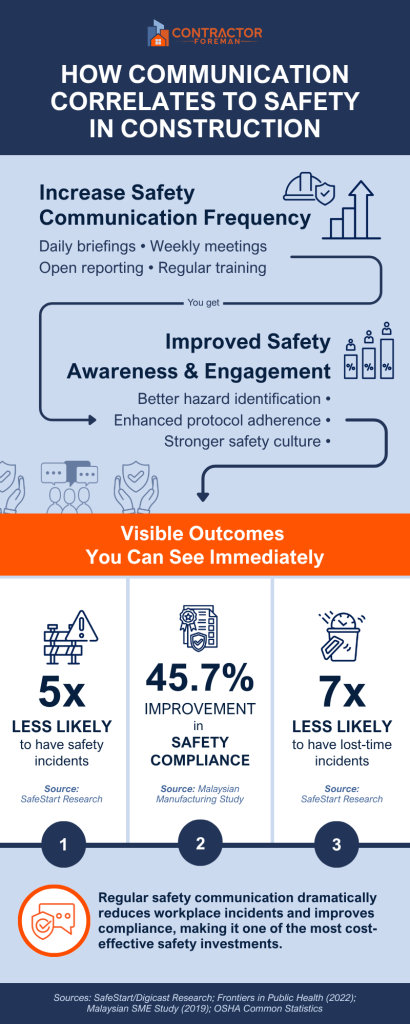
The Communication-First Safety Culture Model
You can’t build a safety culture through checklists alone. Protocols don’t drive behavior: trust does. And trust starts with communication.
When workers see that their input leads to action, that schedules are clear, and that their concerns don’t vanish into a void, they stop going through the motions and start taking ownership.
This model is built on three communication systems that reinforce that trust, day after day.
1. Crew Communication: Ongoing, Not Occasional
If the only time workers can raise safety concerns is during a meeting, you’ve already missed too much.
- Why it matters: Most safety issues surface in the field—unexpected, urgent, and often in-the-moment. Without a fast, frictionless way to speak up, workers stay quiet.
- What to implement: A dedicated team communication system that allows for quick, jobsite-based updates. Think structured channels, not scattered texts.
- What it changes: When communication is constant, safety becomes proactive, not reactive.
Group chats can’t scale. A tool like team chat creates a record, routes issues to the right people, and builds visibility across crews.
Properly documented crew communications and safety acknowledgments aren’t just smart, they’re your best protection during inspections or legal disputes.
When logged in real-time and tied to the worker, no question is informed, and when.
2. Construction Safety Meetings: Collaborative, Not Perfunctory
Too many safety meetings feel like performance reviews where one person talks, and everyone else waits to leave.
- Why it matters: One-way meetings don’t build accountability or trust. Workers who can’t contribute don’t buy in.
- What to implement: A structure that invites discussion, assigns ownership, and shows that input leads to follow-through.
- What it changes: Safety meetings become a place for problem-solving, not just policy review.
You can use the safety meetings tool to document attendance, track follow-ups, and give crews a consistent place to surface real concerns.
3. Scheduling: Clarity as a Sign of Respect
It might not seem obvious, but unpredictable scheduling undermines safety.
- Why it matters: Constant changes signal disorganization. Crews feel like resources, not people. That mindset shows up in how they treat protocols.
- What to implement: Fair, consistent scheduling that’s mobile-accessible and updated in real time.
- What it changes: When staff know where they’re going and when, they plan ahead, show up ready, and feel more invested.
Manual scheduling creates gaps. With crew scheduling, leaders send a clear message: “We respect your time and expect your focus.”
When communication is baked into your operations, safety isn’t a policy. It’s a shared value, visible in how crews speak up, how leaders respond, and how the whole system supports the work.
And when that happens, culture doesn’t need to be forced. It just works.
What a Strong Safety Culture Actually Looks Like
It’s easy to spot safety failures, missed inspections, ignored hazards, and disengaged crews. But what does success look like?
In companies with a healthy safety culture, you see the opposite of compliance theater. Safety isn’t just a policy, because it’s visible in the way work gets done:
- Crew members speak up when something feels off and expect to be taken seriously.
- Foremen reinforce expectations, but also listen and adapt based on feedback.
- Near misses are logged, not hidden, because teams understand they’re learning opportunities.
- Jobsite conversations include safety as a natural topic, not a formal interruption.
- Turnover is lower because workers feel respected, not replaceable.
These outcomes don’t come from rules alone. They come from trust earned through consistent communication, clear systems, and real follow-through from leadership.
In this kind of environment, workers don’t need to be reminded that safety matters. They already believe it, because the culture shows them—every day—that their well-being is a shared priority.
And the companies that build this kind of culture? They don’t just reduce incidents, they increase retention, morale, and project performance.
That’s the difference between a safety binder and a safety culture. And communication is what makes it real.
What Happens When Workers Feel Heard
Multiple studies across construction and small enterprise environments point to the same conclusion: open, two-way communication improves safety outcomes.
According to the National Institute for Occupational Safety and Health (NIOSH), workplaces that implement structured near-miss reporting systems and empower workers to speak up see measurable construction safety improvements. Not just fewer incidents, but earlier identification of hazards and higher compliance with procedures.
Studies have shown that small businesses that improve communication channels, especially those that allow workers to share safety concerns without fear of retaliation, see:
- Increased near-miss reporting, which is directly linked to fewer actual incidents
- Improved resolution speed on field-level hazards due to faster upward communication
- Enhanced worker morale, particularly when concerns are acknowledged and acted upon
What’s especially notable is that benefiting from these gains doesn’t require massive cultural overhauls. In many cases, it’s the implementation of basic systems like dedicated communication platforms and structured feedback loops that makes the difference.
And while those systems can be manual, they’re significantly more effective and harder to ignore when powered by tools built for the job.
To see this in action, book a free demo. Try Contractor Foreman and see how live communication, trackable safety meetings, and scheduling work that your crews can count on.
It’s a straightforward and risk-free way to turn what you’ve just read into something real, measurable, and built for the field.
Common Pitfalls That Undermine Safety Culture (And How To Avoid Them)
By the time a safety issue shows up in an incident report, it’s already too late. The real damage often starts earlier, with preventable mistakes in how communication is structured (or neglected).
Here are four of the most common missteps we’ve seen in construction environments—and what to do instead.
1. Treating Safety as a Compliance Exercise
It’s one of the most common missteps: assuming safety culture is built by checking boxes instead of changing behaviors.
The mistake: Thinking that having safety meetings, checklists, and PPE signs automatically equals a “safety culture.”
Why it happens: It’s easy to confuse activity with engagement. But workers know the difference.
What to do instead: Focus on systems that encourage participation, not just box-checking. The Occupational Safety and Health Administration (OSHA) explicitly notes that successful safety programs include worker involvement in hazard identification and decision-making.
2. One-Way Communication
Safety meetings often turn into top-down broadcasts, and that lack of two-way dialogue erodes the very trust those meetings are meant to build.
The mistake: Top-down Safety meetings, with no room for questions, discussion, or follow-up.
Why it happens: Meetings are rushed. Leaders feel pressure to “get through it.”
What to do instead: Build in time for open feedback. Use structured formats where field concerns can be logged, tracked, and visibly addressed. According to NIOSH, employees are more likely to report hazards when they know their input leads to action.
3. Ignoring Scheduling Friction
Scheduling may seem unrelated to safety, but it plays a powerful role in how crews perceive leadership—and whether they stay engaged.
The mistake: Thinking scheduling is an operational task with no impact on safety.
Why it matters: Disorganized or last-minute scheduling increases stress, cuts into planning time, and sends a clear (if unintentional) message: “Your time doesn’t matter.”
What to do instead: Provide consistent, mobile-accessible schedules. This reduces uncertainty and fosters a sense of fairness and respect, both key ingredients in a strong safety culture.
4. Underestimating Peer-to-Peer Influence
Leadership sets the tone, but it’s the behavior of crew members day-to-day that determines whether safety protocols are followed.
The mistake: Assuming safety culture is built only through leadership directives.
Why it matters: Research shows that peer behavior significantly influences whether workers follow or ignore safety protocols.
What to do instead: Equip supervisors and crew leads with tools to model safe behavior, log feedback from the field, and encourage peer accountability.
Bottom line: Culture is the sum of daily interactions, habits, and signals. Avoiding these common pitfalls means creating a system where safety isn’t enforced from the outside in, but built from the inside out.
Safety Culture Isn’t a Slogan — It’s a System
You understand what it takes to build a real safety culture, one rooted in communication, not just compliance.
Yes, you could try to piece it together manually:
- Running structured safety meetings with paper sign-ins and sticky notes
- Relying on group texts or word-of-mouth to report jobsite issues
- Juggling spreadsheets to manage crew schedules
But let’s be honest, that approach rarely scales. It’s slow, inconsistent, and prone to breakdowns.
If you want to see real results like earlier hazard reporting, smoother compliance, and stronger trust, you need systems built for how construction teams actually work.
That’s where Contractor Foreman comes in. This construction management software has features that can aid any business:
- Safety Meetings that drive accountability and track follow-ups
- Team Chat that keeps crews connected and safety concerns documented
- Crew Scheduling that eliminates confusion and shows respect for your team’s time
With the right tools, building a communication-first safety culture isn’t just possible—it’s practical, measurable, and sustainable.
Together, these tools make it easy to turn “safety is our priority” from a catchphrase into a system everyone can rely on—leadership, foremen, and field crews alike.
Ready to build a safety culture that actually works? Start your free 30-day trial of Contractor Foreman and make communication your company’s most powerful safety tool.







