
Nobody likes waiting — ever. Five minutes feels rude. Thirty feels personal. A few hours? Friendship over.
Construction, meanwhile, has somehow built an entire industry around making people do exactly that — even the aggressively organized ones running on three hours of sleep.
Because no matter how airtight the timeline looks on Monday morning, delays are simply part of the deal.
About 72% of project managers deal with them regularly, with average setbacks stretching 46 days. Which doesn’t sound catastrophic until those 46 days start multiplying across labor costs, rescheduled crews, unhappy clients, and the next project wondering why nobody’s returning calls anymore.
Delays are inevitable. But the right construction management tools can minimize them, sometimes prevent them altogether.
Before we get there, let’s talk about why projects stall in the first place.
Here are the usual culprits behind construction delays:
- Handoff problems: Over 168,000 variances in a year due to trades waiting on others to finish.
- Labor shortages: 92% of firms struggle to find skilled workers, with a projected shortfall of 499,000 by 2026.
- Material delays: Items like switchgear can take over a year to arrive.
- Poor communication: Miscommunication causes delays of up to 302 days, with 18% of time wasted searching for information.
- Scheduling inefficiencies: Misaligned schedules lead to idle crews and wasted resources.
Technology like Contractor Foreman addresses these issues by streamlining communication, scheduling, daily logging, and financial management. This helps reduce delays, improve productivity, and minimize costs. Tools like GPS-enabled timecards, client portals, and centralized document storage ensure better coordination and faster problem resolution. For contractors, using such platforms can mean completing projects faster, cutting costs, and avoiding disputes.
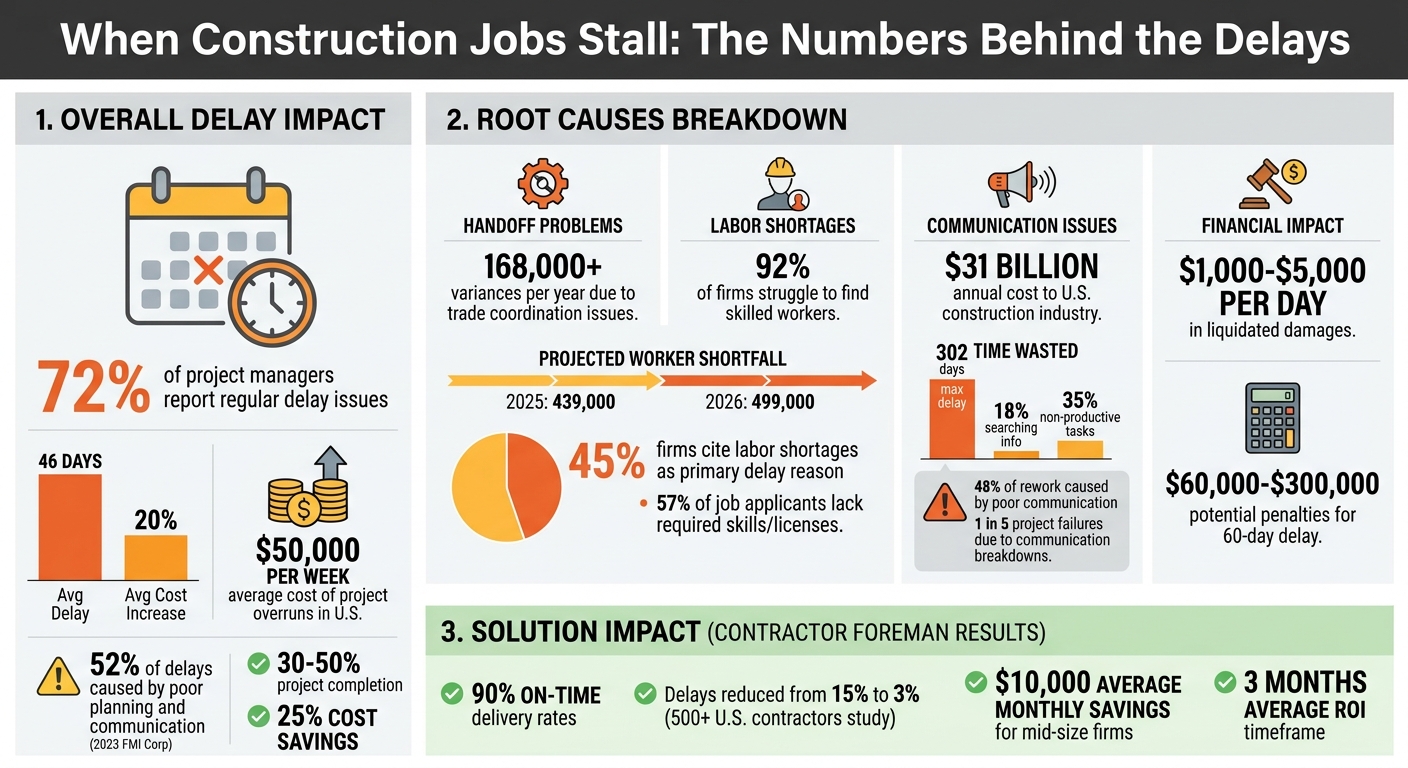
Construction Project Delays: Key Statistics and Impact on U.S. Construction Industry
Workforce Shortages and Scheduling Problems
The construction industry is grappling with a serious labor shortage that’s slowing projects nationwide. A staggering 92% of U.S. construction firms report difficulties finding qualified workers. Looking ahead, the labor gap is expected to grow, with a projected shortfall of 439,000 workers in 2025 and 499,000 by 2026.
This shortage stems from several issues. For starters, 57% of job applicants lack the required skills or licenses, while a generational skills gap complicates matters further. Veteran workers struggle to adapt to digital tools, while newer employees often lack practical, hands-on experience. Adding to the problem, stricter immigration enforcement has disrupted staffing for nearly one-third of construction firms, leading to no-shows and reduced subcontractor availability.
These challenges are having a major impact on project timelines. 45% of firms cite labor shortages as the primary reason for schedule delays. Ken Simonson, Chief Economist at AGC, summed it up well:
“Construction projects of all types are being delayed because there aren’t enough qualified workers available for firms to hire.”
On top of labor shortages, inefficiencies are compounding delays. 18% of project time is wasted on workers searching for information – like foremen hunting through emails for specs or returning to trailers to check the latest drawing revisions. When teams are already stretched thin, even small inefficiencies can snowball into major setbacks.
Poor scheduling only makes things worse. Miscommunication about schedules leads to multiple trades showing up on the wrong day or crews standing idle without clear tasks. In fact, construction professionals spend about 35% of their time on non-productive tasks, such as resolving information conflicts or dealing with reporting gaps. With fewer workers available, every wasted hour hurts productivity. Streamlined scheduling is essential to minimize these delays.
Using Centralized Scheduling to Maximize Productivity
Solving labor shortages isn’t just about hiring more workers – it’s about getting the most out of the workforce you already have. Centralized scheduling replaces the fragmented communication of emails, texts, and verbal updates. Tools like GPS-enabled timecards ensure accurate labor tracking by verifying hours onsite, streamlining job costing and payroll.
Digital scheduling tools also prevent trade conflicts before they happen. For example, when electrical and HVAC teams can see each other’s schedules in real time, they avoid overlapping in the same workspace. Subcontractors arrive on the right day with the correct materials, while field teams receive instant updates on schedule changes through mobile notifications – reducing errors and costly delays.
This approach also eases the burden on foremen. As EngineeringCivil.org explains:
The foreman bottleneck is not a foreman problem. It is a system design problem.
sbb-itb-5eea312
How Daily Logging Prevents Project Delays
Daily logs act as real-time records that help avoid project delays. When disputes arise over timelines, courts and arbitrators rely heavily on these “contemporaneous” records rather than after-the-fact recollections. Inaccurate or incomplete logs often lead to reliance on faulty memories, which can complicate delay disputes.
The stakes couldn’t be higher. Poor communication and unreliable data are responsible for 48% of all rework. Manual logs only add to the problem – they’re prone to being lost, damaged, or unreadable. Instead of making their way to the office in real time, crucial details often stay trapped in the field. On top of that, verbal instructions given during morning meetings frequently go undocumented, leading to disagreements when those details are later misremembered.
The impact of these issues can be massive. Poor information flow has caused project delays of up to 302 days. Workers also lose about 18% of their project time searching for data, whether it’s digging through email threads or walking back to trailers to find updated drawings. Late or incomplete daily logs allow recurring problems – like consistent late deliveries – to spiral out of control.
Accurate daily logs, however, can provide financial protection. For instance, one contractor avoided an $80,000 dispute because their logs clearly showed that their team wasn’t working on the contested plumbing section during the disputed timeframe.
This gap in proper record-keeping highlights a broader issue in construction: poor documentation often leads to delays. It underscores the need for effective project management tools that enable real-time, accurate logging to prevent these setbacks.
Streamlining Daily Logs with Contractor Foreman
Digital tools like Contractor Foreman make daily logging faster and more reliable. The platform simplifies the process so crews are less likely to skip it. By following the five-minute rule, logs can be completed in under five minutes using easy-to-navigate templates, dropdown menus, and voice-to-text features. Foremen can log details immediately on their phones right at the job site, eliminating the need to reconstruct events later.
The system also auto-populates weather data and allows users to attach photos with automatic timestamps and GPS tags. This ensures precise records for weather-related delay claims without requiring manual input.
Real-time cloud syncing ensures that updates from the field are instantly available to office staff, reducing the need for extra calls or site visits. Project managers can review logs daily to spot trends and address issues before they grow into major problems. Even in areas with limited cell service, the platform works offline, allowing foremen to log information on-site. All data remains searchable and backed up for future reference.
Better Communication Across Teams and Clients
Communication breakdowns are responsible for one in five construction project failures. With multiple communication channels in play, critical details often slip through the cracks. Field crews can become disconnected from office staff, leading to missing records and growing frustration. The financial impact is massive – miscommunication costs the U.S. construction industry about $31 billion every year.
But the damage isn’t just financial. Workers spend 18% of project time hunting through email threads or trailer files for information. Misunderstandings can lead to costly mistakes, like using the wrong materials or demolishing the wrong section of a wall. Without access to real-time updates, crews may rely on outdated blueprints, resulting in errors that clients typically refuse to pay for.
The situation worsens when clients are kept out of the loop. Delays in approving change orders or selecting materials can push a project back by months. When stakeholders can’t easily access up-to-date project details or financial summaries, trust diminishes quickly. Construction professionals already spend 35% of their time on unproductive tasks like searching for specifications or resolving disputes with project tracking solutions. Adding client confusion into the mix only compounds the problem.
The solution lies in centralizing communication. Closing these gaps ensures smoother workflows and prevents unnecessary project delays.
Using Client Portals for Transparency and Coordination
A unified digital platform can make all the difference in tackling these communication challenges. Contractor Foreman’s client portals replace scattered communication with a single, reliable source of information. Everyone – field teams, office staff, and clients – can access the same documents, schedules, and drawings from anywhere. By storing everything in one cloud-based location, the platform eliminates the chaos of juggling multiple tools.
Real-time updates ensure everyone stays on the same page. When schedules shift or change orders are issued, the portal instantly shares the new information. Features like read receipts and timestamps help avoid disputes about whether instructions were received. Clients can check financial summaries and project milestones without needing constant phone calls, while field crews access the latest blueprints without wasting time returning to the office. This level of transparency strengthens trust and keeps projects on track, reducing the risk of preventable delays caused by poor communication.
Fixing Financial and Document Management Problems
Even with improved scheduling and daily reporting, financial oversight, construction cost estimates, and document control remain significant challenges for contractors. Poor financial management can quickly erode profits. Without access to real-time Work-in-Progress data, contractors may fail to catch early signs of budget overruns. This often leads to rejected draw requests, forcing contractors to cover costs themselves. Generic accounting software frequently lacks the detailed insights needed to identify these issues early. The consequences can be devastating: for instance, a three-month delay on a US$1.5 million project could turn a 12% profit margin into a 3% loss. Liquidated damages can range from US$1,000 to US$5,000 per day, meaning a 60-day delay could rack up penalties between US$60,000 and US$300,000. Additionally, undocumented scope changes often lead to billing disputes, delaying project closeouts by months.
On top of financial issues, document management adds another layer of difficulty. Scattered document storage often results in lost records and version control problems, which can lead to costly on-site errors. When project management and accounting teams rely on separate systems, decisions may be made based on outdated or conflicting data.
Subcontractor payment tracking is another critical area where errors can lead to delays. Failing to properly monitor lien waivers and payment schedules can result in subcontractors halting work or even legal complications that push project timelines further back. Solving these problems requires a system that integrates financial tracking and document management.
Using Contractor Foreman’s Financial and Document Tools
Contractor Foreman provides a unified solution to tackle financial and document management issues, complementing earlier tools for workforce and communication challenges. Its integration with QuickBooks ensures financial data is automatically synced, eliminating manual entry errors and aligning project managers and accountants with the same up-to-date figures. Detailed job costing breaks down expenses by phase and cost code, helping to identify and address budget overruns early.
All project-related documents – such as RFIs, submittals, permits, safety records, and drawings – are stored in a centralized, cloud-based hub. This eliminates version control issues, ensuring field crews always have access to the most current plans and reducing expensive rework. Digital approval workflows simplify change orders with electronic signatures, and a comprehensive correspondence log keeps track of emails, phone calls, and meeting notes, which can be invaluable for resolving disputes.
Real-time cost tracking integrates bills and expenses into a live database, enabling proactive financial adjustments instead of costly, last-minute fixes. The mobile app gives field teams instant access to financial updates and project documents, cutting down on unnecessary trips to the office. Starting at just US$49/month, Contractor Foreman offers construction-specific financial and document management tools without the overwhelming complexity of larger enterprise systems.
Conclusion: Filling the Gaps with Contractor Foreman
Construction projects often grind to a halt when scheduling, daily logging, communication, and financial oversight break down. A 2023 FMI Corp report revealed that 52% of construction delays are caused by poor planning and communication, costing U.S. projects an average of $50,000 per week in overruns. These problems tend to snowball, turning small setbacks into prolonged delays that eat into profits and strain client relationships. This highlights the importance of having a unified platform to transform delays into timely completions.
Contractor Foreman addresses these challenges head-on with an all-in-one platform that replaces the need for over 10 separate tools. Users have reported impressive results, including 30–50% faster project completion, 25% cost savings, and 90% on-time delivery rates. In a study involving more than 500 U.S. contractors, average project delays dropped from 15% to just 3% after adopting the platform. Mid-size firms saw a return on investment within three months, saving an average of $10,000 per month. By bringing together scheduling, documentation, communication, and financial management, every stage of construction becomes more streamlined and manageable. Features like centralized scheduling, mobile daily logs, construction communication software, and integrated financial tools ensure real-time updates and instant access to critical documents.
The difference between a stalled project and one that stays on schedule often boils down to visibility and coordination. With Contractor Foreman, field teams can log issues in under two minutes, while clients can approve changes the same day through secure portals. Budget overruns are flagged early, preventing small issues from becoming major financial setbacks. And with affordable pricing, the platform delivers immediate value.
For contractors dealing with fragmented systems that waste time and cut into profits, the answer is straightforward: bridge the gaps with tools designed specifically for construction workflows. With reliable uptime, features tailored to U.S. needs, and seamless financial integration, Contractor Foreman delivers results – often as quickly as the first week.
FAQs
What should I fix first when a job starts slipping?
To start, it’s crucial to address any communication gaps that could be slowing things down. Set up systems that allow for real-time updates, encourage prompt responses, and clearly define who is responsible for reporting issues. Resolving these challenges early on can stop minor problems from snowballing into bigger delays, keeping your project moving smoothly.
What belongs in a daily log to protect against delay claims?
A daily log should capture detailed information about weather conditions (like temperature, rainfall, and wind), work completed, site conditions, and any delays or challenges faced. Record events as they happen – using tools like voice notes if necessary – to maintain accuracy. It’s also important to log details about visitors, safety incidents, and site disruptions to build a thorough record that can help defend against potential delay claims.
How can a client portal prevent approval delays and disputes?
A client portal minimizes approval delays and reduces disputes by serving as a single hub for real-time communication, organized documentation, and instant project updates. With everything in one place, misunderstandings are less likely, approvals happen faster, and everyone stays on the same page throughout the project.







