
“Scaffolding Collapse: 1 Dead, 4 Hurt in Downtown Mishap”
“Worker Electrocuted on Job Site — Sparks Fly as Crew Watches in Horror”
“Concrete Spill Smashes Vehicles, 3 Workers Suffer Broken Bones”
Don’t these headlines just make you want to order your crew to wear full hazmat suits, chain themselves to the scaffolding, strap on jetpacks for a quick escape, and and practice emergency escape drills every 10 minutes?
You’re not simply paranoid. You have every reason to worry—because in this industry, “unlikely” still happens every day.
In the U.S., construction is one of the deadliest industries, with roughly 1,030 workers killed and more than 100,000 injured each year from falls, machinery accidents, electrocution, and other job-site hazards.
We don’t need to spell it out- Construction Risk Assessment is absolutely critical. It’s the backbone of safe, cost-effective, and timely projects.
Luckily, you have technology on your side. You can do it with ease using digital tools.
Here’s what you need to know:
- Why it matters: Over 20% of workplace fatalities in 2023 happened in construction. Ignoring risks can lead to delays, budget overruns, lawsuits, and safety issues.
- Types of risks:
- Safety risks: Falls, electrocution, accidents with machinery, and long-term health hazards like silica exposure.
- Financial risks: Budget overruns, payment delays, and disputes.
- Weather risks: Delays from rain, heat, and unforeseen site conditions like unstable soil.
- How to assess risks:
- Identify hazards through site walkthroughs and past reports.
- Prioritize risks using tools like a risk matrix.
- Implement controls (eliminate hazards, use PPE, etc.).
Digital tools like Contractor Foreman simplify risk tracking, reporting, and compliance. They help you log hazards in real time, automate documentation, and monitor safety measures. Construction risk assessment isn’t a one-time task – it’s an ongoing process to protect lives, budgets, and schedules.
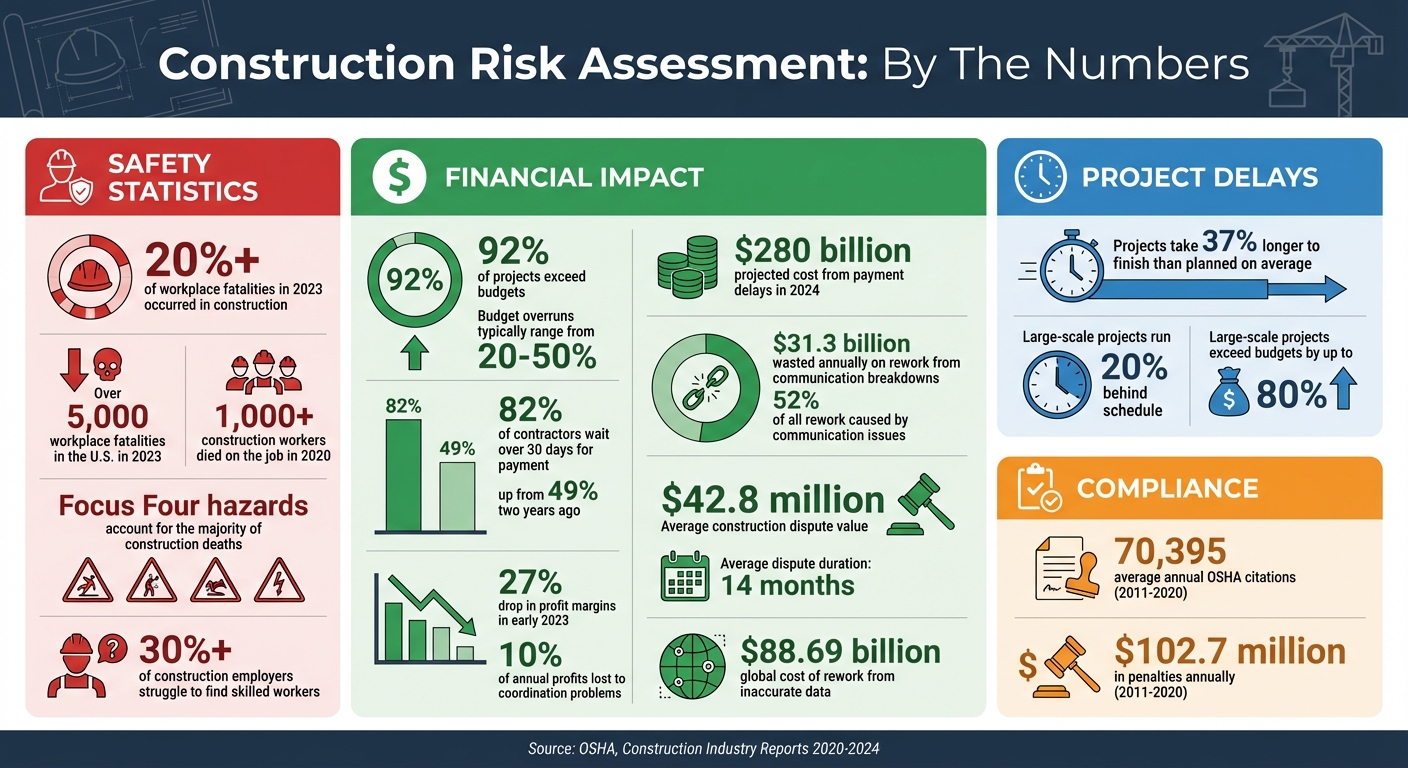
Construction Risk Assessment: Key Statistics and Impact Data
Common Construction Risks
Construction projects come with challenges that fall into three main risk categories, all of which can affect worker safety, project timelines, and budgets. Recognizing these risks upfront allows for better preparation and reduces the chaos of last-minute problem-solving.
Safety and Health Risks
According to OSHA, the “Focus Four” hazards are the leading causes of fatalities on construction sites: falls from heights, struck-by incidents (like being hit by vehicles or falling objects), caught-in/between accidents (involving machinery), and electrocution. These dangers account for the majority of deaths in the industry.
The American Industrial Hygiene Association also points out other less obvious threats, such as musculoskeletal injuries from manual labor, hearing loss caused by constant noise, and exposure to harmful airborne substances. Heat stress from working in high temperatures is another concern. Long-term health issues, like those caused by silica dust or asbestos exposure, can develop years after the initial contact.
Accidents don’t just harm workers – they disrupt projects, cause delays, and drive up costs. With over 30% of construction employers already struggling to find skilled workers, losing even one team member can throw schedules off track. Utilizing project management features can help mitigate these disruptions by optimizing existing resources. On top of that, safety lapses can lead to higher workers’ compensation premiums, OSHA fines, and costly lawsuits. The financial impact of safety failures is as significant as the human toll, making it a critical area of focus.
Financial and Contract Risks
Construction projects also grapple with financial and contractual risks that can derail budgets and schedules.
Nearly 92% of projects exceed their budgets, often by 20% to 50%, with design flaws and scope creep being major contributors to disputes.
These issues often originate from poor cost estimates, sudden spikes in material prices, and delayed payments from clients or financiers. Subpar subcontractor qualifications can worsen the situation. Payment delays are particularly problematic, with 82% of contractors waiting over 30 days for payment – up from 49% just two years ago. In 2024, these delays are projected to cost the U.S. construction industry $280 billion.
Communication breakdowns are another major factor, accounting for 52% of all rework and resulting in $31.3 billion in wasted labor and materials annually. Construction disputes average $42.8 million in value and can drag on for about 14 months. Labor shortages and rising material costs have also contributed to a 27% drop in profit margins in early 2023.
Weather and Environmental Risks
Weather and environmental factors can throw off schedules, jeopardize worker safety, and inflate costs through unexpected expenses.
These might include idle labor as workers wait for better conditions, equipment downtime that leads to higher maintenance costs, and rework, such as repairing freshly poured concrete damaged by rain.
Environmental risks go beyond just weather. They include surprises like unstable soil, underground rock formations, or contamination discovered during excavation. On average, projects take 37% longer to finish than planned, with large-scale projects running 20% behind schedule and exceeding budgets by as much as 80%. While these risks don’t happen often, their impact can be severe when they do.
“Environmental risks are considered low probability, high impact risks, meaning they’re unlikely to occur but can have a serious impact on your business if they do.” – Jonas Construction
Weather delays can also lead to contractual disputes, especially if agreements lack clauses addressing weather-related issues or don’t include a “weather float” in the schedule. Without proper documentation and contract safeguards, contractors may have to absorb these extra costs themselves. These challenges highlight the need for thorough risk assessments and well-structured contracts.
sbb-itb-5eea312
How to Conduct a Risk Assessment
A construction risk assessment is an ongoing process that revolves around three main steps: identifying hazards, evaluating and prioritizing risks, and implementing effective control measures. Let’s break down each step to help make your assessments more efficient.
Identifying Hazards
Start by conducting site walkthroughs before any work begins and continue doing so throughout the project. These walkthroughs should involve foremen and crew members to ensure a well-rounded perspective.
Ahmed Al-Hassany, HSQE Manager, emphasizes this point:
“One of the most common mistakes I see is one person sitting in an office, ticking boxes and filling out all the risk assessments for a site. This approach is doomed to fail.”
Take time to review blueprints, inspect equipment, and analyze past incident reports from similar projects. For larger sites, divide them into smaller, focused zones – like excavation, electrical, or roofing areas – to make sure no hazards go unnoticed. Record all findings in a risk register, including unique IDs, detailed descriptions, and assigned owners for each hazard.
Evaluating and Prioritizing Risks
Once hazards are identified, the next step is assessing and ranking them. Use a risk matrix to evaluate each hazard. Multiply the likelihood of occurrence by its potential severity to calculate a risk rating. For instance, a score of 1–5 might represent low risk, 6–12 medium risk, and 15–25 high risk that demands immediate attention.
Focus first on high-impact, high-probability risks, but don’t ignore rare events with catastrophic potential. Some teams prioritize severity more than likelihood, using formulas such as:
Severity = Likelihood + (2 × Impact)
Stick to a consistent scoring system to make comparisons easier and ensure clarity when communicating risks.
Implementing Control Measures
Once risks are assessed, act quickly to apply targeted control measures. Follow the Hierarchy of Controls for guidance:
- Elimination: Completely remove the hazard.
- Substitution: Replace hazardous materials or methods with safer options.
- Engineering Controls: Introduce physical solutions like guardrails or machine guards.
- Administrative Controls: Adjust work practices through training, safety signage, or updated procedures.
- Personal Protective Equipment (PPE): Use items like hard hats and safety glasses as a last line of defense.
Assign each control measure to a responsible person and set deadlines for implementation. Identify triggers for reassessment, such as near-misses, new equipment, extreme weather, or new subcontractors joining the project. By maintaining a structured approach and regularly revisiting risks, you’ll keep your project adaptable and prepared for changes.
Risk Management Tools and Methods
After identifying and prioritizing risks, the next step is to use tools and methods that turn raw hazard data into actionable priorities. These tools help streamline decision-making and ensure the team focuses on what matters most.
Using a Risk Matrix
A risk matrix is a simple yet powerful visual tool. It compares the likelihood of an event happening with its potential impact, helping teams prioritize threats effectively. The process is straightforward: multiply the likelihood score by the impact score.
For example, if a risk is rated as “Likely” (4) and its impact is “Major” (4), the total score is 16. This places it in the “High Risk” category, signaling the need for immediate action.
A common format is the 5×5 matrix, which divides risks into four categories:
- Low Risk: Monitor but no immediate action needed.
- Moderate Risk: Address as resources become available.
- High Risk: Requires swift action.
- Critical Risk: Stop work immediately and resolve.
In 2023, over 5,000 workplace fatalities occurred in the U.S. alone, emphasizing the importance of accurate risk prioritization. To ensure consistency, use predefined criteria for assessing frequency and impact.
“A matrix alone doesn’t reduce risk – it’s merely the starting point to identify priorities. Failure to link risks to controls and action plans limits its practical value.” – Jason Doel, COO & CRO, Tracker Networks
Risk matrices should be reviewed quarterly or whenever major changes occur, such as new project phases or the arrival of subcontractors. Including field crews and supervisors in risk workshops can uncover up to 50% more actionable hazards compared to planning done in isolation.
While traditional matrices are effective, digital platforms take risk management a step further by integrating real-time updates and data sharing.
Digital Risk Management Tools
Switching from paper-based systems to digital platforms can transform how risks are managed by automating data collection and enabling proactive monitoring. Digital tools allow teams to use live field data, mobile reporting, and automated alerts to stay ahead of potential threats.
For example, Contractor Foreman simplifies risk tracking with features like daily logs, safety meeting modules (covering over 700 topics), and document management. Custom fields make it easy to tag hazards, assign responsibilities, and set deadlines. The platform also offers tools to track near-miss incidents and monitor corrective actions before issues escalate. Field crews can capture photos or voice notes on-site, which sync automatically even after working offline.
Plans for Contractor Foreman start at $49 per month and include a “Price Lock” guarantee. With a 4.3/5 rating from 470 reviews, it’s a reliable option for teams looking to improve their risk management processes.
AI-powered tools are also making waves by analyzing patterns in risk data. These tools predict which threats are most likely to occur and recommend mitigation strategies based on historical project data. By digitizing risk management, teams eliminate version control issues and ensure everyone – from field workers to project owners – has access to the most up-to-date information.
Contractor Foreman simplifies risk assessment by integrating data collection, tracking, and reporting into one streamlined platform. Field crews can record hazards on the spot, while managers gain instant insights into site conditions and compliance status through automated reporting.
Daily Logs and Safety Meetings
Daily logs allow teams to capture hazards in real time, enabling swift action.
For example, when heavy rain interrupted outdoor work, a site manager logged the incident immediately – detailing the time, affected teams, and safety measures taken. This quick documentation allowed for immediate adjustments to the project timeline. The mobile app also tracks weather conditions, equipment issues, and site incidents as they occur, keeping everyone informed.
Contractor Foreman includes over 800 preloaded safety topics in both English and Spanish, making it easier to conduct consistent toolbox talks. Digital sign-in sheets automatically track attendance, eliminating the need for manual paperwork and ensuring compliance for audits. With 62.4% of construction companies now using mobile devices for field reporting, this approach aligns with current industry practices. Photos and notes sync automatically, ensuring no hazard goes undocumented.
Beyond real-time logging, the platform’s document management system further strengthens risk oversight.
Document Management for Risk Records
A cloud-based repository organizes key documents like risk assessments, safety data sheets, inspection reports, and permits into clearly labeled folders.
You can sort files by project phase or risk type – such as “Safety Audits” or “Financial Risks” – for quick and easy retrieval. Features like version control prevent confusion, while access permissions ensure secure sharing with inspectors or subcontractors.
Between 2011 and 2020, the construction industry averaged 70,395 OSHA citations annually, resulting in $102.7 million in penalties. Contractor Foreman’s automated OSHA 300 logs reduce manual entry errors and keep records ready for audits. The redline tool allows users to annotate drawings and PDFs, visually highlighting specific hazards for clearer communication than text descriptions alone.
Tracking Risks with Custom Fields and Reports
Customizable reporting tools provide deeper insights by quantifying and visualizing risks. Custom fields let teams assign specific data points to risks, such as dropdown menus for severity levels, numerical fields for probabilities, or cost-impact estimates in USD. For instance, you could log an equipment failure risk as “Likelihood: 30%, Cost Impact: $5,000” and track it alongside other potential threats.
The drag-and-drop report builder transforms this data into visual dashboards or exportable reports. Filters by date (MM/DD/YYYY format) or status help identify trends, such as an increase in safety incidents or recurring project delays. Automated weekly summaries spotlight high-priority risks so teams can focus their efforts effectively. Considering that 14% of construction rework – valued at $88.69 billion globally – is linked to inaccurate data, these reporting tools help prevent costly errors.
Conclusion
Construction risk assessment is a continuous effort that protects both your financial health and your team’s safety. By moving from a reactive approach to actively identifying hazards ahead of time, you minimize incidents, maintain profit margins, and keep projects on track.
As Jamie Fraser, HSE Manager at Giusti Group, explains:
“The bottom line is to keep the guys from getting hurt. If there is a major incident – we need to track it with documentation”.
The numbers paint a stark picture: coordination problems and communication breakdowns cost contractors about 10% of their annual profits. Even more alarming, over 1,000 construction workers lost their lives on the job in 2020. This highlights the urgent need for regular risk assessments – not just to meet OSHA standards but to foster a workplace culture where employees feel confident flagging hazards without hesitation.
Modern digital tools offer powerful solutions, such as real-time logging, automated compliance tracking, and customizable reports. These transform disorganized paperwork into actionable insights, giving you an edge during audits and helping you identify trends before they become problems.
Still, no tool can replace the value of your frontline workers’ insights. Involve them actively and implement the Hierarchy of Controls: focus first on eliminating and substituting hazards, then move to engineering and administrative controls, with personal protective equipment (PPE) as the last line of defense. Conduct immediate reviews after near-misses, scope changes, or adverse weather events. By pairing proactive assessments with effective digital tools, you create a risk management strategy that not only saves lives but also strengthens your business and keeps projects running smoothly.
FAQs
How often should a construction risk assessment be updated?
Construction risk assessments need to be reviewed and updated at least annually or whenever major changes occur within the project. These changes could involve introducing new equipment, changes in personnel, or shifts in site conditions. Keeping assessments up to date is crucial for maintaining safety standards and ensuring compliance throughout the project’s duration.
Who should be involved in a site risk assessment?
A site risk assessment involves the combined efforts of project managers, site supervisors, safety officers, subcontractors, and workers. By working together, this team can pinpoint potential hazards, assess the associated risks, and put in place practical safety measures. This collaboration is key to maintaining a safe and compliant construction site.
What should you document to protect against OSHA issues and disputes?
To avoid problems with OSHA and potential disputes, maintain thorough documentation of hazards, safety protocols, training records, and compliance efforts. This includes keeping detailed records of hazard assessments, safety training sessions, incident reports, and steps taken to meet OSHA standards. These records demonstrate that you’ve taken the necessary steps to address risks, enforce safety measures, and properly train employees, which can be crucial in defending against violations or disputes.







