
Quick! Name the exact moment your last project lost money.
Can’t do it, right?
It’s not that you have bad memory, it’s because profit loss in construction almost never shows up as one big, obvious disaster.
Nobody loses $80,000 in a single dramatic afternoon. It’s the many little things: An unwritten “small change” on-site. A damaged delivery nobody flagged. A rental that ran three extra days because no one logged the job was done…just to name a few!
None of it feels like a crisis in the moment. But when you add it all up? The numbers can make you want to throw your clipboard into the dumpster.
And here’s the part nobody wants to admit: most of these “mistakes” aren’t mistakes at all. They’re habits.
Small shortcuts your team takes every single day because “eh, we’ll log it later.” Then one day, a client disputes an invoice — or you’re staring at a job that should’ve been profitable, wondering where the money went.
The good news? These leaks are predictable.
They show up in the same handful of places on almost every job. Which means, they’re absolutely preventable.
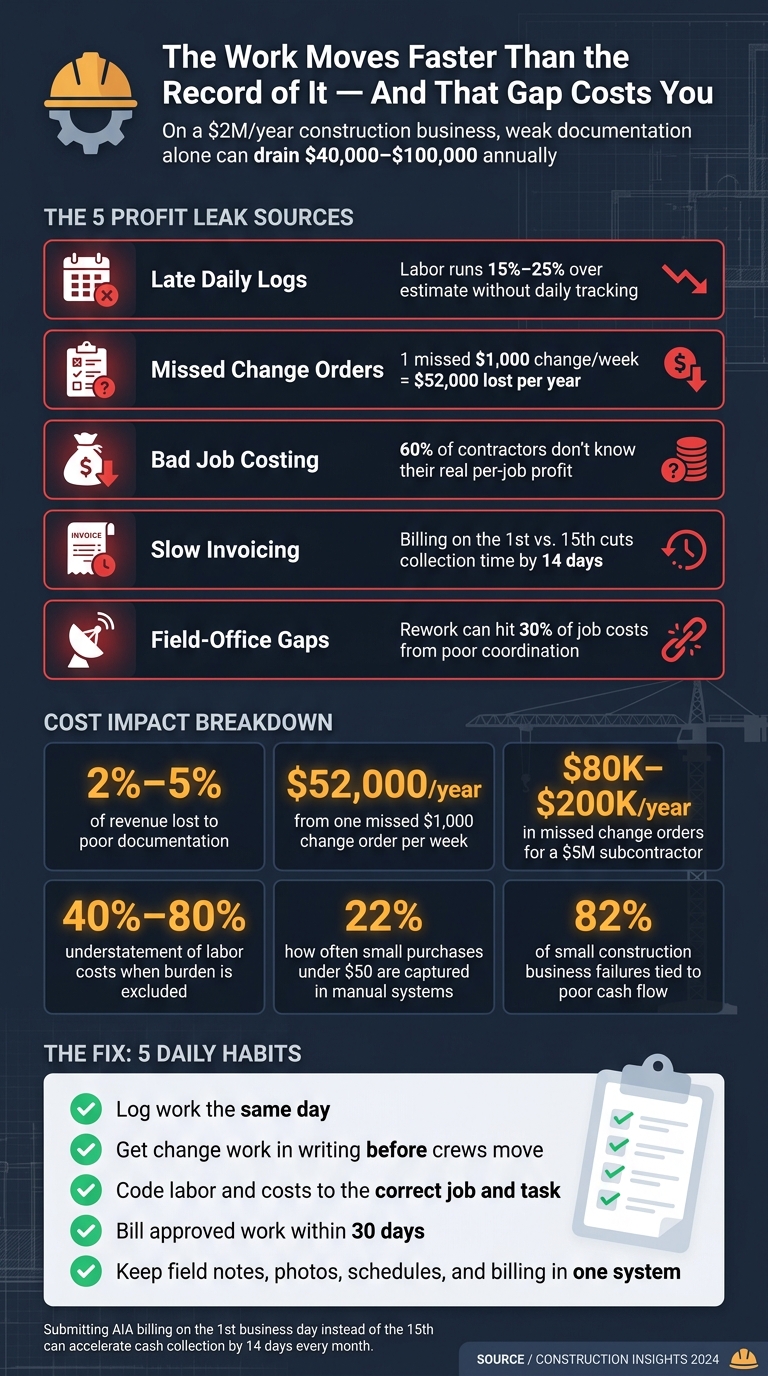
Here’s where contractors are usually losing money:
- Late daily logs make it harder to back up labor, delays, and extra work
- Missed change orders turn approved work into free work
- Bad job costing hides labor, material, and equipment overruns
- Slow invoicing turns finished work into cash strain
- Field-office gaps lead to rework, idle crews, and billing mistakes
In this article, we’ll break down where these small mistakes show up, what they cost, and how to tighten the daily routine so more of each earned dollar stays on the job.
Hidden Construction Profit Leaks: What Poor Documentation Really Costs You
How small workflow mistakes turn profitable jobs into thin-margin jobs
Profit erosion usually starts in the field, not in the accounting office. Missed logs, undocumented changes, wrong cost codes, and slow invoices all chip away at margin. And the first place that leak tends to show up is the daily log.
Profit fade is the gap between projected margin and actual margin when reporting lags behind the work.
As Josh Luebker, Fractional CFO at The Construction CFO, puts it:
“The margin leaks because the numbers arrive too late to act on.”
Preventing these leaks starts with an accurate construction estimate. The numbers get painful fast. One undocumented $1,000 change order each week turns into a $52,000 annual loss. For a $5 million civil subcontractor, missed or unbilled change order opportunities often drain $80,000 to $200,000 per year. This isn’t rare. It’s what happens when normal jobsite chaos meets weak controls.
These issues begin as field-control problems and show up later in the books. Work gets recorded poorly, passed along loosely, or billed late. Then, weeks later, the damage appears in the financials, when getting that margin back is much harder.
What poor daily logs and missing documentation actually cost you
A weekly log built from memory is not the same as a daily log.
Once entries are missing or uneven, the job record stops being something you can trust. Daily logs and field notes aren’t just admin work. They’re financial controls tied to labor allocation, WIP schedules, and change order claims.
Weak documentation leaves contractors with very little to stand on when delay claims, unpaid extra work, or productivity disputes come up. When a GC pushes back on a change order, the contractor with photos, timestamped entries, and signed daily logs has a much stronger case than the one relying on memory or scattered texts.
Labor tracking is where the cost often hits hardest. Without daily time tracking, labor costs usually run 15% to 25% over estimate. And when hours get coded to the wrong job or dumped into a catch-all category, production rates get warped across the board. One job can look more profitable than it is, while another looks like it’s falling apart. Then that bad data rolls into future estimates, and the same mistake follows you into the next bid.
Mobile logs, time tracking, and jobsite photos help keep field records billable and defensible. Once the record gets weak, proving extra work becomes a lot tougher.
How untracked change orders become free work
The next leak is extra work that gets approved in conversation but never locked down in writing. A superintendent says yes on a phone call or during a quick talk on-site, the crew moves ahead, and the paperwork shows up days or weeks later, if it shows up at all. By then, the cost has already hit the books, but the revenue hasn’t. That’s unbilled work.
The average lag between a verbal agreement on-site and a documented change order is 24 days. Over five years, that lag alone can cost a $10 million contractor $500,000 in margin. When changes live across scattered notes, texts, and emails instead of one approval trail, they become harder to bill and much easier to dispute.
That’s how scope creep turns into free work. The job expands, costs climb, and the original contract price stays put because nobody closed the loop between the field request and signed approval. By the time the project manager spots the problem, the chance to bill for it is often gone.
Contractor Foreman’s change order workflow keeps the request, approval, and billing trail in one place. Changes can be logged as soon as they’re spotted, sent for approval, and carried into invoicing once signed. Keep the request, approval, and billing trail in one place.
sbb-itb-5eea312
Fixing the financial blind spots that hide job overruns
Weak field records throw off job costing and invoicing, so overruns stay hidden until the profit is already gone. Once field records are incomplete, those same holes show up in both job costing and billing.
Why inaccurate job costing leads to bad decisions
Labor burden is the clearest example. A worker paid $35/hour can actually cost $52.17/hour after taxes and benefits, and manual timesheets often miss that gap. If you track only base wages, you can understate labor costs by 40% to 80%.
Materials create the same kind of drift. Small purchases under $50 often slip through manual systems, even though they stack up fast – captured only 22% of the time. Equipment is another common blind spot. If you’re not charging an internal equipment rate for owned equipment, you’re eating depreciation and maintenance costs with no job carrying them.
The result is false profit. A job can look fine on paper while costs pile up in the background. Sixty percent of contractors don’t actually know their real profit on a per-job basis. That’s not just a bookkeeping issue. It changes how people bid, staff, and plan. If your cost data is off, your precision in calculating building costs will suffer, and that mistake follows you into the next bid.
Bad cost data is one problem. Late billing turns it into a cash problem.
Contractor Foreman’s GPS timecards and cost codes log labor at the point of work instead of relying on memory at the end of the week. That keeps cost reports closer to what’s happening in the field.
How delayed invoicing turns earned revenue into cash flow pressure
The same lag that bends job costs also slows billing. Unbilled work ties up cash. It may show up as an asset on a work-in-progress schedule, but it doesn’t pay subcontractors or cover payroll. Eighty-two percent of small business failures in construction are tied to poor cash flow management, and a big part of that comes from the gap between when work gets done and when the invoice goes out.
Delayed invoicing usually starts with a few familiar problems:
- Late billing cycles
- Missed change orders
- Mismatched pay applications
Submitting an AIA billing on the first business day of a cycle instead of the 15th can speed up cash collection by 14 days every month. Over a full year, that can make a big difference in working capital. And when a change order sits unbilled for more than 30 days, the odds of collecting it drop hard; by 90 days, it often turns into a write-off.
Contractor Foreman keeps approved change orders visible inside invoicing, so they’re ready for the next billing cycle instead of getting lost in an email thread. The client portal gives owners project visibility, which cuts down on back-and-forth and helps payments move faster.
That gap usually starts when field and office teams are working from different versions of the same job.
Closing the gap between field work and office records
Where miscommunication shows up on real projects
Those billing and costing leaks often start with a simple issue: the field and office are working from different information.
Most of the time, miscommunication isn’t one big mistake. It’s a daily coordination problem. Small misses pile up, each one costing a little, until the total starts to hurt.
A crew gets to the jobsite, but the materials still haven’t arrived or site access isn’t ready. The schedule never got updated after the delay, so the crew can’t start. Labor costs keep ticking up anyway. Then everyone scrambles to make up time later, overtime kicks in, and it gets labeled a labor overrun when the root cause was poor coordination.
Drawings create the same kind of mess. A foreman is using an old plan set, while the revised version never reaches the field. The crew installs from the old layout. Then comes rework, along with added labor, more material use, and pressure on the schedule. Rework can reach 30% on some jobs, often driven by execution drift and poor coordination.
Equipment handoffs can go sideways too. If equipment gets reassigned by phone or text and nobody updates the schedule, one crew ends up waiting while another job sits short on gear. That’s the kind of friction that comes from calls, texts, and paper notes living in different places.
How Contractor Foreman keeps field updates, documents, and schedules in one record
Informal communication leaves no clean trail. A call can settle an issue in the moment, but if no one logs it somewhere easy to find, that decision can disappear.
Contractor Foreman puts updates, documents, and schedules in one place tied to the project record. Instead of scattered back-and-forth, teams get a shared system where field updates, task assignments, documents, and photos connect straight to costs and approvals.
Field crews can submit daily reports, upload photos, and flag issues from a mobile device while they’re still on-site. The office can see that information right away instead of days or weeks later. That means managers are looking at what happened today, not trying to piece together what someone thinks happened later.
What helps is one shared record for updates, documents, and assignments.
The gap between informal communication and a structured system shows up across project control:
| Feature | Informal (Phone, Text, Email) | Structured (Contractor Foreman) |
|---|---|---|
| Traceability | Low; info buried in personal threads | High; full audit trail of all entries |
| Searchability | Difficult; requires scrolling through history | Instant; searchable by project, date, or tag |
| Link to Records | None; data is isolated from the budget | Direct; logs link to two-tier cost codes and WIP |
| Dispute Support | Weak; relies on memory and screenshots | Strong; time-stamped photos and signed logs |
Shared schedules let crews and equipment assignments update in one spot that everyone can see. Document management keeps the current drawing set available in the field, which cuts down on version mix-ups. And when something unusual happens, like a delay, a design clarification, or an access restriction, it gets logged where the work is happening instead of being rebuilt from memory later.
Live visibility gives managers a shot to catch small problems before they turn into margin loss.
Conclusion: Fix daily routines before small profit leaks become margin erosion
These profit leaks all come from one thing: the work happens faster than the record of it.
That’s the thread running through late daily logs, missed change orders, weak job costing, slow invoicing, and field-to-office mix-ups. Each one may look small on its own. But those small misses stack up. For a contractor doing $2 million a year, that can mean up to $100,000 slipping out of the job.
The fix isn’t fancy. It’s about doing the basics on time.
Record work the same day. Send invoices on the first business day. Get written approval before any change work starts. And once a change order is approved, bill it within 30 days.
That kind of discipline is much easier to keep when the field and office are working from the same record instead of piecing things together after the fact. Contractor Foreman keeps field updates and office records in one system, so managers can spot overruns sooner. Field crews can log time and upload photos from a mobile device, and the office sees that same information the same day.
That’s how the gap closes between work performed and profit captured.
Every dollar earned on a job should make it to the bottom line. In practice, that comes down to daily habits: how time gets logged, how changes get documented, and how fast invoices go out.
FAQs
What causes profit fade on a construction job?
Profit fade usually doesn’t come from one big blow. It shows up when small day-to-day problems pile up over time – idle crews, late deliveries, poor communication, and weak cost visibility.
Some of the most common causes are missed change orders, delayed or inaccurate job costing, gaps between the field and office, manual entry mistakes, and messy processes that bury labor, material, and productivity issues until it’s too late.
How can I improve change order tracking?
Use a single workflow instead of verbal agreements. As soon as someone asks for a change, write down the details, who approved it, a rough cost estimate, and photos. Then log it right away so it’s timestamped and tracked from day one.
Next, update the project budget and assign cost codes so labor, materials, and equipment tie back to the new scope. Reconcile each change with your WIP schedule, and include it in billing as soon as possible to avoid unbilled work and margin fade.
What should I track daily to protect margins?
Treat daily documentation like a standard operating requirement, not a pile of admin tasks. It gives you a day-by-day record of what happened on site and helps you spot problems before they grow.
Record labor hours and daily activities by cost code. That way, you can compare actual job performance against your estimate in real time instead of waiting until the damage is done.
Your daily logs should cover:
- Date
- Weather
- Subcontractors on site
- Work completed
- Quantities installed or completed
- Equipment use
- Visitors
- Delays or disruptions, including the cause and timing
- Site photos by phase or area
Done well, this kind of record becomes your running job story.
If costs drift, production slows, or someone asks what happened on a given day, you have the details ready.







