
A bad construction takeoff can kill profit before the job starts.
Let’s say your estimator’s putting a bid together at 11pm, trying to get it out the door by morning.
He measures the drywall off the floor plan, but skips the waste factor to save time — figures he’ll “true it up later.” He never does. The stud count gets rounded down the same way. Nobody catches it, because the total still looks reasonable, and the bid goes out.
Three weeks into the job, the crew runs out of drywall on a Thursday afternoon. Now someone’s making an emergency supply run at retail price instead of the discounted rate you locked in at the start.
None of this shows up as one big mistake. It shows up as a dozen small ones, spread out over the whole job, and by the time someone adds it all up? The margin’s already gone!
Accurate construction takeoffs help you bid with less guesswork, order the right materials, plan labor with better numbers, and track costs from estimate to closeout. Bad takeoffs do the complete opposite. They lead to underbids, waste, delays, change orders, and budget trouble — the kind you’ll be putting out fires over for months, all because all because the numbers were wrong from day one.
Key Points:
- What a takeoff does: turns plans into counts, lengths, areas, volumes, and labor hours
- What goes wrong: missed scope, wrong units, skipped waste, and bad material calls
- What that costs: lower margin, rushed purchases, crew downtime, and rework
- What helps: digital measurement, linked estimating, shared cost codes, and version control
- How Contractor Foreman fits in: it keeps estimates, budgets, change orders, and cost tracking in one workflow
Here’s something you need to know: precision in calculating building costs is not just an estimating task – it is a cost control issue from day one.
The True Cost of Inaccurate Construction Takeoffs
Problems Caused by Inaccurate Takeoffs
Inaccurate takeoffs can set off a chain reaction: cost overruns, change orders, delays, rework, and disputes. And the frustrating part is how small quantity mistakes can snowball across bids and live jobs.
Here’s a quick look at common takeoff mistakes and what they can lead to:
| Takeoff Error | Financial Impact | Operational Impact | Risk Level |
|---|---|---|---|
| Missing Scope | High – unpriced work and claims | Major delays; rework; disputes | High |
| Measurement/Conversion Error | High – compounding pricing error | Shortages or overages; budget failure | High |
| Ignoring Waste Factors | Moderate – emergency retail-price orders | Crew downtime waiting for materials | Moderate |
| Incorrect Material Grade | Moderate to high – wrong material quality | Inspector rejection; costly rework | High |
The first hit usually lands in pricing. Then it shows up in the field.
Budget Overruns, Bad Bids, and Margin Loss
The biggest risk with a bad takeoff isn’t always losing the bid. Sometimes it’s actually WINNING it.
When quantities come in low, a bid can look sharp on paper while the job is already short on money. You win the work, but at a price that leaves little room to breathe.
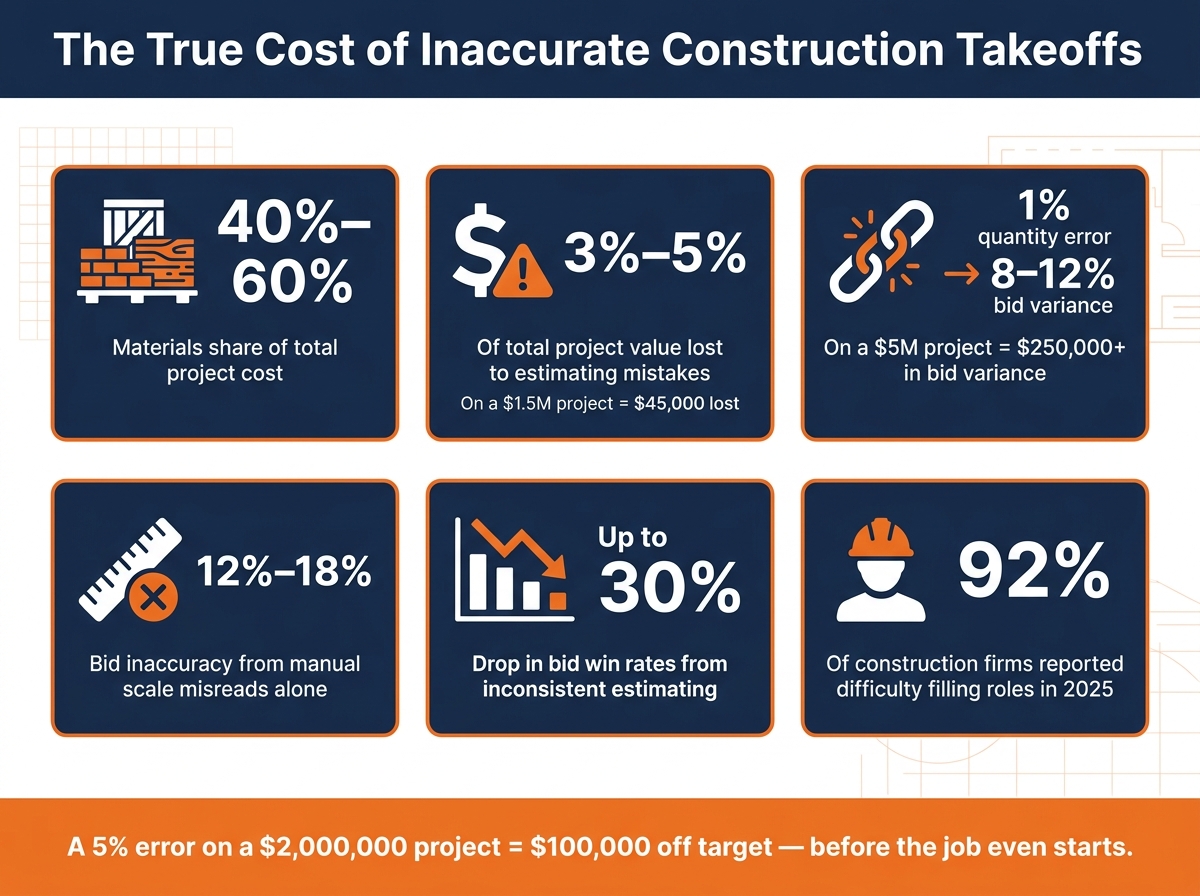
Construction estimating errors cost contractors an average of 3% to 5% of total project value, and projects won with inaccurate takeoffs can lose about 3% of profit per job. On a $1.5 million project, that’s $45,000 gone before closeout.
Unit mistakes can hit even harder. In one case, an estimator won a $1.1 million school renovation bid by $30,000, then found that wall areas had been measured in linear feet instead of square feet. That left the drywall budget off by a factor of nine.
Change Orders, Delays, and Material Waste
Missed scope and weak waste factors often turn into rushed purchases, delivery issues, and crews standing around with nothing to install. Materials get ordered at premium prices, extra deliveries pile on more job costs, and labor time slips away if shipments show up late.
Waste factors are a common trouble spot. Raw plan measurements don’t account for cutting, breakage, or spillage. Standard waste factors – 10% to 15% for framing lumber, 10% to 12% for drywall, and 3% to 5% for concrete – are often skipped.
That might not sound like much at first. But when prices move up, the gap gets painful fast. In early 2026, aluminum prices were up nearly 40% year over year, and nonresidential construction input prices had jumped at a 12.6% annualized rate.
Inconsistent Estimating Across Projects and Estimators
Even good estimators can produce shaky pricing if the team doesn’t follow the same rules every time. Different rounding habits, waste factors, and measurement methods make bids tough to compare – and even tougher to trust.
That lack of consistency creates problems when opportunities move fast. If you can’t confirm that recent bids were built the same way, you can’t tell whether your pricing is competitive or just uneven. Inconsistent estimating can cut bid win rates by up to 30%.
sbb-itb-5eea312
What Accurate Takeoff Services Improve
When the takeoff is right, a lot of downstream risk starts to shrink. Better takeoffs lead to better purchasing, tighter scheduling, and stronger cost control. Put simply, accurate quantities turn drawings into data teams can actually use for buying materials, planning labor, and tracking costs.
Reliable Material Quantities and Labor Forecasts
A QTO measures the net scope from the drawings. An MTO adds waste, overlaps, and packaging to get gross order quantities. That split helps cut ordering mistakes and makes the estimate easier to audit.
When measured quantities are combined with productivity rates and crew makeup, teams can build labor forecasts based on actual scope instead of rough assumptions. That matters even more in a tight labor market. 92% of construction firms reported difficulty filling open positions in 2025, so each crew hour has to be planned with care.
Better labor forecasting also helps tighten bid assumptions.
More Competitive Pricing Without Guessing
Accurate quantities help trim contingency padding and keep bids competitive. A 1% quantity error can snowball into an 8–12% bid variance. On a $5 million commercial project, that can mean more than $250,000 in bid variance.
That same quantity baseline should also carry forward into job cost tracking.
Better Cost Control During the Project
Accurate takeoff data becomes the starting point for budgets, purchase orders, and cost codes. That gives teams a clear way to compare budgeted quantities against actual usage during execution. A 5% variance on a $2 million project equals a $100,000 cost difference. Catch it early, and you protect margin. Catch it at closeout, and the damage is already done.
That baseline also helps project teams spot overruns before they spread. Digital workflows make it easier to keep that baseline in place.
Digital Takeoff Workflows and Software That Reduce Errors
Paper plans and scale rulers leave a lot more room for mistakes. In fact, manual measurement errors from scale misreads alone can lead to 12–18% bid inaccuracies. And it doesn’t take much after that. One bad transcription when someone re-enters totals can throw off the whole estimate.
Digital workflows cut down those risks by automating the math and keeping the data in one place from the first measurement to the final bid. Put simply, every measurement stays tied to the drawing instead of getting lost between notes, spreadsheets, and printed sheets.
How Digital Takeoff Tools Improve Measurement Accuracy
Modern digital takeoff software lets estimators trace plans right on-screen. From there, the software calculates linear footage, area, volume, and unit counts automatically. No manual arithmetic. No ruler-based guessing. This is why many pros use a house building calculator to ensure their initial figures are solid.
So instead of a rough rounded number, you get a precise figure like 1,250.75 sq. ft. or 32.5 cu. yd. That level of detail matters, especially when small errors stack up across a full project.
Two features stand out in day-to-day use:
- Calibration controls make you verify the drawing scale against a known dimension, like a gridline or a standard door opening, before measuring anything. That helps prevent errors from resized or incorrectly scaled PDFs.
- Visual audit trails connect each measurement to a visible markup on the drawing. That makes gaps and double-counts much easier to catch.
Cloud-based version control adds one more layer of protection. When a revised plan set comes in, the whole team works from the latest version automatically instead of relying on an old printed copy.
How Estimating Software Connects Quantities to Costs
Getting quantities right is only half the job. Those numbers also need to move into pricing without someone typing them in again.
When construction finance software connects straight to takeoff data, quantities fill cost line items automatically. No copy-paste. No second entry step. Each item connects to a unit price, a labor rate, and a cost code, and the estimate total builds from there.
That matters because a takeoff mistake doesn’t stay isolated. If a quantity is wrong, it flows straight into pricing and budgets, and the impact spreads through every downstream cost.
Consistent cost codes and reusable assemblies help make this process repeatable. An assembly groups related materials into one measured item. For example, a wall assembly might include studs, plates, and fasteners. Once that assembly is built, estimators can reuse it across projects instead of rebuilding the logic every time.
That saves time, sure. More than that, it keeps the numbers easier to compare across bids, which makes review and auditing much faster.
Using Contractor Foreman as the Central Workflow Hub
The last step is moving those numbers into the live project budget without losing anything along the way. That handoff is where data often slips.
Contractor Foreman keeps estimates, budgets, schedules, and financial tracking in one system, so quantities move from the estimate into the project budget without manual exports. Cost codes stay aligned with job costing, and QuickBooks integration helps keep accounting data synced without duplicate entry.
Web and mobile access also keep office and field teams working from the same numbers, whether they’re at a desk or on-site.
How to Build Accurate Takeoff Practices with Contractor Foreman
Once you spot takeoff mistakes, the goal shifts. Now it’s about turning accuracy into a process your team can repeat job after job.
Standardize Units, Rounding, and Cost Structures
Start by setting one measurement standard before anyone begins a takeoff. If one estimator works in square feet and another rounds to the nearest 10 sq. ft., your numbers won’t line up – and your bids won’t either. Pick your standard units – sq. ft., lin. ft., cu. yd., and EA – and set the decimal precision up front. That way, every estimate follows the same format, no matter who builds it.
Next, apply that same discipline to pricing. Bring in cost codes through CSV so your team works from one shared pricing library. Organize those codes by division to keep scopes clean and easy to review. Then add waste factors right into the database so purchase quantities match what the job will actually need.
Build Reusable Templates and Connect Them to Budgets
Once those standards are in place, turn repeat scopes into templates. This gives every estimate the same starting point and cuts down on missed scope. Use Item Groups to save repeat assemblies like framing packages or concrete pours. Save full estimate structures as Estimate Templates for your main project types so each scope section is already there when the estimate begins.
From there, takeoff quantities can move straight into the project budget. That gives you a cost baseline you can track against as the job moves forward. When scope changes come up, use Change Orders > Import from Estimate to carry over pricing, codes, and a clear audit trail. The payoff is simple: bids, budgets, and change orders all stay tied to the same numbers.
Here’s how each workflow step maps to Contractor Foreman:
| Workflow Step | Contractor Foreman Feature | Business Outcome |
|---|---|---|
| Takeoff | Digital Takeoffs & AI Assistant | Faster measurements; reduced manual error |
| Estimate | Estimates Module & Cost Items Database | Consistent pricing; no duplicate data entry |
| Budget | Project Budgeting & Financials | Real-time Budget vs. Actual tracking |
| Change Order | Change Orders (Import from Estimate) | Cleaner change management; clear audit trail |
| Reporting | WIP Reports & Financial Reports | Stronger forecasting; early variance detection |
A practical rollout takes about four weeks:
- Week 1: Audit and import your cost codes
- Week 2: Build Item Groups and Estimate Templates
- Week 3: Train estimators on digital calibration and AI-assisted measurement
- Week 4: Set up a Schedule of Values (SOV) workflow to connect takeoff quantities to progress billing
Conclusion: Accurate Takeoffs Are a Profit and Control Issue
Inaccurate takeoffs don’t just hurt the bid. They follow you through the whole job. Overruns, change order disputes, material shortages, and schedule delays often start with quantity mistakes made before construction begins. Accurate takeoffs make estimating a controlled, repeatable process that protects profit.
FAQs
What is included in a construction takeoff?
A construction takeoff is the process of reviewing project drawings and specs to measure and quantify the physical scope of work. It gives you the baseline data needed for estimating, bidding, and buying materials.
A takeoff usually includes:
- Quantities like lengths, areas, volumes, and item counts
- Material needs, including types, sizes, and specs
- Labor hours, equipment needs, and waste factors or contingencies
Put simply, a takeoff defines the scope of the job – not the final price.
How do inaccurate takeoffs affect profit?
Inaccurate takeoffs cut into profit because they throw off a project’s financial base. If you underestimate quantities, contractors often have to eat unplanned material and labor costs. That can squeeze margins fast or turn the whole job into a loss.
Overestimating quantities creates a different problem: bids come in too high, and you can lose the work before the project even starts. Either way, mistakes can lead to change orders, idle crews, and rush material orders that burn through cash in a hurry.
How can digital tools improve takeoff accuracy?
Digital tools make takeoff work more accurate by replacing manual, error-prone tasks with on-screen measurement. Instead of marking up paper plans and double-checking math by hand, estimators can upload drawings into software and measure areas, lengths, and counts directly. That cuts down on calculation mistakes and transcription errors.
They also leave a visual audit trail tied to exact spots in the drawings. That makes quantities easier to review, check, and explain if someone asks where a number came from. On top of that, real-time drawing comparisons and AI-supported calculations help estimators keep numbers consistent and in line with the job’s needs.







