
- Why Ignoring Residential Construction Law Hurts More Than You Think
- How Legal Missteps Become Expensive Business Problems
- Why Legal Protection Needs a System—Not Just Good Intentions
- How Professional Contractors Protect Themselves From Legal Exposure
- What Contractors Gain When Compliance Systems Are in Place
- Four Legal Traps That Catch Even Experienced Contractors
- Compliance Is Legal and Operational
A 2023 survey by NAHB/ICC found that 45% of residential field inspections resulted in code violations, and 33% of residential construction projects were denied due to code violations. Most contractors don’t realize how often even minor oversights lead to inspections and official warnings.
Residential construction law is more than paperwork. In reality, local ordinances, HOA rules, and permit clauses hide layers of liability. A small oversight, such as missing a setback mark or skipping a required cleanup step, can trigger a stop-work order, fines, or a mandatory re-inspection.
Legal compliance underpins project flow, financial stability, and client trust. Without consistent documentation of permits, crew actions, and communications, contractors expose themselves to risks that go beyond a single job.
Now, let’s walk through how structured systems intervene before those vulnerabilities escalate into serious shutdowns.
Why Ignoring Residential Construction Law Hurts More Than You Think
Contractors often assume that if they’ve pulled a permit, they’re covered. However, there’s a lot more to residential construction law that contractors need to be aware of.
Cities, counties, and HOAs enforce rules that vary block by block about noise hours, fence placement, dumpster staging, stormwater runoff, debris containment, and even tool storage. Failing to have any of these in place can result in a stop-work order or a fine, even if the client has given their approval for the plan.
The most common violations include:
- Starting too early or finishing too late in noise-restricted zones
- Working without site signage when required
- Skipping debris containment or proper disposal steps
- Overlooking HOA regulations, even when city rules are followed
These violations don’t always show up immediately. In many cases, they surface weeks into the project, after an inspector visit, a neighbor complaint, or a surprise HOA notice. That timing makes them harder to resolve because the job is already in motion, subs are already scheduled, and delays start to compound.
Contractors also face liability even when violations stem from homeowner decisions. If a client insists on skipping a minor condition in the permit agreement, and you comply without logging the change, you’re the one exposed. Inspectors and enforcement boards don’t weigh who gave the instruction; they look at who signed the permit.
The gap between what is approved on paper and what is enforced in practice leaves contractors vulnerable. Without a structured system to track compliance, it’s easy to miss a rule—and even easier to get blamed for it.
How Legal Missteps Become Expensive Business Problems
Legal violations rarely stay isolated. One citation or stop-work order almost always sets off a chain reaction that slows down your job, frustrates your client, and bleeds into future work. Most contractors don’t factor in how quickly these costs accumulate, not just in fines but also in lost time and credibility.
What starts as a missed rule turns into compounding delays, rework, and liability. Here’s a typical timeline of what a single overlooked violation can cost:
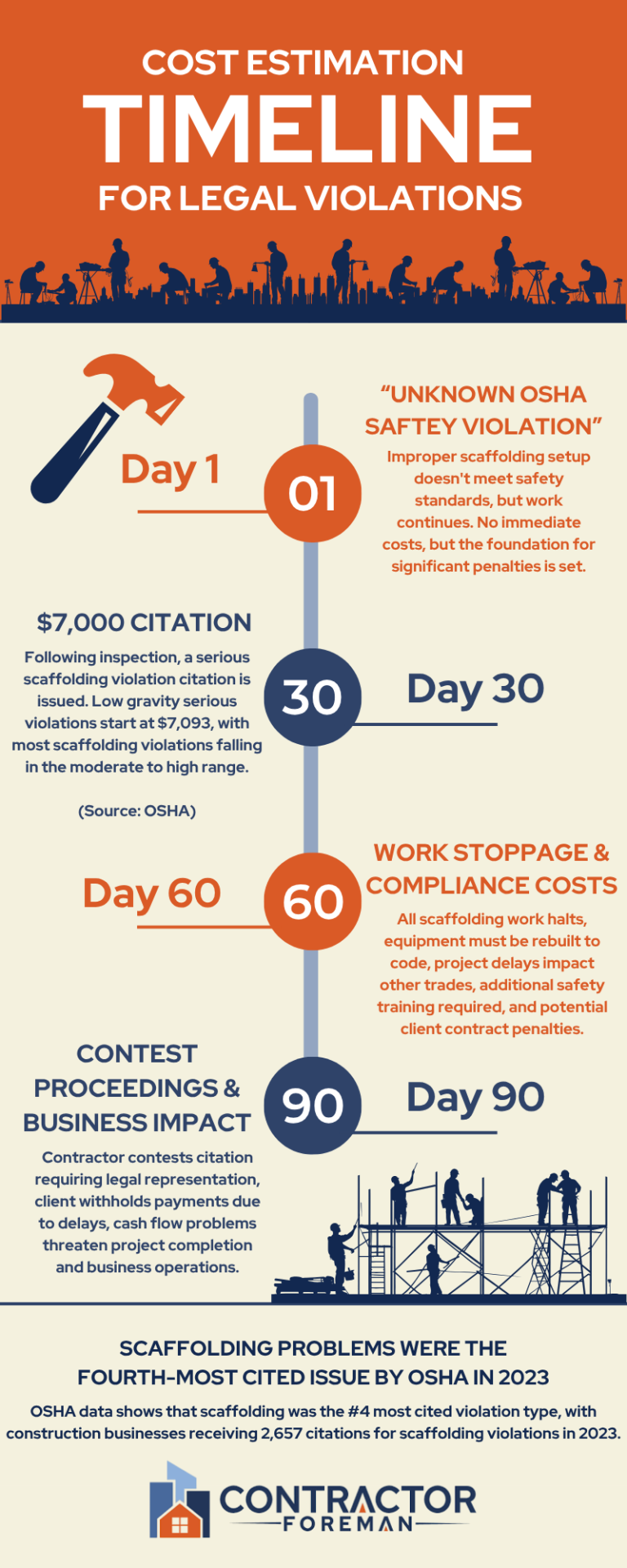
1. A Stop-Work Order Doesn’t Just Pause One Job
Every day of delay affects multiple trades. Framers shift to the next project. Drywall schedules slide. Rescheduling inspections takes time you don’t control. What looked like a one-day citation becomes a week of lost momentum, and you’re still paying overhead while work stalls.
2. Clients Lose Confidence Quickly
The moment a city inspector shows up unannounced or the HOA sends a formal notice, homeowners start asking questions. Why didn’t you know about that setback rule? Why wasn’t that approval posted on-site?
Even if they don’t say it directly, your professionalism is under review. And when confidence drops, referrals stop.
3. Legal Trouble Spreads Past the Jobsite
Violations affect more than your current client. Insurance providers review claims history during renewals. Lenders or developers may scrutinize past disputes when evaluating future partnerships.
In some cities, repeat offenses affect license standing or future permit processing times. These risks don’t just damage one project—they threaten your ability to win the next one.
Contractors who view compliance as an isolated task miss the broader risk. Legal issues can create operational, financial, and reputational damage, none of which are reflected in a standard project estimate. Without a system in place, you’re absorbing liability every time you break ground.
Why Legal Protection Needs a System—Not Just Good Intentions
Most contractors don’t intentionally ignore the law. However, relying on memory, emails, and scattered notes leaves too much room for error, especially when cities, HOAs, and permit offices all operate independently of one another. A permit isn’t enough. You need proof that the job followed the permit requirements at every step.
Without structure, it’s easy to miss a rule and even easier to be blamed for it.
Here’s where most breakdowns happen:
- No daily record of job site activity: If an inspector claims a violation happened on Tuesday, and you can’t show who was on-site or what was done, you’re cornered.
- Permit approvals aren’t shared with clients or crew: Without visibility, the homeowner can unknowingly override compliance requirements, and you’re the one who takes the hit.
- Changes occur in the field but aren’t documented: A crew adjusts fence placement or shifts materials closer to a setback zone, thinking it’s a minor adjustment. If that change isn’t logged, it becomes a code violation with no defense.
- Crew doesn’t know what’s required: Site signage, work hour limits, and containment procedures often fall apart because no one communicates the rules clearly.
These aren’t one-off mistakes. They’re system failures. Contractors who fail to establish a daily process for tracking compliance put their licenses, reputation, and income at risk.
Legal protection doesn’t start with your attorney. It starts on-site with how you document, communicate, and coordinate the work. Let’s break that down.
How Professional Contractors Protect Themselves From Legal Exposure
Avoiding legal problems in residential construction isn’t about checking boxes—it’s about building a daily workflow that makes compliance visible, verifiable, and shared. The most effective contractors rely on three core practices to reduce risk across every job site.
Turn Every Workday Into Legal Evidence With Daily Logs
Verbal updates and memory aren’t defensible when fines, insurance audits, or stop-work orders hit. A complete daily log gives you time-stamped proof of the following:
- Who was on-site, and when
- What work was performed
- Weather or safety-related delays
- Any city, HOA, or inspector interactions
- Crew actions tied to code-related tasks (signage, noise start time, containment)
If a permit condition is questioned, your log shows what happened down to the hour. It’s your first line of legal defense, and it’s what separates professionals from exposed operators.
A Client Portal Keeps Compliance Visible and Shared
Homeowners aren’t always the problem, but they often make things harder, especially if they don’t understand what you’re required to do. A client-facing portal builds protection in three ways:
- Shares current permit approvals, notices, and conditions
- Documents conversations around rule changes or homeowner requests
- Confirms when clients are notified about constraints like noise hours or dumpster locations
If a client tells the HOA, “I didn’t know,” and you’ve logged the update they approved, you’ve already defused the problem.
Coordinate Legal Compliance Across the Crew
Crews and subs don’t need legal training, but they do need clarity. A shared internal channel creates alignment:
- You can flag jobs with HOA involvement or unusual local rules
- Instructions about containment, hours, or setbacks don’t get lost
- PMs and supervisors can escalate questions instead of improvising
Legal issues can arise when a crew member tries to “just get it done.” Internal coordination reduces the need to fix compliance problems after the fact.
Compliance isn’t just paperwork. It’s communication: up, down, and across every job. Professionals don’t guess their way through it. They build systems that make the rules easy to follow and hard to ignore.
What Contractors Gain When Compliance Systems Are in Place
Contractors who document consistently and communicate clearly avoid more than just fines—they keep projects moving, protect payment schedules, and avoid being blamed when problems arise.
A contractor in Colorado avoids a $2,500 citation when a neighbor claims his crew started too early. Instead of arguing, he shared a daily log that showed his team doesn’t begin work until 8:15 a.m., along with photo evidence. The complaint was dismissed, the inspector closed the file, and the client appreciated the fast resolution.
Another builder in Southern California used a client portal to prevent a chargeback. After the homeowner disputed a cleanup fee, citing an HOA violation, the contractor shared documentation from two weeks earlier.
It included the HOA notice, the agreed-upon cleanup plan, and the homeowner’s written approval. The issue ended there with no refund and little friction.
These aren’t rare cases—they’re examples of what happens when documentation is part of the process, not a reaction after the fact. The common thread wasn’t luck or lenient inspectors; it was structure.
Contractors who rely on memory, emails, and verbal agreements will continue to get caught off guard. Instead, successful contractors use construction management software that includes daily logs, client-facing records, and internal coordination tools. It enables them to stay protected without slowing down the job.
Book a demo today to see how Contractor Foreman, an all-in-one construction management software that brings a client portal, daily logs, and documentation together, anywhere, can work for your company.
Four Legal Traps That Catch Even Experienced Contractors
Legal problems in residential construction rarely stem from a single major mistake. Most issues start small. They’re overlooked, undocumented, or miscommunicated. Then they grow until they stop a project cold. These are the errors that appear across the industry, even among knowledgeable contractors in their trade.
1. Assuming a Permit Covers Everything
Pulling a permit doesn’t mean you’re in full compliance. Cities layer on conditions related to noise, access, environmental controls, and more. HOAs add another layer that may not show up in the permit at all.
Instead: Treat the permit as a starting point. Document every condition, communicate it to the crew, and track any updates or additions from the city or HOA.
2. Failing to Record Inspector Interactions
Inspectors may give verbal approvals, informal warnings, or time-based conditions. Without a record, you have no proof of what was said or when.
Instead: Log every visit, phone call, and direction received. Add photos and notes into the same system you use for daily logs.
3. Leaving Legal Details to the Homeowner
Clients sometimes pressure crews to “just get it done,” even if it conflicts with regulations. If you comply and things go sideways, the liability doesn’t fall on them.
Instead: Never rely on verbal homeowner approvals when rules are in play. Confirm and document any request that alters scope, schedule, or site requirements.
4. Letting Crews Work Without Clear Rule Briefings
If a subcontractor dumps debris in the wrong spot or a laborer starts work before legal hours, the blame doesn’t stop at them—it rolls uphill.
Instead: Share the job’s compliance rules with your team before work starts. Use internal chat or a written brief. Accountability starts with clarity.
You can’t fix what you don’t track. And you can’t defend what you didn’t document. Legal risk isn’t just about knowing the rules—it’s about building a process that makes them hard to break.
Compliance Is Legal and Operational
Legal violations rarely begin with poor work. They start with silence: no documentation, no process, no shared understanding of what’s required. One overlooked setback, missed log entry, or ignored HOA clause can stall your job, trigger fines, and damage future business.
You’ve seen where the risk comes from: scattered communication, unclear crew direction, and assumptions about what’s covered. You’ve also seen how professional contractors avoid these problems with daily logs that create proof, client-facing tools that align expectations, and team coordination that keeps the job compliant in real time.
Most violations don’t feel urgent until they become expensive, but by then, you’re not just managing a project—you’re defending it.
You could track all of this manually, but when it’s your name on the permit and your company is at risk, guesswork won’t suffice.
Build your legal protection into how you work by using the right project management software. Start your free trial of Contractor Foreman before the next complaint turns into a shutdown.







