
- Remodeling vs. Construction: Why Definitions Matter for Cost Control
- Real-Time Cost Tracking: The Difference Between Profits and Losses
- What Is the 30% Rule in Remodeling?
- Digital Cost Tracking vs. Manual Methods
- Managing Scope Changes Without Sacrificing Profit
- What Is the Difference Between Remodeling and Renovating?
- Keeping Projects Profitable: Real-Time Tracking and Early Warnings
- Protect Your Profits with Cost Control
Ask any contractor what keeps them awake at night, and “jobs running over budget” will always rank high. Up to 70% of construction projects are predicted to overshoot their budgets, with remodeling projects leading the pack.
The sting comes when the numbers surface only after the job is finished. By then, it’s too late because the work is done, payments are in, and the profit margin has vanished.
Yes, poor workmanship drains money, but the real killers are the small leaks: hours that don’t get logged, sudden spikes in material costs, or subcontractor bills that land higher than expected. One or two may feel minor, but stacked across a project, they chip away at profitability until it disappears.
What separates struggling contractors from consistently profitable ones isn’t chance—it’s visibility. Tracking costs as they happen removes the guesswork and shows where money is going while there’s still time to act. Skip that visibility, and you’re steering blind, hoping the job doesn’t bleed you dry.
Remodeling vs. Construction: Why Definitions Matter for Cost Control
Before discussing cost control further, it is helpful to separate two terms that are often confused by clients and sometimes contractors. Remodeling and construction overlap, but they’re not the same, and the difference has a direct impact on profit margins and long-term sustainability.
Construction usually means building from the ground up or expanding what already exists. These jobs are often more predictable: labor and materials can be estimated with a fair degree of accuracy, and although surprises still occur, the overall scope tends to stay steady, giving contractors more control over budgets.
Remodeling creates far more risk. Altering layouts, structures, or systems means opening walls, floors, or ceilings, and that’s when the hidden issues appear. Old wiring, hidden leaks, non-standard framing, or past DIY fixes can all derail a carefully built budget and force expensive mid-project adjustments.
Clients also come into remodeling projects with different mindsets. Many see it as a simple “update,” but in reality, it can carry the complexity of new construction with none of the predictability.
That mismatch often triggers scope changes in the middle of the job, which only makes careful cost tracking more vital to staying profitable.
Construction jobs can often stay within initial estimates, but remodeling projects often involve shifting targets and financial uncertainty. Without real-time tracking and the ability to adjust quickly, profits evaporate before most contractors even realize what happened.
Real-Time Cost Tracking: The Difference Between Profits and Losses
For most small and mid-sized contractors, the jobsite demands nonstop attention from directing crews to coordinating subs, and keeping materials flowing so work doesn’t stall.
With so many moving pieces, it’s tempting to believe the numbers will fall into place once the dust settles. The trouble is, by the time you check, the profit you counted on may have already slipped away unnoticed.
Real-time cost tracking changes that dynamic completely. Instead of waiting until the last invoice to discover where you stand, you see how every dollar moves as the project unfolds. That insight matters because:
- Small overruns compound quickly. A few hours of your crew working without recording it or a delivery that comes in $1,500 higher than expected may seem minor, but stacked together, they can erase a healthy margin by the project’s end.
- Clients hate last-minute shocks. Most homeowners accept paying more for extra work when it’s explained up front. What they won’t accept is an unexpected final bill that lands thousands above the original estimate.
- Early insight allows course correction. Spotting a labor spike mid-project gives you options: reshuffle schedules, renegotiate sub rates, or pause material orders before costs spiral out of control.
For example, your lumber supplier doesn’t just drop off a pile of 2x4s and say, “Pay me when you feel like it.” They issue a clear invoice so you always know the exact number. Your projects deserve that same transparency because without it, you’re steering blind and hoping for luck.
The contractors who consistently protect their profits aren’t relying on easy jobs. They’re the ones who monitor the financial picture in real time and act before problems grow into disasters.
What Is the 30% Rule in Remodeling?
Most contractors have heard the rule of thumb: set aside 20–30% of a remodeling budget for hidden issues. It’s sound advice—once walls come down, problems almost always surface.
The catch is that a contingency only works if you know how quickly you’re using it. Without active tracking, that safety net evaporates faster than a box of screws on a crowded jobsite.
How It Plays Out in Real Life
Let’s say you price a higher-end kitchen remodel at $50,000 with an $16,000 cushion.
- Midway through, you uncover outdated wiring that must be upgraded to code, which may mean $7,500 is now gone.
- A week later, your cabinet supplier raises prices by 8%, wiping out another $2,400.
- Soon after, a subcontractor submits an invoice $3,000 higher than the original estimate.
At this point, you’ve already burned $12,900 of the contingency, and the project isn’t close to finished.
When costs are logged in real time, you see how fast the cushion shrinks, and you can adjust before profits vanish. You can also discuss the increase with the client in the moment before the job is complete and the budget is blown.
Here’s the reality: What destroys trust with a client is dropping a surprise bill at the end. Try showing clients live updates with explanation: “Here’s the issue, here’s the cost, here’s the revised budget” protects your margin and earns confidence.
The 30% rule works as a buffer, but it’s not the only plan. Contractors who stay profitable use live cost tracking to measure that buffer in real time and adjust before a project spins out of control.
Digital Cost Tracking vs. Manual Methods
Many contractors still juggle spreadsheets, scribbled notes, and receipts stuffed in glove boxes to monitor project costs. It works—until it doesn’t. Manual methods are slow, prone to mistakes, and force you to react long after the damage is done.
Digital cost tracking eliminates that guesswork by pulling every number into a single system and updating it in real time. Instead of chasing paperwork or waiting for the bookkeeper’s report, you see a live snapshot of your finances while work is in progress. The switch matters because:
- Purchase Orders keep spending under control. Instead of a crew member making an unplanned $800 supply run, a PO system ensures every expense is tied to the project and approved before it hits the budget.
- Subcontractor tracking prevents overpayment. Compare invoices against agreements immediately and stop extra charges before you sign the check, keeping labor costs aligned with what was negotiated.
- Bills and small expenses stay visible. A $400 rental or dump fee might feel minor, but several overlooked charges can erase weeks of profit if they’re not tracked.
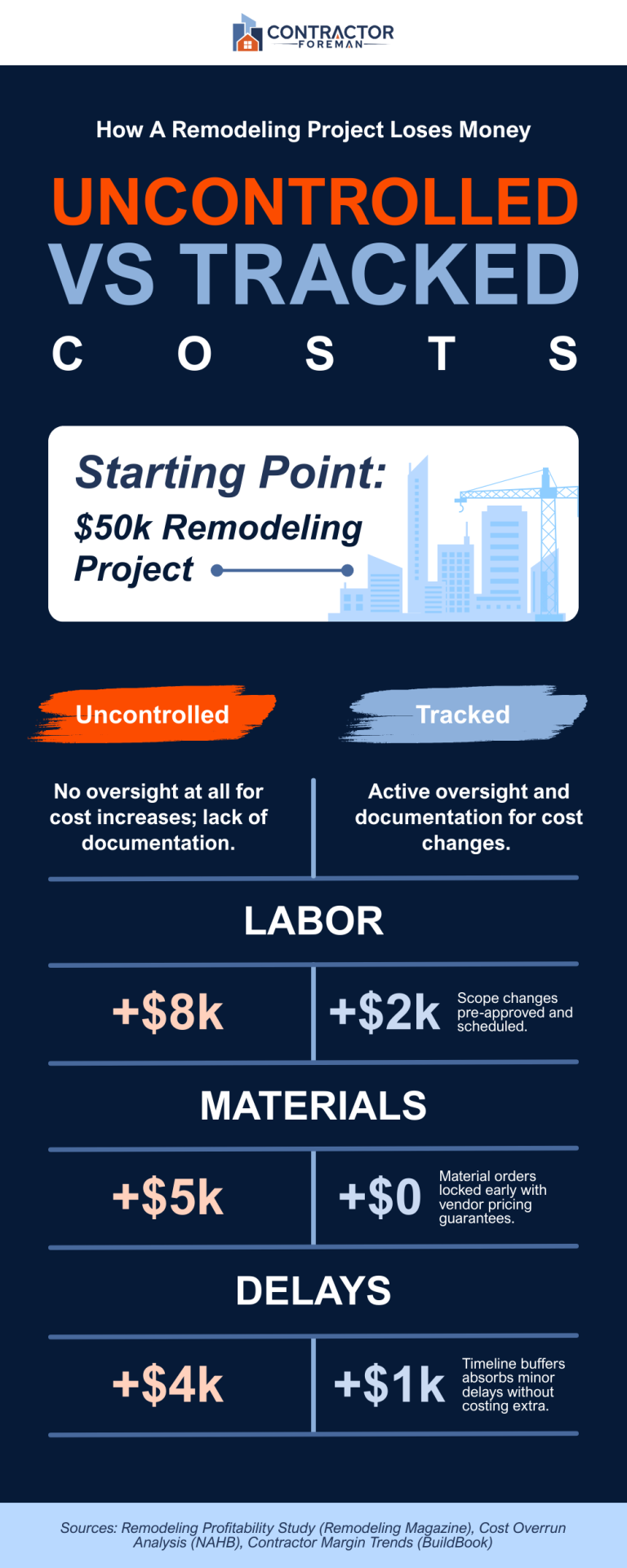
Think of it this way: you’d never frame a house without a level. The walls may lean, and the doors might not fit. Digital tools act like the level, square, and tape measure for your finances, keeping everything aligned before you take the next step.
Managing Scope Changes Without Sacrificing Profit
Handling client-driven scope changes ranks among the toughest challenges for small and mid-sized contractors.
A homeowner might request a larger kitchen island, swap out a bathroom fixture, or change flooring materials midway through a project.
Every change ripples through the budget: requiring extra labor, adding materials, and occasionally requiring adjustments to subcontractor agreements. If left untracked, these shifts quietly eat into your profit margin.
Consider a contractor renovating a historic home. Mid-project, the client opts for higher-end bathroom fixtures, adding $4,500 in material costs alone. Without careful tracking, absorbing that expense could have caused tension or worse, a financial loss.
Using real-time cost tracking, the contractor immediately updated the budget, recorded new material costs using purchase orders, and notified subcontractors of the revised plan.
All these updates were shared with the client, including showing them how the budget will be impacted and the options they can offer to offset costs.
The outcome was that the client approved changes with less hesitation, the project stayed on schedule, and the profit margin remained intact. Tracking every adjustment turns potential headaches into opportunities for clear communication, smoother workflow, and trust.
Pro tip: Log all mid-project changes immediately. Book a demo of Contractor Foreman and see how contractors using these systems aren’t just cleaning up paperwork; they’re protecting profit margins every single day.
Tools like Contractor Foreman also make it easy to adjust budgets, track subcontractor costs, and generate client-ready reports, protecting your margin while accommodating changes efficiently.
What Is the Difference Between Remodeling and Renovating?
As a contractor, you already know the difference between remodeling and renovating. The problem is that many clients don’t, and that confusion is often what blows up budgets.
Renovating typically involves surface-level upgrades, such as painting, installing new flooring, and replacing fixtures. It’s mostly cosmetic, which makes costs fairly predictable.
Remodeling involves altering the structure, layout, or systems of a building. The second you open a wall, you’re stepping into unknown territory with potentially bad wiring, water damage, code issues, or old “DIY fixes” from a past owner.
Here’s why this matters: if a client thinks they’re “just renovating,” they’ll expect the price tag to stay tight. But once hidden problems come to light, those expectations crash headfirst into reality. That’s when you get the dreaded: “Why is the final bill so much higher?”
Tracking costs helps you control them as they occur, which in turn helps you avoid the unpleasant discussion of a final bill. When you can show clients exactly where money is going—“We found outdated plumbing, here’s the cost impact”—they understand the difference between the original renovation estimate and the actual remodeling work that’s happening.
Remodeling projects come with moving targets. Renovations usually don’t. The contractors who stay profitable are the ones who track those moving targets in real time and communicate clearly before surprises turn into disputes.
Keeping Projects Profitable: Real-Time Tracking and Early Warnings
How you track labor, count materials, and pay subcontractors can help you catch issues before they damage your profit margin, and give you the ability to act immediately.
Labor: Monitor Hours Before They Erode Profit
Unexpected overtime, extra touch-ups, or on-site problem-solving can quietly reduce your margin.
A real-time cost tracking system lets you compare actual crew hours to estimates as work unfolds, giving you the chance to adjust schedules, reallocate resources, or prevent overruns before they become a financial headache.
Materials: Prevent Surprises Before Delivery
Price spikes on materials, damaged goods, or wasted supplies can silently drain your budget, but with the right techniques, you’ll know the cost of each delivery and its effect on the estimate, eliminating unwelcome surprises on the final invoice.
Digital tracking provides complete visibility into every purchase, and purchase orders ensure that every expense is approved and tied to the relevant project.
Subcontractors: Keep Contracts and Invoices Aligned
Even minor discrepancies on subcontractor invoices can hurt profitability. Bills & expenses tracking lets you match invoices to the subs agreements in real time, catching extra charges before they’re paid. This keeps work flowing smoothly, protects margins, and builds trust with clients.
Early Warnings: Course-Correct Before It’s Too Late
The real advantage comes from seeing all costs together. Live tracking of labor, materials, and subs delivers early warning alerts for potential overruns.
Acting on these signals is like having a profit dashboard: small problems can be corrected before they turn into major project disasters.
Protect Your Profits with Cost Control
Profitability in remodeling and construction doesn’t happen by chance. Instead, it comes from precise control. Contractors who monitor costs in real time, track labor and materials, and receive early alerts consistently finish jobs on budget and safeguard margins—all things clients love.
Contractor Foreman’s digital cost tracking features provide the insight, organization, and confidence you need to catch issues before they escalate, make informed decisions instantly, and protect every dollar you earn.
Start your 30-day free trial and keep margins intact, clients satisfied, and stress off your plate. Your business deserves that clarity and control today.







