
According to the U.S. Bureau of Labor Statistics, of the 43,277 construction businesses that formed in March 2011, only 37.6% were still in operation 10 years later. For small contractors, one delayed project doesn’t just hurt profits—it can put everything at risk.
When Walmart’s new distribution center runs three weeks behind, it’s Tuesday. When your roofing project hits the same delay, it’s a business-ending crisis. Large firms have deep pockets and backup plans. Small contractors have hope, hustle, and no margin for error.
Construction schedule issues create a perfect storm for smaller operations. When projects run behind schedule, payment delays compound exponentially. Clients withhold payments on incomplete work while you’re still covering payroll, materials, and subcontractor costs for multiple jobs. Unlike your bigger competitors, who can shift resources between dozens of projects, you’re working without a safety net.
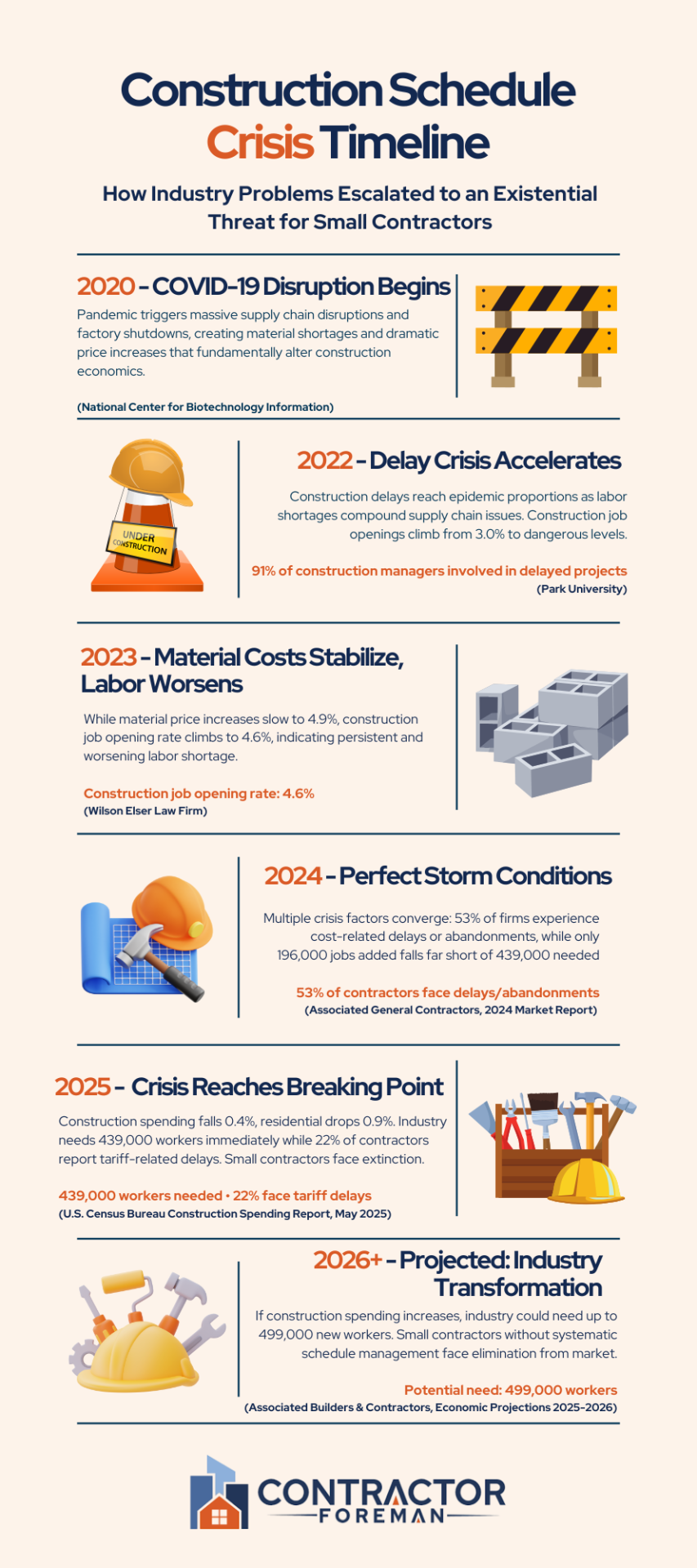
Systematic schedule management isn’t just good business practice for small contractors—it’s the difference between thriving and going out of business. With 91% of construction professionals reporting involvement in delayed projects, up from 85% in 2016, and 53% of firms experiencing cost-related delays or abandonments in 2024, the pressure on small contractors has never been higher.
Why Schedule Delays Hit Small Contractors Harder
Construction delays aren’t getting better—they’re getting worse. According to Cornerstone Projects, 91% of construction professionals report involvement in delayed projects, up from 85% in 2016. The problem is accelerating, not stabilizing.
As for project completion rates? Some research shows that only 25% of construction projects are completed within 10% of their original deadlines. Large projects typically take 20% longer than expected, while mega projects see delays or budget overruns 98% of the time.
For small contractors, these statistics represent existential threats rather than acceptable business risks. General contractors with fifty active projects can absorb a few delayed jobs. Small contractors running three to five projects simultaneously cannot.
The Snowball Effect
Construction schedule issues compound differently for smaller operations. Crew scheduling conflicts that would be minor inconveniences for larger firms cascade across your entire business when you can’t simply reassign workers from other projects. Overbooking construction crews becomes a dangerous necessity when you’re trying to maximize revenue from limited resources.
Client change orders causing delays can become hazardous territory. Large contractors often have the leverage and established relationships to push back on unreasonable timeline demands. Small contractors generally lack the negotiating power to refuse changes that could disrupt their schedules, especially when competing for repeat business or working with their largest clients.
Communication breakdowns between trades cost exponentially more when you’re wearing every hat. Project managers at large firms focus solely on coordination and oversight. Smaller contractors juggle project management alongside estimating, sales, and running the business. A missed call or delayed email can derail an entire project timeline.
Resource overbooking shifts from calculated risk to survival gamble. Large firms maintain buffer crews and equipment that can be deployed when construction schedule issues arise. Small contractors typically operate at capacity, meaning any scheduling disruption forces them to make impossible choices between disappointing clients or working crews into exhaustion.
Did You Know? Schedule delays don’t just disrupt timelines—they destroy cash flow patterns that keep small contractors afloat. Managing construction cash flow becomes even more critical when schedule delays compound these operational challenges.
The 5-Pillar Schedule Protection System
Small contractors need systematic approaches to scheduling that protect both timelines and cash flow. These five pillars create a defense system against the scheduling chaos that destroys smaller operations.
Pillar 1: Change Order Command Center
Design changes account for 7-10% of total project costs and contribute to delays in 35-40% of projects. Most contractors focus on the cost impact and miss the schedule devastation.
Change orders add work while shattering carefully planned sequences. A simple electrical change can delay drywall installation, which in turn pushes back flooring, ultimately affecting the final inspection.
Create structured workflows that evaluate every change for both cost and schedule impact before making a decision. Require clients to acknowledge timeline adjustments, not just price increases. Document everything immediately and establish clear approval processes that prevent work from starting until agreements are signed.
Track pattern data from your change orders. Certain clients or project types consistently generate changes that destroy schedules. Use historical data to build appropriate buffers into future estimates.
Spreadsheets can track basic change order information, but Contractor Foreman automatically calculates timeline impacts and maintains complete change order audit trails that protect you during payment disputes.
Pillar 2: Realistic Resource Planning
Poor planning and unrealistic scheduling remain the #1 cause of delays, chosen by 31.4% of respondents in one survey as the primary reason for project failures. Optimistic scheduling tanks more small contractors than aggressive competitors ever will.
Calculate crew productivity based on your historical performance, rather than relying on industry averages or wishful thinking. Account for equipment maintenance, sick days, material delivery delays, and inevitable interruptions—schedule crews for seven hours of productive work in eight-hour days rather than hoping for perfect productivity.
Build contingency time directly into schedules rather than hoping everything goes perfectly. Weather delays, permit issues, and material shortages aren’t exceptions but standard operating conditions that regularly cause construction schedule breakdown.
Map dependencies carefully between different trades and phases to ensure optimal efficiency. Document actual performance on completed projects to improve future planning accuracy.
Pillar 3: Communication Systems That Prevent Cascading Delays
Information silos between trades, suppliers, and clients compound delays exponentially. Resource constraints affect approximately 30% of projects worldwide, often because coordination failures prevent the efficient deployment of resources.
Daily standup meetings keep everyone aligned on priorities and potential construction schedule issues. Spend ten minutes each morning reviewing critical tasks, identifying bottlenecks, and coordinating between crews.
Establish clear progress reporting templates that capture actual completion percentages, not wishful estimates. Require specific, measurable updates: “Kitchen cabinets installed and secured” rather than “kitchen work progressing well.”
Develop stakeholder notification systems that alert relevant parties when schedules are updated. Document all communication through centralized systems, rather than relying on phone calls and text messages. Real-time monitoring tools provide transparency that prevents minor problems from becoming disasters.
Pillar 4: Strategic Buffer Management
Small contractors face a cruel paradox: they need schedule buffers more than large firms, but can afford them less. Weather-related delays alone account for 3-5% of total project duration, yet traditional 20% buffers make small contractors uncompetitive in bidding.
Smart buffer allocation focuses protection where you need it most. Build larger buffers into uncertain phases, such as permits, inspections, and weather-dependent exterior work. Use smaller buffers for controlled phases like interior finishing, where variables are more predictable.
Build working buffers into daily schedules rather than adding buffer time at the end of a project. It’s better to schedule for realistic productivity, not theoretical maximums.
Communicate buffers strategically to maintain competitive positioning. Provide realistic completion dates that include reasonable contingencies without explicitly highlighting the buffer time. Create buffer recovery plans for when contingencies get consumed.
Pillar 5: Technology as Your Competitive Equalizer
McKinsey reports that up to 80% of projects experience delays due to poor planning; yet, small contractors often rely on manual methods, which typically lead to planning failures. Digital tools level the playing field with larger firms that have dedicated project management teams.
Critical path identification reveals which activities truly control your project timeline, allowing you to focus resources on tasks that actually determine completion dates. Automated progress tracking builds on this foundation by eliminating guesswork and capturing real performance data that improves future estimates. Predictive scheduling takes the process further by analyzing your historical performance to anticipate bottlenecks before they occur.
Integration between scheduling, estimating, and accounting systems prevents the coordination failures that plague manual processes. When scope changes affect budgets, timelines update automatically rather than requiring separate manual adjustments. Mobile access ensures your entire team stays connected to current schedules and updates, whether they’re in the office or on job sites.
Large construction firms already use enterprise-level project management systems as standard operating procedure. Small contractors can access similar capabilities through specialized platforms designed for smaller operations, creating competitive advantages that help win projects and complete them profitably.
Contractor Foreman delivers enterprise-level scheduling and project management capabilities specifically designed for small to mid-sized contractors, without the complexity and cost that make traditional systems impractical for smaller operations.
Real World Application: How Strategic Schedule Management Transforms Small Operations
A small residential contractor was drowning in schedule chaos. Forty percent of projects ran over schedule, creating constant cash flow crises and threatening client relationships. The breaking point came when three concurrent projects hit delays simultaneously—material shortages on one, change orders on another, and weather delays on the third.
Crews sat idle on one job while being desperately needed on another. Client complaints escalated. Cash reserves depleted rapidly as payment schedules collapsed along with project timelines.
The contractor implemented systematic change order management and realistic resource planning with strategic buffer allocation. Rather than hoping for perfect conditions, they scheduled around reality and created structured workflows for handling inevitable disruptions.
Results came quickly. Within six months, the contractor achieved a 95% on-time completion rate. Project capacity increased 30% without adding overhead costs. Cash flow emergencies disappeared as predictable schedules enabled predictable payments.
Key Insight: “The difference wasn’t working harder—it was having systems that prevented small problems from becoming crises.”
Construction management software users report 24% higher profit margins compared to those using manual methods. Contractors who use systematic approaches to scheduling exhibit measurably better survival rates in competitive markets.
Book a Free Demo to learn more about how Contractor Foreman’s scheduling tools deliver similar results for small contractors →
Where Schedule Management Goes Wrong
Even contractors who recognize the need for better scheduling often sabotage their own efforts through predictable mistakes. Understanding these common construction schedule issues and pitfalls helps you avoid the traps that turn well-intentioned schedule improvements into expensive failures.
Pitfall 1: The “Wing It” Mentality
Success with small projects breeds dangerous overconfidence. Contractors who complete a few residential jobs on time assume they can handle larger or multiple projects using the same informal approach. Complexity scales exponentially, not linearly.
What works for a single bathroom remodel creates chaos when managing three concurrent projects with overlapping trades, varying client demands, and competing resource needs. Systematic approaches from day one prevent this scaling disaster, even when projects seem simple enough to manage informally.
Pitfall 2: Technology for Technology’s Sake
Many contractors assume that any run-of-the-mill digital tool automatically solves construction schedule issues. In reality, using the wrong tools can create more chaos, not less. Overly complex software designed for enterprise clients overwhelms small contractors with features they don’t need. Meanwhile, basic apps lack the construction-specific functionality required for effective project management.
Focus on workflow first, then find supporting technology. Define your actual scheduling needs, communication requirements, and reporting processes before selecting tools that support those specific workflows rather than trying to adapt workflows to arbitrary software.
Pitfall 3: Fighting Client Changes Instead of Managing Them
Many contractors view client change orders causing delays as schedule killers and resist them aggressively. Changes are inevitable in construction—resistance creates worse problems than the changes themselves.
Fighting changes damages client relationships, creates adversarial project environments, and often results in clients making changes anyway without proper documentation or compensation.
Structured change management protects both parties. Establish clear processes for evaluating, pricing, and implementing changes that maintain project timelines while ensuring fair compensation for additional work and schedule impacts.
Pitfall 4: Underestimating Communication Overhead
Informal communication works fine for single projects with small teams. Information chaos compounds quickly with multiple concurrent projects involving different trades, suppliers, and client requirements. Phone calls get forgotten, text messages disappear, and verbal agreements often lead to disputes.
Formal communication protocols and accountability systems become essential as project complexity increases. Centralized documentation, regular progress meetings, and clear reporting structures help prevent coordination failures that can disrupt schedules when managing multiple projects simultaneously.
Your Next Steps to Schedule Mastery
Small contractors face unique construction schedule issues that can quickly put their businesses at risk. Unlike larger firms with safety nets and backup resources, you’re operating without a margin for error. Systematic approaches to scheduling provide competitive advantages that help level the playing field with better-funded competitors.
You now have everything needed to implement these scheduling improvements manually. Structured change order processes, realistic resource planning, and strategic buffer management can be implemented without the need for expensive software.
However, manual systems inevitably break down as you scale beyond two or three concurrent projects. Spreadsheets become bottlenecks. Communication gaps multiply. Critical details fall through the cracks.
Automation eliminates the time complexity and human error that plague manual scheduling while delivering measurably better results. Large firms already use enterprise-level scheduling systems, and with 81% of construction firms reporting difficulty filling skilled positions, efficiency becomes even more critical for survival.
Superior scheduling also becomes your competitive advantage in bidding wars. When you can confidently commit to realistic timelines and deliver on them, you stand out from competitors who overpromise and underdeliver. Reliable project completion creates repeat business and referrals that fuel sustainable growth—clients remember contractors who finish on time, and they share their positive experiences with their networks.
Book a Free, No Obligation Demo and discover how Contractor Foreman gives small contractors enterprise-level project control without enterprise-level complexity.







