
- What is Progress Billing?
- What is Milestone Billing?
- Key Differences Between Progress Billing and Milestone Billing
- Advantages and Disadvantages of Progress Billing
- Advantages and Disadvantages of Milestone Billing
- When to Use Progress Billing vs. Milestone Billing
- How Contractor Foreman Supports Progress and Milestone Billing
- Conclusion
- FAQs
Could you believe it? Just when you’ve finally memorized the exact shade of concrete dust in your life, there’s another thing to stress over: how you bill.
Yes, in addition to deadlines, permits, and the occasional existential dread that comes with a hard hat, apparently you also have to pick a billing method.
Contractors usually choose between two main options: progress billing and milestone billing.
Progress Billing: You send invoices like clockwork—monthly, maybe—based on how much work you’ve actually done. Think of it as the “steady drip of cash” approach: predictable, reliable, keeps your blood pressure low and your crew fed.
Milestone Billing: You wait for big project achievements (ex. foundation done, roof on, nail guns returned), then you send them the bill for that milestone. This method reduces administrative work but can result in irregular cash flow.
Both methods have their own sets of pros and cons. Your choice impacts cash flow, risk, and administrative effort.
In this article, we’ll help you to pick wisely by factoring in your project’s scope, timeline, and financial needs.
Quick Comparison
| Aspect | Progress Billing | Milestone Billing |
|---|---|---|
| Payment Trigger | Regular intervals (e.g., monthly) | Completion of specific project milestones |
| Cash Flow | Predictable and steady | Irregular, with larger gaps |
| Risk | Spreads risk with incremental payments | Higher risk for contractors (delays = no payment) |
| Best For | Long-term, complex projects | Short-term projects with clear phases |
TL;DR: Progress billing suits long-term, complex projects requiring consistent payments, while milestone billing works best for shorter projects with clear deliverables.
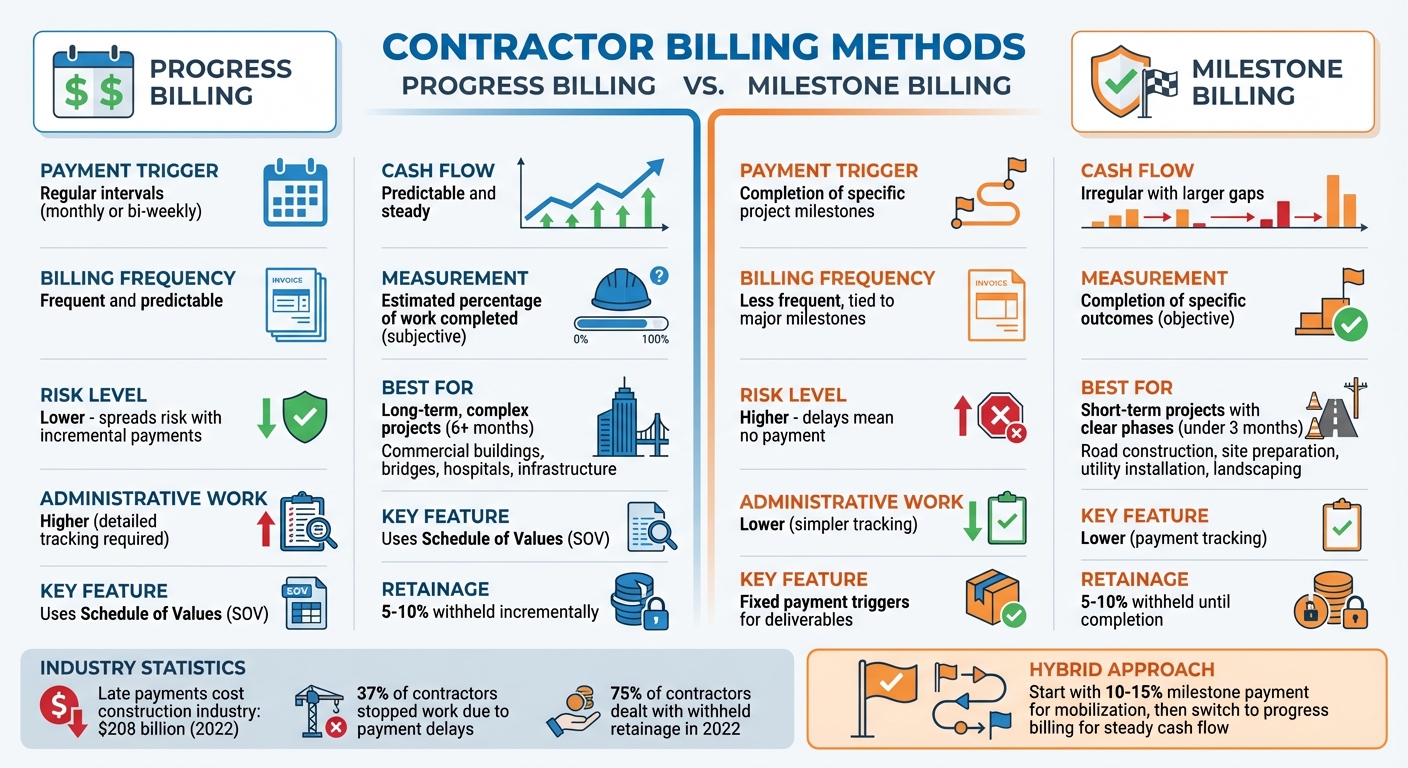
Progress Billing vs Milestone Billing: Side-by-Side Comparison for Contractors
What is Progress Billing?
Progress billing is a way of invoicing clients in stages, based on how much work has been completed during a set period, such as monthly or bi-weekly intervals. Instead of waiting until a project is finished to bill the full amount, contractors issue invoices as the project moves forward.
Here’s how it works: At the start of a project, you create a Schedule of Values (SOV), which breaks down the total contract value into specific tasks.
As work progresses, you calculate the percentage of each task completed, subtract any previous payments and retainage, and invoice for the remainder. Retainage – typically 5% to 10% – is held back by the client as a safeguard until the project is completed. For example, if 50% of a $500,000 project is complete, you’d bill $250,000, minus any earlier payments and retainage.
For commercial projects, industry-standard forms like the AIA G702 (Application and Certificate for Payment) and G703 (Continuation Sheet) are often used. These forms provide a clear breakdown of the original contract amount, approved change orders, total billed to date, and the amount currently being requested.
This invoicing method ensures that cash flow aligns with project progress, offering financial stability for both contractors and clients.
Key Features of Progress Billing
Progress billing isn’t just about invoicing in stages – it’s a structured process with specific features that enhance transparency and control.
- Regular Billing Cycles: Most contractors invoice monthly, though some prefer bi-weekly schedules depending on the contract terms. This consistency makes it easier to plan cash flow compared to irregular payment schedules.
- Schedule of Values (SOV): The SOV acts as a roadmap for billing. Many contractors use the MasterFormat guide, which categorizes construction tasks into 50 divisions, to organize their SOV. Each line item reflects measurable progress, ensuring accurate billing.
- Calculation Methods: The method for determining progress depends on the project:
- The cost-to-cost method calculates the percentage completed by dividing total costs incurred by the estimated total project cost.
- The units-of-work method measures physical units completed, like miles of paved roadway or installed components.
- The efforts-expended method tracks labor or machine hours consumed, ideal for service-heavy projects.
- Documentation: Keeping detailed records such as daily reports, photos, delivery tickets, and inspection logs is crucial. These documents support invoices and help resolve disputes over progress percentages.
- Retainage Management: Retainage is withheld from each invoice as a financial safeguard. For example, on a $500,000 project with 10% retainage, $50,000 is held until the project is completed. Some contractors negotiate to reduce or eliminate retainage after reaching 50% completion to improve cash flow.
Use Cases for Progress Billing
Progress billing is especially useful for projects with long timelines and significant upfront costs.
It’s commonly used in large-scale, long-term projects like commercial buildings, bridges, or hospitals, where waiting until the end for payment would create financial strain. These projects often involve substantial expenses for labor, materials, and equipment, making periodic payments essential.
This method works best when progress can be clearly tracked and documented, such as by completed square footage, installed systems, or finished structural elements. Monthly progress reports provide a clear basis for invoicing.
In addition, progress billing helps businesses comply with IRS requirements. For contracts spanning multiple tax years, the IRS often mandates the percentage of completion method for revenue recognition. This approach simplifies accounting and reduces the risk of audits.
Beyond construction, progress billing is widely used in industrial and infrastructure projects. Any industry with extended timelines and significant capital investment benefits from the steady cash flow and reduced financial risk this method provides.
sbb-itb-5eea312
What is Milestone Billing?
Milestone billing is a payment approach where contractors send invoices only after completing specific, agreed-upon project milestones.
Unlike progress billing, which is based on percentages of work completed, milestone billing ties payments to tangible project achievements. For example, a contractor might invoice a client only after the foundation has been poured and approved.
Here’s how it works: A project is broken into distinct phases – like site preparation, foundation work, framing, roofing, and final inspection. Each phase is assigned a set dollar amount or percentage of the total contract value. Payments are triggered once a milestone is completed and approved by the client. Until then, no payment is issued, which means contractors must manage their expenses between milestones.
The key distinction between milestone and progress billing lies in its focus on concrete deliverables. Instead of estimating that “25% of the project is done”, milestone billing requires proof of a completed task, such as finalized schematics approved by the client. This approach reduces disputes by relying on measurable outcomes.
To make milestone billing effective, it’s essential to have clearly defined deliverables, agreed payment terms, a formal approval process, and proper documentation. To avoid delays, contracts can include a maximum review period (e.g., 10 business days) to ensure clients approve milestones promptly. Verification of milestone completion often involves agreed-upon documentation, providing both parties with clarity and assurance.
Key Features of Milestone Billing
Milestone billing stands out from time-based or percentage-based invoicing due to its unique characteristics:
- Fixed Payment Triggers: Payments are tied to specific, verifiable milestones established during contract discussions, often in a kickoff meeting. Common milestones might include contract signing and mobilization (10%), foundation completion (20%), framing (25%), rough inspections (20%), and final inspection and handover (25%). While this reduces the frequency of invoices, it requires detailed documentation to confirm progress.
- Irregular Cash Flow: Payments come in larger sums after milestones are completed, but there may be long gaps between them. This structure increases financial risk for contractors since any delays in reaching a milestone result in delayed payments.
Use Cases for Milestone Billing
Milestone billing works best for projects with clearly defined and measurable phases.
It’s particularly effective for shorter projects (under three months) where contractors can manage cash flow between payments. This method is often used in industries like road construction, site preparation, utility installation, and large-scale landscaping. For example, in a roadwork project, milestones could include “excavation complete”, “base layer installed”, and “final paving finished.”
However, contractors need sufficient cash reserves to cover labor, materials, and equipment costs while waiting for milestone payments.
A 2022 Rabbet study highlighted the challenges of delayed payments, reporting that late payments cost the construction industry $208 billion, and 37% of contractors had to halt work due to these delays. Milestone billing offers strong client protection since payments are only made for completed and verified work, fostering trust in projects with well-defined scopes. That said, prompt milestone approvals are crucial; delays in client sign-offs can disrupt cash flow, even after the work is done.
Key Differences Between Progress Billing and Milestone Billing
Progress billing and milestone billing both ensure contractors are compensated, but they work in fundamentally different ways.
Progress billing calculates payments based on the estimated percentage of work completed, typically referencing a Schedule of Values (SOV). The formula looks like this: (Percentage completed × Total contract value) + approved change orders + stored materials – retainage – previous payments. Since this method relies on estimates, it’s inherently subjective.
On the other hand, milestone billing is far more concrete and straightforward. Payments are only released when specific deliverables are 100% completed and approved. These are tied to fixed dollar amounts or percentages, with no room for estimation – either the milestone is achieved, or it isn’t.
Payment Timing and Cash Flow
One key distinction lies in how payments are scheduled. Progress billing follows a regular timeline, such as monthly or bi-weekly intervals, regardless of specific task completion.
Milestone billing, however, is event-driven, meaning invoices are only issued when major project phases are completed. This difference directly impacts cash flow: progress billing offers a more consistent and predictable stream of payments, while milestone billing results in larger, irregular payouts.
Risk Allocation
The two methods also differ in how they handle risk. Progress billing spreads risk over time by providing partial payments as the work progresses.
In contrast, milestone billing places more risk on the contractor; delays in reaching a milestone mean no payment until that phase is finished. Both methods often include retainage (typically 5%-10%), but progress billing applies it incrementally.
Quick Comparison: Progress vs. Milestone Billing
| Aspect | Progress Billing | Milestone Billing |
|---|---|---|
| Definition | Invoices tied to the percentage of work completed over time | Invoices issued upon reaching specific project achievements |
| Payment Trigger | Regular intervals (e.g., monthly or bi-weekly) | Completion of predefined deliverables (e.g., foundation, MEP) |
| Billing Frequency | Frequent and predictable | Less frequent, tied to major milestones |
| Measurement Basis | Estimated percentage of work completed (subjective) | Completion of specific outcomes (objective) |
| Cash Flow Impact | Predictable cash flow | Irregular cash flow with larger gaps |
| Risk Allocation | Spreads risk with incremental payments | Shifts more risk to contractors (delays = no payment) |
| Best Project Types | Long-term or complex projects (e.g., road construction) | Projects with distinct phases or long gaps between deliverables |
Advantages and Disadvantages of Progress Billing
Advantages of Progress Billing
Progress billing offers a steady cash flow by allowing contractors to invoice as expenses occur. This means labor, materials, and equipment costs can be billed incrementally, reducing the need for full upfront financing. By spreading out payments, contractors can avoid relying on costly bridge loans or lines of credit.
This approach also minimizes financial risk throughout the project. If a client stops paying, work can be paused before additional resources are spent. This flexibility helps contractors avoid significant losses if payment issues arise.
A well-structured Schedule of Values (SOV) adds clarity, making it easier to manage billing and adjust for change orders. While these advantages help maintain financial stability, progress billing isn’t without its challenges.
Disadvantages of Progress Billing
Progress billing does come with its share of hurdles:
The biggest challenge is the administrative burden. It requires meticulous cost tracking, accurate calculations of completion percentages, and detailed documentation. These tasks can lead to disputes or delays if not handled carefully. According to Andrew Eckas from Knowify, even small rounding errors can throw off invoice accuracy.
Disagreements over completion percentages are another common issue. Since progress billing relies on estimates, contractors and clients may have differing interpretations, which can lead to payment delays and strained relationships.
Tax implications also pose a challenge. For large, multi-year projects, the IRS may require contractors to pay income tax on billed amounts in the year they are earned, even if the funds haven’t been received yet. Additionally, retainage – typically 5% to 10% withheld from each invoice – can add up to substantial unpaid amounts if not managed properly.
Advantages and Disadvantages of Milestone Billing
Understanding the upsides and downsides of milestone billing helps you decide if it’s the right approach for your project.
Advantages of Milestone Billing
Milestone billing makes project management simpler by tying payments to specific deliverables, reducing the need for constant tracking and frequent invoicing. This approach cuts down on administrative work and the risk of calculation errors.
Another key benefit is that it sets clear financial expectations from the outset. Both parties agree on the costs and deliverables upfront, which minimizes confusion and reduces the chances of billing disagreements. Clients often prefer this method because they only release funds for verified, completed work, giving them more control over payments.
“One approach that can help foster payment is to provide a fee schedule up front that relates to the project schedule. The fee schedule can be used as a back-up to the invoice. It is especially helpful for complex projects with overlapping phases” – David B. Richards, FAIA.
This method can also motivate teams to work efficiently. Since payments are tied to completed milestones, contractors are incentivized to reach those points quickly.
“Every milestone brings not just a chance for compensation, but innovation and speed – the faster you get there, the quicker you can get paid” – Andrew Eckas, Knowify alternative.
While these advantages are appealing, milestone billing isn’t without its challenges.
Disadvantages of Milestone Billing
One of the biggest drawbacks of milestone billing is uneven cash flow. Contractors may face long gaps between payments while still needing to cover ongoing expenses like labor and materials. This means they’re essentially financing the project until the next milestone is achieved, which can strain resources.
Another challenge is the risk of subjective milestone definitions. Vague descriptions like “Phase 1 nearly done” can lead to disagreements about whether a milestone is truly complete. These disputes can delay payments, sometimes for weeks.
External factors can also complicate things. Weather issues, supply chain delays, or permit holdups can postpone milestone completion, directly affecting when payments are received. On top of that, clients may take time to approve deliverables or request rework, further delaying compensation. To reduce these risks, it’s crucial to define milestones with specific, measurable criteria. Including contractual deadlines for client approvals – such as 10 business days – can help keep the process on track.
When to Use Progress Billing vs. Milestone Billing
Choosing the right billing method depends on the nature of your project, its duration, cash flow requirements, and your team’s administrative capacity.
Progress billing is ideal for long-term projects that stretch beyond six months or even several years. This method works particularly well for complex commercial or infrastructure projects where regular payments are tied to the percentage of work completed. In fact, government contracts and large-scale commercial projects often require progress billing as a standard practice.
On the other hand, milestone billing is better suited for short-term projects lasting less than three months. If your project has distinct, measurable phases – like road construction or utility installation – milestone billing can streamline invoicing and reduce administrative overhead. However, this method is most effective when you have enough working capital to cover expenses between payments and when deliverables are easy to verify.
Cash flow is another critical factor. If you need to pay subcontractors and suppliers promptly, progress billing provides a steady income stream to cover ongoing costs. Without this, you may find yourself financing the project out of pocket. As Construction Cost Accounting puts it:
“The difference between waiting 90 days for payment and getting paid every two weeks isn’t just convenience, it’s the margin between making payroll or laying off your crew”.
Late payments have historically caused significant disruptions in projects, making predictable cash flow a necessity.
Administrative capacity also plays a role in your decision. Progress billing requires detailed cost tracking and an accurate Schedule of Values (SOV), which is best managed with construction management software. For smaller teams or those with limited administrative resources, milestone billing might be the simpler, more practical option.
For projects with significant upfront costs, a hybrid approach can be effective. Start with a 10–15% milestone payment to cover mobilization expenses, then transition to progress billing for consistent cash flow. This combination helps balance cash flow needs while minimizing financial risks. Whatever method you choose, ensure your contract clearly defines completion criteria and negotiate retainage reductions – such as eliminating retainage after 50% completion – to avoid disputes.
How Contractor Foreman Supports Progress and Milestone Billing
Contractor Foreman takes the complexity out of managing progress and milestone billing by offering a centralized platform for financial tracking, project management and scheduling, and client communication. It simplifies these processes, making them more efficient and less time-consuming.
Financial Tracking for Billing
When it comes to AIA-style progress billing, Contractor Foreman has you covered. The software generates industry-standard G702 and G703 forms and creates a detailed Schedule of Values (SOV). This SOV breaks projects into task-specific dollar amounts, while the system tracks completion percentages to ensure invoices are accurate and aligned with project progress.
Retainage management is another standout feature. The platform tracks, holds, and releases retainage – typically 5–10% – throughout the project lifecycle. This is especially helpful, considering that in 2022, 75% of contractors dealt with withheld retainage on at least one project.
The two-way QuickBooks sync is a game-changer for financial consistency. It seamlessly transfers estimates, invoices, payments, and expenses between Contractor Foreman and QuickBooks (both Online and Desktop versions). This reduces manual data entry and minimizes errors, keeping your financial records in sync.
“I like that this software is able to accurately track our service tickets and clued GPS information per service team. Each service ticket has all the necessary information we need to give to the customer to adequately price and invoice each service.” – Patrick C., Moser Roofing Solutions, LLC.
These financial tools are available with the Pro Plan, priced at $166 per month (billed annually). Beyond financial tracking, Contractor Foreman also integrates project management tools to enhance efficiency and billing accuracy.
Project Management Features
Contractor Foreman’s project management tools work hand-in-hand with its financial features, ensuring real-time updates and smoother billing processes. Field staff can update task completion percentages directly through the mobile app, providing immediate data for invoicing. This real-time connection reduces delays between work completion and billing, improving cash flow.
The client portal is another key feature. It allows clients to monitor project progress, approve change orders, and make online payments via Stripe or WePay. With this transparency and convenience, you can shorten the accounts receivable cycle and get paid faster. Additionally, the platform’s change order automation updates contract amounts and budgets instantly when changes are approved. This ensures that invoices always reflect the latest project details without requiring manual adjustments.
Conclusion
The choice between progress billing and milestone billing plays a crucial role in managing cash flow, minimizing risk, and maintaining strong client relationships. Progress billing is ideal for long-term, complex projects where steady income is necessary to cover ongoing labor and material costs. Meanwhile, milestone billing works better for shorter projects with clearly defined phases, though it may require contractors to shoulder costs between payment intervals.
Consider this: in 2022, late payments amounted to a staggering US$208 billion, and 37% of contractors had to stop work because of delayed payments. The importance of your billing method cannot be overstated. As Construction Cost Accounting puts it:
“Cash flow problems kill more construction businesses than bad bids ever will.”
Your decision should align with the specifics of your project – its scope, duration, and risk tolerance. For projects that span over six months, progress billing can provide the consistent cash flow needed to keep operations running smoothly. On the other hand, for shorter projects with clear deliverables, milestone billing could simplify administrative work and keep the focus on results.
Some contractors have found a hybrid approach to be effective. For example, starting with a 10–15% milestone payment for mobilization and then transitioning to monthly progress billing can offer both upfront security and ongoing financial stability. This combination can adapt to the unique demands of your project.
Regardless of the method you choose, it’s essential to document project completion clearly, track retainage, and leverage construction management tools to connect field updates with invoicing. These practices not only build trust but also help avoid payment delays.
FAQs
Can I combine progress billing and milestone billing on one project?
Yes, you can combine progress billing and milestone billing within a single project. These two methods are adaptable and can be used together based on the project’s requirements and payment terms. By merging them, you can create a customized invoicing approach that matches the unique demands of the project.
How do I define milestones so approvals don’t delay payment?
To keep payments on track, it’s crucial to outline milestones with specific, detailed criteria for both completion and approval in your contract and project plan. This clarity minimizes confusion and sets clear expectations from the start.
Leverage tools that automate approval workflows and tie those approvals directly to payment triggers. This streamlines the process and reduces manual follow-ups. Additionally, maintaining open communication and setting realistic timelines for approvals can help sidestep potential delays.
Real-time tracking of milestone approvals is another key component. It ensures that once a milestone is completed and approved, payments can be processed without unnecessary holdups.
How should I handle retainage with progress or milestone billing?
Retainage is typically withheld as a percentage of each progress or milestone payment throughout a project. This amount is held back until the project is finished or particular milestones are achieved. Its release should follow the terms outlined in the contract and comply with any relevant laws, ensuring smooth cash flow management. Always double-check that your retainage process matches the agreement and adheres to legal obligations.







