
The construction industry has a dirty little secret: almost NONE of its projects finish on time.
According to Buildern, 98% of construction projects face delays. The average project runs 37% longer than originally planned. Not a little over. Not a rounding error. Thirty. Seven. Percent.
And it gets worse. Large-scale projects don’t just slip on schedule — they blow their budgets by up to 80%. Meanwhile, construction businesses are losing more than one full day of productive work every single week to pure inefficiency. Two-thirds of workers spend over a quarter of their hours just… waiting.
Waiting for materials.
Waiting for the other crew to finish.
Waiting for someone to make a decision that should have been made three weeks ago.
McKinsey estimates that up to 80% of these delays come from poor planning. Nope, not bad weather, not supply chains, not acts of God. BAD PLANNING.
This is the trillion-dollar problem that the industry has decided to just accept as normal.
Lean scheduling offers a solution by involving teams in planning, reducing waste, and improving timelines.
This approach focuses on working backward from milestones, ensuring resources arrive exactly when needed.
Key techniques include:
- Collaborative Planning: Engages subcontractors and trade workers to create realistic schedules.
- The Last Planner System (LPS): Empowers on-site leaders to make reliable commitments, improving task completion rates from 55% to over 80%.
- Pull Planning: Schedules tasks by starting with milestones and addressing potential blockers early.
- Digital Tools: Platforms like Contractor Foreman streamline scheduling, task tracking, and communication.
Case studies show lean scheduling can cut project timelines by over 25%, save costs, and enhance coordination.
Lean scheduling isn’t just about saving time – it’s about creating more reliable, efficient workflows for all project stakeholders.
Core Principles of Lean Scheduling
Lean scheduling is built on a collaborative foundation, transforming how construction planning is approached.
Instead of relying on a single scheduler to create timelines in isolation, this method actively involves the team members who will execute the work. By shifting from a top-down “command and control” model to a participatory approach, lean scheduling ensures that plans align more closely with the realities of the construction site. These principles set the stage for the case studies explored later.
The Last Planner System
The Last Planner System (LPS) is a cornerstone of lean scheduling, empowering on-site foremen and trade supervisors – referred to as “Last Planners” – to take charge of planning. Their deep understanding of on-the-ground challenges allows them to make more reliable commitments. LPS organizes planning through five stages of conversations: Should (milestone planning), Can (removing constraints), Will (weekly commitments), Did (tracking progress), and Learn (analyzing outcomes).
“The Last Planner System is a system for project production that promotes the creation of a predictable workflow among various parties so that it achieves reliable results.” – Lean Construction Institute
In traditional construction projects, only 54% of weekly commitments are typically met.
However, involving on-site experts in planning has proven to significantly improve reliability. For instance, during a major hospital project, the percentage of planned tasks completed (PPC) rose from 55% to over 80%, demonstrating the system’s effectiveness. Keyan Zandy, a CEO, highlighted this shift: “The people doing the work are the experts, so they should own the plan. This approach improves accuracy, reliability, and morale”.
Pull Planning and Constraint Management
Pull planning flips the traditional scheduling process on its head by starting with the project’s milestones and working backward. This ensures materials, equipment, and crews arrive exactly when needed, avoiding overcrowding on-site and minimizing risks like damage or rework.
“Pull Planning refers to the method of developing a construction schedule by working backwards from a milestone, ‘pulling’ the required handoffs for each activity into the plan to identify when the work is actually required.” – Grace Sauline Rockwell, Corporate Manager of Project Controls, Higley
Constraint management complements pull planning by identifying and addressing potential blockers early. Using a 6-week look-ahead window, teams can tackle challenges before they disrupt the schedule. For example, in June 2020, Project Superintendent Thomas Hardy at Skiles Group successfully completed a 12-week hospital behavioral unit renovation during the COVID-19 pandemic. By focusing on critical path items, such as specialty anti-ligature hardware facing supply chain delays, the project stayed on track despite unprecedented challenges.
Continuous Improvement through PDCA Cycles
Lean scheduling incorporates the Plan-Do-Check-Act (PDCA) cycle to drive ongoing improvements. Teams collaboratively plan tasks, execute them, review performance through PPC metrics, and take corrective actions based on lessons learned. This process ensures that setbacks lead to meaningful changes rather than recurring issues.
For instance, during a 2018 pharmaceutical facility project, a team compressed a 32-week schedule into just 24 weeks by leveraging PDCA cycles. When “Client documentation signoff” repeatedly emerged as a bottleneck, they applied 5-Why analysis and A3 problem-solving to identify and address resource constraints. As a result, the project finished on time with zero Lost Time incidents and a 30% reduction in punch-list items.
The table below provides a quick overview of the LPS planning stages:
| LPS Planning Level | Key Question | Primary Focus |
|---|---|---|
| Milestone Planning | What should be done? | Align major project deadlines and goals |
| Phase (Pull) Planning | What can be done? | Define task sequences by working backward from milestones |
| Look-ahead Planning | What will be done? | Identify and remove constraints 3–6 weeks in advance |
| Weekly Work Plan | What did we do? | Secure reliable commitments for the upcoming week |
| Learning (PPC) | What did we learn? | Analyze variances to improve future planning reliability |
sbb-itb-5eea312
Case Studies: Applying Lean Scheduling in Real Projects
Lean scheduling principles truly shine when applied to real-world construction projects. These case studies highlight how these methods adapt to different challenges and deliver practical solutions.
New Line Structures: Lean Scheduling in a Mixed-Use Development
New Line Structures took on a demanding project in New York City: transforming a historic warehouse into a modern, 1.2 million square-foot workplace.
This effort combined facade restoration, demolition, and new construction – all within occupied spaces. The complexity required seamless coordination among numerous subcontractors. To tackle this, Lead Superintendent Frank Parker and Project Controls Engineer Nicolas Torres introduced Touchplan, a digital tool aligned with Last Planner System practices. This replaced traditional methods like whiteboards and spreadsheets with a more integrated approach. Many firms now compare Fieldwire alternatives to find the most integrated solution for their field teams.
A standout feature was involving trade partners directly in the planning process. Subcontractors entered their tasks into the system themselves, encouraging them to carefully consider material needs and crew sizes before committing to deadlines.
“Touchplan helps us keep the subcontractors on time with their tasks, and they have to speak to a delay right in front of us. When they say they will be done in two days and they end up being late, it is easier to flush out the reason right in the meeting.”
This real-time accountability proved invaluable, as subcontractors explained delays during meetings, fostering transparency. Touchplan’s constraint-logging feature also allowed project managers, BIM coordinators, and superintendents to collaborate on a unified schedule, addressing potential issues proactively. Impressively, subcontractors mastered the platform after just a 15-minute introduction, highlighting its user-friendly design.
Baker Concrete: Multi-Site Scheduling Success

Baker Concrete applied lean scheduling across all its project sites nationwide, emphasizing continuous improvement.
The company empowered field employees through its Opportunity for Improvement (OFI) Program, which used a mobile app to report problems and suggest solutions in real time. This system helped identify shifting project needs and develop new practices, which were added to a “Best Practice Library” for company-wide use. Performance metrics, such as labor per cubic yard (CY), further refined future planning and bidding accuracy.
“Even the visuals used to track Last Planner, material needs, and production tracking are standard across projects so any new personnel can walk in and quickly assess the project status.”
What set Baker Concrete apart was its decentralized lean culture, where every employee was encouraged to champion continuous improvement. Standardized visual management boards and meeting agendas ensured that staff could seamlessly transition between projects. Meanwhile, the Baker 3.0 Operational Model – a detailed guide for standard operating procedures – was reviewed and updated quarterly, keeping processes fresh and effective.
Fire Station Construction: Location-Based Scheduling
For specialized projects like fire station construction, a location-based scheduling (LBS) approach proved effective.
LBS focuses on physical space as a key resource, aligning with lean scheduling’s goal of optimizing resources. Unlike traditional activity-based schedules, LBS recognizes that in construction, workers move through the site rather than the work moving to them.
In fire station projects, LBS combined with Takt planning created a consistent rhythm for activities, ensuring stability and a clear timeline for specialty contractors. This approach simplified complex, multi-page schedules into visual formats that crews could easily follow. By dividing the building into zones and maintaining a steady pace, LBS improved crew allocation and minimized inter-trade conflicts, resulting in smoother operations.
Digital Tools for Lean Scheduling
Digital tools bring lean scheduling to life by simplifying collaboration and streamlining task management. Lean scheduling thrives on a solid digital foundation that turns theoretical principles into actionable strategies. While lean principles set the stage, modern construction management software transforms how teams work together and make informed decisions.
Features for Lean Scheduling
The best digital tools for lean scheduling come equipped with features that make planning and execution more efficient. Visual planning interfaces help teams see task dependencies and timelines clearly. Mobile updates from job sites eliminate redundant data entry, ensuring that information stays accurate and current. Constraint tracking allows project managers to log and address potential bottlenecks before they lead to delays, making sure tasks are “Make Ready” before execution.
Real-time collaboration tools replace outdated methods like static PDFs and email chains, providing a single, up-to-date source of truth for all stakeholders. Baseline tracking and percent-complete monitoring enable teams to use PDCA (Plan-Do-Check-Act) cycles effectively, comparing planned progress with actual outcomes to identify trends and areas for improvement. Automated notifications enhance pull planning by sending instant alerts when schedules shift due to on-site changes.
These features are game-changers for efficiency. For example, 40% of contractors encounter daily scheduling problems, and professionals lose more than 14 hours weekly on unproductive tasks. Cloud-based scheduling tools can reduce overtime by 20% and crew turnover by 10%. Tools like Contractor Foreman illustrate these capabilities, integrating scheduling with financial and communication systems to streamline operations.
How Contractor Foreman Supports Lean Scheduling
Contractor Foreman stands out as a prime example of a tool designed to support lean scheduling. It combines scheduling, financial tracking, and real-time communication in one platform. Starting at $49/month, it offers drag-and-drop scheduling, mobile access, and integrated task tracking. This centralized approach addresses a common issue in lean scheduling: fragmented information. As DCL Design Build Group shared:
“Before adopting Contractor Foreman, we faced challenges with manual scheduling, document version control, and inefficient communication between office staff, clients, and field teams.”
Contractor Foreman’s integration with QuickBooks links scheduling directly to financial tracking, offering real-time insights into project costs and enabling precise budget management. Calendar syncing with Google and Outlook helps users manage both personal and professional commitments, reducing scheduling conflicts. Mobile access ensures that crews can update schedules, request shift changes, and view project documents instantly.
The platform’s client access feature has been especially useful for fostering transparency. DCL Design Build Group noted:
“The client access feature has also allowed for more transparent communication with clients, reducing misunderstandings and last-minute change requests.”
Other features like task assignment and progress tracking boost accountability and support continuous improvement, tying directly into the reliability goals of lean scheduling. Centralized document storage ensures that everyone works with the most current information. Additionally, automated compliance tracking for labor hours and GEO fencing for location-based clock-ins reduce administrative burdens, allowing teams to focus on productive work.
Contractor Foreman offers a 30-day free trial with training and support to help contractors transition smoothly to lean scheduling. By consolidating scheduling, financial tracking, and communication into a single platform, it minimizes tool-switching and duplicate data entry – two common hurdles that can derail lean efficiency efforts.
Lessons and Strategies for Timeline Optimization
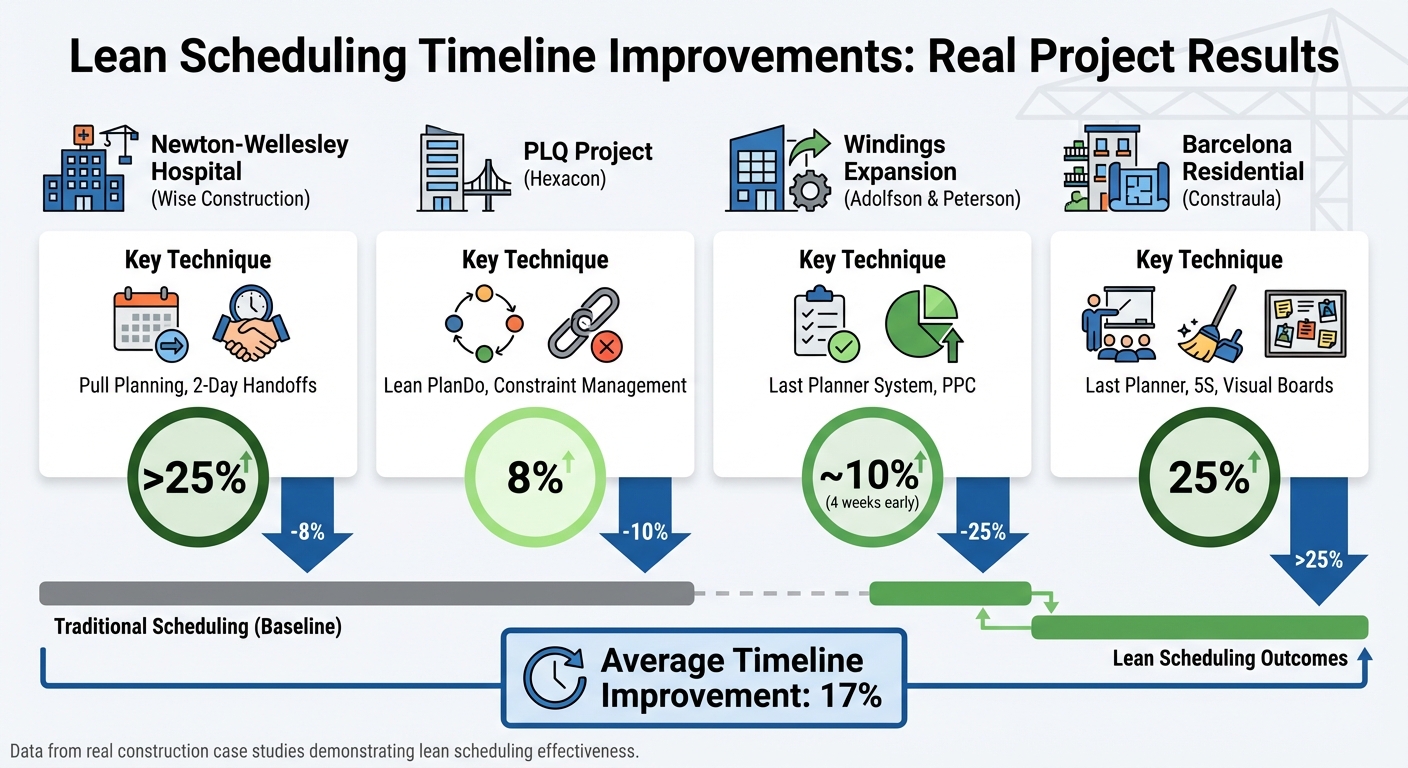
Lean Scheduling Timeline Improvements Across Construction Projects
Comparison of Lean Scheduling Outcomes
Real-world examples show that lean scheduling can significantly reduce project timelines and improve delivery outcomes. Take Wise Construction, for instance: after facing a nine-week permit delay on the Newton-Wellesley Hospital renovation, they used pull planning techniques to cut the schedule by over 25%. Similarly, Adolfson & Peterson Construction completed the Windings Expansion project four weeks ahead of schedule by leveraging the Last Planner System and daily huddles, saving $124,272 that went toward facility upgrades. Meanwhile, Constraula managed to deliver a residential building in Barcelona four months early by batching work and using 4-week look-ahead boards, achieving a 25% timeline improvement.
| Project | Key Lean Technique | Timeline Improvement % |
|---|---|---|
| Newton-Wellesley Hospital (Wise) | Pull Planning, 2-Day Handoffs | >25% |
| PLQ Project (Hexacon) | Lean PlanDo, Constraint Mgmt | 8% |
| Windings Expansion (AP) | Last Planner System, PPC | ~10% (4 weeks early) |
| Barcelona Residential (Constraula) | Last Planner, 5S, Visual Boards | 25% |
These examples highlight the value of collaborative planning and constraint management in driving faster timelines. Projects that engage trade foremen in setting durations and use visual boards to track and resolve roadblocks consistently outperform those relying on traditional scheduling. These lessons provide a strong foundation for practical strategies to adopt lean scheduling.
Practical Tips for Lean Scheduling Adoption
The success stories above show that lean scheduling focuses on cutting waste and improving efficiency. Even smaller contractors can adopt these methods without a complete operational overhaul. A great starting point is pull planning sessions, where subcontractors work backward from a milestone to set realistic durations and commitments. Todd Miller, Superintendent at Rafn, emphasized this approach:
“Working from finish to start enabled each trade to confirm realistic durations, creating reliable scheduling commitments.”
To improve workflow, try small batch handoffs and place visual constraint boards in high-traffic areas to emphasize priorities. Breaking projects into smaller zones can also allow trades to transition earlier. Regularly track PPC (Percent Plan Complete) by dividing completed activities by planned activities to identify delays without pointing fingers.
Keep daily huddles short – 15 minutes or less – and use them to review the previous day’s progress, outline the current day’s tasks, and address immediate obstacles. Involving workers directly in planning sessions is another game-changer. When foremen and tradespeople take part in setting durations and sequences, they feel more accountable, leading to schedules that are more reliable and achievable.
Conclusion
Lean scheduling minimizes waste, encourages teamwork, and streamlines project timelines. Case studies reveal that contractors using methods like pull planning, constraint management, and visual scheduling often achieve better outcomes than traditional approaches. For instance, Wise Construction managed to shorten its project timeline significantly with pull planning, while Straits Construction avoided 57% of expected delays by involving stakeholders collaboratively. These examples demonstrate how lean scheduling can reshape project management strategies.
Switching from a top-down scheduling model to a collaborative planning approach fosters accountability across all trades. When subcontractors actively participate in setting task durations and sequences, they are more likely to commit to realistic timelines. Digital tools such as Contractor Foreman enhance these lean practices by offering features like Gantt charts, mobile daily logs, and real-time job costing – starting at just $49 per month for the Basic plan.
The financial advantages are equally compelling. Big-D Construction anticipates over $1.5 million in first-year ROI from collaborative scheduling, while Hexagon reported a 23% boost in productivity through forward planning and resolving constraints. These efficiencies not only prevent costly delays but also create a unified system that keeps field teams, office staff, and project owners on the same page.
For contractors looking to shift from reactive problem-solving to proactive planning, lean scheduling provides a clear roadmap. Starting with pull planning sessions and visual constraint boards, and then integrating digital platforms for real-time updates and mobile access, contractors can achieve greater predictability and profitability in their projects.
FAQs
How is lean scheduling different from a traditional CPM schedule?
Lean scheduling thrives on adaptability and real-time adjustments, contrasting sharply with the Critical Path Method (CPM), which relies on fixed, detailed planning and long-term projections. While CPM follows a rigid framework, lean techniques such as pull planning and Takt planning focus on teamwork, minimizing waste, and responding to on-site conditions. These methods improve communication, streamline workflows, and help projects move faster by continuously refining processes throughout the project lifecycle.
What should we track first to show lean scheduling is effective?
To see if lean scheduling is doing its job, keep an eye on the progress of key tasks and their completion dates. This makes it easier to spot delays or inefficiencies in the process, helping to fine-tune timelines more effectively.
How does Contractor Foreman support pull planning and constraint tracking?
Contractor Foreman makes pull planning and constraint tracking easier by offering tools for collaborative scheduling and visual task management. Teams can map out task dependencies, keep milestones in check, and adjust plans as needed. With real-time updates, it’s simple to spot and resolve scheduling issues, ensuring projects stay on course and timelines are streamlined.







