
A general contractor in Colorado has had the same core framing crew for over 20 years. Same lead, same rhythm, same result: fast, clean builds with clients who notice.
Meanwhile, his competitors can’t seem to keep a team together for more than a few seasons. Every spring, it’s the same scramble: new hires, retraining, schedule slips, and quality issues that surface too late.
It’s both a labor problem and a competitive disadvantage.
In today’s construction market, experienced crews are in short supply, so when you lose a good worker, you lose productivity, trust, continuity, and often, the next job. The cost of constant crew turnover shows up in missed deadlines, callbacks, and client dissatisfaction.
What separates contractors who retain good people from those who don’t? It’s not luck, and it’s not just pay.
Its systems of communication, respect, and fairness are baked into daily operations.
Read on, and we’ll show you how construction management software that includes tools like team chat, crew scheduling, and safety meetings does more than streamline work because it creates a culture that keeps great crews loyal, year after year.
Why Crew Loyalty Beats Recruiting Every Time
Construction labor shortages aren’t new, but the stakes have changed. According to the Associated Builders and Contractors, the U.S. construction industry needed over 500,000 additional workers in 2024 to meet demand.
Contractors nationwide are feeling the pressure. Reliable crews are increasingly scarce, and turnover remains one of the most expensive—and least predictable—line items in any project budget.
When skilled workers leave, the impact goes far beyond filling a slot:
- Productivity slows as new hires ramp up.
- Mistakes increase due to inconsistent training.
- Supervisors lose time to reorienting new team member.
- Clients start to question project control and reliability.
The average turnover rate in the construction industry remains higher than in other sectors, according to the U.S. Bureau of Labor Statistics. While job ads and hiring bonuses might bring people in the door, they don’t build long-term engagement.
The real cost is in the churn: time, rework, fractured jobsite culture, and client trust that quietly slips away.
Crew loyalty changes that equation. When workers stay, they develop a rhythm, efficiency, and a sense of pride in their work. They train each other, spot issues early, and raise the bar on job quality without being asked. That kind of consistency can’t be outsourced—and it can’t be faked.
Crew loyalty also impacts your bottom line in less visible and measurable ways. Retained crews require less oversight, adapt more quickly to project-specific workflows, and reduce error-related rework.
According to the Construction Industry Institute (CII), companies with high workforce stability experience up to 30% better labor productivity and significant reductions in safety incidents. When the team knows the job, the process, and each other, efficiency naturally improves—and that leads to stronger margins and happier clients.
The True Cost of Crew Turnover
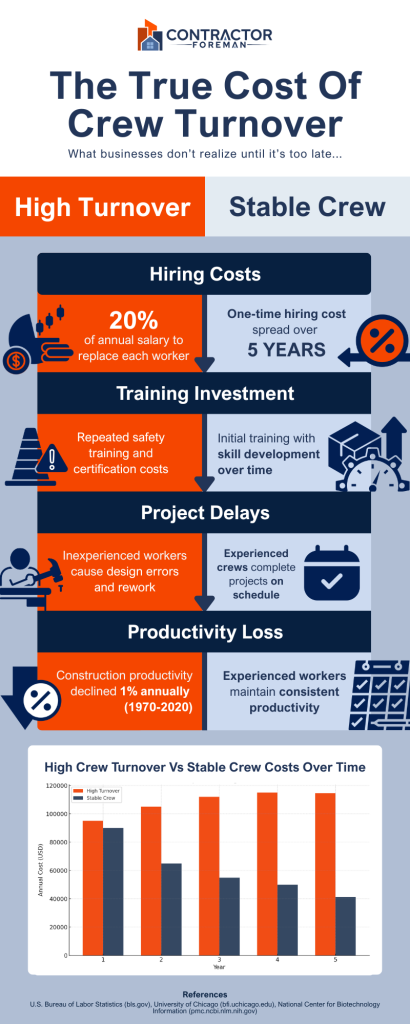
Many contractors underestimate the true cost of crew turnover. This visual breaks down the direct and indirect costs, including productivity loss, rework, recruiting spend, and insurance premiums.
If you’re trying to decide whether systems like team chat or digital scheduling are worth the investment, this chart shows the math. Stability isn’t just good for culture—it’s smart business.
The Systematic Culture Loyalty Is Built On
Crew loyalty isn’t luck. It’s a byproduct of what workers experience day to day—how they’re scheduled, how they’re spoken to, and whether they feel their time and input are respected. Loyalty grows when crews know what to expect and trust that leadership is consistent.
This kind of culture doesn’t require slogans or perks. It requires systems that demonstrate respect, fairness, and inclusion, the building blocks of any long-term working relationship.
Here’s the framework successful contractors use to keep great crews together:
1. Team Chat → Respect in Real Time
Respect isn’t a banner on the wall. For most crews, it sounds like:
- “Got your message.”
- “We’re on it.”
- “Appreciate the heads-up.”
The ability to speak up and receive a response is one of the simplest yet most powerful drivers of job satisfaction. But when communication is inconsistent—relying on scattered texts or verbal updates—it becomes easier to overlook issues and harder for field teams to trust that leadership is listening.
A structured team chat system provides crews with a reliable and organized way to stay in touch. Everyone knows where to go to raise a concern or clarify a task, and leaders have visibility into what’s happening across job sites without needing to chase information.
Why it works: Visible and trackable communication means your crews can stop guessing. They know someone’s paying attention.
Team Chat replaces group texts with searchable, job-specific threads that keep teams aligned and responsive.
2. Crew Scheduling → Fairness You Can See
Few things damage loyalty faster than crew members feeling like the schedule isn’t fair, or worse, that it’s political.
When scheduling decisions seem inconsistent or last-minute, it creates tension and resentment. Workers compare hours, question how decisions are made, and lose trust in leadership.
Fair, transparent scheduling signals respect. It tells your crew: “We planned ahead, and we value your time.” It enables workers to prepare, reduce stress, and remain committed to their job.
Why it works: When the process is predictable, people stop worrying about whether they’re getting the short end of the deal. That clarity leads to commitment.
Crew Scheduling allows crews to check their assignments from their phones. It eliminates the need for whiteboards, ensuring no surprises or confusion.
3. Safety Meetings → Inclusion That’s Visible
Most crews know the drill: you show up, sign the sheet, and listen to a foreman talk through fall protection again. But when safety meetings are one-sided, they can feel like a formality instead of a conversation.
Done right, safety meetings are a high-value opportunity for inclusion. They’re one of the few structured moments when field workers interact with leadership. If they’re allowed to share feedback, recognize good work, or help shape solutions, those meetings become culture moments.
Why it works: Inclusion isn’t just about collecting input—it’s about showing that input matters.
With the Safety Meetings tool, crews can track attendance, record concerns, and follow up on action items, all from a single platform.
A strong crew culture doesn’t happen in reaction to problems. It’s built ahead of time through predictable, fair systems that show your team they matter.
And when workers know their time, effort, and voice matter, they reciprocate with loyalty.
Most contractors want to do right by their crews. But without scalable systems, good intentions get buried under the daily urgency of running jobs. What starts as “we’ll fix this later” becomes a pattern and eventually, a reputation.
Loyalty doesn’t collapse all at once; it fades with every missed follow-up, last-minute schedule change, or ignored concern.
The right systems don’t replace leadership; tools reinforce it, even when the pressure’s on. Book a free demo of Contractor Foreman to see how it can help your business.
Proof That Loyalty Pays Off
Loyalty isn’t just good for morale. It’s good for business.
One mid-sized contractor in the Southeast made a conscious shift: instead of chasing faster recruiting, they invested in retention. That meant rolling out consistent team chat, predictable crew scheduling, and safety meetings that encouraged input from the field.
They didn’t increase pay or hire a new HR team. They just made communication non-negotiable.
Within six months, they saw:
- A large reduction in crew turnover
- A significant drop in project delays tied to re-training or miscommunication
- Fewer callbacks due to rushed or inconsistent work
- Higher field morale, reported via anonymous crew surveys
Perhaps most notably, their bid win rate went up. Project owners noticed the difference, consistent teams, stronger site performance, and fewer staffing disruptions. That kind of reputation travels fast.
This wasn’t about culture in the abstract. It was about execution with systems that created clarity, consistency, and respect across every jobsite.
What a Loyal Crew Culture Looks Like in Practice
You can spot a loyal crew culture without looking at a spreadsheet. It shows up in the small, everyday moments that keep jobs running smoothly—and workers showing up season after season.
You’ll see:
- Crews that load out before anyone asks
- Supervisors who don’t have to repeat themselves twice
- Workers correcting each other on safety and quality without tension
- New hires getting trained without formal onboarding sessions
- Fewer no-shows, fewer mistakes, and far fewer dropped balls
These aren’t just signs of experience—they’re signs of buy-in. When people feel valued, they take ownership. They watch out for each other. They care about how the work gets done, not just that it does.
And while culture may appear informal on the surface, it’s often supported by a structure underneath: consistent communication, clear scheduling, real-time feedback, and opportunities for open discussion. That’s what builds the kind of reputation that attracts and retains great workers.
Pitfalls That Break Loyalty Before It Begins
Crew loyalty doesn’t erode overnight. It breaks down through small, avoidable failures—missed details, inconsistent systems, or habits that send the wrong message.
If you’re struggling to keep good people, these four issues might be the root cause.
1. Playing Favorites With the Schedule
When one crew consistently receives the preferred shifts or lighter assignments, others take notice. Even if the favoritism isn’t intentional, the perception can damage morale and foster resentment.
How to fix it: Use scheduling tools that make decisions visible and trackable. Rotating crews fairly and communicating clearly helps reduce friction and maintain trust.
2. Failing to Close the Feedback Loop
Nothing disengages workers faster than sharing a concern and watching nothing happen. When feedback disappears into a void, crews stop offering it.
How to fix it: Build systems where input is documented, acknowledged, and followed up on. Visibility is key. Workers don’t expect every suggestion to be implemented, but they do expect to be heard.
3. Overlooking Peer Recognition
Loyalty isn’t just built through top-down leadership. Peer influence plays a huge role. When hard work goes unrecognized—or worse, is overshadowed by louder personalities—engagement tends to drop.
How to fix it: Create space in safety meetings or team chats for informal shout-outs. Recognition doesn’t need to be elaborate. A few words at the right time can go a long way.
4. Assuming Culture Will “Just Happen”
Culture fills the vacuum left by systems. Without consistent communication, clarity, and follow-through, you don’t get loyalty—you get confusion and churn.
How to fix it: Build culture the same way you build anything else: with tools, structure, and intent.
From Turnover to Legacy Teams
You don’t need to compete on wages to keep good workers. You need systems that show people they matter.
When crews feel respected, scheduled fairly, heard consistently, and included in daily decisions, they stay. Not for a paycheck—but for a culture that works. And when you keep crews together, everything improves: quality, morale, project timelines, and your reputation in the market.
The tools you use signal what kind of company you run.
- Do your crews know where they’re supposed to be?
- Can they get questions answered quickly?
- Are they included in conversations that affect their safety and workflow?
You could try to manage all of that manually. But as your projects grow, so does the risk of small lapses turning into big turnover.
Contractor Foreman makes crew loyalty scalable, whether you’re managing two projects or twenty.
With built-in tools like Team Chat to keep field and office connected, Crew Scheduling to ensure fairness and transparency, and Safety Meetings that transform compliance into a genuine culture of inclusion, it’s a platform designed to support the systems that loyal crews are built on.
Start your free 30-day trial of Contractor Foreman today and build the kind of crew culture that doesn’t just retain workers, it builds your legacy.







