
How often do you hear, “Wait… who was supposed to handle that?” or “Hey, I thought it was covered”?
Probably more than you’d like.
I’m sure you’ve wondered “Why can’t just my crew figure themselves out and stick to their assignments?!”
Well, let me give you the real answer: Because it’s not easy.
And you know why it’s not easy? It’s not that they’re lazy or incompetent or any of that. Most of the time it’s simply because ownership isn’t clear.
Maybe they were diligently following the original plan, not the latest update.
Maybe the handoff wasn’t communicated clearly.
Or maybe- just maybe- no one ever owned the task in the first place.
In construction, task assignment isn’t just instructions – it’s clearly defining who is responsible for each part of the work. It’s about making sure the jobsite isn’t held together by guesswork and on-the-fly coordination.
When everyone knows exactly what they’re supposed to do, projects runs the way it should.
Here’s how structured task assignment transforms construction projects:
- Clear Responsibilities: Assigning tasks to specific individuals or crews ensures accountability and prevents missed steps.
- Real-Time Updates: Digital tools provide instant progress tracking, reducing delays caused by outdated communication methods like construction daily logs or phone calls.
- Improved Workflows: Linking tasks to schedules and dependencies ensures work follows the right sequence, avoiding rework and bottlenecks.
- Balanced Workloads: Evenly distributed tasks prevent burnout, reduce idle time, and improve productivity.
- Integration with Budgets: Tying tasks to two-tier cost codes helps track expenses and avoid budget overruns.
Common Task Assignment Problems in Construction
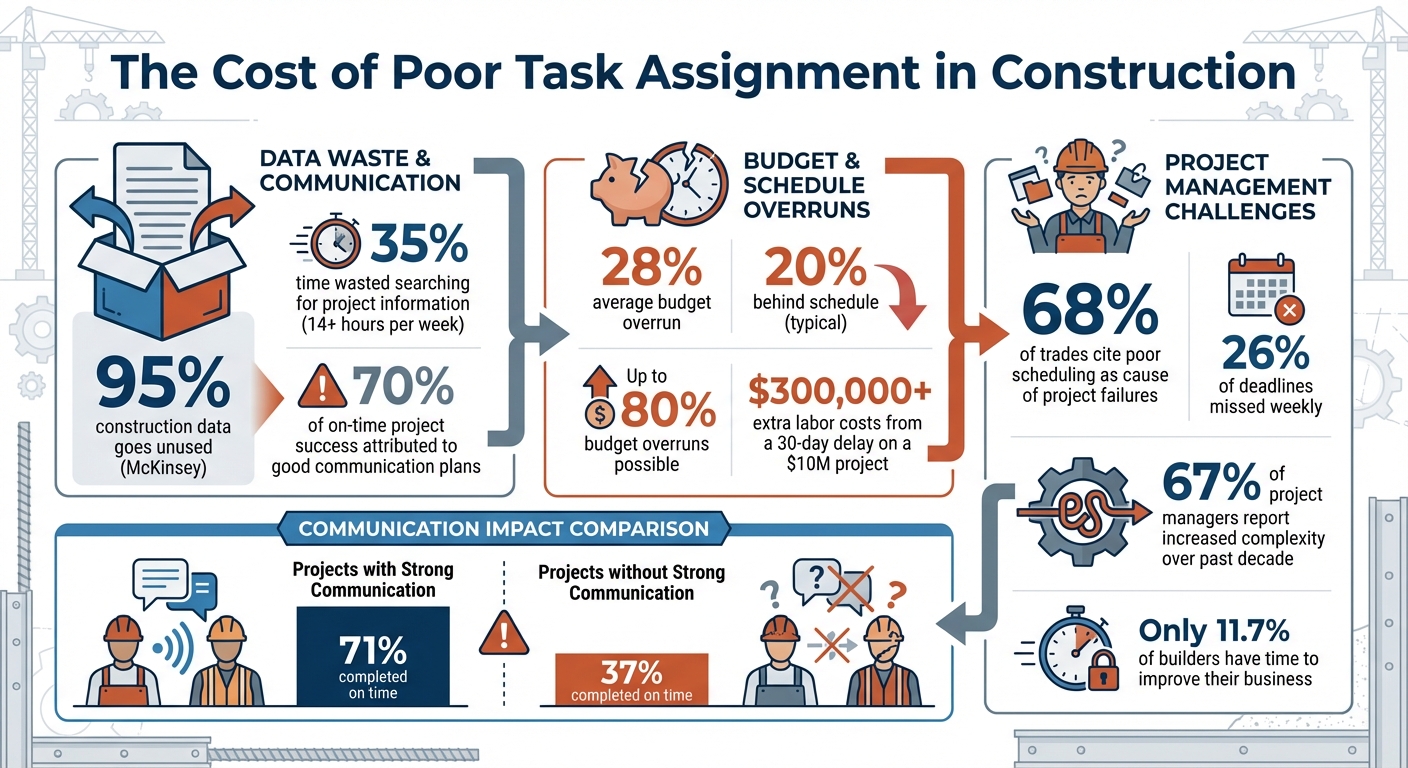
Construction Task Assignment Problems: Key Statistics and Impact on Project Performance
When task assignment lacks structure, construction projects often face a cascade of operational and financial challenges. Issues like unclear responsibilities, manual tracking, and uneven workloads can disrupt workflows, delay timelines, and inflate costs. According to McKinsey, a staggering 95% of construction data goes unused, fueling miscommunication and delays. These inefficiencies hit hard, with budget overruns averaging 28%. Addressing these problems is critical, as they directly affect performance and profitability.
Unclear Responsibilities and Handoffs
Unclear task assignments are a recipe for delays, especially during trade handoffs.
Without clearly defined ownership, important tasks can easily fall through the cracks. For example, when electrical crews finish their work and plumbing teams step in, poor documentation often leaves the status of tasks ambiguous. This lack of clarity leads to rework, quality issues, and delays that ripple through the project timeline.
It starts hitting the budget harder than you think. A 30-day delay on a $10 million project can rack up over $300,000 in extra labor costs, not to mention lost productivity. Miscommunication during these transitions also strains relationships with clients and subcontractors. As one industry analysis notes, poor task assignment can result in “reduced team efficiency, project delays, increased costs, and negation of staff skills”. When stakeholders don’t have the context they need, problems like client dissatisfaction and repeated vendor callbacks become almost inevitable.
Manual Tracking and Fragmented Communication
Using outdated tools like paper logs, spreadsheets, and scattered emails creates information silos that block real-time project updates. This disjointed communication makes it harder for project managers to spot critical issues – like material shortages or safety concerns – until it’s too late, triggering a domino effect of setbacks.
Administrative work eats up valuable time. Instead of focusing on project execution, managers often find themselves chasing down status updates across multiple platforms. In fact, only 11.7% of builders report having enough time to invest in improving their business. A well-organized communication plan is crucial, with studies showing it contributes to 70% of a project’s on-time success.
Unbalanced Crew Workloads
When tasks aren’t distributed evenly, the consequences can be severe. Overworked crews face burnout and are more likely to make mistakes, while underutilized teams waste paid labor hours waiting for materials or instructions. These inefficiencies drive up costs without improving productivity. Overtime costs soar for overworked teams, while idle crews represent wasted resources.
Construction projects often run 20% behind schedule and can exceed budgets by as much as 80%. Poor scheduling is cited by 68% of trades as a leading cause of project failures. Beyond immediate costs, overworked crews are at higher risk for accidents, which can lead to legal issues and even project shutdowns. Assigning tasks without considering skill levels can result in subpar work, unhappy clients, and expensive rework. High turnover due to burnout adds to recruitment and training expenses, further straining budgets.
Without real-time insight into crew availability, contractors miss opportunities to reassign workers from nearly finished jobs to active ones, perpetuating the cycle of imbalance. These challenges highlight the urgent need to rethink task assignment strategies to ensure smoother operations and better outcomes.
sbb-itb-5eea312
How Structured Task Assignment Improves Construction Workflows
Structured task assignment can turn the typical chaos of a construction site into a well-oiled machine. By implementing clear processes for assigning, tracking, and integrating tasks, you can eliminate many inefficiencies that plague traditional project management. The secret lies in shifting from vague instructions to specific, measurable tasks that tie directly to the project’s timeline and budget. Precise task assignments also help create accountability across the team.
Assign Tasks to Specific People or Crews
When tasks are assigned to specific individuals or crews, accountability becomes clear, and deadlines are less likely to slip. Instead of issuing general instructions like “work on plumbing”, more detailed assignments such as “install plumbing fixtures on floors 1-2” ensure everyone knows exactly what they’re responsible for.
This level of clarity reduces downtime, as workers no longer waste time figuring out their next steps. Modern tools and Fieldwire alternatives can take this further by automatically populating timesheets based on task assignments and tracking start/stop times, cutting down on administrative work. Additionally, checking resource availability before assigning tasks ensures that no crew is overbooked, while mobile notifications keep teams updated on new assignments or schedule changes.
Link Tasks to Construction Phases and Dependencies
Connecting tasks to specific construction phases and their dependencies ensures that work flows in the correct sequence, avoiding costly delays. For example, on a 10-story office project, a plumbing delay caused by a late permit was mitigated using Gantt charts. These visualized the dependencies, allowing managers to reassign crews to exterior cladding work immediately. Automated reminders kept the permitting process on track, preventing further disruptions.
By linking tasks to dependencies, project managers can also identify the critical path needed to stay on schedule. In one instance, a community center project faced an 8% schedule lag due to a four-day storm. The foreman used real-time dashboards to quickly redirect crews to indoor electrical work, minimizing further delays. Research shows that construction teams miss about 26% of their deadlines weekly, underscoring the importance of managing task dependencies effectively.
Beyond sequencing, integrating tasks with schedules and budgets strengthens overall project control.
Connect Tasks with Schedules and Budgets
Tying tasks directly to schedules and budgets provides real-time insights into both timelines and costs. By attaching cost codes to individual tasks, managers can quickly identify which activities are driving up expenses and address potential overruns before they spiral out of control.
Digital tools streamline coordination by automatically notifying the next trade when a task is completed. For example, once electricians finish rough-ins, the drywall crew can be alerted to start immediately. Automatic reminders for upcoming or overdue tasks also help prevent schedule slippage, keeping everyone aligned and on track.
How Task Assignment Improves Accountability and Communication
Clear task assignments do more than just organize workflows – they create accountability and improve communication across the board. By defining responsibilities and streamlining collaboration, teams can work more efficiently while avoiding the missteps that often arise from unclear expectations.
Track Task Status in Real Time
When task statuses are visible – whether labeled as Not Started, In Progress, or Completed – it becomes much easier to monitor progress and address potential delays. This kind of real-time tracking is increasingly important, especially as 67% of project managers report a rise in project complexity over the past decade.
Tools like digital dashboards make it simple to see what’s happening at a glance. For example, if a framing crew’s task is stuck in “In Progress” for three days past its deadline, the project manager can step in immediately. Whether the issue is a resource shortage, unclear instructions, or something else, this visibility allows for quick action. Plus, having clear data reduces the blame game when deadlines slip – everyone can see exactly where the problem started.
Using frameworks like RACI (Responsible, Accountable, Consulted, Informed) further clarifies roles by defining who is responsible for each task and who needs to give final approval. Chandler Paul, a Senior Project Manager at NEWMEDIA.com, implemented a RACI chart during a national campaign launch. It streamlined feedback processes, cutting revisions by about two-thirds and enabling the team to deliver the project five business days ahead of schedule.
This clarity naturally extends into standardized processes, which can be reinforced through task templates and checklists.
Use Task Templates and Checklists
Templates and checklists are the unsung heroes of consistent project execution. By standardizing repetitive tasks and safety checks, they ensure that critical steps aren’t overlooked, saving both time and resources.
Take safety inspections, for example. A well-designed template might include checkpoints like verifying fall protection equipment, ensuring scaffolding stability, and checking for proper signage. When every team follows the same checklist, nothing gets missed – even if different crews handle the same tasks. These completed checklists also serve as documentation for compliance, proving that safety protocols were followed.
Beyond safety, templates simplify administrative tasks and create consistency across all project phases. They also make it easier to communicate updates between the field and the office.
Enable Field-to-Office Updates
Mobile tools are game-changers when it comes to bridging the communication gap between field crews and office staff. With smartphones, superintendents can upload progress photos, mark tasks complete, and log daily activities – all in real time .
This eliminates the delays that come with traditional methods like phone calls or end-of-day reports. For instance, if a crew encounters unexpected soil conditions during excavation, they can alert the project manager instantly. This allows schedules to be adjusted or materials to be ordered before the issue causes a ripple effect across the project timeline.
The benefits of real-time communication are hard to ignore. Research shows that projects with strong communication practices are completed on time 71% of the time, compared to just 37% for those without. Mobile updates also create a searchable record of all decisions and changes, which is invaluable for resolving disputes or tracking progress.
| Communication Aspect | Manual Processes | Software-Managed Processes |
|---|---|---|
| Field Updates | Relies on phone calls, emails, or reports | Real-time updates with photos and timestamps |
| Information Accuracy | Prone to delays and miscommunication | Centralized data with instant visibility |
| Decision Speed | Dependent on delayed reports or site visits | Immediate access for proactive problem-solving |
This centralized approach saves time and reduces conflicts. Instead of wasting 35% of their time searching for project information – equivalent to over 14 hours per week – team members can quickly access updates, weather data, and incident reports. Everyone stays on the same page, which minimizes rework and keeps projects moving forward efficiently.
Assigning tasks effectively requires tools that can bring everything together seamlessly. Contractor Foreman simplifies this process by centralizing task management, connecting tasks to schedules and financial reports, and offering extensive training and support to ensure teams can adopt the system with ease. This all-in-one approach not only streamlines task assignment but also integrates it smoothly with scheduling.
Create and Assign Tasks in One Place
With Contractor Foreman’s To-Do module, you can create and assign tasks to specific employees or crews in just a few clicks. Once assigned, notifications are automatically sent via email or text to the responsible team members. Tasks are organized visually using Kanban-style columns sorted by status, providing managers with a clear view of what’s pending, in progress, or awaiting action. Custom filters remain active across sessions, keeping high-priority tasks front and center while helping identify potential bottlenecks before they escalate.
“I like that it has almost everything in one place from the client portal to schedules, to budgets, and so on.” – Shawn B., Avan Company LLC
Link Tasks with Schedules and Daily Logs
Contractor Foreman takes task management a step further by linking tasks directly to Gantt (CPM) schedules. Field crews can update the “percent complete” in real time through the mobile app, ensuring office staff always have up-to-date information. Changes made in the field, whether related to task progress or daily logs, are instantly visible to the office team.
Tasks are also tied to job costing reports, making it easy to track whether specific activities, like framing or trim work, are taking longer than planned and impacting budgets. Daily logs generated from timecards provide a detailed view of labor hours and productivity, ensuring tasks align with the actual work completed.
Get Free Training and Support
To make sure teams get the most out of the software, Contractor Foreman includes free training and support with every plan. Each account is assigned a dedicated Customer Success Manager to guide onboarding. Live support is available Monday through Friday from 7 AM to 7 PM ET, with an average wait time of just 13 seconds and 95% of support chats earning 5-star ratings.
“The support team has been awesome training us all the features within the app. This app has everything you need to run your projects, no need to have multiple apps anymore.” – Brian M., Morrell Electric
For new users, private training sessions or webinars are available to speed up adoption. With plans starting at $49 per month and a 100-day money-back guarantee, Contractor Foreman offers professional-grade construction management software without stretching your budget.
Conclusion
Structured task assignment helps eliminate wasted effort, clarify ownership, and improve communication. When specific tasks are assigned to individuals, teams can avoid confusion and costly delays. Research highlights that managers spend 37% of their time making decisions, with over half of that time lost to inefficiency. For Fortune 500 companies, this inefficiency translates to about 530,000 lost workdays and $250 million in wasted labor costs every year.
The benefits of clear task assignment extend directly to project outcomes. Organizations with well-defined roles and accountability are over three times more likely to achieve top-tier organizational health. For example, a semiconductor company that revamped its responsibility matrix managed to cut decision-making time by 15% and reduce project delays by 20%. These results show that structured task management not only organizes workflows but also leads to better timelines and increased profitability.
“Making a single person accountable for a task means that there is absolute clarity on who is ensuring that the tasks are delivered on time and correctly.” – Kevin Murphy, CEO & Executive Leadership EML
Digital solutions play a key role in achieving this level of clarity. Tools like Contractor Foreman bring these benefits to life by centralizing task creation, tying assignments to schedules and budgets, and providing real-time updates between the field and the office. With plans starting at just $49 per month, adopting professional-grade task management is not a heavy investment – it’s simply a smarter way to work.
FAQs
How can organized task assignment help prevent delays in construction projects?
Clear task assignment is key to ensuring every team member understands their role, reducing the chances of confusion or miscommunication. When tasks are well-defined, resources are allocated wisely, and deadlines are realistic, projects are more likely to stay on schedule and avoid delays.
This structured approach also allows for real-time updates and quick resolution of conflicts, addressing potential issues before they grow into bigger problems. By keeping workflows efficient and ensuring milestones are achieved on time, teams can enjoy a smoother path to project completion.
How do digital tools improve task assignment in construction projects?
Digital tools have completely transformed how tasks are assigned in construction, moving away from old-school methods like paper lists and spreadsheets to modern, cloud-based systems. With these tools, contractors can assign tasks, update schedules, and notify teams instantly, cutting down on miscommunication and delays. Managers gain a clear, real-time view of who is responsible for each task, what resources are required, and when work needs to be completed.
Take platforms like Contractor Foreman, for example. They simplify the process with features such as automated task templates, document sharing, and mobile accessibility. Teams can receive assignments, review updated plans, and track their progress from virtually anywhere. Plus, integrated tools for time tracking and resource management offer instant insights into labor and material usage, helping projects stay on schedule and within budget. By streamlining workflows and boosting accountability, these digital tools lead to smoother operations and better project results.
How does balancing workloads improve productivity and safety on construction sites?
Balancing workloads is a key factor in boosting both productivity and safety on construction sites. When tasks are shared evenly, workers are less likely to face exhaustion, which helps them stay alert and lowers the chances of accidents or injuries. It also prevents bottlenecks that can arise when certain team members are overloaded, keeping the entire crew on track and avoiding expensive delays.
A well-structured task assignment process ensures that every worker understands their role, aligns tasks with the right skill sets, and allows for quick adjustments when needed. This approach not only improves accountability but also enables foremen to shift tasks around as necessary, preventing burnout and encouraging safer, more efficient work habits.
Using tools like Contractor Foreman to plan and manage daily workloads can help contractors maintain steady productivity, reduce mistakes linked to fatigue, and complete projects on time – all while supporting a motivated and healthy team.
Related Blogs:







