
“Oh yeah… now I remember! We fell behind because it rained hard that week…like, really hard.”
That kind of memory might sound convincing in a meeting, but it rarely holds up when money, timelines, or liability are on the line.
In construction disputes, weather delays get challenged constantly — especially when there’s no reliable documentation to support the claim.
And the cost can be BRUTAL!
A contractor could lose tens of thousands of dollars on a rejected delay claim. An owner may deny a schedule extension. A supplier could dispute responsibility for missed deadlines. Without solid evidence, weather-related delays quickly turn into expensive arguments.
HOW TO DO IT RIGHT?
Most construction contracts require contractors to PROVE the weather was unusually severe compared to historical averages for that location and season. In other words, it’s not enough to show that it rained or snowed. You have to demonstrate that the conditions were beyond what would normally be expected!
That’s where historical weather data becomes critical.
By comparing actual jobsite conditions against 10-year historical averages from trusted sources like NOAA, contractors can document whether rainfall, wind, snow, heat, or freezing temperatures were truly abnormal. That data can help support delay claims, justify schedule extensions, and strengthen communication with owners, insurers, and legal teams.
When projects go sideways, historical weather reports become more than just information — they become evidence.
How historical weather documentation helps contractors:
- Unusual weather matters: Claims are valid only if weather exceeds historical norms (e.g., rain days or extreme temperatures).
- Detailed records win: Precise daily logs, weather station data, and photos strengthen your case.
- Timely notice is essential: Most contracts require reporting delays within 48–72 hours.
- Critical path impact: Weather must affect activities tied to the project’s completion timeline.
For U.S. data, NOAA’s tools like Climate Data Online and certified records are highly reliable. Contractors can also use private weather services or construction management software like Contractor Foreman to track and document weather impacts in real-time.
Accurate, organized evidence can reduce disputes, save on consultant fees, and protect against financial losses.
Why Historical Weather Data Matters for Construction Claims
Proving Weather-Related Delays
Historical weather data turns subjective claims into hard evidence. To prove a weather-related delay, you need to show that conditions exceeded the 10-year averages for that location and time period. For instance, if your site experienced 7.2 inches of rain in a month where the typical rainfall is 3.8 inches, that discrepancy strengthens your case.
Most contracts only allow extensions for “unusually severe” weather. This means normal seasonal patterns don’t count. The 10-year averages provided by NOAA establish what contractors should reasonably expect in terms of rain days, extreme temperatures, or wind events when planning their schedules. Without this benchmark, it’s impossible to prove that conditions were outside the norm.
Historical data also helps justify recovery time – the period needed for a site to become workable after adverse weather. For example, standing water in excavations or a saturated subgrade requires drying time, which adds to delays. By comparing current conditions to historical norms, contractors can substantiate these additional delay days. This evidence not only supports claims but also facilitates smoother negotiations.
Reducing Disputes with Accurate Data
Accurate weather data can reduce disputes by replacing guesswork with facts. A simple log entry like “rained all day, no work” often falls short under scrutiny. Third-party meteorological records provide an objective, trusted reference point that both contractors and project owners can rely on.
Having precise data also builds credibility. Experts in the industry emphasize that contractors with detailed records are far more likely to win claims. On the other hand, poor documentation can lead to losing claims – even when the contractor is in the right.
When you present a claim backed by specific weather station data, detailed logs, and photos of site conditions, it carries significantly more weight than a vague explanation or generalized request for relief.
Meeting Contractual Requirements
Historical weather data also ensures compliance with strict contract terms. Many contracts define specific thresholds for compensable weather events. For example, a “rain day” might be defined as measurable precipitation over 0.10 inches or conditions that halt work for more than half of a shift. Historical records help confirm whether these thresholds were met.
Timely notice is another critical requirement. Most contracts specify that weather-related delays must be reported within 48–72 hours, though some allow up to 14 days. Missing this deadline can invalidate your claim, no matter how strong your evidence is. Real-time weather tracking can help contractors meet these notice requirements, even before the full impact of the weather is assessed.
Finally, for a claim to hold up, the weather event must tie directly to the critical path of the project. If the weather didn’t affect activities that directly impact the project’s completion timeline, it likely won’t justify a delay claim. By combining historical weather data with schedule analysis, contractors can prove not only that severe weather occurred but also that it disrupted critical work.
sbb-itb-5eea312
Where to Find Reliable Historical Weather Data
Government and Meteorological Agencies
For U.S. weather data, NOAA is the go-to federal source. Through its National Centers for Environmental Information (NCEI) – formerly the National Climatic Data Center – it archives an impressive 229 terabytes of environmental data monthly, collected from over 130 observing platforms. This makes it a key resource for historical weather records.
If you’re dealing with construction claims, NOAA’s Climate Data Online (CDO) portal is indispensable. It provides daily, monthly, and yearly climate measurements like temperature, precipitation, and wind. While digital access is free, certified hard copies can also be ordered for legal purposes.
“Customers can also order most of these data as certified hard copies for legal use.”
– NOAA Climate Data Online
For accident investigations or legal disputes, NOAA’s Service Records Retention System (SRRS) holds National Weather Service (NWS) observations, forecasts, and warnings for up to five years. Tools like the NOAA Mapping Tool help you locate the nearest weather station to your site, while the Historical Observing Metadata Repository (HOMR) verifies a station’s history and location for precise site representation.
For recent events, NOAA’s NOWData portal offers preliminary local climate data. However, it’s a good idea to cross-check this with finalized NCEI data for formal claims.
When government data isn’t immediately available, private services can fill the gap.
Private Weather Services
Private weather services are especially helpful when government data is delayed. For example, while the Global Historical Climatology Network-Daily (GHCN-D) data is highly reliable, its rigorous quality assurance process can cause a slight lag. During this time, private services can provide real-time, site-specific data, ensuring you have immediate access for daily logging.
Opt for services that offer hourly data, which can be more detailed than daily summaries. Government sources like Local Climatological Data (LCD) provide hourly, daily, and monthly summaries for around 2,400 U.S. locations. This level of detail can be critical when proving weather-related work stoppages. For catastrophic events, cross-reference private data with NOAA’s Storm Events Database and Severe Weather Data Inventory (SWDI) to validate claims when delays in government records occur. Ordering certified records early is key, as processing times may impact timely claims.
For streamlined project management, private data can be validated through tools like Contractor Foreman.
Construction Tools with Weather Tracking Features
Combining real-time site logs with verified weather data strengthens your claims by aligning on-site records with trusted meteorological benchmarks. Contractor Foreman simplifies this process by integrating weather tracking into your daily project management workflow. Its Daily Logs feature lets you document site-specific weather conditions as they happen, creating a contemporaneous record – a crucial factor since courts often favor records created at the time of an event.
Contractor Foreman is known for its user-friendly interface, with a 4.5/5 rating and an average support response time of just 13 seconds. Starting at $49 per month, the platform links weather entries with scheduling delays and financial impacts. It also integrates with over 50 systems, including QuickBooks, CompanyCam, and Google Calendar, making it easy to cross-reference weather-related delays with financial and scheduling data.
For thorough documentation, use Contractor Foreman for daily logs and validate this data against GHCN-Daily records once available. In legal scenarios, combining Contractor Foreman logs with certified NOAA data creates a strong, admissible case for weather-related claims.
How to Document and Use Historical Weather Data in Construction Claims
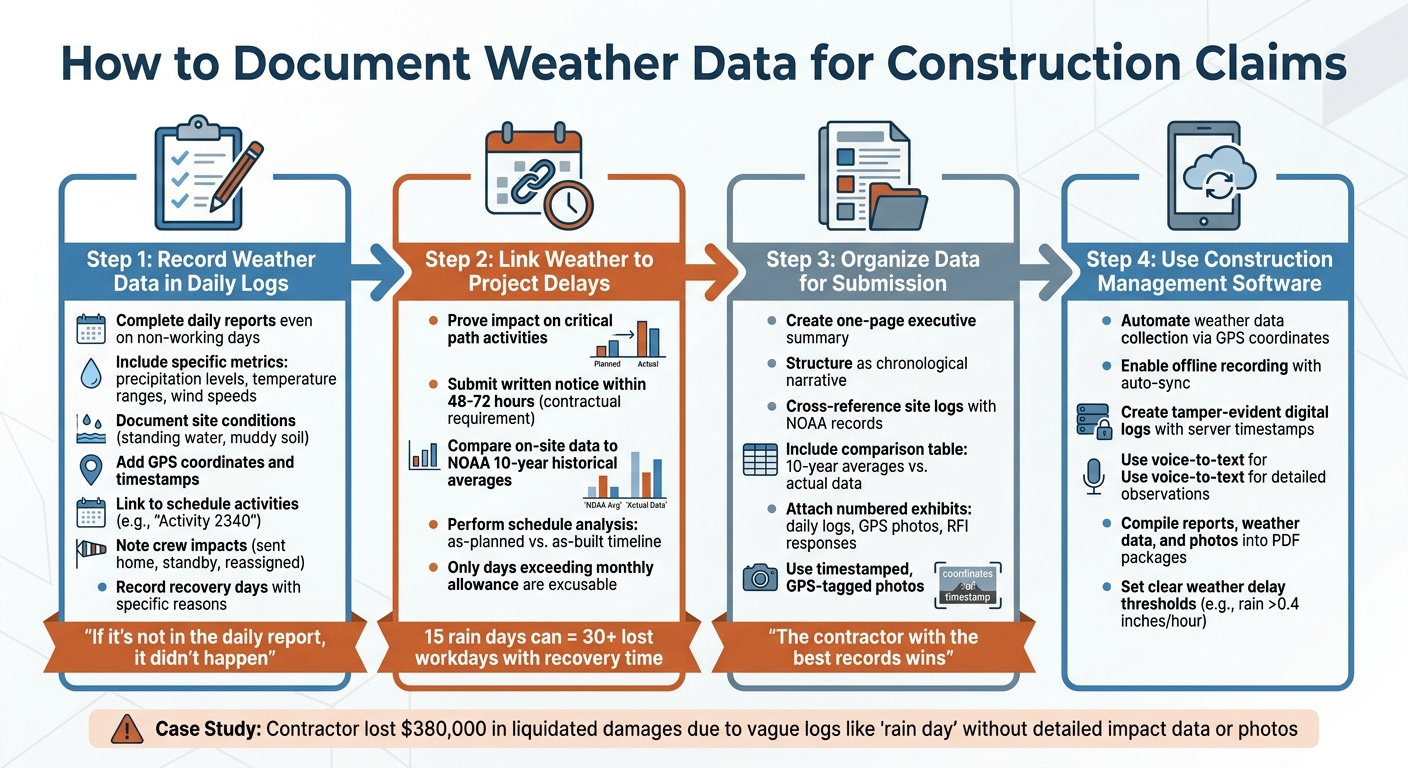
4-Step Process for Documenting Weather Delays in Construction Claims
Thorough weather documentation is the backbone of any successful construction claim. As we’ve discussed, objective data and real-time records are crucial when proving delays caused by weather. Here’s how to properly gather, connect, and organize that evidence.
Recording Weather Data in Daily Logs
Courts and arbitrators place far greater trust in records created during an event than in those reconstructed later from memory. This means completing a daily report is non-negotiable, even if no work occurred that day.
“If it’s not in the daily report, it didn’t happen. This is how attorneys, judges, arbitrators, and inspectors view site documentation.” – BuildLog
Your daily logs should include specific metrics such as start and stop times, precipitation levels (e.g., “1.2 inches accumulated”), temperature ranges, wind speeds, and detailed site conditions like standing water or muddy soil. Modern voice-to-text apps can make this process faster and more accurate while also embedding GPS coordinates and timestamps for added credibility.
Don’t just record major events – document non-events, too. Link each weather entry to specific schedule activities (e.g., “Activity 2340”) and note how crews were affected, whether they were sent home, put on standby, or reassigned to indoor tasks. This detail is essential for supporting cost-related claims.
Recovery days are another critical area. After a storm, it may take days for conditions to improve enough to resume work – time that can lead to significant losses. For instance, 15 rain days could translate to 30 or more lost workdays when recovery time is factored in. Be specific about why the site remained unworkable, such as saturated soil or water-filled trenches, rather than simply noting the date work resumed.
This meticulous documentation is key to connecting weather events to your project schedule.
Linking Weather Data with Project Delays
Weather data by itself doesn’t prove a delay – you need to show how it impacted your project’s critical path, which is the sequence of tasks that determines your completion date. A rain delay justifies a time extension only if it affects critical path work.
“The difference between a rain delay claim that succeeds and one that fails is almost never whether the rain actually happened… The difference is whether the contractor can prove the rain was unusually severe, that it impacted critical path work, and that proper notice was given.” – BuildLog
Most contracts require written notice of a delay event within 48 to 72 hours. Missing this deadline can void your claim, no matter how well-documented the event is. To avoid this, set up a system to flag potential delay events immediately and ensure formal notice is sent within the required timeframe.
To prove the weather was “unusually severe”, compare your on-site data to NOAA’s 10-year historical averages for your location and the relevant month. If your contract includes a monthly allowance for rain days based on these averages, only days exceeding that allowance are typically excusable. Perform a schedule analysis comparing your original “as-planned” timeline to the “as-built” timeline to calculate the exact number of days added by the weather event.
Once you’ve established the delay’s impact, the next step is organizing the data for a strong claim submission.
Organizing Weather Data for Claims Submissions
Start with a one-page executive summary that outlines the delay events, total impacted days, and the compensation you’re requesting. Structure the claim as a chronological narrative, linking specific weather events to corresponding schedule activities.
Cross-reference your site logs with NOAA records from the nearest weather station to validate your data. Include a comparison table showing 10-year historical averages versus your project’s actual weather data to highlight unusually severe conditions. Attach supporting materials like daily logs, GPS-stamped photos, and RFI responses as numbered exhibits for a professional and easy-to-follow presentation.
Timestamped, GPS-tagged photos add another layer of objective proof. Modern construction management tools can streamline this process by compiling daily reports, weather records, and photos into a single, tamper-proof PDF, cutting claim preparation time from weeks to minutes.
“The contractor with the best records wins. The contractor with nothing written down loses, even when they are right.” – Projul
Best Practices for Using Weather Data in Construction Management Software
Modern construction management tools have taken the hassle out of weather documentation, automating the process to create detailed records that hold up in legal disputes.
1. Using Contractor Foreman for Weather Documentation
Contractor Foreman simplifies weather tracking with its daily log feature. By automatically pulling weather data based on your project’s GPS coordinates, it captures key metrics like temperature, wind speed, humidity, and precipitation – no manual input required. This ensures the data reflects the actual jobsite conditions rather than relying on readings from a far-off airport station.
The platform’s mobile app is designed for field use, even in areas without cellular service. Teams can record weather-related impacts and attach GPS-tagged photos offline, with all data syncing automatically once a connection is available. This eliminates the risk of losing critical information, an issue often encountered with paper forms or systems that rely solely on internet access.
Another advantage is the tamper-evident nature of digital daily logs. For example, if a report is completed at 5:30 PM on a rainy Tuesday, the server timestamp confirms exactly when the entry was made. This provides an objective record, which can be invaluable during disputes.
Voice-to-text functionality further enhances efficiency, allowing superintendents to quickly capture detailed observations.
Instead of vague notes like “rain day”, they can dictate specifics that directly link weather to project tasks:
Heavy rain from 6:00 AM to 2:30 PM, 1.4 inches accumulated.
Standing water in Excavation B prevented foundation pour for Activity 2340.
Crew sent home at 8:15 AM.
This level of detail can make all the difference between a successful claim and one that’s denied.
2. Connecting Weather Data with Scheduling and Reporting
Accurate weather logging is just the first step – it’s equally important to connect these records to your project schedule.
Referencing specific activity IDs in daily logs (e.g., “Activity 2340: Foundation Pour”) creates a clear, verifiable link between weather events and project delays, which is essential for forensic schedule analysis. This approach doesn’t just show that bad weather happened; it proves how it impacted critical work.
Contractor Foreman’s scheduling tools make it easy to track tasks delayed by weather. For instance, documenting that “Scheduled steel erection (Activity 4120) was postponed due to wind speeds exceeding 30 mph, which are above the manufacturer’s specifications”, provides solid evidence for excusable delay claims. The software also compiles daily reports, weather data, and GPS-tagged photos into organized PDF packages, ready to share with stakeholders or legal teams in minutes. This saves you from piecing together timelines from scattered emails and memory.
By integrating weather data with scheduling and reporting, you create a unified, easily accessible record of weather-related impacts.
3. Maintaining Accuracy and Accessibility
Consistency is key when it comes to weather documentation. Filing reports daily – even on non-working days – ensures there are no gaps in your records, which could otherwise be exploited in disputes.
Accurate weather data starts with setting your project’s latitude and longitude correctly in the software. This ensures the data reflects real jobsite conditions, not a location miles away. Additionally, defining clear thresholds for weather delays, like rain exceeding 0.4 inches per hour or wind speeds over 30 mph, helps maintain consistency in your records.
Centralized storage in Contractor Foreman allows the entire team to access the same data, whether on web or mobile devices. This unified system ensures records are preserved for the full duration of warranty periods or potential legal claims.
Consider this: In March 2026, a general contractor on an 18-month highway project lost a 45-day weather delay claim because their logs only included vague entries like “rain day.” Without detailed impact data or supporting photos, the owner denied the time extension, leaving the contractor to absorb $380,000 in liquidated damages. This case highlights the steep cost of poor documentation and the importance of reliable, automated recordkeeping.
Conclusion
Historical weather data plays a key role in securing time extensions and minimizing unrecoverable costs. Contractors who successfully navigate disputes are those who can demonstrate that weather conditions were unusually severe, directly impacted critical path activities, and that proper notice was given within the contractual timeframe.
Using tools like Contractor Foreman simplifies this process by automatically logging GPS-tagged weather data, timestamped photos, and detailed daily reports as conditions change. This creates a reliable, tamper-proof timeline that’s hard for insurance adjusters and project owners to challenge.
Adopting a structured, data-driven approach not only reduces the likelihood of disputes but also enhances your company’s reputation for professionalism and reliability. When you can quickly access a comprehensive weather record complete with photos, precipitation details, and crew activity notes, you’re not just protecting your current project – you’re building trust and credibility that can lead to future opportunities. This method strengthens your claims and reinforces your standing as a dependable contractor.
FAQs
What counts as “unusually severe” weather in a construction contract?
In the context of a construction contract, “unusually severe” weather refers to extreme conditions that differ greatly from typical weather patterns. This could mean intense cold or heat, heavy rainfall, or an unexpected number of severe weather days that disrupt the project schedule. Since these conditions are generally outside the contractor’s control, they can affect timelines and may lead to claims or adjustments in the project plan.
Which NOAA records are best for proving a weather delay claim?
The best NOAA records for backing up a weather delay claim are found on Climate Data Online (CDO), managed by the National Climatic Data Center. These records provide quality-controlled daily data on key factors like temperature, precipitation, and wind. This information is crucial for documenting extreme weather conditions and their effects, making it a reliable resource for supporting such claims.
How do I tie weather days to critical path delay in my schedule?
To link weather-related days to delays on the critical path, begin with a well-defined baseline schedule and pinpoint activities that are sensitive to weather conditions. Keep detailed records of weather events, noting their severity, duration, and effects. Use contemporaneous evidence such as weather reports, daily logs, and site documentation to support your findings. By comparing actual progress against the planned schedule, you can demonstrate how specific weather events disrupted critical activities. Thorough documentation strengthens claims and helps justify potential time extensions due to weather-related delays.







