
- Quick Comparison
- Why Green Building Trends Matter on U.S. Jobsites
- 1. Software Tools for Green Project Coordination
- 2. Net-Zero and High-Performance Building Targets
- 3. Low-Carbon Concrete and Embodied Carbon Tracking
- 4. Prefabrication and Modular Construction
- 5. Smart Building Systems and Energy Management
- 6. Construction and Demolition Waste Reduction
- 7. Certification-Driven Planning with LEED and Similar Standards
- 8. Site Operations and Field Management for Greener Jobsites
- How These Trends Change Day-to-Day Project Delivery
- Green Building Trends Compared: A Quick Reference Table
- Conclusion
- FAQs
Remember when “green building” meant slapping a few solar panels on the roof and calling it a day?
Yeah…those days are over—but you should be pleased!
Because here’s the thing nobody tells you upfront: green building isn’t just about saving the planet anymore. It’s also saving your project (and a few thousand dollars along the way).
Yep, the game has changed.
Green building now touches your bids, buyout, field logs, and closeout—not just the design phase. Teams today have to track carbon, product data, waste, testing, and site records with the same discipline they already bring to cost and schedule.
Here’s what that means for you on the ground:
- Carbon data now affects prequalification, procurement, and substitutions
- Low-carbon materials can cut emissions, but they can also affect lead times and approvals
- LEED v5 and the 2024 IECC push more work into testing, commissioning, and field documentation
- Waste sorting, IAQ checks, fuel logs, and EPD tracking now belong in daily project work
- Tools like Contractor Foreman help keep submittals, RFIs, daily logs, and closeout records tied together
This article breaks down eight jobsite changes every contractor should have on their radar right now.
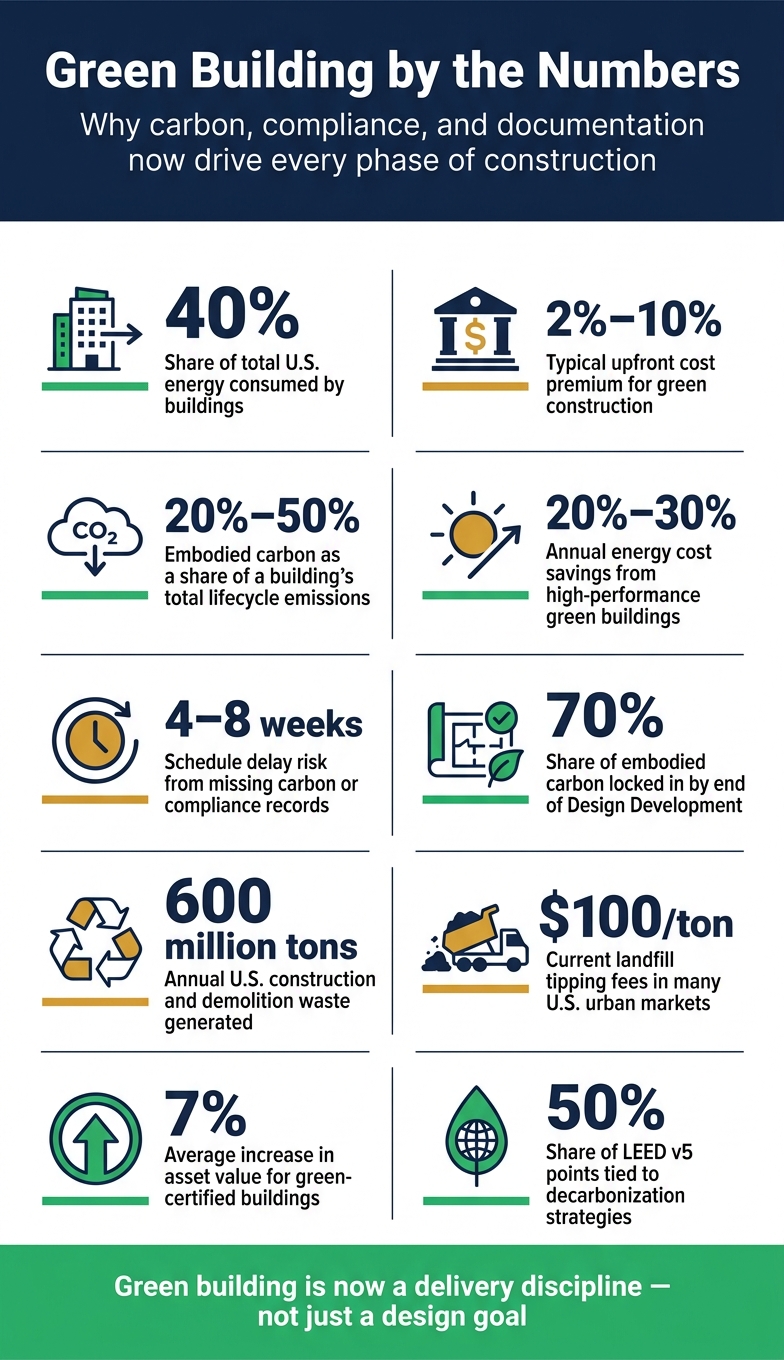
Green Building by the Numbers: Key Stats Every Construction Team Should Know
Quick Comparison
| Trend | What it changes most | What teams need to track |
|---|---|---|
| Contractor Foreman | Recordkeeping across the job | Submittals, RFIs, daily logs, closeout files |
| Net-zero / high-performance | Early design and procurement | LCA data, EPDs, testing, commissioning |
| Low-carbon concrete | Mix review and vendor selection | GWP caps, Type III EPDs, mockups |
| Prefab / modular | Early design freeze and logistics | BIM updates, release dates, QA logs |
| Smart building systems | MEP coordination and startup | Sensor schedules, network records, benchmarks |
| C&D waste reduction | Hauling, sorting, and closeout | Weight tickets, diversion reports, dumpster photos |
| LEED and similar standards | Credit planning from day one | Credit tracker, cover sheets, submittal proof |
| Greener site operations | Daily field supervision | IAQ logs, fuel use, utility use, heat plans |
Green building is now a delivery issue. The teams that keep clean records early have a much better shot at staying on budget, on time, and in spec.
sbb-itb-5eea312
Why Green Building Trends Matter on U.S. Jobsites
Green building used to live in design meetings and closeout binders. Well, not anymore.
Today it shapes preconstruction decisions, bid screening, and submittals before a single crew member sets foot on site. Owners are using embodied carbon caps and EPD requirements to filter bids early—and those requirements don’t disappear once work starts. They follow the project straight into daily field coordination.
LEED v5 made that shift official. Construction Management is now a prerequisite, which means teams must actively manage indoor air quality, source-separated waste, and heat protection during active construction—not just document them after the fact. The paperwork still matters, but the work behind it has to actually happen on the jobsite.
The numbers explain why owners are pushing so hard. Embodied carbon can account for 20% to 50% of a high-performance building’s total lifecycle emissions. That’s too big a share to manage casually. Material submittals now need EPDs before procurement kicks off. Waste sorting needs verified recycling partners and clear separation rules before the first dumpster arrives—not after it’s already full.
Owners also have real financial skin in the game now, which means they’re holding contractors to the plan with more consistency. Broad sustainability goals sound fine in a proposal, but they don’t help crews waiting on product approvals, hauler confirmations, or missing documentation. What actually moves projects forward are clear workflows—who handles what, when, and how.
That’s the shift driving every trend covered below.
1. Software Tools for Green Project Coordination
Primary Sustainability Benefit
Green projects run on data that people can actually find and use. Software tools like Contractor Foreman puts EPDs, waste records, and compliance documents in one place, so teams can check material choices as the work moves ahead.
Project Management Workflow Impact
The biggest risk on a green project is a broken data trail. If a material substitution comes through an RFI or change order, the carbon record has to move with that change. It can’t disappear in an email chain.
That’s where Contractor Foreman helps. Its submittals, RFIs, and daily logs make it easier to keep that record connected from start to finish. Field teams can log IAQ inspections with notes and photos in daily logs, which is more and more expected for certification. Teams can also use submittals with certification-ready templates from day one, so Contractor Foreman stores and routes compliance documents instead of forcing everyone to rebuild the file at closeout.
When the paper trail is clean, cost and schedule decisions get a lot easier to handle.
Cost and Schedule Implications
Carbon now sits next to cost and schedule as a third project constraint. That changes day-to-day planning in a big way. Low-carbon materials can come with longer lead times, and that needs to show up in the schedule early, not pop up halfway through the job.
Keeping long-lead materials, federal incentives, and budget effects inside one project record gives the project manager and owner a clearer view of what’s happening. It’s a simple idea, but it matters: if the data lives in one place, the team has a much better shot at making sound calls before small issues turn into expensive ones.
That same discipline sets up the next shift: turning performance targets into jobsite tasks the team can measure.
Documentation and Compliance Needs
Contractor Foreman’s document management keeps certifications, carbon reports, and environmental compliance evidence organized and easy to pull up. So when an owner or inspector asks for records, the team can respond fast without digging through scattered files.
2. Net-Zero and High-Performance Building Targets
Primary Sustainability Benefit
Once a team has carbon and compliance data in hand, the next move is setting targets that guide design, buying decisions, and field checks. Net-zero goals push projects to cut both operating energy and embodied carbon.
That’s the big shift: looking at whole-life carbon instead of energy use alone. In plain English, that means lifetime energy use plus the emissions tied to materials. And that materials piece matters a lot. Embodied carbon can account for 20% to 50% of lifecycle emissions.
Project Management Workflow Impact
Timing changes everything here. Because 70% of embodied carbon is locked in by the end of Design Development, teams need to run Life Cycle Assessment before construction documents are finished.
That puts procurement right in the middle of the job. Owners now review bids based on embodied-carbon data, and material submittals need Environmental Product Declarations (EPDs) at the start of the process, not at closeout.
In other words, this is no longer a late-stage paperwork task. Early planning shapes which materials make the cut, especially for carbon-heavy products.
Cost and Schedule Implications
Set the targets early, and the cost gap stays surprisingly small. High-performance buildings typically run just 0% to 4% more than conventional construction—and that premium gets easier to justify when you look at what comes back. High-performance design can cut operational energy use by 30% to 70%, lowering long-term operating costs and strengthening asset value.
The business case isn’t hard to make:
- Green buildings show an average 7% increase in asset value
- They also bring in 8% higher rental income than conventional buildings
- Federal incentives under the Inflation Reduction Act, including the Section 179D deduction for commercial buildings and the Section 45L tax credit for residential projects, can help offset upfront costs
What shifts is the schedule risk. Instead of showing up only in construction, it moves earlier into procurement, testing, and commissioning.
Documentation and Compliance Needs
The 2024 IECC tightens the rules. It requires blower-door testing, stricter duct leakage limits, and commissioning for high-efficiency HVAC and electrical systems. So compliance now depends on test results, not just a visual review.
LEED v5 pushes the same direction. It ties 50% of points to decarbonization, and embodied carbon measurement is now a prerequisite, not just an optional credit.
That means teams need product-specific EPDs sorted by specification division, with GWP values that are easy to trace and audit during certification review. If that documentation is messy, the review process gets messy too.
3. Low-Carbon Concrete and Embodied Carbon Tracking
Primary Sustainability Benefit
Concrete is one of the biggest embodied-carbon levers on the jobsite. It usually accounts for 25% to 30% of a project’s total material-related embodied carbon.
That’s why the mix design matters so much.
Supplementary Cementitious Materials (SCMs) such as fly ash and slag cut the amount of cement needed in the mix. And tools like CarbonCure push this further by injecting captured CO2 during batching, which can reduce cement use and may improve compressive strength.
The upside is pretty simple: with familiar approaches like SCMs and CO2 injection, teams can often get 10% to 20% carbon cuts with no added cost. In practice, that makes procurement the main control point for low-carbon concrete.
Project Management Workflow Impact
The shift starts early, and it starts with buying decisions. Owners are now writing embodied carbon caps into RFPs, and bid leveling no longer looks at unit price alone. Teams also compare GWP during vendor review.
That changes the selection process in a very direct way. A vendor with the lower price can still lose the bid if the proposed mix goes over the project’s carbon limit.
After the mix is approved, the team needs to track each substitution against the carbon target using eco building supplies tracking solutions. If something changes mid-project, a new LCA is needed to confirm the revised mix still stays under the GWP cap.
There’s also a field-side effect. High-SCM blends don’t always behave like standard mixes, so crews should test mockups before structural placement. Set times and finishing can shift, and that’s the kind of issue you want to catch early, not during a pour.
Cost and Schedule Implications
In some markets, slag and fly ash cost less than standard Portland cement. So the project can cut carbon and lower material cost at the same time.
The Mountain West Data Center project from late 2025 shows what that looks like in dollars and tons. By moving from a 100% standard Portland cement reference mix to a 50% slag / 30% fly-ash blend during schematic design, the team cut 9,200 metric tons of CO2e and saved $1.4 million in cement costs on a $240 million hyperscale project.
Timing matters here. If the team waits until the Construction Documents phase, the cost goes up fast. Retrofitting carbon-reduction measures at CD costs 3 to 5 times more than building them in during Schematic Design.
Documentation and Compliance Needs
For low-carbon concrete submittals, product-specific Type III EPDs are required for federal Buy Clean work and LEED v5 audits.
To make that enforceable, teams should place clear GWP ceilings – for example, kg CO2e per cubic yard – right in Division 03 specs. That gives the GC a clean basis to reject submittals that miss the mark.
It also helps to track EPD expiration dates in the submittal log. EPDs usually stay valid for five years, and an expired EPD can create problems during closeout and certification.
| EPD Type | When to Use | Compliance Level |
|---|---|---|
| Industry-default | Schematic Design target setting | Not accepted for Buy Clean or LEED v5 review |
| Industry-Average Type III | Design Development option screening | Acceptable for some LEED v4.1 credits |
| Product-specific Type III | Construction Documents and procurement | Required for Buy Clean, GSA P100, LEED v5 |
The same early submittal discipline carries into prefabrication, where lead times and approvals also need to be locked in before work reaches the field.
4. Prefabrication and Modular Construction
Primary Sustainability Benefit
Early planning matters even more in prefab because design freezes happen sooner.
When more of the work moves off-site into a factory, teams can cut waste in a very direct way. Modular construction reduces material waste by 70–90% compared to site-built methods. A big reason is simple: factory production allows precision cutting, bulk purchasing, and recycling routines that are hard to keep up on a busy jobsite. It also helps teams get better material yield and tighter QA.
Design for disassembly pushes this further by using mechanical fasteners, which lets teams take modules apart and reuse them later. The Austin modular school project in late 2025 showed how that works on the ground. By sorting and tagging steel framing offcuts for reuse on a later Dallas project, the contractor cut material waste by about 16% in a single phase.
Project Management Workflow Impact
Once fabrication begins, field changes stop being simple fixes. Prefabrication pulls decisions forward, so teams have to lock in key choices much earlier.
The biggest change is the early design freeze. After fabrication starts, late design changes get expensive fast. That means GCs need to step into Design Assist during Schematic Design and early Design Development. In practice, that usually means using BIM and design for manufacturing and assembly (DfMA) to solve clashes before fabrication starts.
Logistics also shifts earlier in the process. Modules have to meet U.S. road limits – typically no wider than 16 ft and no taller than 14 ft – so any transit-driven design changes need to happen during the concept stage, not later during procurement. In other words, model updates, submittals, and release schedules carry just as much weight as the physical build.
Teams also need one live log for design updates, submittals, and delivery dates. Without that, fixed release packages can go off track fast.
Cost and Schedule Implications
Prefabrication makes the strongest cost case on repetitive project types, especially multifamily housing, medical clinics, data centers, and schools. The math works best when teams standardize the same assemblies across more than one project. If every module changes, the payoff starts to slip.
There’s a catch, though. Teams without strong BIM coordination often end up creating more rework than savings.
Documentation and Compliance Needs
Material passports are digital records tied to components that track specs, batch data, and maintenance history. They help make future recovery and reuse far more practical.
It also helps to automate shop production logs and QA/QC sign-offs during production instead of piecing them together at handover. That can prevent documentation slowdowns and handover delays.
5. Smart Building Systems and Energy Management
Primary Sustainability Benefit
Once the materials and assemblies are locked in, smart systems become the biggest driver of how well a building performs day to day. That matters because operations are where teams can still cut emissions after construction wraps up.
Smart controls can trim energy use in a big way. In commercial buildings, lighting controls like occupancy sensors and daylight harvesting can reduce electricity used for lighting by 30% to 50%. And when teams use an integrated BAS instead of separate standalone systems, total energy use can drop by 15% to 25% more.
Submetering gives teams a close-up view of energy use by zone or by piece of equipment. That kind of detail helps people spot waste that would otherwise stay hidden. AI-based tools add another layer by flagging systems that are drifting out of calibration before they fail. That drift and poor performance can account for up to 30% of energy waste in typical commercial buildings.
Project Management Workflow Impact
These systems need to be part of the job early. Bring the systems integrator in during schematic design so conduit paths, containment, risers, and MEP layouts can support sensors and network cabling without last-minute fixes.
Commissioning also follows a strict sequence. Sensors have to go in first. Then controllers get programmed. Only after that can integrated testing begin. On a first smart-building project, this phase often takes 40% to 60% longer than planned, so teams need schedule buffer built in from the start.
Cost and Schedule Implications
There is usually a higher upfront spend with green construction. High-performance green buildings tend to cost 3% to 7% more than conventional construction at the start, but the payback often comes in less than five years.
For multifamily work, the math can look a lot better. Projects that meet ENERGY STAR‘s 2026 standards may qualify for 45L tax credits of $2,500 to $5,000 per unit. That can take some of the sting out of the added investment.
Code version also matters more than some teams expect. It now shapes the controls package, testing scope, and commissioning scope, so the adopted edition needs to be checked before design begins.
Documentation and Compliance Needs
Handover for a smart building is a different animal than a basic as-built package. FM teams need records they can actually use when something goes wrong, especially if they want to find a fault without opening ceiling after ceiling.
At a minimum, the handoff should include:
- An as-installed sensor schedule with network addresses and calibration dates
- Network architecture diagrams
- System configuration records
- Performance benchmarks
- Energy consumption baselines
One simple habit makes this much easier: keep the sensor schedule as a live document throughout installation instead of trying to rebuild it at handover.
Store those records in a live digital handoff file so certification and tax-credit paperwork stays up to date. The same logs can also help teams track installation waste and close out greener jobsites.
6. Construction and Demolition Waste Reduction
Primary Sustainability Benefit
Green jobsites need a tighter waste plan from day one. In the U.S., construction and demolition work generates more than 600 million tons of waste each year, or about 40% of the solid waste stream. That hits both cost and compliance.
The best move is source reduction. Put simply: stop waste before it starts. Teams can do that with precise material takeoffs, smarter material choices, and simpler assemblies. On site, separating wood, metal, gypsum, and concrete at the source helps push diversion rates higher.
Project Management Workflow Impact
During preconstruction, precise quantity takeoffs and just-in-time delivery help keep materials from sitting out in weather or getting damaged by site traffic. Less exposure usually means less waste.
It also helps to write diversion rules into subcontracts and review them during preconstruction, not at kickoff. That shifts waste planning into buyout and subcontracting, where many of these costs are set, instead of treating it like a last-minute dumpster problem.
Cost and Schedule Implications
Landfill tipping fees have gone up fast. In many urban U.S. markets, they now top $100 per ton, up from about $50 to $70 per ton a decade ago. At that point, diversion is not just a green box to check. It’s direct cost control.
Diversion can cut hauling and tipping fees, and it may also bring in commodity revenue. Selective deconstruction usually costs about 10% to 15% more upfront than standard demolition, but salvage revenue and avoided tipping fees can help shrink that gap.
Documentation and Compliance Needs
Under LEED v5, teams need a Construction and Demolition Materials Management Plan that names at least five material streams for diversion. Keep the paperwork moving in real time:
- Upload weight tickets, dumpster photos, and diversion reports as the job progresses.
- Treat commingled waste as a lower-credit stream. Under LEED v5, it defaults to 35% diversion unless the hauler is RCI-certified.
- Leave Alternative Daily Cover (ADC) out of diversion totals.
- Track asbestos and lead-based paint on their own, and never count them toward diversion.
Those records also feed straight into certification review and project closeout.
7. Certification-Driven Planning with LEED and Similar Standards
Primary Sustainability Benefit
Certification turns sustainability goals into hard project controls. It pushes those goals into procurement, submittals, and commissioning instead of leaving them as loose design ideas.
With LEED v5, carbon is now front and center. Half of all points are tied to decarbonization strategies, and embodied carbon is now a required prerequisite, not just an optional credit.
Project Management Workflow Impact
Set sustainability targets during schematic design. If you wait, costs climb fast.
A delayed LCA review can drive up redesign costs and add weeks to the schedule, so it should be assigned at schematic design. On active jobs, certification work shows up in submittal logs, QC checklists, and commissioning sign-offs. This is where many teams feel the shift: green planning stops being a design memo and starts becoming field work.
To keep things from getting messy, a few rules help:
- Assign each credit to one owner, with clear evidence needs and due dates before design development starts.
- Use a LEED submittal cover sheet on every material package from day one so subcontractors submit EPD and compliance data upfront.
That change moves green work from design intent to field execution.
Cost and Schedule Implications
LEED-certified buildings command rental rate premiums of 3% to 8% and sale price premiums of 10% to 20%. That upside is one reason teams take certification planning seriously.
LCA consultant fees usually run from $1 to $8 per square foot on commercial work. That cost is far easier to handle when it is built into early planning. Once the job is already moving, it becomes much tougher to absorb.
Documentation and Compliance Needs
Documentation can make or break certification. A live certification tracker helps teams monitor credits and upload records in real time. Without that kind of system, paperwork tends to pile up until it becomes a fire drill.
Certification review cycles usually take 20 to 25 business days for the first round. If documentation comes in late, those last-minute scrambles can add weeks to the schedule.
For procurement, use product-specific Type III EPDs. Generic data is fine for early target setting, but not for buying decisions. Commissioning also needs to start early. Under LEED v5, commissioning agents must review submittals on all projects as part of Fundamental Cx, so early commissioning integration should be treated as a baseline requirement.
Those records only help if the field team captures them as the work happens.
8. Site Operations and Field Management for Greener Jobsites
Primary Sustainability Benefit
After materials, prefab, and certification, the last big lever is daily site execution. A greener jobsite comes down to what happens in the field each day: how the site gets power, how materials are stored, and how waste is handled. Switching from diesel generators to grid power, and moving light-duty vehicles to electric, can cut jobsite emissions by a large margin.
Project Management Workflow Impact
On greener jobs, field scheduling has to work around heat, curing, and inspection windows. Heavy labor shifts to early morning or evening. Cool potable water needs to stay close to work areas. And a written Heat Illness Prevention Plan (HIPP) has to stay current through the life of the job.
Wet-applied materials also need enough time to cure before carpet or other absorptive finishes go in. If that step gets rushed, problems can show up later. Waste handling needs the same kind of field discipline. Labeled bins for wood, metal, drywall, and concrete let crews sort material right where the work happens.
That changes field supervision in a simple but important way. It becomes a scheduling job, not just a paperwork job.
Cost and Schedule Implications
Renewable diesel for heavy equipment can deliver an immediate 40% to 80% lifecycle emissions reduction per liter, and it works in existing machines without retrofitting. For teams that aren’t ready to switch equipment over to electric, that’s a practical bridge. It fits straight into superintendent decisions about fuel sourcing and equipment selection.
Another low-cost move is setting up take-back agreements with suppliers. If unused full units of shingles, tile, or adhesives can be returned, the site cuts disposal volume and trims logistics work at the same time.
Documentation and Compliance Needs
Daily logs and document management should track fuel, utility, IAQ, and ESC data in one place. When field records are captured during mobile site walks, those logs stay current as work moves from area to area. Teams pursuing construction emissions credits need fuel and utility use logged for both the GC and all subcontractors.
Contractor Foreman’s construction management software keeps field records together, so live data becomes usable project data instead of a pile of scattered notes.
Those live records also make day-to-day project delivery easier to follow across the whole job.
How These Trends Change Day-to-Day Project Delivery
Taken together, these trends change who owns project data, when teams make decisions, and how fast they can show compliance. Green building shifts the job from the first submittal all the way through closeout.
Submittals are the clearest example. Teams now need carbon and compliance data from day one. If those records are missing, procurement can slow down, and schedules can slip by 4 to 8 weeks. The same rule carries into RFIs and change orders, where carbon data needs to stay tied to every substitution.
If a material gets swapped mid-project, the carbon record has to move with that change. In some cases, teams may need to run a formal life cycle assessment (LCA) again to make sure the replacement still fits the project’s carbon limits.
Field reporting gets more detailed, too. Teams must track fuel and utility emissions along with monthly indoor air quality (IAQ) inspection reports in one connected workflow. Those records then move straight into closeout and certification review.
Closeout has changed as well. It’s no longer just about the punch list. Teams now need as-built quantity tracking and a Whole-Building Life Cycle Assessment (WBLCA) report. Carbon reporting can also shape financing and permitting, which means records need to stay current throughout the job.
| Workflow Area | Traditional Approach | Green Building Approach |
|---|---|---|
| Submittals | Technical specs and shop drawings | Specs + EPDs + LEED cover sheets |
| Change Orders and RFIs | Evaluated for cost and schedule | Evaluated for cost, schedule, and carbon budget |
| Field Reporting | Progress photos and safety logs | IAQ narratives, photo logs, and fuel/utility tracking |
| Closeout | Punch list and as-builts | As-built quantity tracking + WBLCA report |
| Procurement | Lowest cost and shortest lead time | Cost, lead time, and GWP values evaluated together |
The table above shows the shift in plain terms. What used to be a cost-and-schedule process now pulls carbon data into daily delivery. Contractor Foreman’s daily logs and document management help keep field records, compliance documents, and procurement data in one place.
Green Building Trends Compared: A Quick Reference Table
Not every green building trend changes a job in the same way. Some mostly affect design and buyout. Others hit the field, closeout, or all of the above.
This table gives you a fast way to see where each trend shows up in project delivery, and what records you’ll need to keep the job moving.
| Green Building Trend | Primary Sustainability Benefit | Project Management Impact | Cost & Schedule Effect | Key Documentation & Workflows |
|---|---|---|---|---|
| Low-Carbon Concrete | High carbon savings with limited field disruption | Requires early coordination with ready-mix plants for SCM or carbon-injected mixes | Neutral to slight cost premium; curing adjustments may be needed | EPDs, GWP calculations, material submittals |
| Prefabrication / Modular | Up to 90% waste reduction; less site disturbance | Moves labor off-site and requires early design freeze | Lower on-site labor costs; savings depend on standardized assemblies | BIM coordination, design-assist reports, install schedules |
| Smart Building Systems | Raises coordination and commissioning demands | Requires specialized tech subs and early MEP integration | Can increase upfront cost, but may reduce operating costs over time | Energy models, ASHRAE 90.1 compliance data, commissioning records |
| C&D Waste Reduction | Requires early source-separation planning | Requires sorting stations and hauler coordination | More sorting labor upfront; can cut waste costs by up to 40% | Materials management plan, diversion logs, waste tracking |
| LEED v5 Certification | Whole-project sustainability; 50% of points tied to decarbonization | High documentation rigor and prerequisite tracking from day one | Adds 2–10% to upfront costs; green buildings average 7% higher asset value | HPDs, EPDs, VOC testing, compliance checklists |
| Net-Zero / High-Performance | Supports electrification and lower operational carbon | Requires early MEP coordination and procurement timing for carbon-heavy scopes | Can be offset by IRA incentives such as Sections 179D and 45L | Energy modeling, HERS ratings, fuel/utility logs |
| Greener Site Operations | Reduces site emissions and protects worker health | Tracks fuel and utility use across trades and subs | Minimal added cost; helps avoid closeout compliance gaps | Monthly IAQ reports, fuel logs, daily field reports |
Use this comparison to set the right controls, records, and approvals before work starts. That way, you’re not scrambling for missing logs, product data, or compliance paperwork at closeout.
Contractor Foreman‘s document management and daily logs help teams keep the records behind these workflows in one place.
Conclusion
Green building now shapes preconstruction, procurement, and field execution.
The formula is simple: set sustainability targets early, and every buyout, submittal, and field log starts to line up behind them. Carbon now sits next to cost and schedule. Teams that measure it early are in a better spot to manage risk and win work.
Bad data and miscommunication drive about 52% of rework and cost U.S. projects $31.3 billion a year. That kind of breakdown can throw every sustainability target off course. So green building doesn’t succeed in the design phase alone. It succeeds or fails in the day-to-day work on the job.
Owners now expect compliance, waste reduction, and carbon accountability as standard deliverables. Teams that treat green building like an operating discipline will close cleaner jobs, win more bids, and build a stronger track record with clean data, live logs, and early submittals. Green building is now a delivery discipline.
FAQs
How do we start tracking carbon on a real project?
Start by giving one person clear ownership of carbon tracking. That helps you avoid scattered spreadsheets, missing inputs, and data that lives in too many places.
Next, build a simple process for gathering primary activity data. That usually includes material purchasing records, fuel use, and utility bills. The goal is to pull data from the source instead of piecing it together later.
For embodied carbon, gather EPDs for structural and enclosure materials starting at the submittal phase. Then use software that keeps carbon data linked to those materials through change orders and substitutions.
Which green building records matter most during construction?
Construction teams should keep close track of records for EPDs and material sustainability. That includes embodied carbon, recycled content, VOC levels, and regional origin.
They should also document waste diversion and source separation, along with commissioning reports, renewable energy logs, water fixture flow rates, and IAQ inspection and worker safety records.
Do green building requirements usually raise costs or delay schedules?
Usually, yes. Green building requirements can push upfront costs higher, often by 3% to 15%, depending on the materials and systems involved. Energy codes and certification mandates can also add labor, testing, and electrical costs.
They can make the schedule more complex, but that doesn’t always mean delays. In some cases, prefabrication can cut timelines by 30% to 50%. Over time, energy savings, tax incentives, and marketability may help offset the higher initial costs.







