
Are you tired of watching your profit margins dwindle? Between rising material and labor costs, it’s no surprise that estimating costs for construction projects has become increasingly difficult.
There’s not enough wiggle room to accommodate unexpected overages. Unlike a large construction firm, you can’t hope to grow your business unless you turn a reasonable profit on every job.
Since the current economic challenges don’t seem to be shifting in favor of the little guy, you need to find a different way to protect your profits. Sitting back and waiting for things to change isn’t a much better option.
So, what can you do?
Maybe it’s time to take a step back and reevaluate your current cost-planning processes. Boosting your project estimation accuracy can bolster your confidence, your bottom line, and your customer relationships.
Stop letting construction cost overruns drag you down. Learn how to avoid common pitfalls and rework your practices to turn things around and set your company on the path to sustainable growth.
Common Construction Estimating Errors: How To Avoid Them
Nobody intentionally creates inaccurate project estimates to cost their company profits.
More often than not, the errors stem from oversights or insufficient information. Both situations can be rectified with the right knowledge and tools. Start by creating a mental list to use every time you start the estimation process to avoid overlooking critical information.
Omissions and Gaps
Estimating omissions and scope gaps is the first common mistake leading to construction cost overruns.
Overlooking even the smallest thing can be costly when compiling a construction project estimation. Similarly, the scope gap remains a source of frustration that is only partially avoidable given the impact of unforeseen events. Some considerations to avoid losses due to scope gap include:
- Prepare for additional subcontractors. Think beyond the immediate need to account for unexpected shifts in workflow, injuries, and unforeseen mishaps on the worksite that might require additional help.
- Clarify the project’s scope at the beginning. Even if it seems overly detailed, you need to know where your responsibilities shift so you don’t inadvertently take on tasks that will cost you.
- Communicate clearly with stakeholders. Open lines of communication ensure everybody remains aware of their roles at each phase, which reduces gaps in the project.
- Get a second opinion. Even if you’re a small team, having somebody you trust to review your initial work is helpful. They might catch something you missed.
Research suggests that a proactive approach, including stakeholder collaboration and regularly monitoring projects, can reduce the fallout related to scope gaps.
Inaccurate Cost Projections
Inaccurate material and labor cost projections can lead to project losses, and it’s easy to underestimate both.
Attempting a one-size-fits-all approach, failing to keep track of current industry standards, and misunderstanding a project’s needs all contribute to these inaccuracies.
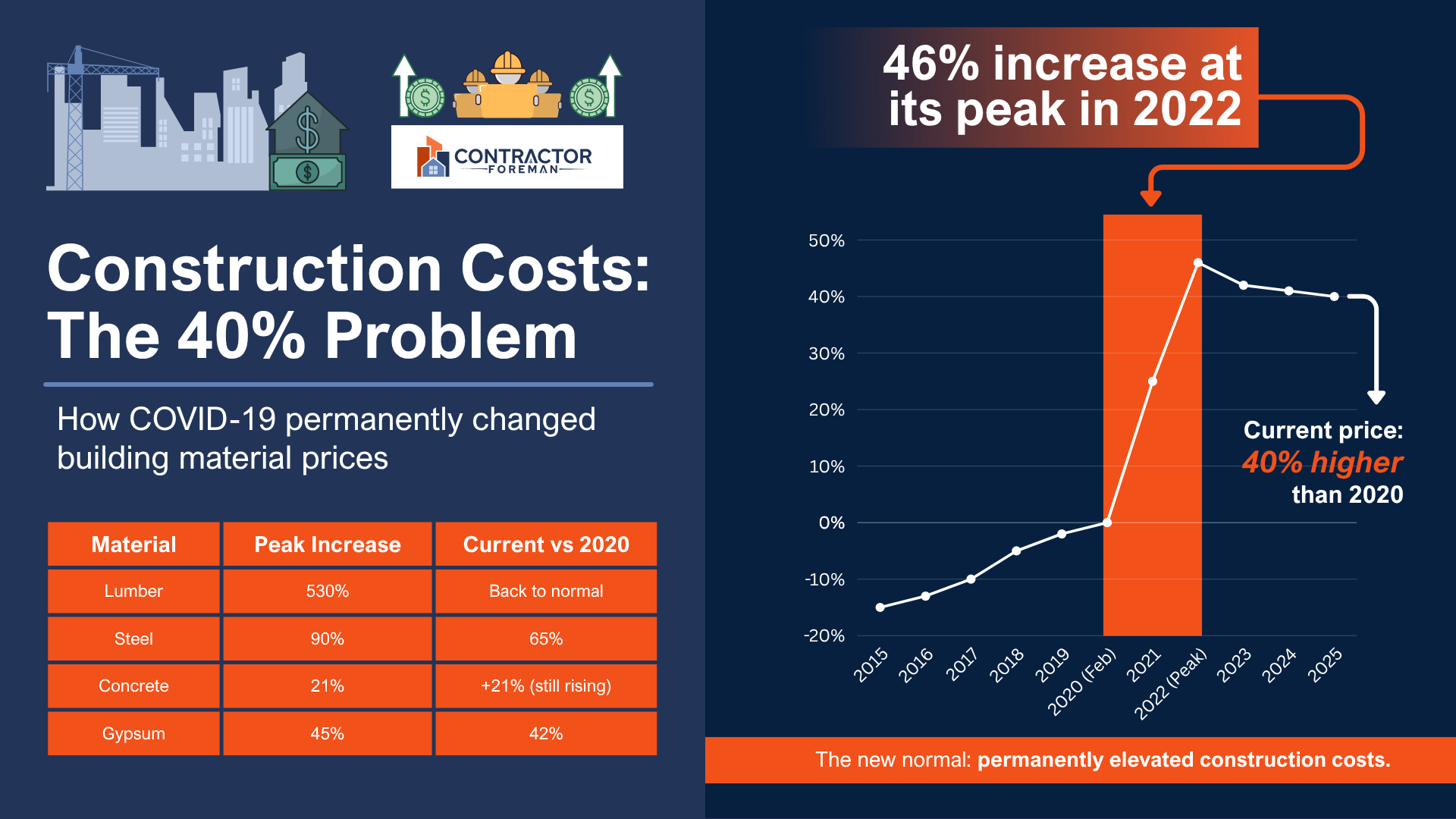
- Keep tabs on market trends. Materials costs have experienced erratic fluctuations over the past decade, albeit not to the extent seen this year. 2025 marks an increase in tariffs with prices as much as 40% higher than they were during 2020.
- Follow current events. Knowing what’s going on in the world at every level means you can identify potential impacts on material costs, supplies, and labor issues. For example, skilled workers planning a strike in your area could affect labor costs.
- Consult all stakeholders about their concerns. Perhaps the owners know something unique about the property that could alter your estimation. If you don’t have all the facts, you could miss key components in your projections.
- Customize as needed. A cookie-cutter approach may seem like it saves time, but no project is the same. Instead, consider a flexible template that hits all the necessities but allows room for customization.
Taking extra time at the beginning to get your ducks in a row can save you significant time and money down the line. The extra preparation might seem to delay the project start, but an accurate estimation is the best option for staying on track.
Miscommunications
Communication is a recurrent theme that impacts every facet of a project. It’s a common thread because poor communication compounds every other mistake related to construction estimating errors.
- Strong site management is crucial. Maintain a professional approach and recognize that different parties involved in a project may have conflicting interests.
- Ensure everyone understands their role. Incorrect assumptions about project requirements and responsibilities lead to decreased productivity, botched tasks, and missed deadlines.
- Hire the right team. Knowing your subcontractors and having a level of trust is ideal, but not always possible. Seek out reputable parties and don’t be afraid to request references. If someone is difficult to reach before the project starts, that’s unlikely to change.
The right communication tools open doors and smooth gaps by reducing roadblocks between stakeholders. There’s no need to play phone or email tag when you can open a chat and send a quick message to a partner for a prompt response.
Failure to Track and Identify Trends
Did you know that poor resource management is the most common cause of construction cost overrun?
Product shortages and delays aren’t always preventable, but conducting thorough research can go a long way. Tracking historical data on products and suppliers can help you avoid inaccurate project estimates.
Have you ever worked with a supplier who consistently fails to deliver the product on time? You may have a great relationship, and they give you a good deal, but the supplier’s delays always create a chain reaction in your work. Consider tracking the savings over the long term to see if those initial savings ultimately benefit or harm your bottom line. It could be time to move on.
The right software can bring all your project management and financial tasks into one place. It would be convenient to access everything in real-time, wherever you are, so you can identify a project’s needs for faster decisions.
Tips for More Accurate Estimations
Overcoming the most common contractor estimating mistakes is a step in the right direction. There are more ways to reduce construction cost overruns if you know where to look.
Strategies for Accurate Material and Labor Cost Forecasting
As noted above, it’s not always easy to account for fluctuations in material and labor costs. While there is no foolproof approach, there are a few steps you can take to reduce the impact.
- Use a cost-system that can pull historical data and handle new wholesale numbers.
- Explore potential outcomes based on “what-if” scenarios.
- Experiment with predictive analytics that uses AI and machine learning to develop increasingly accurate models.
Consider investing in construction-specific software that tracks and analyzes data that’s most helpful to you. Accessing all the information you need in one place gives you better oversight than referring back to several different sources.
Build Contingency Planning into Project Estimates
There is no doubt that something will go wrong over the course of any project. Sometimes it’s a small blip that barely disrupts the workflow. Other times it’s an inferno that threatens to knock the entire project off course.
Consider time and money when building contingencies into your project estimates. Set up additional funds for unexpected costs and additional time to address unexpected delays.
You may not be able to plan for everything, but building contingencies can give you the necessary buffer for any disruption. The goal is to create enough of a buffer to absorb major setbacks. If you don’t need them, you’ll only impress your client in the end.
Track Actual Costs Against Estimates for Continuous Improvement
It can be tempting to finish a project and never look back, especially if it was especially challenging. However, you might learn the most from your difficult projects.
If you take the time to track everything along the way, you have a gold mine at your fingertips. Make it your habit to compare a project’s estimates with the final budget and timeline to see how things match up. How close was your estimate to the result? Is there room for improvement?
Continuous improvement is key to any growing business, and that means learning something from every job you complete.
Leverage Technology
You can have everything you need at your fingertips with the right tools. Your phone or tablet is a powerful resource, especially with the right software.
There’s something to be said about “old school” options like manila folders and spreadsheets, but they only get you so far. It’s not easy to tote a stack of files from one site to another, and that can lead to lost or misfiled documents. Spreadsheets are useful, but what if somebody forgets to update them when they get back to the office?
Choosing a platform like Contractor Foreman can save you time and money by making everything you need accessible wherever you go. Does something about a current project remind you of a past one? Pull up the data you need immediately and make an informed decision with a matter of clicks.
Best Practices for Improving Project Estimation Accuracy
It sometimes feels like there are too many contractor estimating mistakes to make. Remember that you can’t account for everything or prevent every catastrophe from impacting your projects.
Understanding common mistakes and embracing the above strategies is a good start, but there are still a few best practices to consider.
Work From the Bottom Up
It’s not uncommon for somebody to take the lead and make a best guess based on their experiences.
You get more accurate numbers by consulting the people doing the work. Since they understand the full scope of their work, including how much time it takes, you get fewer errors.
Consider the Power of Three
Try a three-fold approach to estimation where you create three different scenarios and craft estimates for each one.
- The best guess is the average based on a typical project. This scenario will rely heavily on experience and historical data.
- The optimistic situation imagines that everything goes according to plan with no hiccups or delays.
- The worst possible outcome is a situation where everything goes wrong.
When you have the scenarios and numbers for each one, you can work out averages. For example, tiling would take two hours in the optimistic scenario, six hours in the best case, and sixteen in the worst case. Add the hours up (24) and divide by three to get eight hours as an estimate.
Ask Questions
It might seem like overkill, but asking questions at the outset can avoid painful delays down the road. The better you understand a project’s scope, the better you can prepare enough to avoid overruns.
Try Predictive Analytics
Predictive analytics pulls information from existing data and uses algorithms to identify patterns. This approach relies heavily on historical data to make better predictions about future projects.
Since this approach relies on complex statistical algorithms and machine learning, you need estimating software that leverages predictive analytics. For the best results, ensure that the software focuses on data and metrics relevant to the construction industry.
Reducing Estimating Errors Boosts Your Bottom Line
Why should you keep sacrificing profits to preventable estimating errors? You can’t prevent every mishap, but you can learn to build superior project estimates that boost your bottom line.
Be more confident in your bids by taking extra time when building your estimation. Ask more questions to understand the project’s scope and consult key workers to ensure you fully grasp their needs and contributions.
Eliminate the guesswork by tracking current market trends and world events that could impact material and labor costs.
You can manage some of these tips, tricks, and best practices manually, but at some point, you will need technology to level up. Predictive analytics is just one option for refining your estimations to create more accurate bids.
The truth is that technology can save you time to focus on the tasks that matter while providing more detailed insights to guide estimations.
As the world gets increasingly competitive, you need every tool at your disposal to stay ahead of the game. Start your free trial today to see how Contractor Foreman can help you take control of construction cost overruns.







