
Nobody gets into construction thinking, “Yey! I can’t wait to manage a spreadsheet and figure out where to get money to pay for damages I didn’t see coming.”
And yet, here you are — watching a perfectly good schedule unravel in real time.
The thing about scheduling mistakes is that they don’t call for attention. They don’t wave a red flag or come with a price tag. They just quietly snowball… until one day your crew is standing around doing nothing—at $10,000 a pop.
We’re not here to scare you silly—just to show what’s actually happening.
Here’s what the numbers say:
- 91% of contractors face delays, and only 25% of projects finish close to their original timelines.
- Idle crews cost over $10,000 per day, while penalties for delays can exceed $500,000 in just two weeks.
- Poor communication and outdated schedules cause 5-15% of rework costs, amounting to $31 billion annually in the U.S.
The funny thing?
Scheduling is actually pretty simple if you think about it. Most mistakes aren’t unavoidable—they’re just a matter of visibility, communication, and keeping everything in one place.
That’s where tools like Contractor Foreman come in. With real-time updates and resource tracking, you can catch problems before they snowball, keep projects on track, and finally stop bleeding money on preventable mistakes.
Common Scheduling Errors That Delay Projects
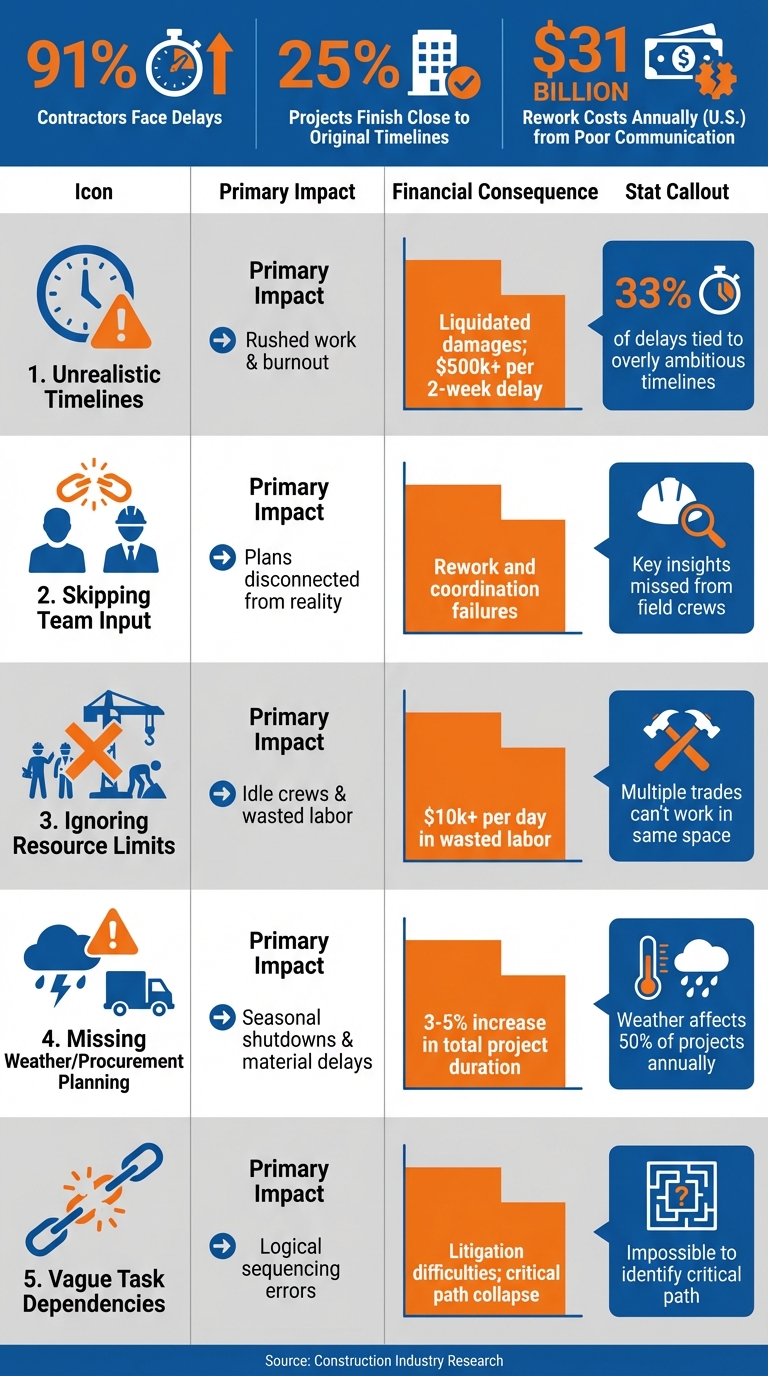
5 Common Construction Scheduling Mistakes and Their Financial Impact
Project delays often stem from recurring mistakes rather than sheer bad luck. These scheduling missteps can derail timelines and inflate budgets, leaving contractors scrambling to recover. Below, we’ll explore five common errors and their financial consequences.
Setting Unrealistic Deadlines to Please Clients
In an effort to win bids or keep clients satisfied, contractors sometimes commit to deadlines that are simply unattainable. While this might seem like a good idea initially, it often backfires.
Rushed work leads to errors, rework, and diminished profits.
The statistics are hard to ignore: nearly one-third of project delays are tied to overly ambitious timelines. For example, a commercial build running just two weeks late can rack up over $500,000 in extra costs due to penalties, labor, and materials. Beyond financial losses, contractors risk damaging their reputations and facing legal challenges when they overpromise and underdeliver.
Skipping Team Input and Construction Methodology
When schedules are created without consulting field crews or considering real-world construction practices, problems are inevitable. Planners may overlook key insights, like how long a specific task actually takes or potential supply chain disruptions. For instance, a superintendent might know that drywall installation requires three days instead of two, or an electrician could flag delays in panel deliveries.
Failing to involve the team from the start often results in schedules that are disconnected from reality. This lack of coordination increases the likelihood of rework and resource bottlenecks, setting the stage for costly setbacks.
Ignoring Resource Limits and Availability
One of the most common mistakes is assuming unlimited resources. But in reality, you can’t have multiple trades working in the same confined space or pour concrete if your crew is tied up elsewhere. Similarly, materials stuck in transit can bring progress to a standstill.
Every day of idle time on a large-scale project can lead to over $10,000 in wasted labor costs. When schedules fail to account for worker availability, equipment constraints, or material lead times, inefficiencies pile up quickly.
Not Planning for Weather, Procurement, and Site Issues
External factors like weather, procurement delays, and site-specific challenges are often underestimated.
Weather alone can account for 3% to 5% of a project’s total duration. Yet, many schedules are built on the assumption of perfect conditions, ignoring seasonal patterns or the reality of lengthy lead times for critical materials.
Permitting delays and site access issues can also create cascading problems if not addressed early. By failing to plan for these variables, contractors risk major disruptions that could have been mitigated with better foresight.
Creating Vague Schedules Without Task Dependencies
A schedule without clear task dependencies is more of a wish list than a functional plan. Logical sequencing – like completing foundations before walls or rough-ins before drywall – is critical to keeping a project on track. Without these dependencies mapped out, it’s nearly impossible to identify the critical path or manage delays effectively.
| Scheduling Mistake | Primary Impact | Financial/Timeline Consequence |
|---|---|---|
| Unrealistic Timelines | Rushed work & burnout | Liquidated damages; $500k+ per 2-week delay |
| Skipping Team Input | Plans disconnected from reality | Rework and coordination failures |
| Ignoring Resource Limits | Idle crews & wasted labor | $10k+ per day in wasted labor |
| Missing Weather/Procurement Planning | Seasonal shutdowns & material delays | 3-5% increase in total project duration |
| Vague Task Dependencies | Logical sequencing errors | Litigation difficulties; critical path collapse |
When dependencies aren’t clearly outlined, confusion reigns. And when delays occur – as they inevitably will – lacking proper documentation makes it harder to prove who’s responsible, opening the door to disputes and potential litigation.
sbb-itb-5eea312
How Poor Communication Increases Project Costs
Even the most meticulously planned schedules can crumble without solid communication within the team. While planning is undeniably important, poor communication can derail even the best-laid plans, leading to budget overruns caused by rework, idle labor, and legal disputes.
Miscommunication Between Project Teams
When information fails to flow smoothly between field crews, subcontractors, and office staff, errors start piling up. For instance, imagine a concrete crew arriving at a site only to find it unprepared because the excavation team never received updated plans. This results in idle workers, wasted mobilization costs, and a chain reaction of delays.
The financial impact of miscommunication is staggering. Rework driven by poor communication typically accounts for 5% to 15% of a project’s total value. In the U.S. construction sector alone, companies lose $31 billion annually because crews operate with outdated or incorrect information. Workers also waste an average of 90 minutes each day just searching for critical project details. This lack of clear communication undermines the accuracy of schedule updates, creating further inefficiencies.
Outdated or Infrequent Schedule Updates
Another major issue is the lack of timely schedule updates, which can disconnect project timelines from on-site realities. Communication is the glue that keeps schedules adaptable and relevant. When schedules become outdated, they jeopardize legal protections for time extensions and delay claims. Many construction contracts mandate regular schedule updates, and failing to provide them isn’t just an oversight – it’s a breach of contract.
“It is essential that…any time extensions due to the contractor be incorporated into progress [schedules] concurrently with the performance of the changes…” – Douglas J. Cefali, Attorney, Gordon Rees Scully Mansukhani
Operationally, outdated schedules wreak havoc. Missed trade handoffs – often the main culprit behind delays – lead to worker congestion, idle labor, and emergency replanning meetings. For smaller contractors, these disruptions can create cash flow problems, especially when clients withhold payments for incomplete work.
Courts also take a dim view of schedules reconstructed from memory or poor records. As Cefali aptly points out, “An apple a day keeps the doctor away; timely updates keep the lawyers at bay”. Without proper documentation, contractors face significant challenges defending delay claims in court, where such claims are often “mercilessly attacked”. By improving communication and maintaining up-to-date schedules, contractors can better utilize technology to keep projects on track and manage costs effectively.
How Contractor Foreman Prevents Scheduling Problems
Contractor Foreman tackles common scheduling issues by combining planning, communication, and resource management into one centralized platform. By eliminating scattered communication and manual tracking, contractors gain a unified system that ensures schedules are accurate and accessible to everyone involved. These tools directly address the causes of delays and cost overruns.
Scheduling Tools in Contractor Foreman
The platform’s drag-and-drop calendar simplifies task allocation across crews and makes it easy to adjust timelines when site conditions change. For example, if bad weather delays a concrete pour, project managers can quickly reassign tasks, avoiding the domino effect of manual rescheduling errors. The Gantt chart feature provides a clear visual timeline, showing how tasks interconnect, helping teams identify potential conflicts before they lead to delays.
With real-time mobile access, field crews always have the most up-to-date schedule, and instant updates from the job site ensure everyone stays informed. Automated notifications via email and text keep workers aware of schedule changes and upcoming assignments, improving team coordination.
To prevent resource management errors, the system uses skill-based tagging and crew assignment boards. Workers can be tagged based on certifications or specialties – like licensed electricians or crane operators – ensuring the right people are assigned to the right tasks. Automated conflict detection also flags double-booked crews or equipment, reducing the risk of on-site delays.
For challenges like weather setbacks, procurement delays, or permit approvals, Contractor Foreman employs predictive analytics. Using historical data, it forecasts potential bottlenecks and sends alerts about possible scheduling conflicts. Additionally, integration with external calendars like Google and Outlook creates a single, reliable source for both office staff and field teams, reducing miscommunication.
These advanced scheduling tools lay the groundwork for understanding the features offered in the Basic and Plus plans.
Basic vs. Plus Plans: Scheduling Features Comparison
Contractor Foreman’s pricing tiers are designed to match project complexity and team needs, offering tailored solutions for different contractors:
| Feature | Basic Plan ($49/month) | Plus Plan ($125/month) |
|---|---|---|
| Drag-and-Drop Calendar | Yes | Yes |
| Task Assignments | Limited | Advanced with recurring tasks |
| Gantt Charts | No | Yes |
| Task Dependencies | No | Yes |
| Resource Board | No | Yes |
| Mobile App Updates | Yes | Yes (enhanced collaboration) |
| Maximum Users | 1 user | 8 users |
| Custom Reports | No | Yes |
The Basic plan is ideal for smaller teams working on straightforward projects, where simple task assignments and calendar views suffice. On the other hand, contractors managing complex projects with multiple subcontractors and intricate task sequences will find the Plus plan invaluable. Features like Gantt charts, dependency tracking, and the resource board help avoid “hangers” and open-ended logic errors that can disrupt critical path calculations. The Plus plan also makes it easier to manage crew availability and avoid overbooking, which can lead to wasted labor and missed deadlines.
Both plans come with a 14-day free trial and U.S.-based support. Pricing can be billed annually or monthly, offering flexibility based on cash flow. Plus, all plans support unlimited projects, keeping costs predictable as contractors take on more work. By leveraging these tools, contractors can achieve precise scheduling that aligns with on-the-ground realities.
Practical Methods to Improve Construction Schedules
Using Technology for Real-Time Schedule Updates
Gone are the days of juggling phone calls, emails, and text messages to coordinate construction schedules. Contractors are increasingly adopting centralized platforms to streamline communication. In fact, over 40% of contractors report that scheduling issues disrupt their projects daily.
With a unified system, field crews can instantly access updates through their mobile devices. For example, if a superintendent adjusts a timeline due to unforeseen delays, the changes are immediately visible to everyone. Automated reminders via email or text further reduce no-shows and tardiness, keeping projects on track.
Take the case of a residential contractor managing a 45-person crew. In 2026, they switched from handwritten timesheets to a mobile GPS time-tracking app. Within just one month, the company eliminated issues like buddy punching and inflated work hours, saving $3,800 in payroll overages. Additionally, this change boosted employee satisfaction by ensuring accurate paychecks and cut weekly payroll preparation time from 11 hours to under 2 hours – a massive 85% efficiency gain.
This type of technology not only enhances scheduling but also lays the groundwork for better collaboration and resource management, which brings us to the next point.
Including Team Feedback and Resource Planning
Unrealistic schedules are a common pain point, but involving subcontractors and crew leads early in the planning process can make a big difference. By basing timelines on real-world site conditions, teams can avoid unnecessary delays. Brief daily standup meetings allow crews to review tasks, identify potential bottlenecks, and address small issues before they snowball into major problems.
Instead of vague progress updates like “work is moving along”, measurable milestones – such as “cabinets installed and secured” – offer a clearer picture of project status. Scheduling seven productive hours within an eight-hour workday also accounts for interruptions, maintenance, and other tasks that naturally arise. For example, a small residential contractor faced delays on 40% of their projects in 2024. By implementing structured change management, realistic resource planning, and strategic buffer times, they achieved a 95% on-time completion rate within six months. Even better, they increased project capacity by 30% without adding extra overhead costs.
Proactive planning is essential, but having backup strategies is equally important for managing the unexpected.
Creating Backup Plans for Unexpected Delays
Weather delays affect nearly half of construction projects worldwide each year. To minimize disputes when weather strikes, contracts should clearly define what qualifies as a “weather day.” This might include rainfall over 0.25 inches, temperatures below 20°F, or wind speeds exceeding 25 knots.
Using historical weather data to build contingency time into schedules can help safeguard timelines. Instead of adding a generic buffer at the end of a project, contractors can schedule non-working days into months with higher risks of delays. For instance, a contractor working in the Pacific Northwest preloaded seven weather days into their February schedule based on past data. When heavy rainfall led to 14 days of delays, they used construction daily logs and drone footage to secure a seven-day extension.
Backup plans should also include alternative suppliers for critical materials and equipment. Additionally, weather-resistant techniques – such as heated concrete blankets or tented scaffolds – can keep temperature-sensitive tasks on track. By categorizing activities as either weather-dependent (like concrete pouring and roofing) or non-weather-sensitive (such as interior MEP and framing), teams can shift focus to indoor tasks during bad weather, ensuring steady progress.
Conclusion
Scheduling errors can wreak havoc on cash flow and even threaten the survival of a business. For small contractors, project delays often escalate into serious issues when payments are withheld due to incomplete work.
To turn these challenges into opportunities, effective scheduling is key. Contractors who embrace structured processes and modern technology see profit margins increase by 24% compared to those relying on manual methods. By centralizing communication, defining task dependencies, managing change orders efficiently, and using data-driven planning, you can keep projects on schedule and avoid costly setbacks.
Contractor Foreman offers tools like real-time updates and automated tracking for as little as $49/month. With features such as mobile access and automated change order tracking, it’s designed to help you sidestep the scheduling pitfalls that many in the industry face. Whether you’re managing a small crew or coordinating multiple subcontractors, integrated systems allow you to work more efficiently and effectively.
While challenges in scheduling will always exist, tackling them with proactive planning, strong team collaboration, and digital tools can make a huge difference. Start small – focus on one weak spot, like centralizing communication or adding realistic time buffers to your timelines. Involve your team in the planning process, and over time, these small improvements will reshape how you manage projects and protect your bottom line. By adopting these strategies, you’ll be better prepared to navigate future challenges and build a more resilient business.
FAQs
How do I know if my schedule is realistic?
A well-thought-out construction schedule should reflect the resources you have, the relationships between tasks, and any potential risks. It’s crucial to factor in elements like weather conditions, the timeline for procuring materials, and any physical limitations on-site. Regular reviews and updates are essential to keep the schedule aligned with actual project conditions as they evolve.
Common pitfalls to avoid include overlooking resource limitations or ignoring task dependencies. To create a realistic and workable plan, leverage scheduling tools and seek input from experts. This approach ensures the schedule is not only practical but also tailored to meet the specific demands of the project.
What should I update daily to prevent rework and delays?
To keep things running smoothly and avoid unnecessary rework or delays, make it a habit to update your project progress logs, resource availability, and communication records every day. Doing this helps ensure that everyone stays on the same page, resources are used efficiently, and any potential problems are identified and dealt with quickly.
How much schedule buffer should I add for weather and material lead times?
There isn’t a one-size-fits-all rule for setting schedule buffers. Many project managers factor in extra time – ranging from a few days to several weeks – depending on things like the project’s location, potential climate fluctuations, and historical weather trends. To prepare effectively, it’s smart to estimate how weather might impact the timeline, review past patterns, and tweak buffers accordingly. Keeping these buffers updated and well-documented not only helps set realistic expectations but also minimizes delays caused by unpredictable weather or material delivery issues.







