
Labor and materials aren’t just two line items.
They’re THE line items.
For most construction projects, labor and materials alone account for 60% to 75% of total costs. So if they drift even a little off track… WHOOOPS! Your entire budget goes with them.
Goes without saying — you have to budget both right. But of course, as the famous saying goes: easier said than done. Because construction would never allow something as convenient as “accurate numbers” and “reliable estimates.”
Material prices fluctuate. Labor availability changes. One delayed delivery turns into three days of downtime. And suddenly the budget you felt pretty good about last week is already outdated.
Look, getting labor and material costs perfect isn’t really the goal. Getting them predictable is.
That’s what this article is about — how to budget smarter, track costs before they spiral, and keep your project from eating your profit alive.
Here’s what we’ll cover in this guide:
- Labor Costs: Beyond wages, labor costs include taxes, benefits, and other expenses, often adding 30%–50% to base wages. For example, a $28/hour wage can cost closer to $39/hour.
- Material Costs: Price fluctuations, waste, and poor inventory management can lead to overruns. Up to 23% of labor time is wasted waiting for materials.
- Common Issues: Inaccurate estimates, outdated tools, and poor tracking often cause budget overruns. For instance, a contractor in 2026 faced a $127,000 shortfall due to underestimated labor costs and material price hikes.
- Solutions: Use digital tools for real-time tracking, update estimates regularly, and involve field teams in planning. Tools like GPS-enabled time tracking and automated alerts can save costs and improve accuracy.
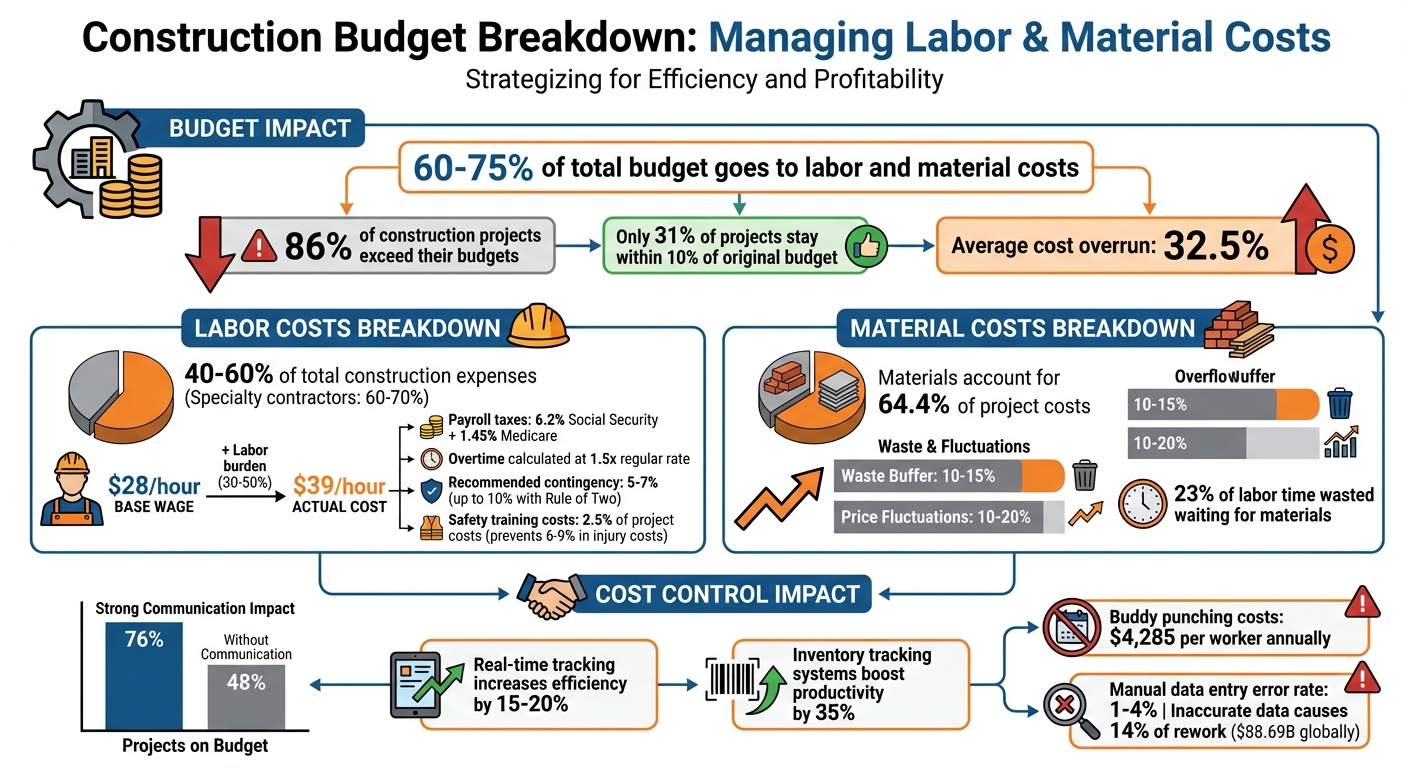
Construction Budget Breakdown: Labor and Material Cost Statistics
How to Estimate Labor and Material Costs Accurately
Getting your estimates right is key to protecting your bottom line. Labor costs alone usually account for 40% to 60% of total construction expenses. And when it comes to sticking to budgets, the numbers aren’t pretty – only 31% of construction projects stay within 10% of their original budgets, with the average cost overrun hitting 32.5%.
Understanding Labor Cost Components
Labor costs are more than just hourly wages. You need to factor in the labor burden, which typically adds about 30% to base wages. For example, a $30 per hour wage becomes roughly $39 per hour when you include the burden.
Start with direct labor costs, which include base wages, health insurance, retirement contributions, paid time off, and overtime pay (usually calculated at 1.5 times the regular rate). Then, add indirect costs, like payroll taxes. Employers are responsible for matching 6.2% for Social Security and 1.45% for Medicare for every employee. Don’t forget other expenses like workers’ compensation, training, and travel.
To calculate the true cost of labor, multiply the hourly wage by the labor burden percentage, then add that to the base wage. Real-world productivity often lags behind theoretical rates, so adjust your estimates accordingly. It’s also wise to set aside a contingency of 5% to 7%, or up to 10% using the “Rule of Two” method, to cover unexpected issues.
Once you’ve nailed down labor, it’s time to tackle the equally tricky task of estimating material costs.
Factors That Affect Material Cost Estimates
Material costs can be a moving target, thanks to global supply chain disruptions and site-specific challenges. Regularly updating your estimates is a must as conditions change.
Plan for waste and scrap by applying a 10%–15% buffer. Ensure your purchase units align with installation units – for instance, buying tile by the box but installing it by the square foot can lead to costly procurement errors and delays. Don’t forget to account for waste, overage, and logistical fees in your material cost calculations.
A great example of efficiency comes from Justin Davis, Executive Vice President of Preconstruction at Walker Engineering. Using 3D modeling, he calculated the exact number of doors needed for a project in minutes – a process that would’ve taken over a day with traditional 2D drawings. Davis highlights the importance of clarity in cost estimation:
“Customers expect and trust [contractors] to fill in all the gaps, make sure that they’ve got their costs covered, and make sure that when we sit in a room, there’s transparency”.
To refine your material estimates, take advantage of digital takeoff tools and compare quotes from multiple suppliers. Early site visits can also help you pinpoint logistical challenges before they turn into expensive surprises.
sbb-itb-5eea312
Budget Planning Best Practices
Effective budget planning goes beyond just crunching numbers – it’s about making smart decisions that minimize waste, optimize productivity, and set your project up for success. With accurate cost estimates as your foundation, you can streamline workforce allocation and procurement strategies to boost profitability.
How to Allocate Your Workforce Efficiently
Labor costs make up a significant portion – 50% to 60% – of most project budgets. Allocating your workforce thoughtfully can have a major impact on your bottom line. Start by matching workers to tasks based on their skills. This reduces downtime and keeps your team motivated.
Your field team is a goldmine of insights when it comes to budget planning. Involve superintendents and foremen early in the process. Their first-hand knowledge of site conditions can improve the accuracy of your estimates and ensure they’re fully committed to managing costs on-site. When they contribute to building the budget, they’re more likely to stick to it.
Leverage data from past projects to gauge how long specific tasks – like pouring concrete or framing walls – typically take your crews. Accurate time tracking isn’t just a metric; it’s a direct driver of profitability.
Don’t overlook safety training. While it might feel like an upfront expense, investing about 2.5% of your project costs in health and safety training can prevent workplace injuries that could otherwise consume 6% to 9% of your budget. Additionally, ensuring materials are readily available when crews need them saves time and eliminates unnecessary trips to hardware stores during billable hours.
Managing Procurement and Inventory
Managing material acquisition and inventory is just as critical as workforce allocation. Procurement plays a strategic role in your budget, schedule, and installation timelines. It’s important to distinguish between procurement and purchasing: procurement involves selection, logistics, and approvals, while purchasing is simply the transaction.
Building strong relationships with suppliers can give you a competitive edge. Suppliers who understand your needs can help you anticipate market shifts, secure better pricing, and plan delivery schedules effectively. With material costs capable of spiking 10% to 20% overnight due to tariffs or supply chain disruptions, these partnerships provide stability in volatile conditions.
Timing your orders is crucial. Purchase only what you need and schedule deliveries as close to installation dates as possible. This minimizes the risks of material degradation, theft, and waste. For items with long lead times, like structural steel or transformers, identify them early during the submittal process to avoid supply chain delays derailing your project.
Storage also plays a key role in controlling costs. Proper on-site storage protects materials from weather, theft, and vandalism. Strategically placing materials on-site can reduce unnecessary handling and idle crew time, while ensuring the right equipment is available for quick offloading.
A real-world example of improved budgeting comes from Diversakore, a construction supply company. In February 2024, they transitioned from manual spreadsheets to a centralized platform developed by Quickbase. This switch cut their project estimate preparation time by 50% and significantly enhanced budgeting accuracy. Moving to cloud-based tools offers real-time visibility into budgets and inventory, eliminating the inefficiencies of siloed systems.
Tracking and Monitoring Costs in Real Time
Accurate estimates and careful budgeting are just the beginning; keeping costs under control requires real-time tracking. Once your project kicks off, waiting until the end of the week – or worse, the month – to review expenses leaves you in the dark. Real-time tracking lets you catch labor spikes, material overages, or productivity dips as they happen, not after they’ve already impacted your bottom line. Considering that only 10% of construction projects avoid cost overruns, having immediate visibility into expenses isn’t just helpful – it’s necessary.
Communication plays a huge role in staying on budget. Companies with strong communication policies manage to keep 76% of their projects within budget, compared to just 48% for those without proper systems in place. Real-time tracking bridges the gap between the field and the office, ensuring everyone operates with the same financial data. This level of visibility also lays the groundwork for using advanced tools to track labor costs with precision.
Technology Tools for Labor Tracking
Labor costs are often the single largest expense in construction projects, making up 40% to 50% of total costs – and for specialty contractors, that number can hit 60% to 70%. When labor takes up such a big chunk of your budget, even minor mistakes can snowball into major issues. Albert Bou Fadel from SmartBarrel puts it succinctly:
“If your time data is wrong, your labor costs are wrong. And when labor represents 40–50% of total project costs, inaccurate labor data undermines every cost report, forecast, and dashboard that depends on it.”
Tools like GPS-enabled timecards ensure workers clock in at the correct job site, eliminating guesswork and preventing time theft. Some systems even use biometric verification to confirm identities and stop buddy punching, an issue that costs contractors an average of $4,285 per worker annually. These tools pay for themselves by curbing such losses.
Mobile platforms let superintendents and foremen log hours directly from the job site using tablets or smartphones. This reduces the delays and errors associated with manual data entry – typically responsible for a 1% to 4% error rate – and ensures labor data syncs instantly with accounting software, giving you an up-to-the-minute view of daily costs.
Automated alerts are another game-changer. They notify you when labor costs approach preset thresholds, allowing you to make timely adjustments, whether that means reallocating crews or managing overtime. Contractors who adopt real-time cost tracking report a 15% to 20% boost in project efficiency.
Tracking Material Usage and Inventory Levels
Materials make up the other half of the budget equation, and poor tracking can lead to delays, waste, and theft. On average, construction crews spend about 23% of their time waiting – often because materials or tools aren’t where they need to be. Real-time inventory tracking eliminates this downtime by ensuring materials are available and accounted for.
Labeling systems like barcodes, RFID tags, and GPS trackers are particularly effective for managing high-value equipment and materials. These digital tools act as a security measure, reducing replacement costs caused by loss or theft. Mobile-friendly software allows field teams to update material counts and usage directly from the job site, keeping office records accurate.
Daily logs, complete with photo documentation and location tracking, provide a clear record of when materials arrive and how they’re used. This creates a paper trail that can help resolve disputes and pinpoint inefficiencies. Contractors who implement robust inventory tracking systems report a 35% increase in overall productivity.
Automated replenishment systems add another layer of efficiency by reordering materials when inventory drops below a set threshold. Entering material expenses as they occur also ensures profitability calculations stay accurate, avoiding unpleasant surprises later on.
The table below highlights key tracking methods and their benefits:
| Tracking Method | Best For | Key Benefit |
|---|---|---|
| GPS Timecards | Labor verification | Confirms workers are clocking in at the correct job site |
| Biometric Systems | High labor counts | Prevents buddy punching and time theft |
| RFID/Barcode Tags | High-value materials | Reduces loss and theft of expensive equipment |
| Mobile Field Apps | Real-time updates | Allows crews to log material usage instantly |
| Automated Alerts | Budget control | Notifies managers when costs approach limits |
Controlling Costs During Construction
When construction kicks off, the challenge of managing costs becomes very real. With profit margins often razor-thin, keeping expenses in check isn’t just important – it’s essential. While real-time tracking gives you insight into spending, true cost control requires decisive action. This means making smart choices about materials and methods while tightly managing any changes that could push your budget off course. Considering that around 84% of firms see costs exceed their initial estimates, having a strong cost management plan is non-negotiable.
One effective approach is conducting monthly, detailed reviews of labor, material, and equipment expenses. These reviews help forecast costs and catch billing errors before they snowball. Involving your project superintendent in these meetings is crucial, as their daily decisions directly influence field costs. Jeffrey Brooks, Solutions Engineer at Procore, sums it up well:
“Cost control is the management of project-related costs against the project budget… making sure that the total project cost will be less than the project budget”.
Another key strategy is early job buyout. Securing material prices and subcontractor rates early shields you from market fluctuations. For instance, critical components like electrical switchgear and generators now come with lead times of 42 to 60 weeks. Waiting to lock in prices could leave you vulnerable to cost spikes. Including escalation clauses in contracts can also help by sharing price surge risks with subcontractors. These measures, combined with value engineering, create opportunities to optimize costs further.
Applying Value Engineering Principles
Value engineering (VE) builds on real-time tracking to enhance efficiency, balancing cost and function without sacrificing quality. Unlike basic cost-cutting, VE takes a more thoughtful approach, analyzing the purpose of each project element to ensure it delivers maximum value for its cost. As Sam Becker from Vena Solutions explains:
“Value engineering is not simply about reducing costs. Instead, it’s about making the most cost-effective decisions”.
Sometimes, spending more upfront makes sense – like choosing a pricier material that’s available immediately to avoid project delays. VE evaluates three key factors: cost reduction, added quality (ensuring savings don’t compromise the project), and life-cycle maintenance (focusing on long-term durability over short-term gains).
Timing is everything with VE. The earlier it’s applied – ideally during the planning or design phases – the greater the potential savings and the lower the cost of implementation. Once construction begins, VE shifts to contractor-led efforts, such as suggesting alternative materials or methods that preserve design integrity while cutting costs. For federal fixed-price contracts, contractors often receive 55% of the savings generated by their VE proposals, providing a strong incentive to innovate.
Collaboration with suppliers can also uncover savings. Share your material quantity estimates (takeoffs) with them to confirm pricing and spot potential price hikes. This approach can reveal opportunities to swap out materials or adjust timelines to avoid cost surges. For example, one construction firm, after reviewing historical data, discovered they had been underestimating certain labor costs for years – budgeting 1% when actual spending averaged 2.5%. By adjusting their estimates based on real data, they safeguarded their profit margins on future projects.
Handling Change Orders and Budget Variances
Even with solid forecasting and tracking, managing change orders effectively is vital. Poorly handled change orders can wreak havoc on your budget. With 98% of construction projects experiencing cost overruns or delays, and only 31% staying within 10% of their original budget, having a strict process for approving changes is critical.
A “1:1 exchange” principle can help – if a subcontractor’s mistake leads to a change, pass the cost along. Use standardized cost codes to make variance analysis clearer. Cloud-based platforms can simplify the process by sending instant notifications for change orders. This real-time communication minimizes confusion and prevents disputes caused by outdated information.
It’s also wise to allocate 5% to 20% of your budget as a contingency fund for unexpected issues. Conduct yearly audits of completed projects to identify patterns – like tasks that consistently go over budget – and adjust future estimates accordingly.
Finally, keep an eye on Cost Variance (CV), which measures the difference between your Budgeted Cost of Work Performed (BCWP) and Actual Cost of Work Performed (ACWP). A positive variance means you’re under budget, while a negative one signals you’re over. Regularly reviewing these variances – daily or weekly – lets you catch and correct issues early, before small overruns spiral into larger problems.
Financial Tracking and Reporting Features
The financial dashboard in Contractor Foreman provides an overview of project health while allowing you to dig into specific expenses. It automatically compares planned labor costs to actual spending, flagging discrepancies before they become significant. This “Budget vs. Actual” reporting works for both labor and materials, making it easier to identify where costs are exceeding estimates by streamlining cost calculations.
GPS-verified timecards and cost-code allocation add accuracy to job costing. Workers can submit timesheets directly through the mobile app, with hours linked to specific cost codes and projects. Matthew S. from M. Smith Contracting shared:
“The time tracking software for my crew allows me to keep track of all my guys’ hours, where they are, and what they are doing. This helps… where I can cross-reference their productivity on linear foot of wall and square foot of wall completed per hour.”
The platform also generates detailed reports on wages, billing rates, and labor burden, giving you a complete view of labor costs, including taxes and insurance. For materials, Contractor Foreman integrates with 1build.com to provide real-time local pricing. You can create custom databases with SKUs, photos, and hidden markups, while Purchase Order (PO) management ensures materials are delivered before payments are made.
When change orders are approved, the system automatically updates your budget and contract totals, saving you the hassle of manual adjustments. With over 100 pre-built reports, including Work in Progress (WIP) statements and financial summaries, the platform supports quick, informed decision-making.
These financial tools are further enhanced by seamless software integrations, making Contractor Foreman a comprehensive solution for project management.
Software Integrations for Better Efficiency
Contractor Foreman integrates with QuickBooks Online to sync bills, expenses, and payments, eliminating duplicate data entry. Bills generated from Purchase Orders or Subcontracts flow directly into QuickBooks, streamlining accounts payable processes. Payments received through platforms like WePay or Stripe are automatically matched to the correct invoices.
This synchronization ensures that Profit and Loss statements and Budget vs. Actual reports are always up-to-date. Anthony W. from Authority Refrigeration, LLC noted:
“The ability to, in one place, track jobs from estimating, to project progress, billing, and employee management all in one place that also integrates with QuickBooks.”
As of January 1, 2026, Contractor Foreman discontinued its QuickBooks Desktop integration to focus on QuickBooks Online. A new integration with Xero is expected by mid-2026.
For Time & Material billing, the software imports timecards directly into invoices, speeding up billing cycles and reducing errors. It also syncs with payroll tools like Gusto, automating timecard data transfers and minimizing manual entry mistakes. Supporting over 75 countries and multiple currencies, the platform accommodates international projects.
All project data – from timecards and material usage to detailed job costing – is stored in one system. This is vital, as inaccurate data and reporting are estimated to cause 14% of construction rework, costing $88.69 billion globally.
| Feature | How It Improves Budget Management |
|---|---|
| GPS Timecards | Ensures accurate reporting of crew locations and hours. |
| Cost Code Allocation | Tracks spending by task for precise job costing. |
| PO Tracking | Matches delivered materials with invoices to prevent overpayments. |
| QuickBooks Sync | Keeps financial reports current by eliminating duplicate entries. |
| Labor Burden Reports | Calculates total labor costs, including taxes and insurance. |
| Change Order Automation | Automatically updates budgets with approved changes. |
Contractor Foreman starts at $49 per month, offering a 30-day free trial and a 100-day money-back guarantee. With a 4.5/5 rating, users highlight its ease of use and extensive features. Customer support is also a standout, with an average 13-second response time and 95% of chats rated 5 stars.
Conclusion
Keeping labor and material costs in check is about staying ahead of the issues that can eat into profits. With more than 66% of U.S. builders facing budget overruns, the line between a successful project and a financial mess often depends on real-time expense tracking. Cloud-based tools that link field data with financial reports are key to spotting problems before they spiral out of control.
Accurate tracking is just one piece of the puzzle – precise building cost estimation are equally crucial. Successful projects share some core principles: breaking down tasks with a detailed Work Breakdown Structure, setting aside a 5%-7% contingency fund, and using standardized cost codes. As Grace Ellis from Autodesk aptly states:
“The budget is useless if we do not follow it and carefully record our expenditure”.
This means updating cost plans daily with site reports instead of waiting until the end of a phase, when it’s often too late to fix overruns.
Technology also plays a big role in keeping budgets on track. Tools like GPS-verified timecards, automated change order updates, and real-time material tracking help reduce manual errors that can lead to budget creep. When field crews log hours and material usage through mobile apps, decisions can be made on the spot, avoiding delays.
After the project wraps up, reviewing budgeted versus actual costs can uncover patterns that improve future bids. Whether it’s identifying consistent inaccuracies in labor production rates or flagging unreliable material suppliers, these insights help avoid repeating costly mistakes.
For just $49 per month, Contractor Foreman offers the tools needed to manage budgets effectively and protect your profits. With an average support response time of 13 seconds and 95% of users giving their support experience a 5-star rating, Contractor Foreman ensures reliable budget control and quick assistance.
FAQs
How do digital tools enhance accuracy in construction budgeting?
Digital tools have transformed construction budgeting by replacing outdated spreadsheets with centralized platforms that update in real-time. This shift allows contractors to monitor labor hours, material costs, change orders, and invoices as they occur, significantly reducing errors. With every expense accurately recorded, budgets stay on track. Plus, automation features – like real-time data syncing and validation checks – catch mistakes early, flagging discrepancies before they snowball into bigger issues. This proactive approach helps managers tackle potential overruns quickly.
Take Contractor Foreman, for example. This platform integrates budgeting seamlessly into construction workflows, offering features like job costing, purchase orders, and billing. By consolidating data across multiple projects, it becomes easier to spot trends, standardize cost codes, and fine-tune future estimates. The payoff? Budgets that are not only more reliable but also help optimize cash flow, control unexpected expenses, and safeguard profit margins on every job.
How can I effectively manage material cost fluctuations in construction projects?
Managing material cost fluctuations begins with precise planning and forecasting. Start by preparing detailed material estimates early in the project and consistently update them as market conditions change. Building strong supplier relationships is also key – these connections can help you negotiate price-lock agreements or secure bulk discounts, reducing the risk of sudden price hikes.
To minimize waste and control expenses, time your material deliveries to match your construction schedule. Proper storage is equally important to prevent damage or loss. Keep a close eye on all transactions – whether it’s receipts, issues, or transfers – to quickly spot cost discrepancies and adjust your purchasing strategy accordingly.
A construction management platform like Contractor Foreman can simplify this process by centralizing cost tracking, supplier agreements, and up-to-date market insights. With these tools, you can make informed decisions, manage budgets effectively, and respond to material price changes with confidence – helping you safeguard your profit margins and keep your projects on track.
Why is it important to track labor and material costs in real time during construction projects?
Keeping a close eye on labor and material costs as they occur is key to managing your construction budget effectively. This approach helps you catch any overspending or inconsistencies right away, giving you the chance to resolve issues before they grow into bigger problems.
When you stay up to date on your expenses, you’re better equipped to make smart decisions, reallocate resources as needed, and keep your project financially on course. Monitoring costs in real time doesn’t just boost precision – it also helps you sidestep delays that might arise from surprise budget gaps.
Related Blog Posts
- How to Track Construction Project Costs
- How Dashboards Simplify Budget vs Actual Cost Tracking
- How to Create Accurate Construction Financial Projections
- Ultimate Guide to Construction Budgeting Software







