
Lumber prices spike 40% mid-project, a payment comes in late, and just like that — Friday’s payroll is a problem. In residential construction, you’re lucky if cash disappears slowly. Sometimes, though, it goes all at once!
And when that happens, jobs stall, suppliers get pushed out, and the crew you spent years building starts taking calls from other GCs.
Do you know that 82% of business failures stem from poor cash flow management? Yep, not bad work, not a slow market. Cash flow.
That’s why cash flow forecasting is simply a must in construction.
It won’t make clients pay faster. But it tells you the gap is coming before it becomes a crisis — which gives you room to actually do something about it. Like negotiating better payment terms and preparing for delays or seasonal slowdowns.
Steps to Build a Cash Flow Forecast:
- Define Project Scope & Timeline: Break down construction cost estimates by project phases (e.g., foundation, framing) and align them with realistic timelines.
- Estimate Cash Inflows: Plan invoicing based on contract terms and payment history. Include deposits, milestone payments, and retainage.
- Forecast Cash Outflows: Separate direct job costs (e.g., payroll, materials) from fixed overhead expenses (e.g., rent, insurance).
- Calculate Net Cash Flow: Compare inflows and outflows weekly or monthly to identify shortfalls early.
Why Use Software?
Manual tracking can lead to errors. Tools like Contractor Foreman provide real-time expense tracking, QuickBooks integration, and automated retainage management, making forecasting easier and more accurate. With plans starting at $49/month, it’s a practical solution for contractors to stay on top of their finances.
Bottom Line: Cash flow forecasting isn’t just about tracking money – it’s about staying ahead of potential problems and ensuring your business thrives.
Cash Flow Forecasting Basics
Cash flow forecasting boils down to three main elements: cash inflows (money coming in), cash outflows (money going out), and your net cash position (what’s left after the dust settles). It’s essentially a map showing when money will enter and leave your business account over the coming weeks or months.
In construction, forecasting needs to be much more detailed. While general business planning might focus on yearly expenses and profitability, project-based forecasting digs into the specifics of each job. This helps determine whether a project can fund itself or if extra cash will be necessary.
It’s important to note that a cash flow projection is forward-looking, unlike a cash flow statement, which only tracks past transactions. Without a projection, you risk relying on your current bank balance and might be caught off guard by upcoming costs or late payments from clients.
Key Terms and Concepts
Here’s a quick breakdown of some key terms you’ll encounter:
- Cash inflows: This includes accounts receivable, progress payments, sales deposits, and retainage releases. For residential contractors, this often means billing based on a Schedule of Values (SOV), which breaks the contract into milestones like completing the foundation, framing, or final finishes.
- Cash outflows: These are split into direct job costs (payroll, materials, subcontractors, and equipment rentals) and fixed overhead costs (office rent, insurance, and taxes). Direct costs vary by project, while overhead expenses stay steady regardless of how many jobs you’re handling.
- Net cash position: This is your real-time liquidity snapshot – the cash you have on hand to cover immediate obligations. It’s what tells you whether you can pay for essentials like payroll or if you’ll need to delay payments to suppliers.
- Working capital: This is the cash buffer you need to bridge the gap between paying for project expenses and receiving payments from clients. Even profitable contractors can run into cash flow issues without enough working capital.
- Days Sales Outstanding (DSO): This measures how long it takes to collect payment after sending an invoice. It’s especially important when supplier payment terms are shorter than the time it takes clients to pay you.
Grasping these concepts is essential for managing the unique cash flow challenges that come with residential construction.
Challenges in Residential Construction
One of the biggest hurdles in residential construction is payment delays. Clients often take 60 to 90 days to pay invoices, meaning you’re essentially fronting the money for the project. On top of that, retainage – where 5% to 10% of payments are held back – makes it even harder to predict when cash will actually be available.
Change orders are another headache. If a client requests an upgrade, like better countertops or an additional fixture, any delay in logging or approving the change order can disrupt billing and postpone payments. This ripple effect can make it harder to meet obligations like payroll.
And then there’s the unpredictable stuff: weather delays, permit issues, or last-minute decisions from clients. These variables make a static forecast almost useless. Instead, you need a rolling forecast that can adjust to changes as they happen.
sbb-itb-5eea312
How to Build a Cash Flow Forecast
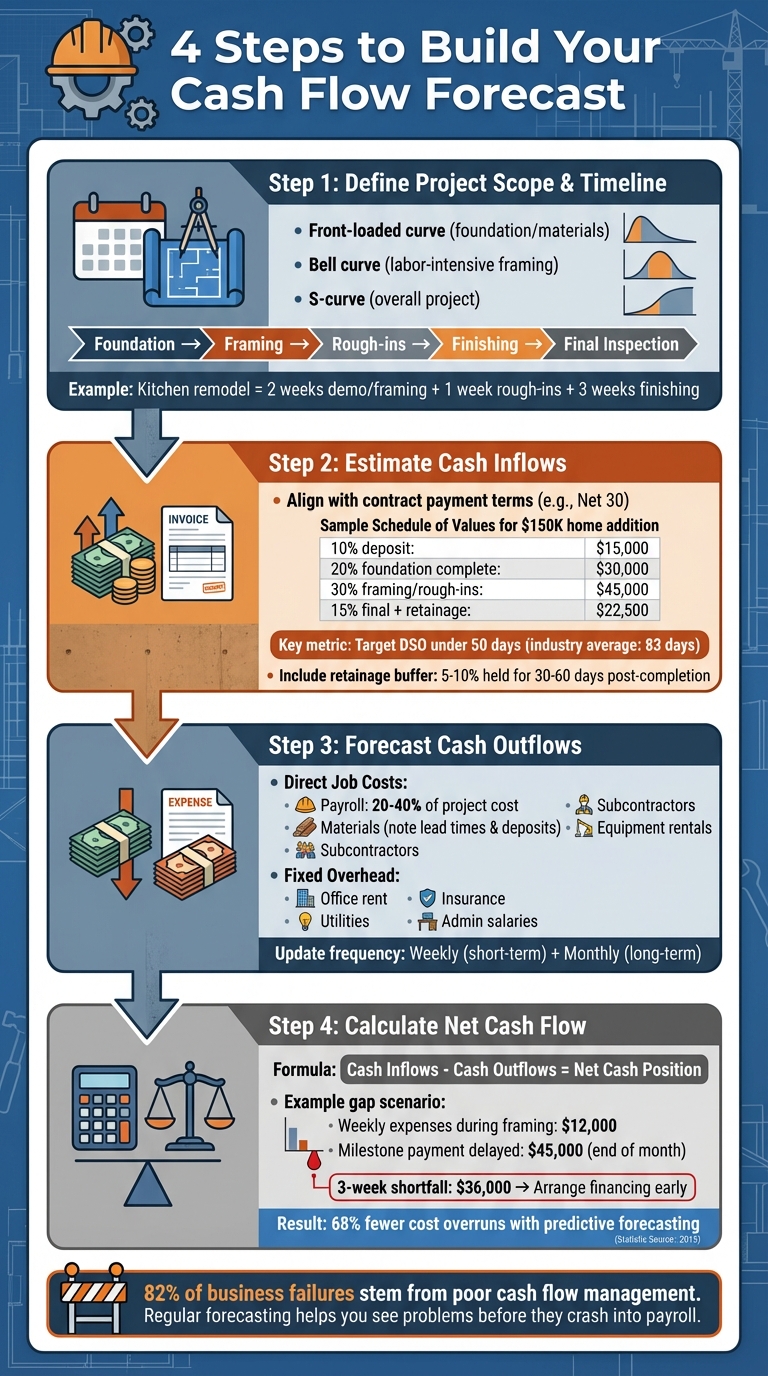
4-Step Cash Flow Forecasting Process for Residential Contractors
Building on the basics of cash flow management, the following steps provide a practical guide for residential contractors. These steps are designed to help you anticipate cash flow movements and avoid disruptions like missed payroll.
Step 1: Define Your Project Scope and Timeline
Start by creating a detailed project schedule with clear phases – foundation, framing, rough-ins, finishing, and final inspection. This schedule will anchor your cash flow timing.
Each phase needs a realistic timeline. For instance, a kitchen remodel might require two weeks for demolition and framing, one week for electrical and plumbing rough-ins, and three weeks for drywall, cabinets, and finishing work. These timelines will determine when you’ll incur labor and material costs and when you can invoice for completed milestones.
Understand how spending patterns vary by phase. Material-heavy stages, like foundation work, often follow a front-loaded curve where most costs hit early. Labor-intensive stages, such as framing, typically follow a bell curve with costs peaking mid-phase. The overall project usually follows an S-curve, with slow spending at the beginning, rapid spending in the middle, and a tapering off toward the end.
One mid-sized residential builder significantly reduced weekly “stress calls” to his accountant by using real-time cost tracking tied to project phases. This allowed him to independently confirm payroll coverage without waiting for end-of-month reports.
Step 2: Estimate Cash Inflows
Align your invoices with your contract’s payment terms – not when you’d prefer to get paid. For example, if your contract specifies Net 30, plan for cash to arrive 30 days after completing a milestone, not the day the work is done. If your client has a history of late payments, include an additional buffer.
Break down your inflows based on your Schedule of Values. For a $150,000 home addition, you might structure payments like this:
- $15,000 deposit (10%)
- $30,000 after foundation completion (20%)
- $45,000 after framing and rough-ins (30%)
- $37,500 after drywall and finishes (25%)
- $22,500 final payment, including retainage release (15%)
Don’t forget about retainage – typically 5% to 10% held back until 30 to 60 days after the final inspection. Negotiate upfront payments or mobilization payments to cover early expenses like permits, insurance, and material orders. This helps avoid funding the project out of pocket during the initial weeks.
The average payment cycle in construction stretches to 83 days, with some contractors waiting up to 94 days after issuing an invoice. To improve cash flow, aim for a Days Sales Outstanding (DSO) under 50 days by invoicing immediately upon work completion and accepting electronic payments like ACH or payment portals.
Step 3: Forecast Cash Outflows
Divide your expenses into direct job costs and overhead. Direct costs include payroll (usually 20% to 40% of the total project cost), materials, subcontractor fees, and equipment rentals. Overhead includes fixed expenses like office rent, insurance, utilities, and administrative salaries.
Consider material lead times and upfront deposits. For example, a 50% deposit on custom cabinets may affect cash flow weeks before installation. Similarly, when ordering lumber or specialty fixtures, account for when suppliers expect payment versus when the materials will be used on-site.
To manage large material purchases, consider supplier credit or short-term financing to keep liquidity available for immediate expenses like payroll. One commercial general contractor linked change orders directly to their cash flow forecasts, turning payroll into a predictable expense and avoiding emergency loans.
Update your projections weekly for short-term needs and monthly for long-term planning. This rolling approach helps you adjust for labor overages, material price changes, and unexpected delays – common issues in residential construction caused by weather, permits, or client decisions.
Step 4: Calculate Net Cash Flow
Plot your inflows and outflows on a weekly or monthly timeline to determine your net cash position – the actual cash available to meet obligations. Subtract total outflows from total inflows for each period. If the result is negative, you’ll need working capital or a line of credit to cover the shortfall.
For example, if your weekly expenses total $12,000 during the framing phase, but a $45,000 milestone payment doesn’t arrive until the end of the month, you’ll face a three-week shortfall of $36,000. Identifying this gap early allows you to arrange financing or negotiate with suppliers before it becomes a crisis.
Contractors using predictive forecasting report 68% fewer project cost overruns compared to industry norms. Regularly compare your “planned versus actual” cash flow to refine your forecasting. If you consistently underestimate material costs or overestimate how quickly clients pay, adjust your future projections accordingly.
Forecasts aren’t about being perfect. They’re about seeing what’s coming before it crashes into your payroll.
Over 80% of construction businesses face cash flow challenges at some point. The key difference between surviving and thriving lies in maintaining visibility. When you know your current cash position and can predict where it’ll be in the weeks ahead, you can make informed decisions instead of reacting to emergencies. Up next, learn how specialized software can simplify these processes even further.
Using Cash Flow Forecasting Software
Relying on manual spreadsheets or simply monitoring your bank balance can leave residential contractors vulnerable to costly blind spots. Even profitable businesses can run into trouble without a clear view of their finances. Modern forecasting software fills these gaps by providing real-time tracking of expenses, so you always know your cash position and can cover essentials like payroll.
Let’s dive into the key features that make these tools game-changers for cash flow forecasting.
Key Software Features
Real-time cost tracking gives you an up-to-the-minute view of material costs, labor hours, and subcontractor expenses. Instead of relying on outdated bank statements, you can monitor daily spending against available funds, helping you avoid cash shortfalls before they happen. This proactive approach reduces the financial stress that 62% of contractors reported in 2023 – even those running profitable businesses.
Seamless accounting integration syncs your bills, invoices, and payments with tools like QuickBooks Online. This automatic connection between your field operations and office accounting eliminates errors that can throw off forecasts. Additionally, change order management ensures any scope changes are recorded as soon as they’re approved. This instant update to your contract amount and projections prevents profit loss caused by undocumented changes.
Progress and AIA invoicing simplifies complex billing systems, including G702/G703 forms and retainage tracking. For contractors handling larger residential projects, this ensures payments align with completed work rather than arbitrary due dates. Mobile accessibility empowers field crews to log time cards and project managers to collect payments directly on-site. Capturing this data at the source speeds up cash inflows and avoids delays caused by manual office processes.
These features set the stage for how Contractor Foreman applies these capabilities to streamline cash flow management.
How Contractor Foreman Helps
Contractor Foreman takes these essential features and integrates them into a single, practical platform tailored to residential contractors. By leveraging real-time tools and automation, it tackles the cash flow challenges contractors face daily.
The platform’s rolling estimates are directly tied to live job costs and active change orders. This allows you to update forecasts weekly, avoiding the pitfalls of static quarterly budgets that often fail to reflect current realities.
With QuickBooks Online integration, estimates, invoices, and bills sync automatically, eliminating manual data entry errors. As Chuck A. from Liercke Construction, LLC shared:
“The integration of the whole platform is very good, including externally with QuickBooks Online. Ability to do time sheets in the field without separate software… Cost codes and cost items that can be used for different jobs, this is huge for us”.
Online payment processing through the platform accepts ACH payments (as low as 1%) and credit cards (2.9%), significantly reducing the time between invoicing and receiving funds. The mobile app lets you send invoices immediately after completing a job, directly improving your Days Sales Outstanding (DSO). Additionally, automated retainage tracking calculates holdbacks (typically 5%–10%) and provides instant visibility into amounts and release dates.
With plans starting at $49/month, including a 30-day free trial and a 100-day money-back guarantee, Contractor Foreman offers an affordable solution for contractors looking to take control of their cash flow. The platform boasts a 4.5/5 rating and provides support with an average response time of just 13 seconds – essential when addressing urgent cash flow issues like payroll. Designed with residential contractors in mind, it transforms cash flow forecasting from a periodic task into a daily management tool, reducing surprises and keeping your finances on track.
Maintaining and Updating Your Forecast
Creating a cash flow forecast is just the first step; keeping it updated is what truly ensures you can cover payroll and handle critical expenses. In construction, the landscape is constantly shifting. Labor overages, material delays, and other unexpected factors can make a forecast obsolete in just a few weeks. Regular updates act as an early warning system, helping you spot potential cash shortfalls before they disrupt operations. This is especially important when you consider that 62% of contractors in 2023 reported moderate to severe financial anxiety – even when their businesses were profitable.
Monitoring Your Cash Flow
Don’t wait for problems to arise before reviewing your forecast. Set a consistent schedule: review short-term forecasts weekly and medium-to-long-term projections monthly. For better control, check cost reports mid-week to catch budget overruns while they’re still manageable.
Daily updates are equally important. Record material costs, labor hours, and any change orders as they happen. This real-time tracking helps you compare actual numbers against your projections, making it easier to spot issues early. For instance, if labor costs show a 27% variance from your forecast, it could point to productivity problems or unexpected scope changes that need immediate action.
Another key metric to monitor is your Days Sales Outstanding (DSO) – how long it takes clients to pay. With the average payment cycle now at 83 days and 82% of contractors facing delays beyond 30 days, relying solely on “Net-30” invoice terms can lead to cash flow surprises. Instead, aim for a DSO under 45–50 days to maintain liquidity. Regular updates to your forecast based on actual payment behavior can help you avoid cash crunches that might delay payroll or supplier payments.
By staying on top of these daily metrics, you’ll be ready to adjust your forecast as soon as project conditions change.
Adjusting for Project Changes
In residential construction, unforeseen changes are practically a given. Whether it’s payment delays, material shortages, or client-requested modifications, the key is to update your forecast immediately rather than waiting for your next scheduled review.
Pay particular attention to change orders, as they directly affect both cash inflows and outflows. Incorporating approved change orders into your forecast right away prevents billing delays and keeps your projections accurate. Using scenario analysis can also help you prepare for potential disruptions. For example, you can model “what-if” scenarios to see how rising material costs or expanding project scopes might impact your cash flow. This kind of proactive planning makes it easier to respond quickly when conditions shift.
When client payments slow down or material prices unexpectedly rise, update your forecast to reflect the current reality. Think of your forecast as a living document that evolves with your projects, not as a static plan locked in months ago.
Conclusion
Cash flow forecasting isn’t just another item on a contractor’s to-do list – it’s the financial lifeline that keeps residential construction projects on track. For contractors juggling delayed payments and fluctuating project costs, mastering this practice is a game-changer. When you’re clear on how much money is flowing in and out, you can ensure payroll is met, suppliers are paid on time, and decisions about growth are made with confidence.
The statistics speak volumes: 82% of businesses fail due to cash shortages, and construction companies using forecasting software see 68% fewer project cost overruns compared to the industry norm. This shift from reactive problem-solving to forward-thinking planning makes all the difference. Spotting funding gaps early allows you to adjust course before minor issues snowball into major setbacks. By comparing actual costs with projections, you can make timely corrections and avoid unnecessary stress.
The secret lies in treating your forecast as a dynamic tool that evolves alongside your projects. Update it whenever change orders occur, tweak it if payments are delayed, and use it to model “what-if” scenarios before committing to big decisions. This level of insight can take you from worrying about covering payroll to confidently planning your next big step.
With Contractor Foreman, cash flow management becomes much simpler. At just $49/month, the platform integrates different types of construction estimates, actual costs, and change orders, cutting down on manual errors and providing real-time visibility into your financials. It’s a powerful way to keep your projects – and your business – on solid ground.
FAQs
How much cash buffer should I keep for a 60–90 day payment gap?
To manage a 60–90 day payment gap effectively, it’s wise to have a cash reserve that covers at least 90 days of operating expenses. This kind of buffer helps keep your business financially secure, even when payments are delayed or unforeseen costs arise.
What’s the best way to forecast retainage and its release date?
To predict retainage and its release date, keep a close eye on retainage at the job level. Make sure it’s reviewed monthly and aligned with job-specific reports. Incorporate expected release dates into your cash flow forecasts, as retainage is usually paid out after a project wraps up and passes final inspections. Stay on top of accurate, current records to enhance visibility and address cash flow gaps that may arise from retainage delays.
How often should I update my cash flow forecast during active jobs?
Updating your cash flow forecast on a weekly basis during active projects is a smart move. It keeps your financial data accurate, helps you tackle potential issues before they escalate, and replaces guesswork with clarity. By staying on top of these updates, you can spot cash shortages or surpluses early, ensuring your financial plans remain aligned and effective.







