
- Common Communication Problems in Home Building
- Setting Clear Communication Protocols from Day One
- Providing Regular and Transparent Project Updates
- Using Contractor Foreman's Client Portals for Better Communication
- Balancing Technology with Personal Communication for Client Satisfaction
- Conclusion
- FAQs
RING. RING. RING.
Voicemail. Again!
This is the eighth time you’ve called Mr. Holloway today after waking up to 3 missed calls from him this morning. Is this his way of getting back at you? Because that would be unfair!
Tomorrow’s payroll is due, and if he doesn’t approve the draw payment soon, things will start going sideways fast:
The supplier will freezes deliveries.
Subs will start pulling crews.
And suddenly you’re burning tens of thousands just to keep the job moving.
So now you’re doing something that feels desperate: calling his wife.
Completely unprofessional. But honestly… do you really have a choice?
She sighs and says:
“Yeah… we’re not exactly speaking to each other today, either.”
Fantastic!
If only this had been discussed earlier…
Poor communication is the #1 frustration homeowners and contractors have during construction projects — and unanswered phone calls are honestly the LEAST dangerous part of it.
The real problems start when:
Verbal agreements get remembered differently.
Clients swear something was included in the budget.
Approvals get buried in giant text threads.
That’s when trust disappears and relationships turn sour.
Construction projects are already stressful enough.
Bad communication just turns normal problems into financial, scheduling, and relationship disasters.
Key Takeaways:
- Why Communication Fails: Unclear timelines, scattered updates, and verbal agreements create confusion and mistrust.
- Solutions That Work: Use detailed project plans, assign a single point of contact, and provide regular updates (e.g., weekly summaries, photo updates).
- Leverage Technology: Tools like Contractor Foreman centralize communication, offering real-time updates, financial transparency, and a client portals.
- Follow-Up Matters: Staying connected post-construction (e.g., addressing warranty issues) builds long-term trust and referrals.
Start small: Set a clear update schedule, document all changes, and use a centralized platform to keep everyone on the same page. These steps can transform communication into your strongest asset.
 1
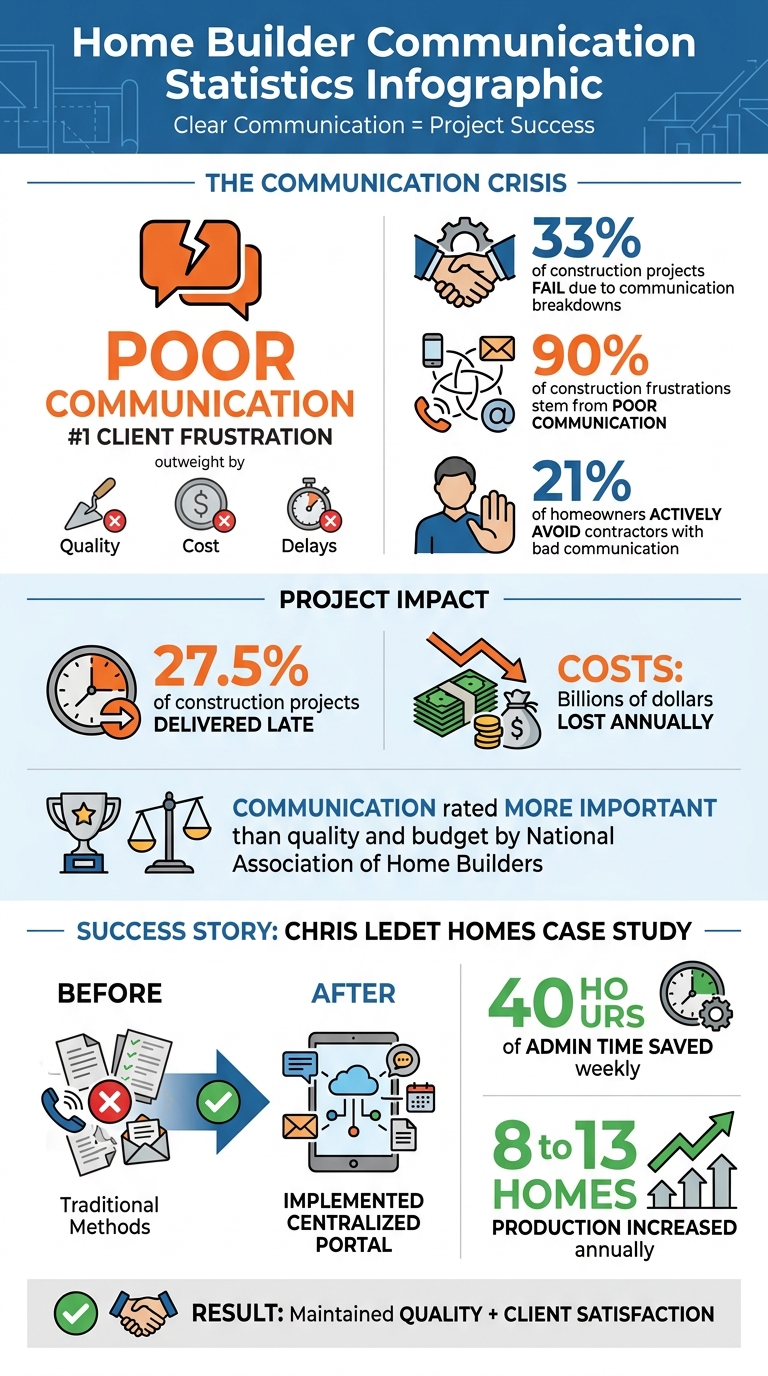
1Home Builder Communication Statistics and Impact on Project Success
Common Communication Problems in Home Building
Even the most skilled builders encounter communication challenges that can strain client relationships. These problems often arise from mismatched expectations, disorganized information, and unclear processes. Understanding these recurring issues is the first step to addressing them effectively.
Let’s take a closer look at some of the most common pain points:
1. Unclear Expectations on Timelines and Budgets
Builders tend to measure progress based on structural milestones, while clients focus on visible progress like finishes and fixtures. This difference in perspective can lead to misunderstandings.
For instance, even if a project is technically 60% complete, a client who sees only bare walls might feel the project is barely underway.
Vague details about costs and schedules are another major source of tension. When challenges arise and aren’t communicated promptly, clients often suspect hidden issues or budget overruns. As Projul aptly puts it, “Bad news does not age well”. Delaying updates about setbacks – whether it’s a two-week weather delay or a $3,000 increase in costs – can erode trust more than the actual problem itself.
With 27.5% of construction projects delivered late, unclear expectations around timelines can lead to disputes, delayed payments, and even legal battles. This is especially true when clients assume their budgets are set in stone.
Beyond expectations, the way updates are communicated can create additional challenges.
2. Fragmented Updates and Messaging
Using multiple communication channels – like emails, texts, phone calls, and handwritten notes – can lead to confusion and errors.
When project details are scattered, it becomes harder for both builders and clients to track progress. For example, a client might reference flooring details from an outdated email, while the builder is working off a more recent text. This misalignment can result in costly mistakes.
Fragmented communication also makes it difficult to maintain a consistent paper trail. Without clear documentation of changes to scope, budget, or schedule, disputes can arise down the line when memories of verbal agreements differ. Poor communication is cited as the root cause of 90% of frustrations during construction projects, and 21% of homeowners actively avoid contractors with inconsistent communication practices.
A great example of solving this issue comes from Chris Ledet Homes.
In 2024, the company transitioned from managing client communications through calls, emails, and texts to using a centralized customer portal. This platform consolidated updates, photos, and messages, drastically reducing “Where are we at?” calls and saving over 40 hours of admin time weekly. As a result, the company increased its capacity from eight homes per year to thirteen – without compromising quality or client satisfaction.
Managing Change Orders and Post-Construction Issues
Mid-project changes are common in construction, but clients often see them as signs of poor planning. While builders view change orders as routine, discussing construction change orders verbally or over the phone can lead to missed details if they aren’t properly documented.
The communication gap can widen after construction is complete. Once the keys are handed over, many builders stop communicating, leaving clients feeling abandoned when warranty or punch-list issues arise. This lack of follow-up can tarnish an otherwise positive experience, especially when satisfied clients could become valuable referral sources. To maintain trust, it’s crucial to establish clear procedures for handling changes and staying connected after the project wraps up.
sbb-itb-5eea312
Setting Clear Communication Protocols from Day One
Establishing proactive communication protocols is essential to avoid the misunderstandings that often derail construction projects. Poor communication contributes to nearly one-third of project failures, resulting in billions of dollars in wasted resources each year. According to the National Association of Home Builders, communication is the most important factor in client satisfaction, even surpassing quality and budget considerations. The foundation of effective communication begins with a well-thought-out project plan. This includes precise building cost calculations to prevent financial surprises.
Providing Detailed Initial Project Plans
A comprehensive project plan should clearly outline the scope of work, budget (in USD), and a realistic timeline (formatted as MM/DD/YYYY). It’s important to include buffers for potential setbacks, such as weather delays or material shortages, so there’s room to adapt to unforeseen challenges. Equally important is a defined communication schedule – specify when and how clients will receive updates. For instance, you might send weekly email updates during the pre-construction phase and twice-weekly photo updates once construction begins.
As Paula Huggett has pointed out, transparency is key to building trust. For U.S.-based clients, use imperial measurements like square feet to ensure clarity. Additionally, provide a list of upcoming decisions – such as tile, fixture, and paint color selections – along with deadlines tied to the construction schedule. This helps avoid delays caused by indecision. During a pre-construction meeting, review the project plan in detail, address any client concerns, and set clear expectations for response times (e.g., responding within four business hours).
Once the plan is finalized, assigning a single point of contact further strengthens communication and trust.
Assigning Roles and Points of Contact
Even the most detailed project plan can fall short without a dedicated point of contact. Assigning one person to handle client communication ensures consistency and reduces confusion. Introduce this individual during the pre-construction meeting and clarify their role, including who will manage site-level decisions versus administrative or financial matters.
When clients know exactly who to contact and when to expect updates, it eases their concerns and builds confidence in the process.
Creating Procedures for Concerns and Changes
Formalizing procedures for handling concerns and changes is another critical step.
From day one, establish a “no verbal agreements” rule. All change orders should be documented in writing and require signed client approval before moving forward. Include detailed language in the initial contract about change order terms, the scope of work, and acceptable communication methods. For example, quick updates can be sent via text, but any changes involving costs or scope should be communicated through email to maintain a clear paper trail.
When delivering bad news, confirm the facts first, then call the client directly – never use text for sensitive updates. Clearly explain how the issue affects the budget and timeline, propose a solution, and follow up with written documentation. Proactive communication during difficult situations can prevent minor issues from escalating. Additionally, scheduling regular check-ins focused on client concerns allows you to address small problems early, avoiding larger conflicts down the line.
Providing Regular and Transparent Project Updates
Establishing clear communication protocols from the beginning is just the start. Keeping clients consistently informed throughout a project is essential to avoid misunderstandings. When clients don’t hear from you, they may assume the worst. In fact, poor communication accounts for 90% of frustration during construction projects, and 21% of homeowners actively avoid hiring contractors with a reputation for bad communication.
Here’s how you can ensure that every stage of construction is communicated effectively.
Scheduling Regular Check-Ins with Clients
The frequency of updates should align with the project’s current phase. For instance, during pre-construction, weekly updates are usually enough to cover scheduling and material deliveries. Once construction is underway, it’s better to increase to twice-weekly photo updates, paired with a detailed summary every Friday. During the finishing phase, when decisions about fixtures, paint colors, and other details come up quickly, daily or every-other-day check-ins are often necessary.
Stick to a consistent schedule, like sending updates every Friday at 3:00 PM. Using a standardized format for updates – such as including sections like “Completed This Week”, “Planned for Next Week”, “Schedule Status”, and “Decisions Needed” – can help clients quickly understand the status of their project. This approach reassures them that the project is on track.
Choose the right communication method for the message. Texts work well for quick confirmations, but budget or scope changes should always be documented in an email. For more complex discussions or bad news, a phone call or in-person meeting is best, followed by written documentation.
Sharing Photos and Videos of Project Progress
Visual updates are a powerful way to build trust and confidence. Photos and videos allow clients to see tangible progress, even if they don’t fully understand technical terms. They’re especially useful for showing work that will eventually be covered up, like insulation or plumbing, providing proof of quality that clients wouldn’t otherwise see.
Take photos from the same two or three angles each day to create a visual timeline. Before snapping photos, ensure the site is clean – a tidy job site reinforces professionalism. Add short captions to explain the context, like “Hot and cold water lines roughed in for the master bath”.
“When homebuyers are informed every step of the way, trust builds naturally, turning buyers into loyal ambassadors.” – Paula Huggett, Bokka Group
While visual updates show progress, being upfront about setbacks is just as important.
Communicating Delays Honestly and Early
Delays are an inevitable part of construction – 27.5% of projects are delivered late. The key difference between a manageable delay and a relationship-ending one lies in how you handle the communication. Clients are often understanding of challenges, but surprises can erode trust. Silence during a delay can lead homeowners to assume you’re hiding mistakes or financial issues.
“Bad news does not age well. Every day you wait to tell a client about a problem, the problem gets worse… because the client’s trust erodes.” – Projul
When delays occur, follow a structured approach. First, confirm all the facts. Then, call the client immediately – don’t rely on texts or emails for bad news. Clearly explain the issue (e.g., “We found moisture damage behind the bathroom wall”), outline the impact on budget and timeline (e.g., “This will add $2,400 and push completion back five days”), and present your solution. After the call, send a follow-up email summarizing the conversation.
Setting realistic timelines with built-in buffers during the planning phase can help minimize conflicts. Be upfront about potential risks, such as permitting delays or inspection setbacks, so clients understand these are normal parts of the process, not signs of poor management.
| Project Phase | Recommended Update Frequency | Primary Focus |
|---|---|---|
| Pre-construction | Weekly | Scheduling and material updates |
| Active Construction | Twice-weekly | Photo updates and weekly summaries |
| Finishing Phase | Daily or every-other-day | Rapid decision-making and fine details |
| Punch List | As items are completed | Final validation and walkthroughs |
Using Contractor Foreman‘s Client Portals for Better Communication
Keeping communication organized is a challenge when updates are scattered across emails and text messages.
Centralizing everything in one place can solve this issue. Contractor Foreman’s client portals act as a digital hub, giving homeowners instant access to schedules, daily logs, photos, and financial summaries – all without the hassle of manual updates. This not only keeps clients informed but also reduces the back-and-forth that pulls you away from the job site. By streamlining communication, both builders and clients stay on the same page.
Key Features of Contractor Foreman’s Client Portals
The client portal updates in real time, so any changes you make on-site are immediately visible to clients, provided you choose to share them. Whether accessed via web or mobile devices, the portal offers instant updates and clear financial dashboards. Clients can see contract totals, amounts billed, and remaining balances. They can also approve estimates and change orders electronically, speeding up decisions and maintaining a clear record. Payments? Those can be handled directly in the portal using credit cards or ACH transfers.
Visual updates are covered too. The integrated photo gallery and daily logs provide a visual timeline of progress, with customizable permissions to control what’s shared.
Communication stays organized through the Client Chat feature, which keeps a searchable history of all conversations. Plus, you can assign specific tasks – like approving submittals or choosing finishes – to ensure the project keeps moving forward.
| Feature | What It Does for Communication |
|---|---|
| Financial Summary | Shows contract totals, billed amounts, and current balances |
| Project Schedule | Shares timelines and next steps using Gantt charts |
| Electronic Approvals | Enables quick digital approvals for estimates and changes |
| Daily Logs | Tracks site activity and weather updates |
| Photo Gallery | Displays selected progress photos |
| Client Chat | Keeps all conversations in one searchable location |
| Online Payments | Allows instant invoice payments via credit card or ACH |
Another great feature is two-way document sharing. Clients can upload files like revised drawings or selection specs, making it easier to respond to RFIs or submittals. For repeat clients, the multi-project login feature lets them view all their projects from a single account using a dropdown menu. This setup simplifies communication across every aspect of the project.
Integrating Financial Transparency with QuickBooks
Clear financial data builds trust, and Contractor Foreman simplifies this by integrating directly with QuickBooks Online. Invoices, payments, and job costing data sync automatically – create an invoice in Contractor Foreman, and it flows into QuickBooks without any extra steps. Payments made by clients are updated in both systems immediately, ensuring everyone is on the same page financially. This integration eliminates confusion, especially when handling change orders. Note that as of January 1, 2026, QuickBooks Desktop support will no longer be available, so QuickBooks Online is the way forward.
### Choosing the Right Construction Management Software Plan for Your Business
Contractor Foreman offers five pricing tiers, all of which include unlimited projects. The plans differ mainly by the number of users allowed. Each plan includes the client portal, unlimited device access, and a Price Lock Guarantee, which ensures your rate won’t increase unless you upgrade to a higher tier.
| Plan | Monthly Price (Annual Billing) | Users | Best For |
|---|---|---|---|
| Basic | $49 | 1 user | Solo builders or very small operations |
| Standard | $79 | 3 users | Small teams with a project manager and crew |
| Plus | $125 | 8 users | Mid-sized companies with multiple projects |
| Pro | $166 | 15 users | Larger teams managing several projects |
| Unlimited | $249 | Unlimited | High-volume builders with extensive staff |
The Plus plan, priced at $125/month, is the most popular choice for mid-sized operations, offering enough user seats while keeping costs manageable. For bigger companies, higher-tier plans include enterprise-level support, dedicated account managers, and guaranteed uptime SLAs.
Built on AWS servers, Contractor Foreman ensures 99.9% uptime reliability. You can even customize the portal with your logo, headers, and footers, keeping your brand consistent across all client-facing documents.
Balancing Technology with Personal Communication for Client Satisfaction
Digital tools like client portals simplify the process of sharing updates, but it’s the personal interactions that truly secure client trust. While technology efficiently handles data management, personal connections are what foster strong relationships. Many top-performing home builders rely on software to ensure consistent updates, but they pair this with personal follow-ups to make clients feel valued and heard.
Using GPS Timecards and Warranty Management Tools
GPS timecards are a practical way to verify crew on-site times, which can be particularly reassuring when clients have concerns about progress or billing. Once construction is complete, addressing warranty issues promptly demonstrates your ongoing commitment to the client. This follow-through solidifies trust and loyalty, extending your relationship well beyond the project’s completion.
Adding a Personal Touch to Client Communication
Even with well-established systems in place, some situations demand a personal approach. For instance, bad news should never be delivered via text or email. While tools like Projul alternatives streamline communication, If there’s a delay or a budget adjustment, it’s crucial to call the client directly to explain the issue and discuss solutions. Afterward, follow up in writing to keep everything documented. Weekly video walkthroughs are another way to combine updates with a personal connection. A Texas builder who adopted this method saw a noticeable drop in anxious calls and emails from homeowners.
Turning Satisfied Clients into Referral Sources
Clear communication is the cornerstone of client satisfaction.
Homeowners who receive regular, honest updates are far more likely to recommend their builder to others. For example, Chris Ledet Homes implemented a centralized client portal between 2021 and 2024, saving 40 hours of administrative work each week. This efficiency allowed them to increase production from eight to thirteen homes annually, all while maintaining high levels of client satisfaction. When clients feel informed and supported throughout the process, they naturally become advocates for your business, generating referrals effortlessly. By combining effective technology with meaningful personal communication, you can ensure clarity and trust throughout every stage of the project.
Conclusion
Communication ranks as the top concern for construction clients – outweighing issues like quality, cost, and timeline. The upside? This is entirely within your control. By setting clear expectations from the start, offering consistent, transparent updates, and leveraging tools like Contractor Foreman’s client portals, you can turn nervous homeowners into enthusiastic supporters of your business. It’s all about combining efficient digital tools with genuine, personal interaction.
Successful builders know how to strike this balance. Platforms like Contractor Foreman consolidate project details, schedules, and budgets, cutting down on disorganized communication that can cause client stress. At the same time, a personal touch – like a quick phone call to explain a delay or an in-person meeting to discuss major decisions – shows clients that they’re more than just a project on your calendar.
“When homeowners can clearly see what’s happening with their build, they feel more confident in the process. A transparent workflow fosters trust.” – Julia Thompson, Buildertrend
When clients feel informed and cared for, they’re more likely to recommend your services, fueling future projects through word-of-mouth referrals.
Start small: Set a consistent update schedule, assign a dedicated point of contact, or activate a client portal. Even minor improvements in communication can lead to noticeable gains in trust, efficiency, and overall business success.
FAQs
What should my weekly client update include?
A well-crafted weekly client update helps maintain clear communication and keeps everyone on the same page. It should cover a few key points:
- Current project status: Share where things stand right now. Are you on track? Have there been any changes or challenges?
- Upcoming milestones: Highlight the next steps and deadlines, so clients know what to expect.
- Important details: Include anything that might impact the project, like delays or new developments. This avoids confusion and builds trust.
Consistency is critical. Whether updates are daily, weekly, or monthly, keep them short and easy to understand. Using a centralized platform for communication can make the process smoother, ensuring clients stay informed and confident throughout the project.
How do I handle change orders without confusion?
Clear communication is key when it comes to handling change orders. To keep things straightforward, make sure every change is documented in writing. This includes details about the scope of work, cost adjustments, and any timeline updates.
Using construction management software with client portals can make a big difference. These tools let you share updates instantly, keeping everyone in the loop. It’s also essential to communicate changes as soon as they arise and ensure clients review and approve each change order before moving forward.
This process not only reduces misunderstandings but also helps build trust and ensures everyone stays on the same page throughout the project.
What’s the best way to communicate delays to clients?
The most effective way to handle delays is by establishing clear expectations from the start and keeping communication consistent throughout the project. Utilizing construction management software with client portals can help share real-time updates and timelines seamlessly. If a delay arises, notify clients immediately, explain the reasons behind it, and offer updated timelines. This level of transparency helps build trust, minimizes confusion, and ensures clients remain informed and involved.







