
Today, it seems like AI can do just about everything except brush your teeth.
Write emails? AI.
Build schedules? AI.
Generate reports? AI.
Answer life’s tough questions? AI.
So naturally, as a smart contractor, you’re probably looking for ways to use it to gain an edge. After all, if a tool can save time, reduce admin work, and help your business run more efficiently…why wouldn’t you use it, right?
But here’s the reality: AI isn’t quite the miracle worker people make it out to be. Yes, it’s incredibly useful. But when it comes to construction, AI still has some VERY REAL limitations.
That’s why the smartest contractors aren’t using AI for every single thing. They use AI WISELY.
In this article, we’ll look at the areas where AI genuinely helps construction businesses, where it falls short (no matter how promising it seems) , and how to use it smartly so you won’t be creating new problems in the process.
Here are critical areas where human expertise remains irreplaceable:
- Field Decision-Making: AI can’t replicate the instinct and judgment of experienced professionals who make calls with limited data and unrecorded context.
- Hands-On Problem Solving: Skilled tradespeople address unpredictable challenges, like unexpected structural issues, that require quick thinking and creativity.
- Building Relationships: Trust and emotional intelligence drive client, crew, and partner collaboration – qualities no algorithm can replace.
- Project Planning: Human planners adapt to shifting conditions and find solutions AI can’t predict.
- Ethical Accountability: Only humans can take responsibility for risks, sign off on decisions, and ensure projects meet ethical and safety standards.
While AI excels at handling repetitive tasks and data-heavy processes, construction success depends on human judgment, creativity, and accountability.
Tools like Contractor Foreman can help, but the human element remains essential.
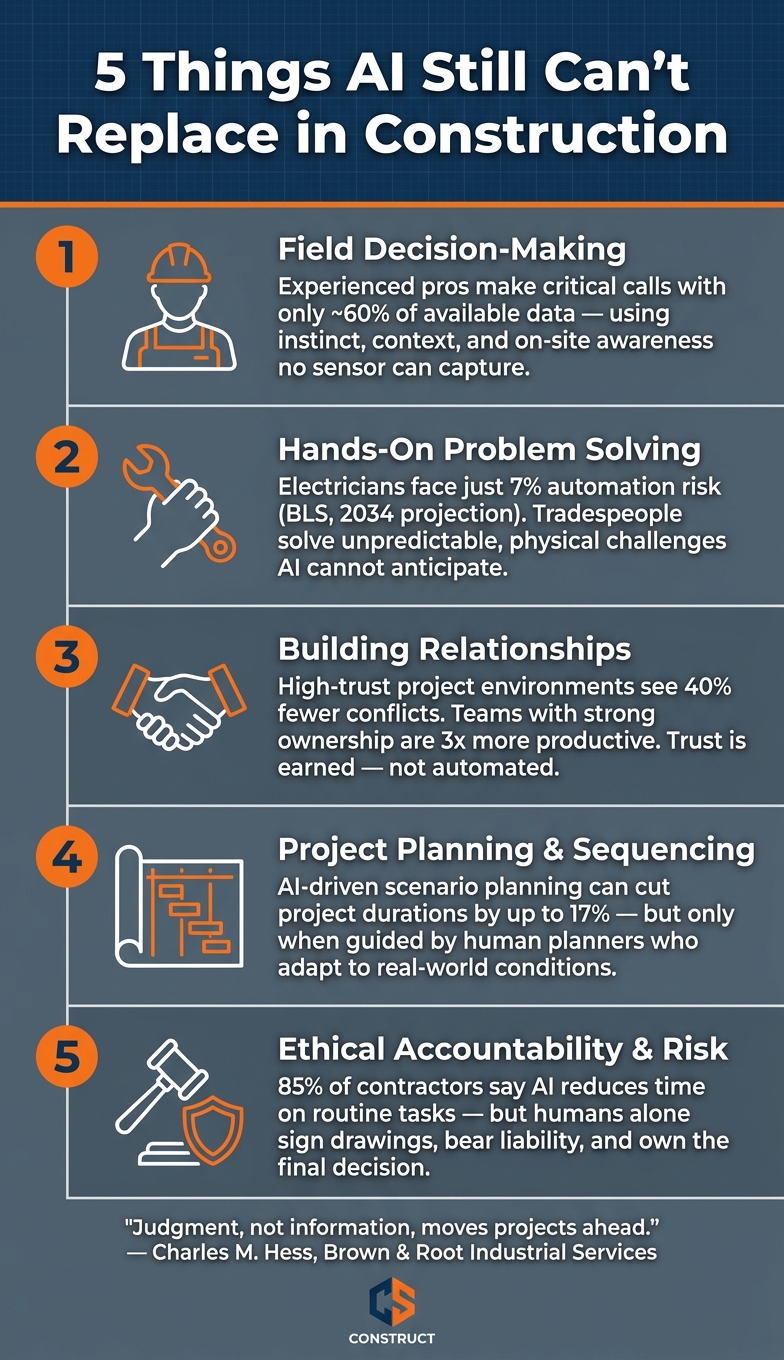
5 Things AI Still Can’t Replace in Construction
1. Making Complex Decisions in the Field
No AI system can walk onto a jobsite and instinctively sense that something is off before the data confirms it. Take an experienced superintendent overseeing a concrete pour – they’re not just following a checklist. They’re reading the slump, observing the crew’s pace, gauging the ambient temperature, and picking up on subtle, intangible cues that sensors simply can’t capture.
As construction professional Robert Barnes puts it:
“An experienced superintendent walking a concrete pour does not just check boxes. They look at slump, placement sequence, the crew’s pace, the ambient temperature, and whether something about the day feels wrong in a way that does not translate to a sensor output.”
This kind of deep, situational awareness – built from years of hands-on experience – is something AI simply doesn’t have.
AI tools excel when they’re fed clean, structured, and complete data. But in the real world, decisions often have to be made with gaps in information. For instance, seasoned project managers frequently make critical calls with only about 60% of the data they’d ideally want, relying on their judgment to fill in the blanks.
Another hurdle for AI is the context that never makes it into the data. AI systems won’t know about an informal agreement made during last Tuesday’s walkthrough, a legacy building configuration omitted from the digital model, or a soil issue flagged in a forgotten report. Humans, however, carry this unrecorded context with them, connecting the dots through conversations, historical knowledge, and on-site observations in ways algorithms can’t replicate.
The consequences of this gap are significant. In May 2026, Charles M. Hess, President of Brown & Root Industrial Services, witnessed a project review where a contractor used AI to generate daily progress reports. While the summaries were polished and grammatically perfect, the AI couldn’t identify what was causing delays or determine the next steps.
Hess explained:
“AI summarized the work but had not understood it… in this business, judgment, not information, moves projects ahead.”
This distinction – between summarizing data and truly understanding it – highlights why human expertise remains irreplaceable. It’s the combination of instinct and data-driven insight that drives effective decision-making and problem-solving on complex projects.
sbb-itb-5eea312
2. Hands-On Problem Solving and Skilled Craftsmanship
Data can guide decisions and construction cost estimates, but physical work often brings unpredictable challenges that require on-the-spot problem solving. According to projections from the Bureau of Labor Statistics, electricians face only a 7% risk of automation, with job growth expected to reach 9% by 2034. This highlights the irreplaceable role of human expertise on job sites, where the physical complexity of tasks defies algorithmic solutions.
Take, for example, a demolition crew working on a 14-unit apartment renovation. If they uncover a load-bearing wall that wasn’t in the original plans, a general contractor must act fast – redesigning the project’s critical path, reallocating crews, and coordinating with a structural engineer to manage change orders, all within a tight six-hour window.
Skilled tradespeople also rely on sensory awareness that AI simply can’t replicate. A plumber might recognize by touch that a pipe joint isn’t seated correctly, while an HVAC technician could detect compressor issues before any gauges confirm it. These skills come from years of hands-on experience, setting true craftspeople apart from those who just follow checklists.
Will Tygart of Tygart Media explains it well:
“Judgment is what happens when a novel situation – one that doesn’t match any template – produces a correct decision anyway. Judgment is pattern recognition operating beyond the edges of the patterns.” – Will Tygart, Tygart Media
While AI is excellent at handling routine tasks, it falls short when faced with unique, real-world challenges. Contractors regularly encounter non-standard problems – like a bathroom floor that’s two inches off-level, an electrical panel blocked by a structural beam, or mismatched smoke patterns during fire restoration. These situations demand quick thinking and creative solutions, proving why craftsmanship remains a cornerstone of construction management.
3. Building Relationships with Clients, Crews, and Partners
No algorithm can replace the power of a handshake, read the room’s atmosphere, or offer the reassurance of a trusted partner. In construction – where projects often stretch for months and involve numerous stakeholders – personal connections frequently make all the difference.
Trust isn’t built with automated emails or generic follow-ups – it’s earned through consistent actions. Returning calls promptly, addressing problems before they snowball, and keeping even small promises all contribute to building that trust. Research supports this: high-trust project environments experience 40% fewer conflicts, and teams with a strong sense of ownership are three times more productive.
This focus on trust extends beyond client relationships to every member of the construction team.
In the field, leadership depends on influence that’s earned – not just authority tied to a title. Keeping teams motivated and collaborative requires a deeper skill set.
While AI can track stakeholder histories or flag changes in meeting sentiment, it can’t mentor a struggling team member, rebuild trust after a misstep, or interpret the subtleties of a dissatisfied client. Technology might assist with monitoring trends, but the personal, trust-based connections essential for effective construction management remain uniquely human.
4. Project Planning and Sequencing
AI can whip up a project schedule in seconds, but let’s be real – those schedules often rely on overly optimistic assumptions. They expect labor to show up on time, materials to arrive exactly as ordered, and the project scope to stay unchanged. On an actual jobsite, though, things rarely go that smoothly. And when conditions shift, AI-generated schedules tend to fall apart rather than adjust.
This gap between AI’s precision and the unpredictable nature of construction highlights the need for human expertise.
It’s in this gray area – where data meets the messy realities of a jobsite – that experienced planners shine. A seasoned superintendent can sense when a crew is falling behind, notice how weather impacts productivity, or recognize when subcontractors are stretched too thin. These are the kinds of subtle, on-the-ground cues that no algorithm can pick up. This practical knowledge, gained through years of experience, is what keeps projects on track when reality doesn’t match the plan.
Human planners also come up with solutions AI wouldn’t dream of. Take project manager Nishchay Pidiha, for example. During a forensics lab build in April 2026, he cleverly repurposed existing lighting to save 16 weeks on the timeline and avoid an expensive change order.
AI certainly has its advantages – predictive models can identify risks earlier, and AI-driven scenario planning has shown potential to cut project durations by up to 17%. This underscores the value of construction scheduling strategies that blend technology with human oversight. But these benefits only come to life when humans are at the helm. In complex projects, it’s human expertise that transforms predictive data into real-world solutions. By filling in the missing context and making the final judgment call, planners ensure that AI serves as a helpful tool rather than a replacement for their critical insight.
5. Ethical Accountability and Owning Risk
While strategic planning often highlights efficiency and innovation, the human role in ethical accountability and risk management remains irreplaceable. AI can identify risks and produce detailed reports, but it cannot shoulder responsibility. No algorithm will ever testify in court, face a client after a misstep, or answer to a professional licensing board. That burden rests squarely on the shoulders of the humans involved. Charles M. Hess, President of Brown & Root Industrial Services, explains this succinctly:
“AI does not bear professional liability. It does not sign drawings, testify under oath or face the public after a failure. Engineers and constructors do.”
This isn’t just a legal formality – it directly influences how real-world decisions are made. For example, if an AI tool recommends accelerating a project timeline and that decision results in quality issues later, the project manager is the one held accountable, not the AI. This dynamic becomes even more critical as AI-generated recommendations become more convincing and harder to challenge.
Another, less obvious risk is the misplaced confidence AI systems can project. These tools may deliver polished outputs while missing key, undocumented context.
Baker Nanduru, CEO of ClearlyRated, highlights the dangers of this:
“When AI hallucinates in a word processor, you get a bad paragraph. When it hallucinates in a construction data workflow, you get a bad building.”
To address these challenges, forward-thinking organizations are beginning to focus on auditing the inputs fed into AI systems, not just the outputs they generate. This ensures that the data driving AI recommendations is as reliable as possible.
The takeaway is straightforward: use AI as a tool for processing data, but keep human oversight at the core of decision-making.
When overriding AI recommendations, document your reasoning thoroughly. Always require human sign-off for critical actions like safety measures, resource reallocations, or handling project shifts and significant scope changes. This approach underscores the ethical responsibility of professionals to remain in control. As Hess aptly puts it, “The person who defines the problem still owns the solution.”
Conclusion
AI has made its mark on construction, but it’s important to remember that it’s -once again- just a tool.
Across all five areas discussed, one thing is clear: human expertise is still a must!
Decisions that break the mold, quick thinking in the face of surprises, building trust, and adjusting plans on the fly aren’t things an algorithm can handle.
This human edge turns technology into a powerful ally. Tools like Contractor Foreman handle repetitive tasks like RFI tracking and daily logs, freeing up project managers to focus on critical decisions and building relationships.
FAQs
Which construction tasks should we automate with AI first?
Start by automating tasks that eat up a lot of time, especially those that are repetitive and follow predictable patterns.
A good starting point for most contractors is tackling administrative work, like:
- Using AI phone answering systems to handle leads around the clock.
- Leveraging AI-powered estimating tools to speed up proposal creation.
After setting these up, you can move on to automating things like document organization, scheduling reminders, and follow-ups. This will help simplify back-office operations and free up more of your time.
How do we keep human judgment in control when using AI tools?
Maintaining control over processes calls for a human-in-the-loop approach.
This means project managers and superintendents should always act as the ultimate decision-makers. It’s crucial to double-check AI outputs for accuracy and ensure they align with real-world conditions since AI can sometimes misinterpret context. Think of AI as a helpful tool for handling routine tasks, while leaving complex decisions and ethical considerations to human judgment. This way, AI can complement your expertise without undermining the essential oversight you provide.
What are the biggest risks of relying too much on AI on a jobsite?
Leaning too much on AI at a job site can be risky because it simply can’t replace human judgment or the ability to adapt in ever-changing conditions. When we rely on AI too much, we risk dulling critical thinking skills, missing early warning signs, and delaying necessary actions. Since AI depends entirely on data, it might fail to catch undocumented risks, such as shoddy workmanship or subtle site-specific factors. Without human oversight, its lack of accountability and context could result in expensive mistakes or even safety hazards.







