
“Oh, we just want a simple bathroom remodel,” says Mrs. Cruz.
You give her the designs, scope of work, timeline, and quote. She says “Lovely!”
Two weeks later, however, she’s sending Pinterest boards titled Modern Scandinavian Spa Retreat.
You explain that this is… not exactly the same bathroom anymore. She disagrees. Everybody gets slightly annoyed. Eventually, you come up with a compromise because arguing with homeowners is rarely worth it.
Then comes the harder part: the budget conversation..
Mrs. Cruz’s expression changes immediately. “Oh wow, I thought I wouldn’t have to spend extra for that!!”
And now you have to explain Construction 101 — change orders affect pricing, upgraded finishes cost more, and once a project drifts outside the original scope, the budget usually drifts with it too. Which, technically, was already in the contract she signed.
Unfortunately, since she’s already annoyed the bathroom isn’t becoming a luxury wellness resort for the original budget, she’s now in a mood. The frustrating part is you’re probably willing to deal with the headache. But Mrs. Cruz also happens to be president of the local homeowners association and knows approximately every person who might hire you next year.
So now you’re internally debating whether you should just absorb the extra costs… because becoming “that contractor” in Mrs. Cruz’s Facebook post somehow feels more expensive. All because expectations weren’t clear from the start.
Clear expectations are the backbone of successful construction projects. Things need to be made very, very clear to the client from the beginning to avoid confusion, surprise costs, delays, and those painfully awkward “that’s not what I thought we agreed on” conversations later.
Here’s how to avoid these pitfalls and keep your projects running smoothly:
- Define the Scope Clearly: Document every detail of the project, including what’s included, excluded, and quality standards. Use precise language to avoid misunderstandings.
- Prevent Scope Creep: Establish boundaries and document all changes through formal change orders.
- Set Realistic Timelines and Budgets: Use itemized estimates, account for delays, and communicate trade-offs transparently.
- Maintain Strong Communication: Designate a single point of contact, set response time expectations, and provide regular updates through structured protocols.
- Leverage Technology: Use client portals and construction management tools to centralize updates, track decisions, and ensure transparency.
The key is consistent communication, detailed documentation, and proactive planning. When clients feel informed and involved, trust builds, and projects succeed.
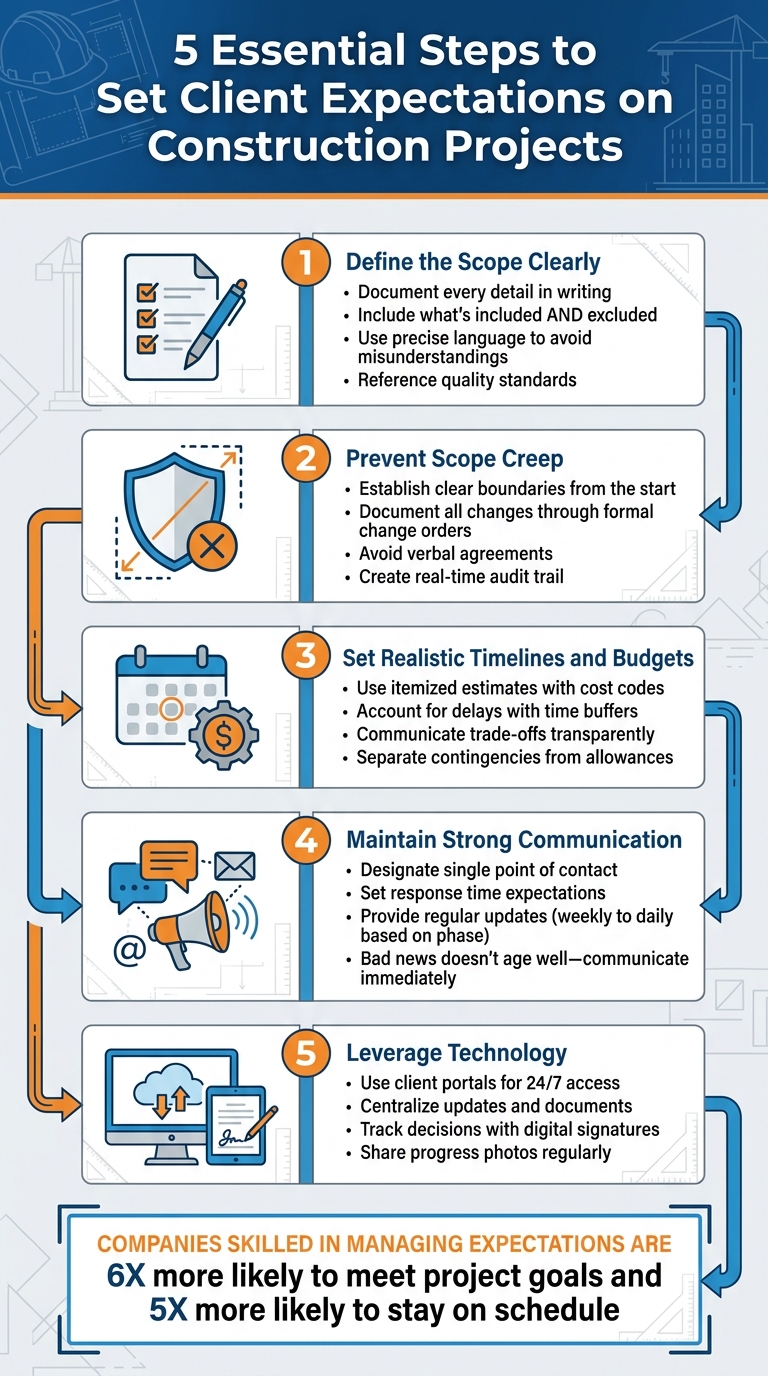
5 Essential Steps to Set Client Expectations on Construction Projects
Define Project Scope and Deliverables
Defining the project scope and deliverables upfront is critical to ensuring that client expectations align with the work being done.
A detailed scope helps avoid misunderstandings and disputes, which are common in construction projects when details are left vague. Assuming that clients fully understand what’s included without clear documentation can lead to costly disagreements. A well-written scope document acts as a safeguard, outlining exactly what is included – and excluded – while protecting against unexpected construction costs and potential legal issues.
Create Written Scope Documentation
Every detail of the project should be documented in writing. For instance, instead of vaguely stating “Install drywall,” specify exactly what the task involves: “Provide and install 5/8″ Type X gypsum board to all interior walls achieving a Level 4 finish ready for paint.” Breaking the document into sections adds clarity.
Key sections to include are:
- Project Overview
- Inclusions (the “What We DO” list)
- Exclusions (the “What We DON’T DO” list)
- Reference Documents
- Quality Standards
- Allowances
For example, the Inclusions section might state: “Provide 4,000 PSI slab-on-grade per structural drawings S-201.”
Meanwhile, Exclusions could highlight items like permit fees or handling unforeseen hazardous materials.
Reference Documents should list all relevant drawings, specifications, and addenda, such as: “A-101, dated 01/15/2024, Rev. 3.” Quality Standards should reference industry benchmarks, like: “Concrete work shall comply with ACI 301 standards.” Allowances can address uncertainties, such as: “A $10,000 cash allowance is included for lobby light fixtures [material only].”
Using construction management tools like Contractor Foreman can centralize these documents, making them accessible and ensuring that project boundaries remain well-defined for both parties.
Prevent Scope Creep with Clear Boundaries
Scope creep – when a project expands beyond its original agreement – can wreak havoc on budgets and timelines.
To prevent this, establish clear boundaries from the start. If a client requests additional work, document it as a formal change order that outlines the added costs and timeline adjustments. Avoid relying on verbal agreements; every change should be recorded in writing with specific details about the new deliverable, its impact on the schedule, and any extra costs. Digital tools for change order tracking can simplify this process, creating a real-time audit trail and requiring client approval before any new work begins.
By maintaining these boundaries, you can also break the project into well-defined milestones, ensuring progress is tracked consistently.
Set SMART Objectives for Project Milestones
Dividing the project into manageable phases helps keep everything on track and prevents confusion.
Use the SMART framework – Specific, Measurable, Attainable, Relevant, Time-bound – to define each milestone. For example, instead of saying, “Complete framing,” specify: “Complete all exterior wall framing and roof trusses by 03/15/2026, ready for inspection.”
A Work Breakdown Structure (WBS) can further simplify the process by breaking the project into smaller, digestible tasks. This also helps clarify dependencies, such as ensuring electrical rough-ins pass inspection before drywall installation begins. Success criteria can include target ranges, such as: “Improving energy efficiency by 25–35%,” which allows for flexibility while still holding the team accountable.
Construction management software can help visually map out these milestones. Tools like Gantt charts provide a clear roadmap, making it easier for clients to understand the project’s progression and how delays in one phase could impact the overall timeline.
| Scope Element | Purpose | Example of Precise Language |
|---|---|---|
| Inclusions | Defines the “What We DO” list to eliminate ambiguity | “Provide 4,000 PSI slab-on-grade per structural drawings S-201” |
| Exclusions | Defines the “What We DON’T DO” list to prevent assumptions | “Permit fees for building, electrical, and plumbing are excluded” |
| Quality Standards | Sets the bar for acceptance using industry benchmarks | “Concrete work shall comply with ACI 301 standards” |
| Allowances | Manages uncertainty for items not yet fully selected | “A $10,000 cash allowance is included for lobby light fixtures (material only)” |
sbb-itb-5eea312
Set Realistic Timelines and Budgets
Setting realistic timelines and budgets is essential for maintaining client trust.
When estimates fall short, clients often feel misled – especially if the project scope is unclear. In 2024, over two-thirds of U.S. builders reported budget overruns on residential and light commercial projects due to poorly detailed estimates or unforeseen disruptions. By establishing clear and achievable expectations from the start, you can protect your reputation and avoid unnecessary financial strain. A key step in this process is creating precise, itemized budgets.
Develop Itemized Estimates
Break down every expense into specific line items. Use standardized cost codes, such as CSI MasterFormat for commercial projects or NAHB Home Builder Cost Codes for residential work, to organize costs by trade or function. This approach minimizes errors like double entries and ensures no costs are overlooked.
Labor estimates should be based on production data from previous projects rather than just hourly rates. For example, if your team installs tile at a consistent pace, factor in potential site-specific challenges like tight spaces or weather delays. Engaging subcontractors during the bidding process can also help validate unit costs early on.
Clearly separate contingencies from allowances in your estimate. Contingencies are meant for project-wide uncertainties – typically 3% to 5% for new builds and 8% to 10% for remodels – while allowances cover client selections that haven’t been finalized yet. Clearly labeling these items helps clients understand that these are provisional figures, not fixed costs.
Plan for Delays and Contingencies
Account for potential delays caused by weather, inspections, or supply chain issues by building time buffers into your schedule. Use the Critical Path Method (CPM) to map out the sequence of tasks that determine the minimum time required to complete the project. Any delays along this critical path can push back the entire timeline, so adding buffer time is crucial.
Prepare a “What-If” playbook to address common disruptions like material shortages, failed inspections, or permit delays. For example, if a material shipment is delayed, inform your clients immediately and propose schedule adjustments or overtime solutions to keep the project on track. Always follow up with a revised timeline in writing, including updated milestones. These proactive steps help set the stage for discussing trade-offs when unexpected changes arise.
Communicate Trade-offs and Alternatives
When clients request changes that impact the budget or timeline, be transparent about the trade-offs. Use a “Yes, and…” approach: acknowledge the change, then explain its effect on cost and schedule.
If your initial estimate exceeds the client’s budget, explore value engineering options. Instead of simply cutting costs, suggest alternative materials or methods that maintain quality while reducing expenses. For instance, if a specific design element significantly increases structural costs, recommend a modification that allows for a more cost-effective solution. Present these options in person or through a video call to address questions and provide context immediately.
Leverage construction management tools like Contractor Foreman to centralize all project details, including estimates, change orders, and schedule updates. With real-time visibility through client portals, clients can stay informed without needing constant updates, reinforcing their confidence that their investment is being managed effectively.
Establish Clear Communication Protocols
Poor communication often ranks as the top complaint from clients, leading to unnecessary anxiety and misaligned expectations.
By setting up a structured communication plan, you can eliminate misunderstandings and keep everyone on the same page throughout the project. These strategies work hand-in-hand with earlier steps, like defining the project scope and timelines, ensuring clients stay informed at every stage.
To avoid confusion and ensure accountability, designate a single primary contact for the client. Use different communication methods based on the situation: text for quick updates, email for formal records, and phone or in-person meetings for more complex discussions.
Set Response Time Expectations
Establish clear expectations for response times – such as “responses within four hours during business hours” – to reduce uncertainty and unnecessary follow-ups. This approach minimizes frustration and ensures smoother communication.
Tailor your response method to the urgency of the situation.
For example:
- Quick questions about site access or delivery schedules can be addressed via text or a client portal.
- Financial discussions, scope changes, or delays should be handled through a phone call, followed by written documentation for clarity.
Always follow verbal approvals with written confirmation to avoid misunderstandings. Clear response protocols like these are key to maintaining a smooth communication flow.
Schedule Regular Updates and Meetings
Keeping clients informed with regular updates builds trust and prevents surprises. Establish a consistent update schedule based on the project phase:
| Project Phase | Update Frequency | Primary Content |
|---|---|---|
| Pre-construction | Weekly | Scheduling and material updates |
| Active Construction | Twice-weekly | Photo updates and weekly summaries |
| Finishing Phase | Daily or every-other-day | Decision-making and detail updates |
| Punch List | As items are completed | Status of final fixes |
Each update should address completed work, upcoming plans, the current schedule and budget status, and any decisions that need client input. This predictable flow of information ensures clients feel involved and informed.
Use Technology for Real-Time Transparency
Construction management software can significantly streamline communication with clients.
Tools like Contractor Foreman’s client portal provide 24/7 access to project schedules, photo galleries, document storage, and invoices – all in one place. This reduces the need for constant phone calls, as clients can check progress whenever they want.
Use the platform to share daily progress photos from consistent angles, creating a visual timeline of the project. Include images of “hidden work”, such as insulation, vapor barriers, or electrical rough-ins, before they’re covered up. This not only demonstrates quality but also answers future questions about what’s behind the walls.
Digital change orders are another game-changer. They allow for instant client approvals, automatically updating budgets and creating a centralized audit trail. Keeping all documents related to money, scope, or schedule changes in one place ensures both parties can verify agreements at any time.
Finally, remember the golden rule: “bad news does not age well”.
If problems arise, call your client immediately – don’t rely on email or text. Clearly explain the issue, its impact, and your proposed solution. Then, document the conversation and next steps in your management system. This proactive approach helps preserve trust, even when challenges occur.
Use Documentation and Client Portals
Keeping all project details in one place helps both you and your clients stay on the same page. When every decision, approval, and change is documented in a centralized system, you reduce the chances of those dreaded “I never agreed to that” disputes. This not only protects trust but also keeps projects moving without unnecessary delays. Using construction management software for small businesses allows you to turn scattered emails, texts, and verbal agreements into a well-organized, accessible record. Below, we’ll explore how to document decisions effectively and use client portals to provide transparency.
Track Decisions and Change Orders
Every change order you process should clearly outline three key things: the reason for the change, a detailed cost breakdown (including labor, materials, and markup), and how it will affect the project timeline. This level of detail makes it easier to avoid disagreements and ensures everyone understands why changes are being made. Digital tools that allow for electronic signatures and searchable logs create a legally binding, timestamped record of every change.
For example, platforms like Contractor Foreman simplify this process by enabling clients to review and approve changes digitally. If a client questions a charge weeks later, you can easily pull up the exact approval record – complete with timestamps, such as one showing that approval was given on a Tuesday at 3:47 PM.
Communication logs are another essential tool. Many modern systems keep a searchable history of every call, message, and decision. If a client claims they were never informed about a delay, you can quickly reference the record that shows when and how the issue was communicated.
Provide Real-Time Project Visibility
Transparency builds trust, and giving clients real-time access to project updates goes a long way in easing their concerns. Client portals offer 24/7 access to schedules, photo galleries, financial records, and daily logs. This kind of visibility helps reduce client anxiety – when they can check progress anytime, they’re less likely to imagine worst-case scenarios or bombard you with unnecessary calls.
Consider this: contractors typically spend 10 to 15 hours per week answering repetitive status questions. A well-designed portal can cut these inquiries by 40% to 60% within the first month, freeing up your time to focus on the actual work.
Contractor Foreman’s client portal, for instance, provides a centralized dashboard that pulls updates directly from your daily logs and tasks. Uploading progress photos from consistent angles creates a visual timeline, showing clients exactly what’s been done. Including photos of “hidden work,” like insulation or wiring before it’s covered, adds another layer of transparency and helps address future questions.
The portal can also streamline payments. Mobile payment options often shorten collection times by 10 to 15 days. When clients can see the completed work and approve payments with a simple tap, cash flow improves, and they’ll feel more confident in the process.
To make the most of these tools, establish clear expectations during your kickoff meeting. Let clients know what updates will be available in the portal and how often they’ll be posted – such as “photo updates every Friday by 3:00 PM”. Setting these boundaries ensures clients feel informed without overloading them with information. When clients trust they’re in the loop, they’re more understanding of delays, cost adjustments, and other project hiccups. Plus, they’re more likely to recommend your services to others.
Educate Clients and Reinforce Expectations
Setting expectations at the start of a project is just the first step. To keep everything on track during construction, you need to continuously educate your clients and communicate clearly. Many clients don’t fully grasp the intricacies of construction, like sequencing, material lead times, or why certain decisions need to be made well in advance. It’s your responsibility to bridge this knowledge gap and build trust through consistent updates and delivery.
Conduct Detailed Kickoff Meetings
Kickoff meetings are your chance to lay the groundwork for a smooth project. Use this time to establish clear expectations, introduce communication protocols, and designate a single point of contact. It’s also an opportunity to explain how client decisions – such as selecting tiles or fixtures – can directly impact the construction timeline.
Go over the Work Breakdown Structure (WBS) to break down project phases and clarify the steps involved. During this meeting, review the communication schedule and explain the formal process for managing changes. This ensures everyone is on the same page from the start, connecting the initial vision to the day-to-day progress.
A lack of clear goals is often cited as a major reason projects fail – 37% of executive leaders agree on this. To avoid this pitfall, co-create a “Success Roadmap” with your clients. This roadmap should outline goals, deliverables, and how communication will flow, eliminating confusion before it arises.
Communicate Changes Immediately
When things don’t go as planned, transparency is key. Delaying bad news only makes things worse.
If delays or issues come up, confirm the facts first. Then, call the client right away to explain the situation, its impact, and your plan to address it. For instance, if a material shipment is delayed by two weeks, let them know immediately and outline how you’ll adjust the schedule to minimize disruption.
Avoid using technical jargon when communicating changes. Instead, focus on what the client needs to know. For example, say, “The custom cabinets will arrive four days later than expected, which means the final walkthrough will move from March 15 to March 19,” rather than diving into unnecessary details about manufacturing processes.
Clear communication is the top factor in client satisfaction – more important than both quality and budget. Considering that project managers spend 90% of their time communicating, addressing changes promptly ensures trust remains intact.
Build Trust Through Consistent Delivery
Clear protocols and timely updates lay the foundation, but consistent delivery is what cements trust. Meeting deadlines and maintaining quality reassures clients that their project is in capable hands.
To keep expectations aligned, establish a predictable communication rhythm. For example, send a weekly status email every Friday. These updates should be quick to read – under three minutes – and include three key points: what was completed this week, what’s planned for next week, and any decisions needed from the client.
Take transparency a step further by uploading daily progress photos to a client portal. Include shots of “hidden work,” like insulation or vapor barriers, before they’re covered up. This not only highlights quality work but also reinforces your commitment to keeping clients informed.
Effective change management plays a big role in project success. When clients see you consistently delivering on promises, they’re more likely to be understanding of delays or cost adjustments. Plus, satisfied clients are your best advocates – they’ll tell six or more people about a positive experience. On the flip side, 13% of unhappy clients will share their negative experience with 15 or more people.
Using tools like Contractor Foreman’s client portal can streamline communication even further. By centralizing weekly updates, progress photos, and change orders in one place, you create a single source of truth that reinforces professionalism and ensures everyone stays aligned.
Conclusion
Managing client expectations isn’t a one-and-done task – it’s an ongoing effort that begins well before construction starts and continues through the final walkthrough.
The strategies shared here work together to build trust: clear documentation minimizes misunderstandings, realistic timelines with buffers help you consistently meet deadlines, and construction communication software keep clients informed without overwhelming them.
Research shows that companies skilled in managing change are six times more likely to meet project goals and five times more likely to stay on schedule. Plus, transparent communication can lead to 60% of satisfied clients returning, with each happy client generating around 11 new referral opportunities.
Tools like Contractor Foreman can simplify this process by centralizing everything in one place. Its client portal offers 24/7 visibility, daily logs provide visual progress updates, and change order management ensures every adjustment is documented with digital signatures. By consolidating schedules, invoices, and project updates into one system, you eliminate the confusion that comes with juggling multiple platforms.
Now it’s time to put these strategies into action. Start your next project with a detailed kickoff meeting using a Success Roadmap, set up a weekly update schedule, and introduce your client portal early. Remember, 37% of executive leaders identify unclear goals as a major challenge – but you can avoid that pitfall by setting expectations clearly from the start. Managing expectations doesn’t just improve individual projects; it strengthens client relationships.
When clients know what to expect, understand timelines, and feel involved in the process, they shift from being potential sources of frustration to becoming enthusiastic advocates. This approach doesn’t just enhance your projects – it can elevate your entire business reputation.
FAQs
What should a scope document include?
A scope document lays out the objectives, deliverables, and boundaries of a project, making sure everyone involved knows exactly what to expect. It usually covers the specific tasks that need to be completed, the timeline, and any exclusions or limitations.
On top of that, it defines roles and responsibilities, sets quality standards, and highlights key milestones. This clarity helps keep everyone aligned and avoids confusion throughout the construction process.
How do you handle client-requested changes?
Dealing with client-requested changes is all about maintaining open communication and setting clear expectations. The key is to address these changes early on. Discuss the requested adjustments as soon as they arise, and take the time to evaluate how they might affect the project’s scope, timeline, and budget. This upfront analysis helps prevent surprises later.
It’s also crucial to document every change. By keeping a clear record of what’s being adjusted, you can reduce the chances of misunderstandings. This level of transparency ensures that everyone – both your team and the client – is on the same page.
Another important step is to set realistic expectations. Make sure the requested changes align with the overall goals of the project. If something doesn’t fit, explain why and offer alternatives that better suit the objectives. Transparent communication like this not only keeps the project on track but also builds trust and strengthens your relationship with the client. With these practices in place, you can handle changes effectively while avoiding scope creep.
What should clients see in a project portal?
Clients need access to clear and straightforward information to manage their expectations effectively. A well-designed project portal can serve this purpose by offering regular updates on progress, timelines, and any changes or challenges that arise. Acting as a central communication hub, it should provide real-time status reports, photos, key documents, and milestone tracking. This keeps clients informed and aligned with the project’s development, fostering confidence and trust while minimizing potential misunderstandings.







