
No one enjoys LOSING MONEY—not even a single cent.
But a lot of homebuilders do it constantly. Not intentionally, of course. Nobody drives to a jobsite thinking, Today’s the day I absolutely destroy my profit margin.
But it happens anyway.
A small lumber delay means crews getting paid $400 a day to stand around doing interpretive dance near a half-framed kitchen. A fixture that costs “only” $20 more suddenly becomes an extra $4,000 when multiplied across an entire development. Tiny leaks become expensive problems very quickly.
That’s why reducing costs is extremely important if you want to have a sustainable residential construction business. Not in a “cut corners and hope for the best” kind of way. More in a “maybe stop casually setting money on fire” kind of way.
Now sure — you could obsess over every receipt and spend your weekends arguing with suppliers over $38.
Or…
You could build smarter systems that effortlessly cut costs for you.
Here’s a breakdown of the strategies to reduce construction costs:
- Analyze Costs: Identify direct (labor, materials) and indirect costs (permits, overhead). Use tools like AI-powered takeoff software to save time and improve accuracy.
- Create Detailed Budgets: Break down tasks, include contingency funds (5%-10%), and align budgets with schedules to avoid overruns.
- Improve Procurement: Build strong supplier relationships, negotiate better terms, and use Just-in-Time delivery to reduce waste and storage costs.
- Boost Labor Efficiency: Train teams to reduce errors, use workforce management tools, and track labor and equipment usage in real time.
- Leverage Software: Centralize tracking of costs, schedules, and resources with tools like Contractor Foreman to prevent errors and delays.
- Apply Lean Principles: Eliminate waste, improve workflows, and track performance metrics like Percent Plan Complete (PPC) to stay on track.
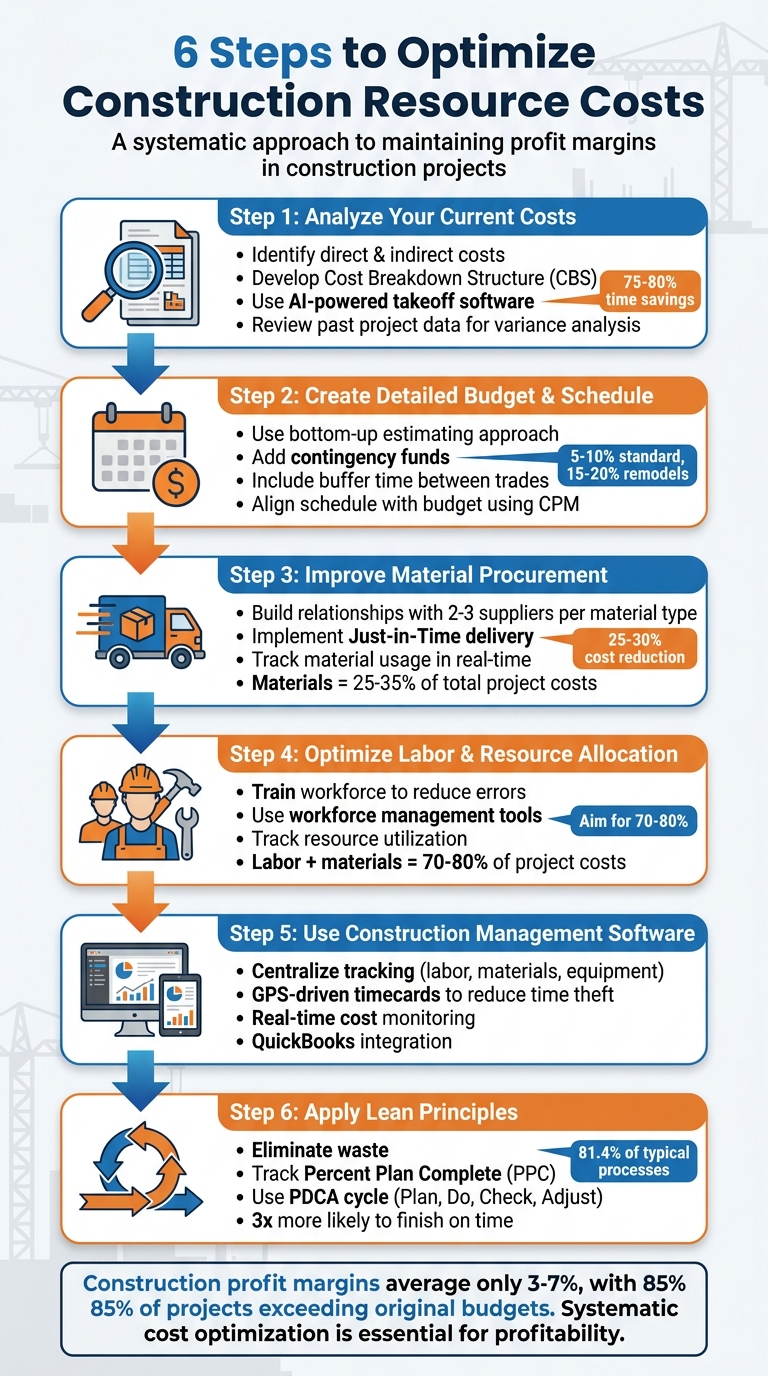
6-Step Process to Optimize Construction Resource Costs
Step 1: Analyze Your Current Costs
Before you can make informed decisions to optimize spending, you need to break down your expenses and review past spending patterns. Without this groundwork, you’re essentially making guesses instead of actionable plans.
Identify Your Main Cost Drivers
Your expenses fall into two broad categories: direct costs and indirect costs.
Direct costs include labor, materials, equipment rentals, and subcontractor fees. Indirect costs cover items like permits, security, and administrative overhead.
To get a clear picture, develop a Cost Breakdown Structure (CBS) that organizes all anticipated expenses into categories. Start with quantity takeoffs – this involves analyzing blueprints and specifications to calculate exact material quantities. Using AI-powered takeoff software can speed up this process by as much as 75% to 80%, making it a game-changer for bidding efficiency.
Consistency is key when analyzing costs across projects. Use standardized cost codes, such as those from the CSI MasterFormat system, to compare specific phases of work. For example, you can evaluate framing costs on your current project against historical averages. Without consistent coding, costs might be misclassified, leading to a distorted financial picture.
Review Past Project Data
Completed projects are a goldmine of information for improving profitability. After each job, spend at least 30 minutes comparing the original estimate to the actual costs, line by line. This “builder’s feedback loop” helps refine your future estimates and highlights which types of work consistently meet your profit goals.
Focus on variance analysis to pinpoint the reasons behind cost overruns. For instance, rate variance tells you if you paid more per unit or hour than planned – perhaps due to material price hikes or overtime costs. Meanwhile, quantity variance shows if you used more materials or labor hours than expected, signaling inefficiencies or waste.
Here’s a real-world example: In 2025, an Arizona contractor bidding on a $340,000 kitchen remodel failed to update his job costing baseline. By the end of the project, untracked material overages and unbilled change orders resulted in an $18,000 loss, even though the initial estimate had been profitable.
Also, keep an eye on your fully loaded labor costs, which include wages, taxes, insurance, and benefits. Ignoring these can lead to underestimating labor costs by 25% to 40%. Similarly, track material waste rates. For example, if your tile waste consistently hits 22% while you budget for 12%, it’s time to adjust future orders.
Set a Baseline Budget
A baseline budget serves as your financial roadmap. It helps you detect deviations early, preventing small problems from snowballing. Assign each estimate line item to a cost code and include a 5%–10% contingency for unforeseen issues.
Break the project into phases – such as site work, structural work, and finishes – and allocate separate budgets for each. This approach improves precision. Use the “percent complete vs. percent spent” metric weekly. For instance, if 40% of the work is done but 60% of the budget is already spent, it’s a clear warning sign.
“Without this discipline [systematic comparison of actual spending against planned expenditures], budgets become wishful thinking rather than management tools.”
– itemit Team
Real-time cost tracking against a baseline budget can help you catch overruns up to three weeks earlier compared to manual tracking. Considering that 85% of construction projects exceed their original budget, this early detection can make a huge difference. Laying this groundwork prepares you for the detailed budgeting process in Step 2.
sbb-itb-5eea312
Step 2: Create a Detailed Budget and Schedule
Once you’ve got a handle on your current costs, it’s time to map out a practical financial and time plan. A well-thought-out budget and schedule should work hand in hand to avoid overspending or delays. The key here is precision – every dollar and day counts.
Start with Accurate Estimates
The foundation of a solid budget is accurate estimating. One effective method is the detailed (or bottom-up) approach, where you break down every task, material, and resource into specific cost categories: Materials, Labor, Subcontractors, Overhead, and Profit. Missing even one category can throw your entire budget off track.
Begin with quantity takeoffs – this means calculating the exact dimensions and quantities for materials like flooring, trim, doors, windows, and concrete. Don’t forget to factor in waste: 10% for drywall and lumber, 15% for diagonal tile layouts, and 5%-10% for concrete. These adjustments prevent shortages mid-project.
For labor, always use burdened rates (which include taxes, insurance, and benefits) instead of just base wages. Depending on the region and trade, burdened rates for residential contractors usually range from $35 to $65 per hour. Subcontractor costs, which often make up 15%-30% of total expenses, should be based on actual bids gathered early in the process.
“Bad estimates don’t just lose jobs. They lose money on the jobs you win.”
– EstimationPro AI
For any line item over $500, verify current pricing to avoid surprises. Clearly document what’s included and excluded in your scope to prevent scope creep, which can derail both your budget and timeline.
Add Buffer Time and Contingency Funds
Unexpected twists are inevitable in construction, so it’s wise to build in safety nets. Set aside a contingency fund – 5%-10% of your budget for standard projects and 15%-20% for remodels, which often uncover hidden structural issues. These funds ensure you’re prepared for surprises like supply chain delays, equipment failures, or even natural disasters.
“A contingency budget is about being prepared for the unexpected, while also fostering a culture of accountability and efficiency.”
– Sidharth Ramsinghaney, Director of Strategy and Operations, Twilio
Keep your contingency fund separate from your main project budget. Use historical data to calculate the average budget overages from past projects, then apply that percentage to your estimate. For simpler projects, a flat 5%-15% of the total cost often works. For more complex jobs, use risk-based calculations: Expected Loss = Potential Financial Impact × Probability of Occurrence.
Buffer time is equally important. Include “float” in your schedule for tasks that can afford delays without affecting the final completion date. Add lag time for activities like concrete curing or drying. For subcontractors, schedule 2-3 days of buffer between trades, such as plumbers and insulators, to avoid bottlenecks if one runs late.
Align Your Schedule with Your Budget
Once your estimates and buffers are in place, integrate them into a cohesive schedule. Tools like the Critical Path Method (CPM) can help you identify tasks that directly impact your project’s end date. For example, a 90-day delay on a $1.2 million project at 8% interest could cost you about $24,000 in daily interest carrying costs.
Resource leveling is another essential strategy. This ensures crews and equipment are properly allocated, avoiding downtime or “stacked crews” waiting for materials or tools. Long-lead items like custom windows, cabinets, or structural steel should be ordered early – some of these can take 8 to 16 weeks to arrive. This preparation helps you avoid labor cost increases and schedule disruptions.
Use dependency mapping with “Finish-to-Start” logic to ensure tasks are sequenced correctly. For instance, framing shouldn’t begin until the foundation has fully cured. Set aside time each week – like 30 minutes every Friday – to review your schedule, track progress, and adjust your budget in real time to account for any shifts. Collaborate with your field team to gather accurate availability and duration estimates from superintendents and subcontractors, ensuring your budget reflects the realities on-site.
Only 31% of construction projects finish within 10% of their original deadlines, according to a 2024 KPMG survey.
By linking your budget and schedule through construction management software, you can see exactly how delays – like a three-day slip – affect daily interest costs or liquidated damages. This integration lets you address small issues before they snowball into major financial setbacks.
Step 3: Improve Material Procurement and Inventory
Materials can make up as much as 25%–35% of a project’s total costs, so procurement offers a big chance to save money. By taking a smart approach, you could cut costs by 5%–15% while keeping your timeline intact. With construction input prices rising 3.5% annually – and specific materials like steel mill products up 12.4%, industrial electrical components climbing 10.3%, and copper wire increasing 9.1% – careful procurement planning isn’t just helpful, it’s necessary.
Build Relationships with Suppliers
Try to consolidate your orders with just two or three reliable suppliers for each material type. This gives you leverage to negotiate bulk discounts, rebates, and better payment terms like Net-45 or Net-60.
As construction supply chain experts at FMI Corporation put it:
“Strong supplier relationships improve reliability, reduce delays, and help projects stay on schedule and within budget.”
Keep your suppliers in the loop by sharing your project pipeline. This helps them plan ahead and might get you better pricing based on future orders. Regularly review supplier performance using metrics like on-time delivery and quality standards, and reward the top performers with more business. Paying invoices promptly and keeping contracts straightforward makes you a “builder of choice” – someone suppliers are eager to prioritize, especially during shortages. Long-term relationships can also help you lock in fixed prices for key materials, shielding you from sudden price hikes.
A solid supplier network is the foundation for streamlining your inventory management.
Use Just-in-Time Inventory
Just-in-Time (JIT) delivery ensures materials show up right when you need them, cutting storage and handling costs by 25%–30%. Since material waste can account for 10%–15% of your total material costs, limiting on-site inventory also reduces the risk of damage, theft, or exposure.
Start by using pull planning, working backward from your project’s completion date. Plan six to eight weeks ahead to handle unexpected delays, and sync deliveries with subcontractor schedules on a daily basis. Local suppliers can help you avoid customs issues and shipping delays from far-off locations [32, 36]. For high-value materials, secure them immediately upon delivery to prevent theft – construction theft costs in the U.S. range from $300 million to $1 billion annually.
Track Material Usage in Real-Time
Ditch manual tracking and switch to digital tools for real-time monitoring of material usage. Once your deliveries are optimized, tracking how materials are actually used becomes critical. Digital platforms let you log material consumption as it happens, tying it directly to your project budget. Assign someone to check every delivery against the purchase order, count the quantities, and document any damage with photos before accepting it – this step prevents disputes and catches errors early.
Real-time cost databases give you instant insight into whether you’re staying within budget, so you can address overruns before they eat into your margins. By managing purchase orders, bills, and expenses in a centralized system, you can keep everything under control. Integrating this data with accounting tools like QuickBooks ensures that material costs are accurately reflected across your financial operations.
| Material Category | Year-over-Year Price Increase (Sept 2025) |
|---|---|
| Steel Mill Products | 12.4% |
| Industrial Electrical Components | 10.3% |
| Copper Wire and Cable | 9.1% |
| Overall Construction Inputs | 3.5% |
Step 4: Optimize Labor and Resource Allocation
Labor and materials make up a huge chunk of project costs – 70–80% to be exact. That’s why improving workforce efficiency is one of the smartest ways to keep your expenses in check. For instance, if you’ve already spent 30% of your budget but only completed 20% of the work, you’re facing a 50% variance that needs immediate action. The secret? Assigning the right people to the right tasks at the right time and keeping a close eye on how resources are being used.
Train Your Workforce
A well-trained team is worth its weight in gold. Training helps cut down on errors and rework, both of which eat into your profits. For example, a skilled crew can complete 1,200 ft² per day, compared to just 600 ft² for an untrained group. It also ensures you’re not overloading or underutilizing your team. Overcrowded sites can slow everyone down, while understaffing can stretch timelines and rack up overhead costs. Pair a trained workforce with digital tools, and you’ll be set to maximize efficiency.
Use Workforce Management Tools
Digital tools can give you a clear view of crew assignments and hours in real time. For example, platforms like Contractor Foreman let you assign crews, track hours live, and sync seamlessly with QuickBooks. GPS time tracking ensures workers are where they need to be, cutting down on time theft and creating audit-ready timesheets. Plus, with automated alerts, you’ll know instantly if labor costs for a specific task go over budget, allowing you to act quickly before things spiral out of control. These tools don’t just track hours – they give you a detailed picture of how your labor costs align with your overall project budget.
Track How Resources Are Used
Keeping tabs on resource use in real time can save you from nasty surprises later. Digital daily logs let you tag labor hours to specific tasks or cost codes, helping you pinpoint where inefficiencies or premium costs are creeping in. For instance, overtime premiums can add 50% or more to regular hourly rates, which can quickly eat into your profits. Equipment tracking is just as important – digital asset tools can cut rental costs by 30–40% by improving visibility and accountability. Aim for a 70–80% utilization rate for billable roles, and if deviations exceed 5%, adjust staffing, scope, or rates accordingly.
| Technique | Primary Goal | When to Use |
|---|---|---|
| Resource Leveling | Balance workload | When deadlines are flexible and you want to avoid team burnout. |
| Resource Smoothing | Optimize within limits | When deadlines are fixed but task timing has some wiggle room. |
Step 5: Use Construction Management Software
Once you’ve set up the basics of cost management, using software can make tracking and managing expenses much more efficient. Relying on spreadsheets often leads to errors and lost profits. In fact, over 80% of construction companies experience costs that exceed their expectations. Construction management software eliminates the guesswork by providing accurate, real-time data on labor hours, material costs, and equipment usage – all in one centralized system.
How Contractor Foreman Works
Contractor Foreman combines over 35 essential features into a single platform, making it a one-stop solution for construction management. It collects real-time cost data through digital daily logs and integrates seamlessly with QuickBooks (both Online and Desktop) and Gusto, removing the need for manual data entry. The bid management tool allows you to compare bids side-by-side, award contracts, and generate purchase orders with ease. Additionally, its real-time costs database, linked with 1build.com, provides up-to-date material and labor pricing. This is especially important given that 82.5% of construction materials have seen major price increases since 2020.
Features That Help Control Costs
The platform offers several tools to help keep costs in check:
- GPS-driven timecards: These track crew locations and work hours, reducing time theft and creating reliable, audit-ready records.
- Purchase Order tracking: This feature compares “Delivered Quantity” to “Billed Quantity”, ensuring you only pay for materials that actually arrive on-site.
- Change order updates: Approved changes automatically adjust your contract amount and project financials, keeping your budget accurate at all times.
- Equipment monitoring: Logs track maintenance schedules and idle time, helping you identify underused equipment and cut unnecessary rental costs.
With plans starting at $49/month and a 30-day free trial, you can explore these tools without a long-term commitment.
By integrating scheduling, billing, and resource tracking, Contractor Foreman helps maintain consistent control over your project’s budget.
Benefits of an All-in-One Platform
Using separate tools for estimating, scheduling, and accounting can create gaps where costs go unnoticed. A centralized system like Contractor Foreman bridges these gaps by aligning field teams and management with shared, real-time data. Anthony W. from Authority Refrigeration, LLC highlighted this advantage:
“The ability to, in one place, track jobs from estimating, to project progress, billing, and employee management all in one place that also integrates with QuickBooks.”
This unified approach eliminates the need to chase down paper records or worry about overlooked change orders. Plus, the platform’s support team boasts an average 13-second wait time, with 95% of chats rated 5 stars, ensuring you get help when you need it. Start by addressing your biggest challenge – whether it’s labor tracking or material procurement – and gradually adopt more features as your team gets comfortable.
With all cost elements monitored in real time, this platform ensures your projects stay on budget and on track.
Step 6: Apply Lean Principles and Track Progress
Use Lean Construction Methods
Lean construction is all about cutting out waste while delivering the best results for your clients. Projects that adopt lean methods are three times more likely to finish on time and twice as likely to stay under budget compared to traditional approaches. Yet, in the U.S., nearly half of construction time is wasted on unproductive activities that don’t add value.
Take this example: A structural steel erection team used Value Stream Mapping to analyze their 45-day schedule. They found inefficiencies that added up to 17 lost days. By addressing these issues, they regained 38% of their project time.
One way to start is by applying the 5S Workplace Organization system – Sort, Set in Order, Shine, Standardize, and Sustain. This method keeps jobsites organized and reduces unnecessary movement. For instance, during a plumbing replacement at the Denver Federal Center, the team recycled 500 porcelain toilets and debris from eight demolished buildings. This effort saved $37,125 and kept 319 semi-truckloads of material out of landfills.
Once your processes are streamlined, establishing clear performance metrics can help maintain and improve efficiency.
Set Clear Performance Metrics
Tracking key metrics like Percent Plan Complete (PPC) and the ratio of value-added to non-value-added time can quickly highlight inefficiencies. For example, delays caused by slow RFI (Request for Information) responses can increase costs. Higher PPC scores mean fewer delays and less downtime for workers. Studies show that only 18.6% of typical construction processes add value, leaving a staggering 81.4% as waste.
Communication breakdowns alone cause 57% of negative outcomes in construction projects. Monitoring how quickly RFIs and approvals are processed can prevent costly delays. Companies that embrace continuous improvement report 42% better on-time delivery rates, proving that consistent tracking and adjustments can lead to real progress.
Review and Adjust Your Approach
Lean practices work best when paired with regular cost monitoring and a commitment to continuous improvement. Using the PDCA cycle – Plan, Do, Check, Adjust – allows teams to make small, daily refinements that add up over time. After each project phase, tools like SWOT analysis or Fishbone diagrams can help identify lessons learned and avoid repeating mistakes.
Industrial engineer Shigeo Shingo once said:
“The most dangerous kind of waste is the waste we do not recognize”.
Visual dashboards can be a game-changer, linking daily activities to outcomes that clients value. They make it easier to spot inefficiencies and fix them quickly. Tools like Contractor Foreman’s real-time job costing provide instant insights, allowing for fast adjustments that reinforce lean principles.
Conclusion
Summary of Cost Optimization Steps
Here’s a quick recap of the six-step process to help you make smarter decisions and cut resource costs at every stage of your project. Start by analyzing your spending habits to pinpoint what’s driving expenses. Create detailed budgets that include realistic estimates and contingency funds to handle surprises. Streamline material procurement by building strong supplier relationships and using Just-in-Time delivery to cut down on storage costs and material waste. Boost labor efficiency by training your workforce and fine-tuning schedules so your team works at peak performance. Finally, apply lean construction principles to eliminate unnecessary steps and streamline operations.
How Technology Helps Control Costs
Technology is a game-changer when it comes to keeping costs in check. With construction profit margins averaging just 3% to 7%, there’s almost no room for mistakes. Tools like Contractor Foreman shift cost control from being reactive to proactive. This platform gives you real-time insights into labor hours, material usage, and budgets – all in one place. You can catch overruns as they happen and make adjustments on the fly. Features like mobile tracking, financial reporting, and QuickBooks integration ensure that field data syncs seamlessly with your budget, cutting out delays in financial reporting. The result? Everyone, from field teams to office staff, works with accurate, up-to-date information.
Getting Started with Cost Optimization
Now that you’ve got the basics of cost management down, it’s time to take action. The stakes are high – 61% of construction businesses say rising material and labor costs threaten their financial stability, and only 31% of projects stick within 10% of their original budget. But these challenges don’t have to define your outcomes. Start by assessing your current practices, updating your processes, and exploring how tools like Contractor Foreman can centralize your resource management. Whether it’s refining your project scope to avoid expensive changes, scheduling monthly budget reviews, or rolling out digital tracking, pick one step and put it into practice this week. With construction spending projected to hit $22 trillion by 2040, those who master cost optimization now will be the ones thriving in the future.
FAQs
Which cost codes should I use to track job costs consistently?
To keep job costs organized and consistent, it’s a good idea to use cost codes. These can be based on standardized systems like the CSI MasterFormat or customized categories that fit your specific projects. Typical categories include:
- Labor
- Materials
- Equipment
- Subcontractors
- Overhead
Using clear and consistent cost codes helps you track expenses accurately, create more precise budgets, and analyze financial performance more effectively across all your projects.
How do I set a contingency amount without overpadding my bid?
To determine a contingency without unnecessarily inflating your bid, rely on a detailed risk assessment rather than random guesses. Approaches such as deterministic or probabilistic calculations can help you pinpoint the right amount. This way, you can address potential risks while keeping costs realistic, ensuring your bid remains competitive and accounts for unexpected expenses.
What should I track daily to catch overruns early?
To stay on top of potential overruns, keep a close eye on these key areas every day:
- Labor costs: Compare actual labor expenses to your estimates to identify any deviations early.
- Material invoices: Match invoices to purchase orders to catch any discrepancies or unexpected charges.
- Change orders: Monitor these closely to understand their financial impact on the overall budget.
- Cost categories: Break down expenses into categories like equipment, labor, and materials to spot trends or issues.
Be alert for red flags such as sudden spikes in costs or mismatches between the budget and actual spending. Regular tracking of these elements helps you detect problems early and keeps your project on track financially.







