
“I can FEEL cement prices will go down next week. Let’s just bid lower.”
Or:
“My GUT tells me we can finish this in 45 days. Let’s go for it.”
Sounds a little ridiculous when you say it out loud, right? And yet, a lot of contractors still make decisions this way. Sometimes because there’s pressure to move fast. Sometimes because experience creates confidence – “I’ve been doing this for 20 years” feels like enough.
Now, intuition isn’t useless. It can help you sense when a deal feels off, when someone’s bluffing, or when your business partner suddenly starts acting weird.
But when hard numbers are involved — budgets, schedules, material costs, workforce planning — decisions shouldn’t be made on gut feel alone. It should be based on real trends, real information, and real insights.
That’s why more companies are shifting toward Data-Driven Decision-Making (DDDM)—using actual data instead of assumptions and “smart guesses” to manage budgets, schedules, safety, and workforce efficiency. It’s the smartest way to run your construction business.
In this article, we’ll break down what DDDM looks like in construction — and why it matters.
Why DDDM in Construction Matters:
- Better Cost Control: Real-time tracking of expenses and labor costs helps identify budget issues early.
- Improved Scheduling: Historical and real-time data create accurate timelines and reduce delays.
- Reduced Risks: Analytics predict potential problems, enhancing safety and decision accuracy.
- Increased Efficiency: Tools like AI-powered takeoff systems are faster and reduce resource waste.
Benefits of Data-Driven Decision Making in Construction
Switching from guesswork to decisions based on data can lead to noticeable improvements in financial outcomes and operational efficiency.
1. Better Cost Management and Budgeting
Using data for decision-making offers contractors real-time financial insights, making it easier to detect potential cost overruns early and manage budgets effectively. By centralizing critical elements like estimates, bids, change orders, purchase orders, and expenses on one platform, managers can address budget gaps more efficiently. This streamlined access to essential financial data simplifies cost oversight.
Real-time tracking tools, such as daily logs and time cards, allow for precise management of labor costs – a notoriously unpredictable aspect of construction budgets. This also helps create more accurate bids that reflect current market conditions.
2. Improved Project Timelines and Resource Allocation
In addition to better budgeting, data insights improve scheduling and resource management. Historical data removes much of the guesswork from setting task durations, allowing managers to base schedules on past performance rather than intuition. Cloud-based systems further enhance this by tracking daily progress against baseline schedules, making it easier to spot delays quickly. Real-time alerts enable supervisors to reallocate idle personnel or equipment dynamically, minimizing downtime and keeping projects on track.
| Feature | Traditional Scheduling | Data‑Driven Scheduling |
|---|---|---|
| Data Source | Personal experience/intuition | Historical + real‑time data |
| Updates | Manual/Periodic | Real‑time/Automated |
| Visibility | Fragmented spreadsheets | Centralized Gantt charts |
| Resource Allocation | Reactive | Proactive |
| Risk Management | Identified after delays occur | Predicted via patterns/analytics |
These tools help teams reduce delays and achieve project milestones more consistently.
3. Reduced Risks and More Accurate Decisions
Data-driven strategies go beyond cost and scheduling improvements – they also enhance safety and decision-making accuracy. By increasing visibility into task assignments and timing, these tools help identify risks proactively, rather than relying on assumptions. Systematic documentation of safety meetings, incidents, RFIs, submittals, inspections, and daily logs ensures decisions are based on the latest project information.
Tracking time cards and crew schedules boosts accountability. With nearly 45% of contractors still using manual methods, adopting data-driven tools can significantly improve accuracy and risk management.
sbb-itb-5eea312
Key Types of Data Construction Managers Should Track
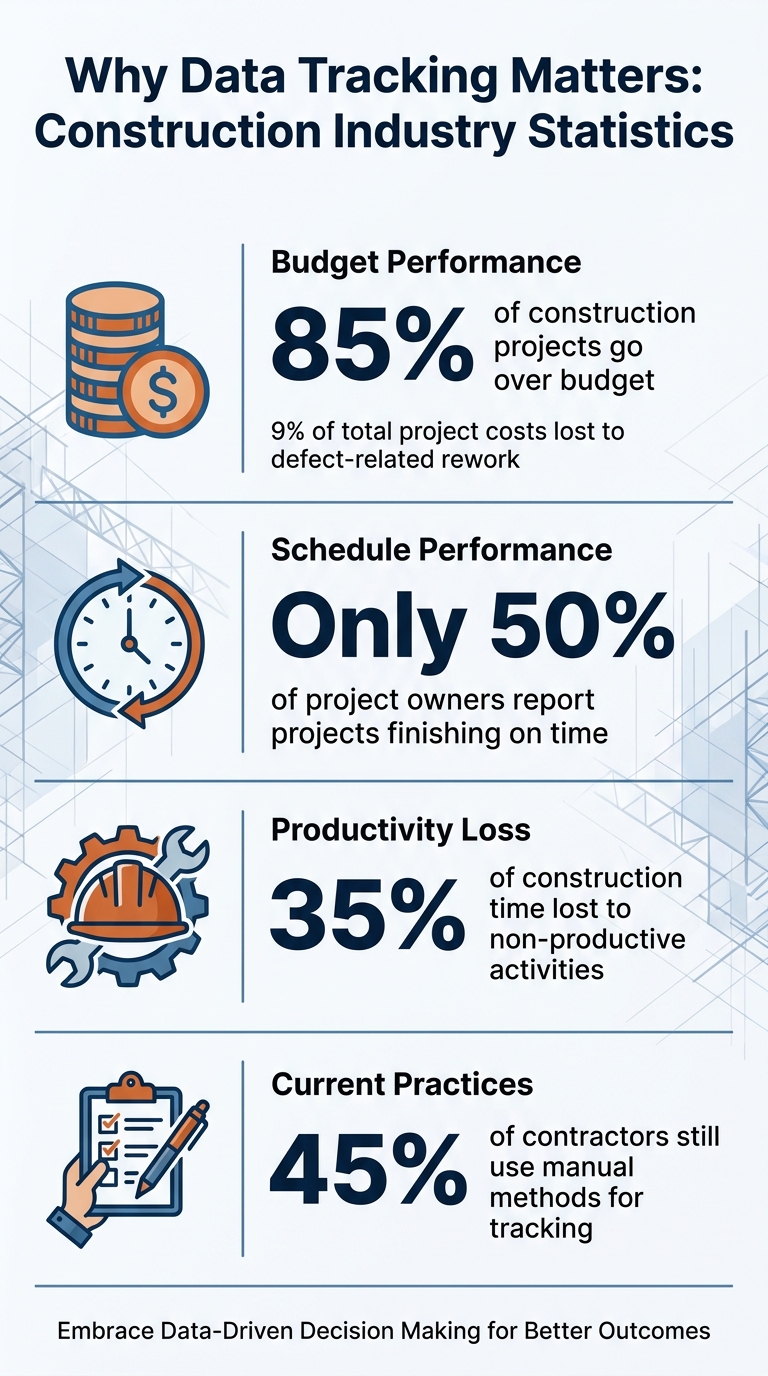
Key Construction Industry Statistics: Budget Overruns, Delays, and Productivity Loss
Knowing what data to track is just as important as how you track it. With 85% of construction projects going over budget, focusing on the right metrics can make or break a project’s financial success. These key data categories are essential for better cost control, scheduling, and managing risks, all of which are critical to keeping projects on track.
Project Timelines and Milestones
Keeping a close eye on schedules helps you spot delays before they spiral out of control. Considering that only 50% of project owners report projects finishing on time, monitoring milestones is non-negotiable. Tools like the critical path method pinpoint tasks that directly affect your completion date, so you can allocate resources where they’re needed most. Daily logs provide insight into worker activity, helping identify productivity bottlenecks. Gantt charts offer a visual snapshot of progress, making it easy to see if you’re ahead or falling behind. Baseline tracking also sharpens future scheduling estimates.
Budget and Financial Data
Tracking timelines isn’t enough – keeping tabs on your finances is just as important. Real-time expense tracking allows you to catch budget overruns as they happen, rather than after the project is complete. Comparing budgeted costs to actual spending helps maintain financial control. With defect-related rework eating up as much as 9% of total project costs, monitoring cost efficiency can improve performance and make bidding more accurate. Job costing gives you quick access to the numbers you need to keep your projects financially viable. Centralizing financial data ensures everyone has access to accurate, up-to-date information.
Workforce and Resource Utilization
Labor productivity, which measures work completed against labor hours, is another critical metric. It can help fine-tune project estimates and highlight underperforming teams or resource gaps. Since 35% of construction time is lost to non-productive activities, tracking workforce utilization is key to staying profitable. Monitoring equipment usage and downtime ensures assets are being used efficiently. Predictive maintenance, which tracks factors like vibration or temperature, can help schedule repairs before equipment breaks down, keeping projects moving smoothly.
How Construction Management Software Supports Data-Driven Decisions
Relying on spreadsheets and paper forms for tracking creates isolated data pockets that slow down decision-making. Construction management software solves this by consolidating all project data into a single platform.
Centralized Data Collection and Storage
Construction management tools bring everything – RFIs, submittals, daily logs, schedules, and financials – into one easily accessible system. This ensures that architects, engineers, and contractors are always working from the same, up-to-date information, reducing the chances of miscommunication or errors. For example, Contractor Foreman allows data collection across multiple devices, eliminating the hassle of pulling information from scattered sources.
Whether you’re in the office or on-site, having all project, financial, and workforce data in one place means you can quickly find the numbers you need.
This centralized system sets the stage for real-time analytics to turn raw data into practical insights.
Real-Time Analytics and Automated Reporting
With real-time analytics, managers gain instant access to job costing and financial updates as expenses occur, making budget tracking more efficient. Automated reporting simplifies the process of gathering project data, turning it into clear insights based on past trends and current metrics. These tools provide immediate visibility into workforce activity, helping managers allocate resources more effectively and streamline project timelines. By identifying bottlenecks early, teams can adjust plans proactively to stay on schedule and within budget.
Integration with Existing Tools
In addition to centralization and analytics, strong integration capabilities ensure the software complements existing workflows rather than complicating them. The ability to connect with other tools is critical for boosting productivity. Contractor Foreman, for instance, integrates with over 50 external systems, such as QuickBooks for accounting, Zapier for workflow automation, CompanyCam for photo documentation, and Google/Outlook Calendars for scheduling. These integrations ensure smooth data flow across project management, accounting, and automation platforms.
This seamless connectivity means financial data syncs effortlessly, schedules update automatically, and field documentation ties directly into project records. By eliminating data silos and reducing manual tracking, construction software makes smarter, faster decision-making a reality.
Steps to Begin Implementing Data-Driven Decision Making
Addressing common construction challenges starts with small, manageable steps toward data-driven practices. You don’t need to overhaul your entire operation – begin with focused changes that can grow over time.
Start with Simple Data Collection
Pick one key issue – whether it’s budget overruns, project delays, or labor inefficiencies – and focus on tracking the most critical metrics. For example, you might monitor on-site manpower hours, drawing revisions, or task completion times. Using digital daily logs can help you create a searchable and structured record of this data.
As researchers in the International Journal of Project Management put it:
“Real-time data collection enables earlier issue detection and more proactive project decisions.”
Once you’ve built a solid foundation of data, you can move on to using advanced tools to streamline your processes further.
Use Construction Management Software Features
Construction management software, like Contractor Foreman, can consolidate data, automate entries, and simplify reporting in real time. With mobile-friendly options, field crews can input timecards and daily activity logs directly from their smartphones or tablets. This ensures that data is timely and accurate. Plus, real-time reporting shifts decision-making from reactive, end-of-month reviews to proactive, daily adjustments.
Train Team Members on Data Utilization
After automating data collection, it’s critical to train your team to use and act on the insights effectively. Accurate data entry is a must, so provide training to field staff on how to collect data properly. Create role-specific reports so that site foremen, project managers, and executives can quickly access the insights most relevant to their responsibilities.
As SmartPM highlights:
“The goal is to create a system that a project manager can open and understand in under five minutes, not one that requires a specialist to interpret.”
Use available training resources to make onboarding seamless and ensure data entry becomes a routine part of your workflow. By establishing regular habits for data entry and reporting, your team can shift focus from reacting to past issues to making proactive decisions that improve performance.
Conclusion
Data-driven decision-making has the power to reshape construction operations by replacing guesswork with clear, actionable insights. Monitoring key metrics like budget, workforce, and timelines allows you to spot issues early, allocate resources more effectively, and minimize costly errors.
Shifting away from instinct-based methods doesn’t have to mean a complete overhaul. You can start small by focusing on one crucial area – whether it’s tracking labor, managing costs, or ensuring schedules stay on track – and expand gradually. Tools like Contractor Foreman provide robust features to consolidate data and simplify operations, eliminating the need for scattered spreadsheets.
With streamlined workflows, your team can make quicker, smarter decisions. Companies that embrace data analytics are often better equipped to stay ahead of the competition. By taking straightforward steps – like starting with basic data collection and investing in team training – you’ll set the stage for more efficient projects, reduced risks, and higher profitability. Adopting data-driven strategies can ultimately lead to stronger project performance and long-term success.
FAQs
What’s the first metric I should start tracking on my projects?
Keeping an eye on progress or milestone achievement is key when managing any project. This metric allows you to monitor how far along the project is and ensures that tasks are being completed on schedule. By tracking milestones, you gain a clear picture of whether your project is moving according to plan. Plus, if something starts to slip, you can make adjustments in time to keep everything on track.
How do I ensure field data is accurate and consistent?
To keep field data accurate and consistent, focus on a few key practices. Start with real-time data entry – this minimizes the risk of forgetting details or making errors later. Use standardized forms and checklists to create a uniform process that reduces mistakes. Regularly train your field staff on proper data collection methods to ensure everyone is on the same page.
A centralized platform can help streamline the process, making it easier to maintain consistency across teams. Additionally, set up validation rules to flag incorrect entries immediately, preventing errors from slipping through. Finally, conduct periodic audits to double-check the accuracy of your data and identify areas for improvement. Together, these steps can make a big difference in the quality of your field data.
What reports should I review daily to catch problems early?
To stay ahead of potential issues in construction projects, make it a habit to review daily reports. These reports provide crucial details about site activities, progress updates, safety incidents, delays, labor usage, and costs. By analyzing them, you can pinpoint deviations from the original plans, identify safety risks, and address productivity challenges.
Leveraging construction reporting tools that provide real-time data can take this a step further. These tools can quickly flag cost discrepancies, scheduling risks, and resource allocation problems. With this information in hand, you can act swiftly to reduce delays and avoid budget overruns.







