
A spreadsheet from six months ago and a supplier quote from six minutes ago are technically both “construction data.” Both are useful, for sure, but for very different scenarios.
Historical construction data is genuinely useful. Tracking labor hours, material costs, delays, and project timelines can tell you exactly where projects usually go sideways. You start noticing patterns fast — which suppliers always run late, which remodels destroy the schedule, which jobs somehow burn through labor hours like it’s a competitive sport.
You may not be a fortune teller, but with enough project data, you can get suspiciously close.
But if your crew is pouring a slab tomorrow morning, historical data suddenly becomes a lot less helpful.
Because at that point, you don’t need a history lesson. You need real-time construction data. You need to know what cement costs RIGHT NOW, how many crew members are actually on-site RIGHT NOW, whether the drywall delivery is still arriving today, and if labor hours are already pushing past estimate before someone accidentally torches the budget.
Because on residential projects, decisions happen fast. And making those decisions with outdated information is how jobs drift off schedule and budgets start bleeding.
In order to make smarter decisions in construction, both types of data matter.
What every residential contractor needs today is a real-time data tool that can collect, organize, and analyze both historical and current project data — so you can plan smarter long-term while still making better day-to-day decisions on active jobs.
Here’s what you need to know:
- Real-time access to project data (timecards, budgets, change orders) improves scheduling, cost tracking, and crew management.
- Tools like Contractor Foreman integrate project management, financial tracking, and field data into one platform – starting at $49/month.
- Key benefits include:
- Avoiding cost overruns by tracking estimated vs. actual expenses.
- Using GPS-enabled timecards and daily logs for accurate labor costs.
- Preventing delays with predictive analytics and real-time updates.
- Improving future projects with historical data and variance analysis.
Switching from guesswork to data-driven decisions ensures projects stay on track, within budget, and more profitable.
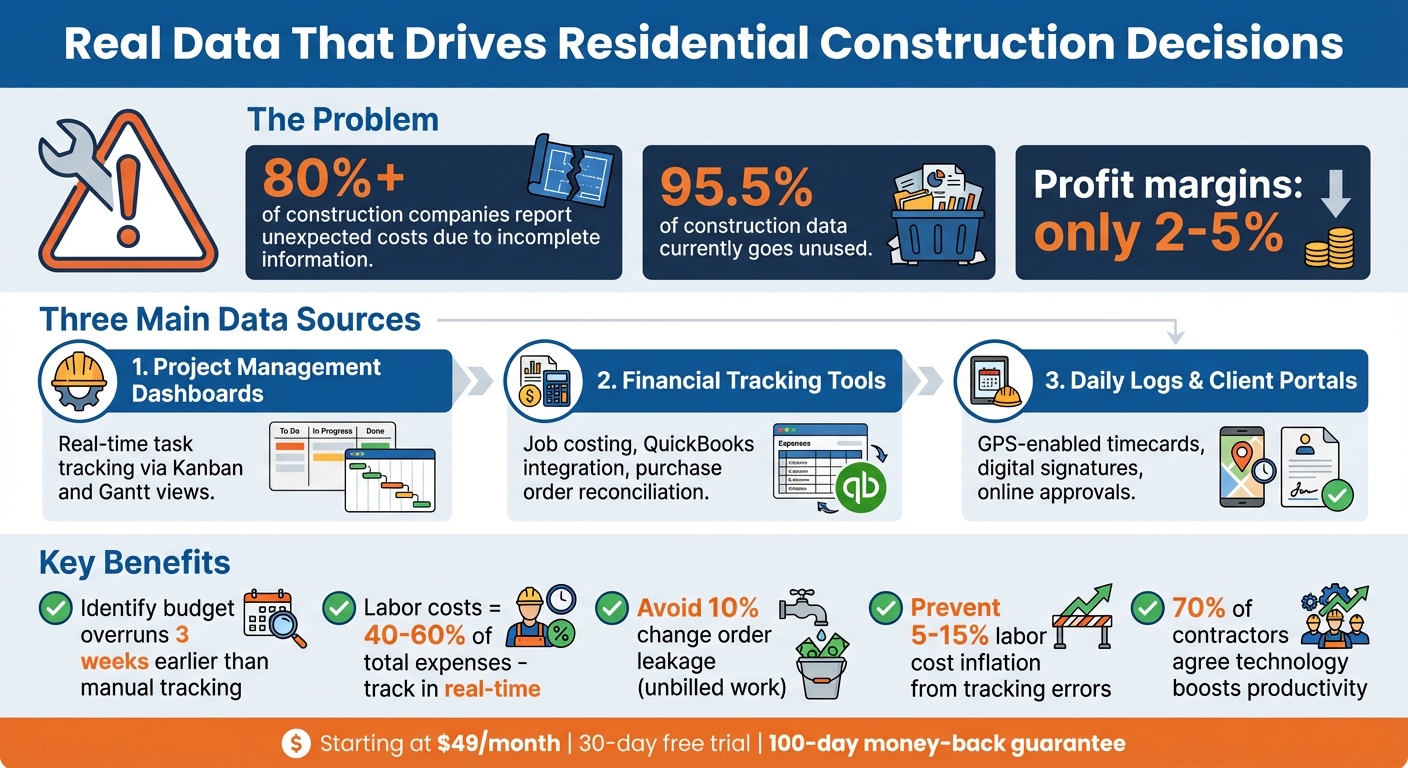
Key Statistics and Benefits of Data-Driven Residential Construction Management
Primary Data Sources for Residential Construction
Turning guesswork into actionable insights in residential construction relies on three main data streams: project management tools, financial tracking systems, and field-level documentation. Together, these streams provide a clear picture of project progress, cost management, and on-site activities. By combining these sources, contractors can identify potential issues early and make necessary adjustments before they escalate.
Project Management Dashboards
Real-time dashboards provide a snapshot of where every task stands at any moment.
For instance, Contractor Foreman uses Kanban views to organize tasks by status – pending, in progress, awaiting approval, or complete. This setup makes it easy to spot bottlenecks and identify who needs to take action, eliminating the need to dig through emails or spreadsheets. Dependencies and delays become immediately visible.
Additionally, the platform’s Gantt (CPM) scheduling feature lays out task sequences and timelines. If a delivery is delayed or a subcontractor falls behind, the system highlights the ripple effects on subsequent tasks. This level of transparency helps prevent minor delays from snowballing into significant scheduling setbacks.
Financial Tracking Tools
Job costing tools provide a real-time look at a project’s profitability. Contractor Foreman tracks estimated versus actual costs, automatically updating budgets when change orders are issued. Integration with QuickBooks Online (note: QuickBooks Desktop integration ended on January 1, 2026) ensures seamless syncing of bills and payments, eliminating the need for duplicate data entry and keeping financial records current.
Purchase orders also play a critical role by tracking “Billed” versus “Delivered” quantities. For example, if you’re billed for 100 sheets of drywall but only 75 are delivered, the system flags the discrepancy. This prevents overpayment and allows you to adjust the project schedule as needed. AIA Style invoicing (G702 and G703 forms) automates retainage calculations, whether it’s 10% or 5%, ensuring accurate progress billing without manual errors.
“The integration of the whole platform is very good, including externally with QuickBooks Online. Ability to do time sheets in the field without separate software. Cost codes and cost items that can be used for different jobs, this is huge for us.” – Chuck A., Liercke Construction, LLC
Daily Logs and Client Portals
Field data, captured via GPS-enabled timecards and daily logs, removes uncertainty around labor costs and crew accountability. GPS verification ensures workers are on-site when they clock in, while daily logs record weather conditions, deliveries, and site activities in real time. This documentation reduces disputes and ensures payroll and job costing are accurate.
Client portals further streamline processes by allowing online approvals for estimates and change orders.
For example, when a client views an estimate, you receive an email notification with a timestamp, giving you the perfect opportunity to follow up. Digital signatures include IP addresses and timestamps, creating a legally valid record. With approximately 95.5% of construction data currently going unused, these portals ensure client feedback and approvals don’t get lost in email threads but instead drive actionable decisions.
sbb-itb-5eea312
Using Data for Planning and Execution
Real-time data is a game-changer for contractors, turning planning into a precise, actionable process. By knowing exactly where resources are, which tasks are on track, and what materials are available, you can eliminate delays that often derail projects. The ability to quickly identify issues and make adjustments can mean the difference between finishing on time or falling behind. This approach not only sharpens planning but also ensures smarter resource allocation and helps avoid unnecessary delays.
Scheduling and Resource Allocation
Effective scheduling hinges on having a clear view of both timelines and resources. Contractor Foreman’s Gantt (CPM) scheduling tool provides insights into task dependencies, enabling seamless adjustments. For instance, if your electrical team wraps up their rough-in work earlier than expected, their scissor lift can be reassigned to the drywall crew the same day. This kind of flexibility keeps projects moving smoothly.
For larger, multi-phase projects like subdivisions or condominiums, month-by-month modeling is essential. It helps track cash flow and absorption rates – essentially, how quickly units are selling or leasing. With this data in hand, you can adjust construction schedules to align with market demand. If townhomes sell faster than anticipated, you can speed up the next phase. Conversely, if sales slow, you can delay construction to avoid tying up funds in unsold inventory.
Resource tracking also prevents overcommitting labor, a common pitfall. Tools like Contractor Foreman’s People module help you monitor “who is doing what and when”, reducing scheduling conflicts like double-booking crews across multiple sites. GPS-enabled timecards add another layer of accuracy, verifying that workers are on-site as scheduled. This data feeds directly into your planning, ensuring labor is distributed effectively.
Identifying and Preventing Delays
Efficient scheduling is just the start. With predictive analytics, you can go a step further by preventing delays before they happen. By combining historical data with current project conditions, you can anticipate issues like material shortages or weather disruptions. For example, if past data shows frequent delays in material deliveries, you can adjust ordering schedules or explore alternative suppliers to stay ahead.
IoT sensors and real-time monitoring add another layer of protection. Temperature sensors, for instance, can alert you when conditions aren’t right for concrete pours, while equipment sensors can flag maintenance needs before breakdowns occur. This proactive approach allows you to schedule repairs during downtime rather than risking cascading delays.
Integrated platforms further streamline communication and prevent missteps. When your project management system syncs with tools like Google Calendar or Outlook, everyone stays updated on schedule changes. Automated quality checks, triggered by pre-set criteria, eliminate delays caused by manual inspections. With 70% of contractors agreeing that technology boosts productivity and improves scheduling, it’s clear that data-driven methods are leaving traditional approaches in the dust.
Improving Budgeting and Cost Control with Data
Staying on budget in residential construction isn’t just about saving receipts. With over 80% of companies reporting cost overruns that eat into already slim profit margins of 2% to 5%, leveraging real-time financial data can turn budgeting into proactive management. This approach helps catch overruns early, preventing them from spiraling into losses.
Real-Time Job Costing and Profitability Tracking
Timing often separates profitable projects from unprofitable ones. Contractors using real-time job costing tools report identifying budget overruns about three weeks earlier than those relying on manual tracking. That extra time can mean the difference between adjusting during the project and discovering losses after it’s too late.
Tools like Contractor Foreman automatically sync daily logs, timecards, and invoices, eliminating the delays caused by manual spreadsheet updates. This immediate visibility is especially critical for labor costs, which typically make up 40% to 60% of total expenses in residential construction. Many contractors underestimate labor costs by 25% to 40% because they only account for base wages, ignoring the full burdened rate, which includes FICA, workers’ comp, and health insurance. Real-time tracking forces these calculations upfront, reducing the risk of underestimating project costs.
Change order management is another critical piece. Automated systems instantly update the contract value and revised budget when change orders are approved, ensuring all work performed is billed appropriately.
Purchase order reconciliation adds another layer of financial control. By tracking “delivered” versus “billed” quantities in real time, contractors can ensure they’re only paying for materials received and quickly identify shortages. Similarly, Work-in-Progress (WIP) reports compare contract value, estimated costs, and current spending to detect billing issues and maintain cash flow. This real-time insight lays the groundwork for more detailed variance analysis and financial reporting.
Variance Analysis and Financial Reporting
Variance analysis answers an essential question: Why are we over or under budget? The basic formula – Budgeted Cost minus Actual Cost – highlights areas needing attention. Interestingly, 80% of budget problems typically stem from just 20% of cost codes, so knowing where to focus can save valuable time.
Breaking variances into rate versus quantity issues provides even more clarity. For example, if overtime raises labor costs from $55/hour to $68/hour, that’s a rate variance. If framing takes 390 hours instead of the planned 320, that’s a quantity variance. Each type of variance requires a different solution, whether renegotiating contracts, adjusting schedules, or addressing productivity challenges.
A real-world example shows the value of early detection. A general contractor working on a $2.8 million commercial building project with a $180,000 foundation budget uncovered a $67,000 (37%) variance just four weeks in. The issue? Unexpected rock required blasting and deeper footings. By documenting the site conditions immediately, the contractor negotiated a $62,000 change order, recovering $40,000 of the overrun. On the other hand, an Arizona kitchen remodeler lost $18,000 on a $340,000 project because their manual tracking system wasn’t updated until the job was nearly done. By then, it was too late to address material overages and missed change orders.
Spending just 15 to 20 minutes per job every Monday to review estimated versus actual costs can help spot trends before they become major issues.
Cost-to-complete forecasting shifts the focus from analyzing past spending to predicting final costs based on current trends in specific cost codes, such as framing or site work. This forward-looking approach allows contractors to make timely adjustments, like tightening material orders, reallocating labor, or discussing scope changes with clients.
One final note: Misunderstanding markup versus margin can lead to costly mistakes. For example, a 25% markup only results in a 20% margin. Getting these figures wrong can cost thousands in expected profit, emphasizing the need for precise financial reporting.
Measuring Project Outcomes and Improving Future Decisions
Post-project analysis is just as crucial as real-time cost control. Spending just 30 minutes after each project to compare estimates with actual costs can help avoid losing 1–2 percentage points in profit margins, especially as material and labor costs continue to rise. This practice turns project closures into learning moments, paving the way for smarter future decisions.
Key Performance Indicators (KPIs) for Success
Tracking the right KPIs ensures you stay on top of project performance. Here are some critical ones to focus on:
- Job Profit Margin: This is the go-to metric for profitability. Calculate it as:
(Revenue – Total Job Cost) / Revenue × 100.
It gives you a clear picture of whether your projects are making money or not. - Percent Complete vs. Percent Spent: This acts as an early warning system. If you’re 40% through the work but have already burned through 60% of the budget, it’s a red flag. Keeping these percentages aligned throughout the project is key.
- Bid Accuracy: Comparing actual costs from completed projects to your initial estimates helps you refine future bids. Contractors using real-time job costing software catch budget overruns about three weeks earlier than those relying on manual tracking. That extra time can make a huge difference.
- Cost Variance: This measures the difference between budgeted and actual costs. Breaking it down into rate variance (paying more per unit) and quantity variance (using more units or hours) pinpoints where things went off track. For instance, errors in labor tracking alone can inflate labor costs by 5% to 15%, while untracked indirect costs like fuel and tools can add another 3% to 8%.
- Change Order Leakage: This is one of the sneakiest profit killers. On average, contractors without formal tracking leave about 10% of change order value unbilled. That’s money already spent but never recovered.
By monitoring these KPIs, you can assess current performance and use the insights to refine future projects.
Using Historical Data to Improve Future Projects
Once you’ve gathered data from completed projects, it’s time to use it to make better decisions. Shockingly, about 95.5% of data generated in the construction industry goes unused. That’s a missed opportunity to improve bidding accuracy, avoid delays, and increase profitability.
Tools like Contractor Foreman simplify this process by letting you review past projects and analyze costs by category. It’s far more efficient than digging through spreadsheets or paper records. For example, if you notice a pattern of underestimating drywall labor, you can adjust future bids accordingly.
Moving from gut instinct to data-driven decisions is a game-changer. Studies show top-performing companies rely on gut feelings far less (40%) than their underperforming counterparts (70%). This shift isn’t about luck – it’s about using data to decide which projects to bid on, how to price them, and where to allocate resources.
Predictive modeling takes it a step further. By analyzing past trends, you can anticipate future challenges. For instance, if winter projects often face weather delays, you can build extra time into your schedule upfront. This kind of forecasting complements other strategies for avoiding delays and cost overruns, creating a continuous cycle of improvement.
Consistency in cost coding is another must. Using standardized structures like CSI MasterFormat ensures you’re comparing similar data across projects, whether it’s for framing, electrical work, or other phases. Without this consistency, your data won’t provide meaningful insights.
Creating a feedback loop is simple but effective. After each project, compare your estimates to actual costs line-by-line and update your estimating templates immediately. This practice ensures your bids become increasingly accurate, helping you protect profit margins as costs fluctuate.
“Effective use of data helps businesses stop guessing and start knowing with confidence.” – Marshall Benveniste, Managing Editor, ConstructConnect
Finally, use precise labor rates for tracking costs. Reconcile invoices weekly and assign each supplier and subcontractor invoice to a specific job and cost code before paying. This discipline ensures your cost reports are accurate and your historical data is reliable for future planning.
Conclusion
Guesswork and outdated practices can drain resources and leave profits untapped. Contractors who succeed today rely on real-time data to make informed decisions about bidding, scheduling, budgeting, and resource management.
Contractor Foreman simplifies this process by centralizing all critical real-time data. Starting at just $49/month, it consolidates tools like daily logs, timecards, job costing, and financial reporting into one platform. This instant access to budget and expense tracking eliminates delays and ensures your financial data stays aligned through seamless integrations.
With Contractor Foreman, you can track job profit margins, compare percent complete versus percent spent, and evaluate variance by category. Plus, historical data helps fine-tune estimates, labor rates, and project selection, creating a feedback loop that continuously improves future projects. These insights, as discussed earlier, go beyond protecting profit margins – they streamline every aspect of project execution.
“Data-driven decision-making is more effective than traditional decision-making because it relies on objective data rather than subjective opinions or intuition.” – Marshall Benveniste, Senior Content Marketing Manager, ConstructConnect
The platform also prioritizes user support, boasting a 13-second average wait time and 95% five-star ratings. With a 100-day money-back guarantee and a 30-day free trial, it’s a low-risk way to leverage data that safeguards profits and elevates project outcomes.
FAQs
What data should I set up first to prevent overruns?
To keep your project on budget, start with real-time expense tracking. By monitoring costs as they occur, you can spot potential overruns early and make adjustments before they spiral out of control. Having accurate financial data at your fingertips allows for smarter decisions and keeps your project on track for better results.
How do I start real-time job costing without disrupting my crew?
To get real-time job costing up and running without a hitch, consider using construction management software that seamlessly ties into your daily operations. Make sure your team is trained properly to enter data accurately, which helps cut down on mistakes. Start by rolling out the system gradually, alongside your existing processes, so your crew doesn’t feel overwhelmed. The key is to collect real-time data on labor, materials, and equipment directly from the job site. This way, you can keep everything accurate without interrupting the flow of work.
Which KPIs should I review weekly to catch problems early?
To stay ahead of potential issues, it’s smart to review key financial metrics every week. Focus on areas like gross margin by job type, average days to collect payments, labor utilization rate, and overhead costs. Keeping a close eye on these KPIs allows you to spot red flags early and make adjustments promptly to keep everything running smoothly.







