
- 1. More Accurate Attendance Tracking
- 2. Stops Time Theft and Buddy Punching
- 3. Saves Time with Automated Clock-Ins
- 4. Better Accountability and Real-Time Tracking
- 5. More Accurate Payroll and Lower Costs
- 6. Better Compliance and Safety Records
- 7. Smoother Operations and Higher Productivity
- Conclusion
- FAQs
- Related Blog Posts
“Pssst! Kevin, can you just punch me in? Traffic was insane. I just need a moment to recover,” Ted whispered, though the ridiculously loud slurping of his latte made sure everyone knew he was there.
Ted hesitated for 0.2 seconds—not out of conscience, of course, but because he was wondering if Kevin would do the same for him.
He clocked Kevin in at 8:59, already imagining when he might need a similar favor in return.
Kevin strolled onto the job site at 9:30, wearing a serious face as if to say “I’m too busy—don’t bother me,” even though all he was really busy with was scrolling through games on his phone.
Congratulations!
The ancient art of buddy punching had claimed another victim. And that, ladies and gentlemen, is how productivity mysteriously disappears before the first meeting even starts.
How do you protect your business from from these kinds of attendance problems?
Geofencing.
If you’re still relying on paper timesheets or punch cards on your construction sites, you’re probably losing both time and money. Geofencing fixes this by using GPS, Wi-Fi, or cellular data to automatically track attendance whenever workers enter or leave a job site. It eliminates manual errors, prevents time theft, and makes payroll a breeze.
Here’s how geofencing improves construction attendance:
- Accurate Tracking: Logs exact times and locations, eliminating guesswork.
- Prevents Time Theft: Stops off-site clock-ins and buddy punching.
- Saves Time: Automates clock-ins and payroll processes.
- Boosts Accountability: Real-time dashboards show who’s on-site.
- Reduces Payroll Errors: GPS-verified hours ensure precise pay.
- Improves Compliance: Provides audit-ready records for safety and regulations.
- Streamlines Operations: Real-time data helps manage crews efficiently.
Geofencing doesn’t just track attendance – it transforms how construction companies manage labor, cut costs, and improve project efficiency.
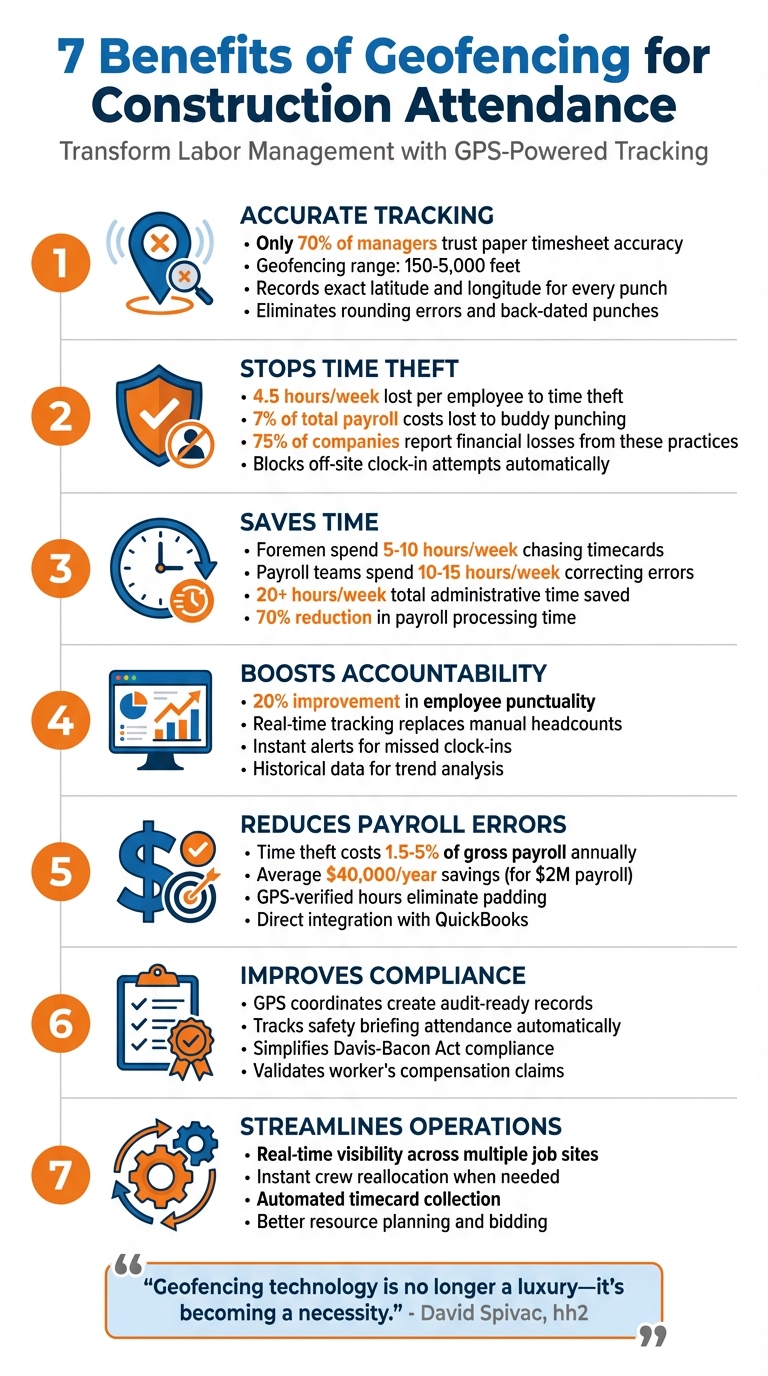
7 Key Benefits of Geofencing for Construction Attendance Tracking
1. More Accurate Attendance Tracking
Tracking attendance manually can be stressful and time-consuming.
Think about it: illegible handwriting, forgotten entries, or even intentional rounding of hours. It’s no wonder that only 70% of managers who rely on paper timesheets trust their accuracy all the time.
Geofencing offers a smarter solution. By using GPS coordinates, it creates a virtual boundary around your job site – usually between 150 and 5,000 feet. When a worker’s smartphone crosses this boundary, the system automatically logs their clock-in time. It even records the exact latitude and longitude for every punch, giving you a map-based record of who was on-site and when. This level of precision eliminates the guesswork and mistakes that come with manual tracking.
By automatically capturing arrival and departure times tied to a physical location, geofencing eliminates rounding errors, back-dated punches, and ‘buddy punching.
This technology also prevents common issues like padded hours or offsite clock-ins.
Workers can’t clock in early or from the wrong location, as advanced systems only allow clock-ins during scheduled shifts. Supervisors can track arrivals in real-time through dashboards, removing the need for on-site monitoring. The result? Accurate, second-by-second attendance records that integrate directly into your payroll system – cutting down on manual data entry and disputes over hours worked.
sbb-itb-5eea312
2. Stops Time Theft and Buddy Punching
Time theft and buddy punching are costly issues for contractors.
Employers lose an average of 4.5 hours per week per employee due to inflated timesheets and buddy punching. This adds up to about 7% of total payroll expenses in construction, with nearly 75% of companies reporting financial losses from these practices. These figures underscore the importance of implementing a system that enforces strict on-site verification.
Geofencing technology offers a powerful solution by tying each clock-in to a worker’s mobile device using real-time GPS. If an employee attempts to clock in from outside the designated job site, the system blocks the attempt and displays an error message. This ensures that only on-site clock-ins are accepted, significantly reducing fraudulent entries.
Geofencing completely eliminates these risks by enforcing strict location-based attendance.
Some systems take it a step further with features like AI-powered facial recognition or selfie verification. Managers can also receive instant alerts when an out-of-bounds punch is attempted, allowing for immediate action. These tools create a secure and reliable attendance system that verifies both who is clocking in and where they are, cutting down on payroll losses and eliminating guesswork.
3. Saves Time with Automated Clock-Ins
Manual timesheets can drain hours of productivity.
Foremen often spend 5 to 10 hours a week chasing down missing timecards, while payroll teams lose another 10 to 15 hours correcting errors from manual entries. Altogether, these tasks can eat up over 20 hours of administrative time every week.
Geofencing technology takes the hassle out of time tracking. By using GPS to set up virtual boundaries around job sites, the system automatically clocks workers in as soon as their phones enter the designated area. Similarly, it clocks them out when they leave. This hands-free approach means workers can get straight to their tasks without worrying about manual punches. It’s not just the clock-in process that benefits – payroll tasks become much faster and easier, too.
Contractors have reported saving up to 70% of payroll processing time by using systems that pre-fill timesheets with verified hours and location stamps. These verified records integrate directly into platforms like QuickBooks, ensuring accuracy and efficiency. Some systems even prevent early clock-ins by holding off until the scheduled shift begins. Workers stay focused on their jobs, while managers gain access to real-time, reliable attendance data. The result? Smoother operations and a noticeable boost in productivity across the site.
4. Better Accountability and Real-Time Tracking
Real-time dashboards provide an instant snapshot of who’s on-site and how many hours they’ve logged, replacing the need for end-of-week timecards or manual headcounts. Each time a worker crosses a geofenced boundary, the system automatically records the date, time, and location, giving supervisors immediate access to this data.
This real-time tracking helps managers make quick decisions, like reallocating labor when crews are short-staffed or schedules fall behind. Automated alerts for missed clock-ins or clock-outs ensure problems are caught early. Alongside these immediate benefits, the system also supports long-term planning by offering historical data for trend analysis.
Attendance data collected over weeks or months can reveal patterns that manual tracking might overlook. For instance, consistent late arrivals at a specific site might point to traffic issues, suggesting it’s time to adjust start schedules. On the flip side, workers lingering in the geofenced area without corresponding activity could signal time-padding. Industry stats show that using geofencing for attendance tracking can improve employee punctuality by up to 20%. These insights fine-tune schedules and enhance safety on-site.
The enhanced visibility is particularly valuable during emergencies or in safeguarding restricted areas. In an emergency, site managers can quickly verify attendance records to ensure all workers are accounted for. Similarly, geofencing can secure hazardous zones – if someone unauthorized enters a high-risk area, supervisors receive immediate alerts.
Accurate tracking of labor hours also improves job costing and resource planning. GPS-verified records remove guesswork, offering detailed insights into crew efficiency and time spent. When labor hours are tied to specific project phases, managers can use this data to make future project bids more precise.
Platforms like Contractor Foreman incorporate these features into their construction management tools. With live dashboards and GPS-enabled timecards, they simplify labor tracking and strengthen overall project accountability.
5. More Accurate Payroll and Lower Costs
Geofencing technology doesn’t just improve attendance tracking – it transforms payroll accuracy while cutting costs.
By replacing manual timesheets with GPS-verified clock-ins and clock-outs, it ensures workers can only log hours when they are physically within the job site boundary. This eliminates off-site clock-ins and prevents workers from padding their hours. The result? Precise timestamps feed directly into payroll software, reducing errors from rounding or manual data entry.
The financial benefits are hard to ignore. Time theft alone costs businesses between 1.5% and 5% of their gross payroll annually. On average, employees steal about 4.5 hours per week through various forms of time theft. For a construction company with an annual payroll of $2 million, cutting just 2% of time theft could save $40,000 a year.
Automation also slashes administrative workload. By seamlessly integrating clock-in data with payroll systems like QuickBooks, it eliminates the need for manual re-entry of hours, overtime, or job codes. This streamlined process ensures that payroll is not only faster but also more accurate, directly translating into cost savings.
Accurate labor tracking doesn’t just stop at payroll – it enhances job costing too. Tying every logged hour to GPS data and specific project phases allows managers to see exactly how labor budgets are spent. This insight helps refine future project bids and highlights which crews or sites operate most efficiently. The system can even track travel time and mileage between job sites automatically, reducing reimbursement errors and preventing overpayment for travel. These detailed records not only improve job costing but also support overall operational efficiency.
Contractor Foreman takes this a step further by integrating GPS-enabled timecards with payroll and accounting tools. The platform syncs effortlessly with QuickBooks and offers real-time dashboards, showing labor costs as they accumulate. This gives managers a clear view of payroll expenses before processing, ensuring complete transparency and control over labor costs.
6. Better Compliance and Safety Records
Geofencing takes compliance to the next level by creating an audit-friendly system. Every clock-in and clock-out is paired with GPS coordinates, leaving behind a clear digital trail that can be invaluable during audits, OSHA inspections, or worker’s compensation cases.
“This irrefutable, map-based record of punch location provides businesses with evidence that verifies worker attendance on a job site.” – Fareclock
This GPS-powered documentation makes it easier to maintain safety and regulatory standards across projects.
For example, the technology automatically tracks attendance at safety briefings and training sessions, ensuring proof of participation in mandatory safety protocols. On government-funded projects, it simplifies compliance with the Davis-Bacon Act by tracking labor hours by job classification and wage rate, removing the need for manual certified payroll reporting. Additionally, it can restrict access to hazardous zones, verifying that only qualified personnel are present and documenting adherence to site safety standards.
In the event of an incident, geofencing offers crucial evidence. GPS-verified records can confirm whether a worker was within the designated work zone when the incident occurred, helping to validate or contest worker’s compensation claims. During emergencies, supervisors can instantly access real-time attendance data to account for everyone on-site – providing a digital roll call that’s vital for effective safety responses.
The system also helps prevent compliance issues by flagging overtime limits and ensuring mandatory rest breaks are properly logged, reducing risks tied to labor law violations. By integrating seamlessly with construction accounting platforms like Sage or Vista, labor hours are automatically assigned to the correct cost codes, keeping records accurate and audit-ready without the hassle of manual data entry.
7. Smoother Operations and Higher Productivity
Geofencing is reshaping how construction managers handle crew coordination and resource allocation across multiple job sites.
Instead of relying on end-of-day reports or chasing manual updates, managers gain real-time visibility into critical details like who’s on-site, who’s running late, and where labor is currently deployed. This instant access to data enables quick staffing adjustments, helping projects move forward without unnecessary delays. It’s a game-changer for keeping resources flowing smoothly.
“Geofencing equips superiors with the ability to perceive their staffing and resource availability in real-time, which assists them in delegating duties smartly and managing their projects effectively.” – SmartBarrel
For example, if one site has too many workers while another is short-staffed, managers can reassign personnel on the spot. This ensures labor is distributed efficiently, avoiding wasted time and reducing the risk of budget overruns. Advanced systems also track these changes automatically, assigning hours to the correct project without requiring manual adjustments.
The data gathered through geofencing doesn’t just help with day-to-day operations – it also uncovers patterns that improve long-term planning. If, for instance, attendance logs reveal that workers are consistently late to a specific site due to morning traffic, managers can shift start times to improve punctuality. Similarly, historical labor data can guide more accurate bidding and resource allocation for future projects. These insights lead to better decision-making both on the fly and in the planning phase.
Another major benefit is automated attendance tracking. Supervisors no longer need to waste time on paperwork or manual timecard collection. Real-time updates flow directly from the field to the back office, streamlining communication and keeping everyone on the same page. This efficiency supports the overall project schedule, ensuring deadlines are met without unnecessary hiccups.
Conclusion
Geofencing tackles common challenges in construction attendance management. It removes the need for error-prone paper processes, curbs time theft – which can account for up to 7% of payroll costs – and provides GPS-verified proof of on-site presence. By automating attendance tracking, it allows managers to concentrate on project execution, ensuring tasks stay on schedule and within budget.
The financial benefits are clear. Geofencing prevents buddy punching, simplifies payroll processes, and produces audit-ready records that meet labor law and certified payroll reporting standards. These features help reduce costs while ensuring compliance.
“Geofencing technology is no longer a luxury – it’s becoming a necessity.” – David Spivac, hh2
Contractor Foreman takes this a step further by integrating geofencing into its construction management platform. With direct connections to payroll systems like QuickBooks, it eliminates manual data entry, ensures accurate job costing, and provides real-time workforce visibility through mobile access and dashboards. This integration transforms attendance tracking into a tool that enhances overall project efficiency.
FAQs
How big should a job-site geofence be?
A job-site geofence works best with a minimum radius of 20 meters to ensure precise tracking. If you manage multiple locations, you can create separate geofences for each site to cover all your areas effectively.
What happens if a worker’s phone loses GPS or the battery dies?
If a worker’s phone runs out of battery or loses GPS signal, the geofencing system might fail to record their location. To address this, alternative methods such as manual check-ins or supervisor confirmation can be used to verify attendance. These backup solutions ensure accurate records are kept, even when technical glitches occur.
How does geofencing handle multiple job sites in one day?
Geofencing simplifies managing multiple job sites by setting up virtual boundaries for each location. This technology allows for automated check-ins and check-outs, ensuring precise time tracking. It also helps detect when employees are at locations they shouldn’t be, boosting accountability and making attendance management more efficient.
Related Blog Posts







