
“WAIT — we only made $4,200 on this project?”
All that stress, scheduling chaos, supplier drama, client hand-holding, and near-spiritual levels of caffeine consumption… for that?!
What happened?
Well, somewhere along the way, you probably got a little too optimistic with the numbers. Maybe labor was underestimated. Maybe material prices changed. Maybe somebody measured with vibes instead of a tape measure.
Estimation mistakes at the grocery store mean accidentally spending $14 on fancy cheese you didn’t need. In construction, they can absolutely massacre your profit margin.
Accurate estimates are critical for small contractors because even minor errors can turn a profitable project into the kind of loss that makes you want to shut everything down and open a hotdog stand instead.
In this article, we’ll break down the most common estimating mistakes contractors make — and how to avoid them before they start eating into your profits.
Here are five common errors contractors make:
- Starting from scratch every time: Wastes time and risks inconsistent pricing. Use templates to standardize and speed up the process.
- Using outdated material prices: Leads to underquoting and financial losses. Regularly update pricing or use estimating software with live data from suppliers.
- Underestimating labor costs: Forgetting hidden costs like taxes and benefits can inflate expenses. Factor in all labor-related costs and add a buffer.
- Missing line items: Overlooking permits, disposal fees, or inaccurate measurements can hurt profitability. Use detailed checklists and digital tools.
- Skipping contingencies and overhead: Not accounting for unexpected costs or indirect expenses can erode profits. Include a contingency fund and overhead in every estimate.
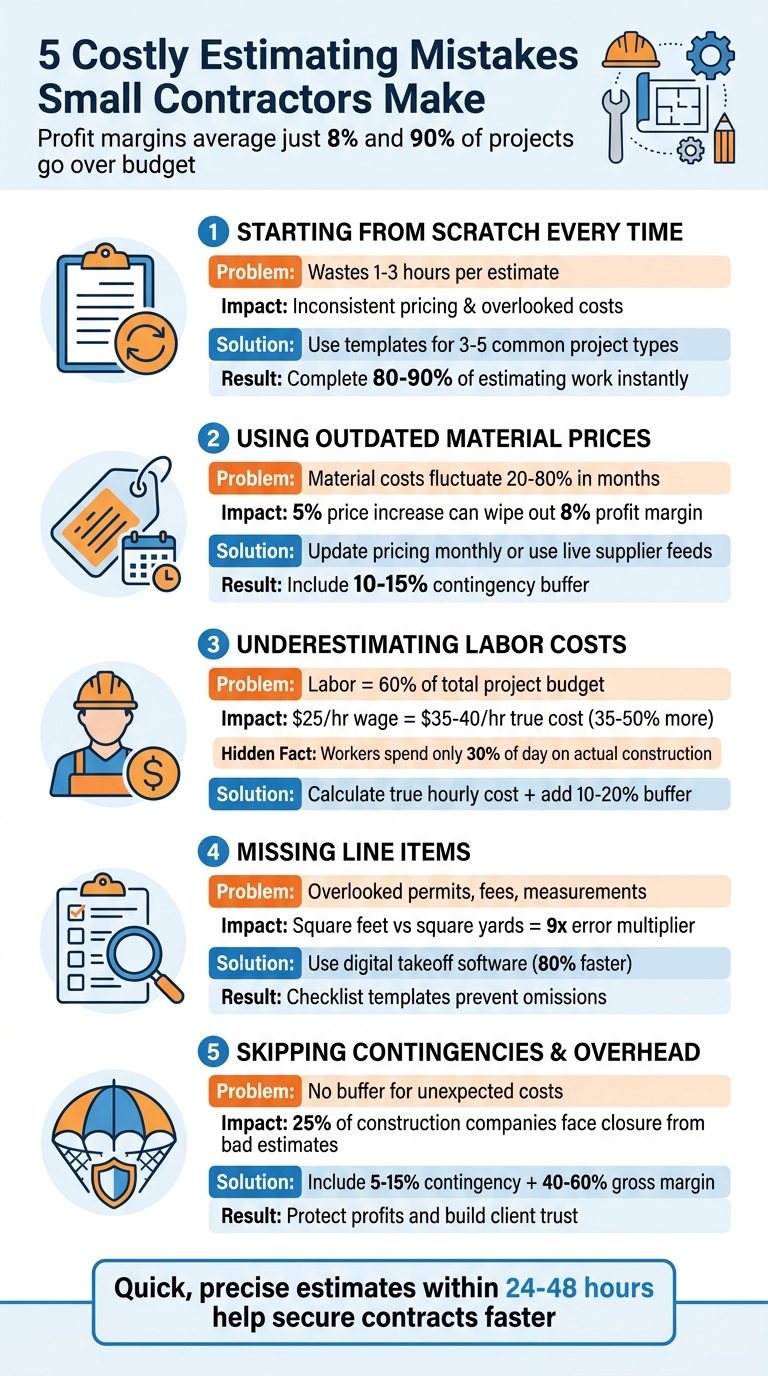
5 Costly Estimating Mistakes Small Contractors Make and How to Fix Them
1. Starting Estimates from Scratch Every Time
Creating estimates from scratch for every bid can eat up 1–3 hours on administrative tasks – time that could be better spent generating leads, visiting job sites, or focusing on construction work. Beyond the time drain, this manual process increases the risk of overlooking small but essential costs, which can chip away at your profits. The key to avoiding these pitfalls? Standardizing your process with construction finance software can help ensure accuracy.
When you lack a consistent system, your pricing can easily become inconsistent. For instance, similar projects might receive vastly different quotes simply because certain elements were missed. As Handoff explains:
“Estimating isn’t just an admin task; it’s the front line of your business. Get it wrong, and it costs you time, profit, and trust”.
Another major challenge is scalability. Relying solely on memory or manual calculations limits your ability to delegate and slows down how quickly you can take on new projects. On top of that, entering data manually into spreadsheets or documents introduces the risk of errors – think typos, misplaced decimals, or miscalculations on taxes and discounts. These mistakes can quickly eat into an already slim 8% profit margin. Streamlining your estimating process is essential for maintaining profitability.
The solution? Start using templates. Develop templates for your 3–5 most common project types – whether that’s bathroom remodels, kitchen renovations, or deck installations. These templates should account for standard materials, labor hours, markups, permits, and waste removal. With these in place, you can complete 80–90% of the estimating work as soon as a lead comes in, leaving only minor adjustments for project-specific details. This approach not only slashes estimating time from hours to minutes but also ensures you don’t overlook critical components.
sbb-itb-5eea312
2. Using Outdated Material Prices
Material costs in construction are always in flux. Essential materials like lumber, copper, steel, and drywall can see price changes ranging from 20% to 80% within just a few months. If you’re relying on outdated pricing – even by just a few weeks – you could face considerable financial losses.
As Handoff points out:
“Underquote the materials, and you’re stuck covering the overage out of your own pocket. One wrong line item can wipe out your profit margin on a job.”
This challenge is especially tough for small contractors. Larger construction firms often have access to real-time pricing data from suppliers. On the other hand, smaller businesses frequently rely on manual methods like spreadsheets or memory to track costs. This outdated approach not only hurts your ability to stay competitive during bidding but can also tarnish your reputation if you have to revise a quote after securing a project.
The financial stakes are high. For instance, the average home builder operates on an 8% profit margin. A seemingly small material price increase of 5% between the time of bidding and procurement can completely throw off your budget.
The solution? Start by updating your material pricing monthly, at the very least, if construction technology apps aren’t available. Better yet, invest in estimating software that connects directly to live supplier feeds for up-to-date rates. Building strong relationships with multiple suppliers can also help you lock in prices during the bidding process. Additionally, including a 10–15% contingency line in your estimate can provide a buffer against unexpected price hikes.
Accurate material pricing is just one part of the equation – next, we’ll dive into how mistakes in labor cost estimation can have a similarly damaging effect on profitability.
3. Underestimating Labor Costs and Hours
Labor typically makes up about 60% of a construction project’s total budget. Yet, misjudging labor costs can quickly eat into profits. This mistake not only increases expenses but also puts the entire project’s profitability at risk.
One common error is focusing solely on base wages when calculating labor costs. For instance, a carpenter earning $25 per hour might actually cost between $35 and $40 per hour once you account for Social Security, Medicare, workers’ compensation, health benefits, and paid time off. These additional costs can add 35% to 50% on top of the base wage. As Handoff.ai warns:
“If you’re bidding jobs based on hourly wages alone, you’re giving away money without knowing it.”
Accurately estimating labor hours is another challenge. Many contractors rely on intuition rather than hard data, which can lead to significant underestimations. In reality, workers typically spend only 30% of an 8-hour day on actual construction tasks. The other 70% is consumed by activities like site setup, cleanup, material runs, tool organization, and inspections. This miscalculation can result in labor estimates being 25% to 50% lower than needed for complex projects.
With home builders operating on an average 8% profit margin, even small labor overruns can wipe out profits. And since 90% of construction projects experience cost overruns, tracking and estimating labor hours accurately is critical. Successful contractors rely on historical data to compare actual hours worked with estimates, refining their types of construction estimates accordingly. This practice ensures they calculate true labor costs and include appropriate buffers.
Here’s how you can address these risks:
- Calculate your true hourly labor cost: Factor in all expenses, such as taxes, insurance, benefits, and paid time off, and divide by total payroll.
- Add a buffer: Include a 10% to 20% labor buffer to account for site-specific challenges like limited access, occupied homes, or weather delays.
- Involve your crew leaders: Collaborate with them to validate estimates. Their on-site experience can help ensure your projections align with real-world conditions, setting your projects up for long-term success.
4. Missing Line Items and Inaccurate Quantities
Mistakes like missing line items and inaccurate measurements can seriously hurt a project’s profitability. When items like permits, site cleanup, or disposal fees are overlooked, they directly eat into your profit margin. These seemingly small omissions add up quickly, creating financial strain.
Measurement errors are another frequent problem. For instance, confusing square feet with square yards can multiply errors by up to nine times. Many contractors rely on rough estimates from past projects instead of taking accurate measurements from the current plans. As Kaiya Barrett from ConstructConnect points out:
“One wrong estimate on a construction project that loses money won’t put you out of business, but a couple of unprofitable projects may have you closing the doors for good.”
This highlights how crucial it is to ensure both accurate measurements and a detailed list of all required items to safeguard your material and labor budgets.
In addition to measurement errors, missing soft costs can also chip away at your margins. Commonly overlooked costs include indirect expenses like insurance, equipment maintenance, and supervision. Unexpected site-specific issues, such as rotted decking or mandatory code upgrades, can also drive up costs. Sometimes, critical details – like fireproofing layers or specific material grades – are buried in complex project drawings and end up being missed.
The financial impact isn’t just limited to materials. Missing essential supplies can leave your crew sitting idle, waiting for deliveries, which is especially costly since labor accounts for roughly 60% of a project’s budget. To avoid these pitfalls, using software solutions for construction cost estimates can speed up the measurement process by as much as 80% compared to manual methods. Combine this with a checklist-style estimate template to ensure no critical items – like demo labor, trim work, or cleanup – are left out.
5. Forgetting Contingency, Overhead, and Preliminaries
Overlooking contingency funds, overhead costs, and preliminaries can quickly turn a profitable bid into a financial nightmare. Contingency funds act as a safety net for unexpected challenges like weather delays, hidden site issues, or sudden material price hikes. Overhead refers to indirect costs such as office rent, utilities, insurance, administrative salaries, and equipment upkeep. Preliminaries, on the other hand, include project-specific expenses like permits, inspections, site supervision, and temporary equipment rentals. If these costs are excluded, you’ll end up covering them out of pocket, which eats away at your profit margin. Including these elements in your bid is critical to staying financially secure.
Given that the average construction profit margin is just 8%, there’s very little room for mistakes. Contingency funds typically range from 5% to 15% of direct construction costs, and a healthy gross margin to cover overhead and profit usually falls between 40% and 60%. Failing to account for these costs only amplifies the risks already posed by underestimating or missing key line items.
Budgeting for contingencies is just as important as ensuring every line item is accounted for.
“If you didn’t include a contingency in your estimate, you’re stuck scrambling, either asking the client for more money, eating the cost yourself, or watching the project timeline go sideways.” – Handoff.ai
To safeguard your finances, always include a clearly labeled contingency line in your estimates. Labels like “Project Contingency (10%)” or “Unforeseen Conditions Allowance” not only protect your bottom line but also build transparency and trust with clients. For overhead, calculate your annual overhead percentage by dividing your total yearly overhead costs by your total annual sales, and then apply that percentage to every bid. When it comes to preliminaries, create a detailed checklist that includes permits, temporary utilities, waste removal, and other site-specific needs to ensure nothing is overlooked during the bidding process.
How Contractor Foreman Prevents These Estimating Mistakes
Contractor Foreman addresses common estimating errors with tools tailored for small contractors who need both precision and ease of use. For instance, it offers over 50 pre-built stock forms and customizable checklists that can be saved as reusable templates. This means if you create an estimate for a bathroom remodel, you can reuse it for similar projects, streamlining your workflow and ensuring consistency in your estimates. This standardized system also makes it easy to update material costs and labor rates without starting from scratch.
The platform includes a centralized items database that keeps all your materials and labor rates in one place. If lumber prices change or suppliers adjust their rates, you only need to update the database once. These changes are then automatically applied to all future estimates, saving time and reducing errors.
Contractor Foreman also provides pre-set estimating templates for common projects like decks, kitchen renovations, or commercial builds. Its “Document Writer” feature pulls project data automatically, removing the need for repetitive data entry. This minimizes the chances of overlooking important line items or miscalculating quantities.
Another key feature is the integration of overhead, preliminaries, and contingencies into a single cost-tracking system. This ensures that all cost elements, including those often forgotten, are accounted for in your bid. You can incorporate these details directly into your estimate templates, giving you peace of mind that nothing has been left out. The platform also allows for real-time tracking of actual costs versus estimates, letting you adjust contingency percentages as needed based on project conditions.
| Plan | Monthly Price (Annual) | Users | Best For |
|---|---|---|---|
| Basic | $49 | 1 | Solo contractors starting out |
| Standard | $79 | 3 | Small crews needing collaboration |
| Plus | $125 | 8 | Growing businesses (most popular) |
| Pro | $166 | 15 | Established contractors with larger teams |
| Unlimited | $249 | Unlimited | Companies scaling without user limits |
All plans come with unlimited projects, free training and support, and mobile access – making it easy to estimate whether you’re in the office or on-site.
Conclusion
Mistakes in estimating can put your entire business at risk. In fact, 25% of construction companies face potential closure due to inaccurate estimates. The five common errors – starting from scratch every time, relying on outdated prices, underestimating labor, overlooking line items, and skipping contingencies – can quickly eat into your already slim profit margins.
The good news? These mistakes are avoidable. By standardizing your process, you can safeguard your profitability. Use templates, update prices regularly, track labor accurately, and factor in contingencies with tools like real-time material cost tracking, digital takeoffs, and documented labor hours. Adding a 10–15% contingency buffer can further protect your bottom line.
Improving your estimation process doesn’t just prevent errors – it sets your business up for success. Providing quick, precise estimates within 24–48 hours can help you secure contracts faster. And when you use the right tools and strategies, you don’t just avoid costly mistakes – you build trust with clients, protect your profits, and position your business for growth.
Take control of your estimates with proven templates, up-to-date data, and integrated tools like those from Contractor Foreman. Your estimates are the foundation of your business – get them right, and you’ll pave the way for long-term success.
FAQs
What should I include in my overhead rate?
Your overhead rate needs to account for the indirect costs that keep your business running smoothly. These include things like administrative salaries, insurance, permits, equipment maintenance, utilities, and other general expenses that support your operations. Accurately tracking and including these costs is crucial to avoid underestimating your project expenses.
How often should I update my material pricing?
Keeping your material pricing up-to-date is a must if you want to ensure accurate estimates and protect your bottom line. Many contractors make it a habit to review and adjust prices weekly or monthly – especially when market conditions are unpredictable. This proactive approach helps you dodge costly mistakes, like underestimating expenses because of outdated numbers, which can eat into your project margins.
How do I figure out my true labor cost per hour?
To figure out your true labor cost per hour, you need to account for more than just wages. Include all labor-related expenses, such as:
- Payroll taxes
- Workers’ compensation
- Employee benefits (e.g., health insurance)
- A portion of overhead costs (like tools and transportation)
Once you’ve added up these costs, divide the total by the number of billable hours. This approach gives you a complete picture of your labor costs, helping you create estimates that are both accurate and profitable.







